Kongofukuji Temple, Tosashimizu
Where Kobo Daishi sensed Kannon's paradise across the Pacific Ocean
Understand sacred places, explore living traditions, and learn how to engage respectfully with Pilgrim Map.
Access has not been verified. Check current local guidance before planning a visit.
Tosashimizu, Kochi Prefecture, Japan
Read the sources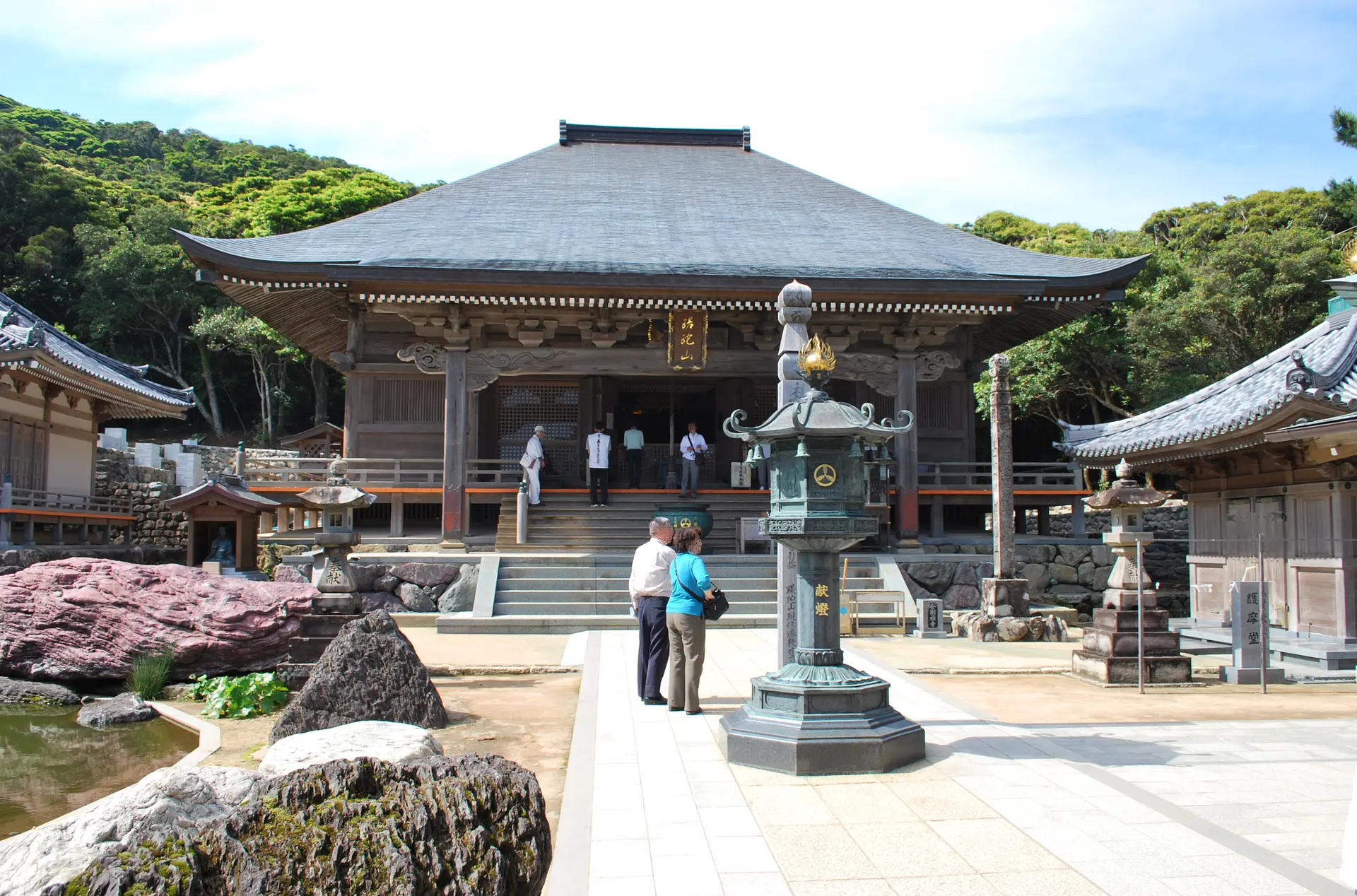
Visit essentials
A quick read before you go
- Duration
- One to two hours for the temple proper.
- Etiquette
- Standard Buddhist temple etiquette applies.
Overview
In 822 CE, aged 49, Kobo Daishi looked across the Pacific from Cape Ashizuri and sensed Fudaraku, Kannon Bosatsu's paradise. This prompted him to establish Kongofukuji, Temple 38 of what became Japan's most famous pilgrimage.
At Shikoku's land's end, unbroken ocean drew later practitioners of Fudaraku Tokai to row small boats alone into the Pacific seeking Kannon's paradise, knowing they would not return. They understood the ocean as passage, not death.
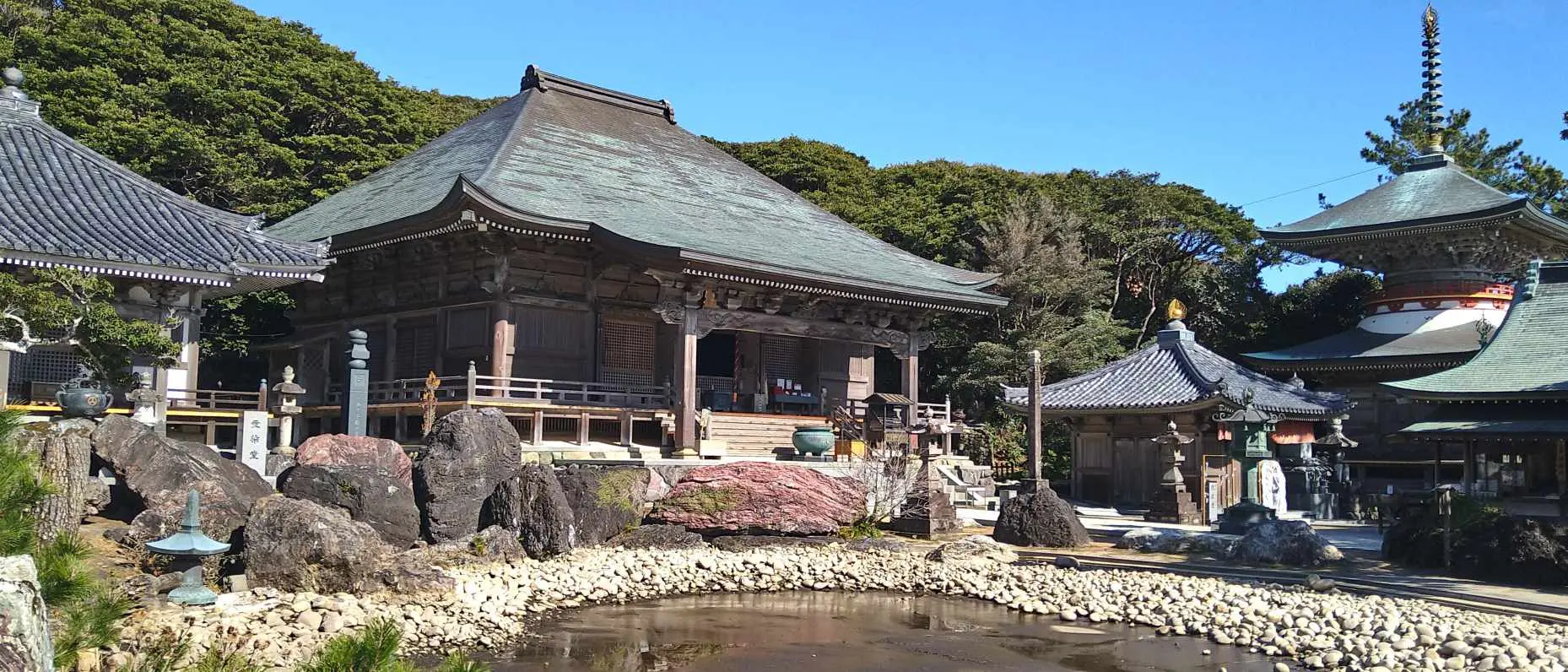
Kongofukuji lies over 80 kilometers from Temple 37—the pilgrimage's longest journey between two temples and three to four days through increasingly remote terrain for walkers. The challenge itself teaches, preparing pilgrims to meet Cape Ashizuri's infinitude. The 120,000-square-meter grounds contain the Seven Wonders of Ashizuri, associated with miracles from Kobo Daishi's time. At Mandala Pond, temple buildings reflected in still water recall that apparent solidity is mirrored in something deeper.
Why this place is sacred
The thinness at Kongofukuji operates through geography as much as theology. Stand at Cape Ashizuri and look south: there is nothing between you and the curve of the earth. The Pacific Ocean continues without interruption. In this vastness, Kobo Daishi sensed the presence of Kannon's paradise—not as metaphor but as spiritual reality lying beyond the visible horizon.
This sensing gave the site its character. Kongofukuji became not merely a temple but a gateway. During the Sengoku period particularly, Fudaraku Tokai practitioners gathered here before rowing their small boats alone into the Pacific. They believed they were sailing to the Pure Land of Kannon, and in a sense perhaps they were—their deaths in the ocean understood as transformation rather than ending.
The practice of Fudaraku Tokai has ceased, but its memory shapes the atmosphere. This is a place where people chose to leave the world of forms, trusting that something awaited them beyond visibility. The enormity of the ocean invites similar contemplation in contemporary visitors, even without the theology of Pure Land travel.
The 80-kilometer journey required to reach the temple from the previous stop creates a kind of earned liminality. The isolation of the location, reached only through sustained effort, prepares visitors for the encounter with infinitude that the cape provides.
Kobo Daishi founded the temple in 822 after experiencing the presence of Fudaraku across the Pacific. He installed a three-faced, thousand-armed Kannon (Senju Kannon Bosatsu) as the principal image and received imperial support from Emperor Saga, who granted the inscription 'Fudaraku Tomon' (Gateway to Fudaraku).
The temple became associated with Fudaraku Tokai—the practice of sailing small boats into the ocean seeking Kannon's paradise—particularly during the medieval period. This gave Kongofukuji its character as a threshold between worlds. The temple also developed the Seven Wonders of Ashizuri, miraculous sites associated with Kobo Daishi's time at the cape. Today the temple continues as Temple 38 of the Shikoku pilgrimage, still marking the completion of the circuit's most demanding stretch.
Experience and orientation
The approach to Kongofukuji already communicates something unusual. The temple lies at Cape Ashizuri, the southernmost point of Shikoku, accessible by winding roads through increasingly sparse landscape. For walking pilgrims who have traveled over 80 kilometers from the previous temple—three to four days of walking—arrival carries the weight of earned accomplishment.
The temple grounds are extensive, covering 120,000 square meters. This spaciousness feels appropriate to the setting: anything smaller would be incongruous with the infinitude of ocean visible beyond. The main hall, the pagoda, the various sub-temples spread across terrain that includes the Seven Wonders of Ashizuri—sites where Kobo Daishi is said to have performed miraculous acts.
The Mandala Pond reflects the temple buildings in its still surface, creating the vertiginous sense of structures extending both up and down. The reflection reminds visitors that the visible world doubles into dimensions not immediately apparent.
But it is the ocean that dominates experience here. From the temple grounds, paths lead to Cape Ashizuri itself, where the Pacific stretches without interruption. Standing at this edge, visitors understand what Kobo Daishi might have sensed: the ocean is not emptiness but fullness, not barrier but invitation. The Fudaraku Tokai practitioners who rowed from here into the horizon were not fleeing life but approaching something.
The temple attracts both pilgrims completing the most demanding stretch of their circuit and visitors drawn to the dramatic coastal scenery. Both groups tend to speak of the site in terms of significance—something about the remoteness and the vastness resists casual encounter.
Visitors typically enter the temple grounds through the main gate and explore the central buildings including the main hall and Kannon statue. The Seven Wonders of Ashizuri are scattered around the cape area and can be visited with additional walking. The cape itself, with its dramatic ocean views, lies a short walk from the temple proper. Allow time for both temple exploration and contemplation at the cape's edge.
Context and lineage
In 822, at age 49, Kobo Daishi traveled to Cape Ashizuri at the southernmost tip of Shikoku. Looking out across the Pacific Ocean, he sensed the presence of Fudaraku—the Pure Land of Kannon Bosatsu—somewhere beyond the horizon. Emperor Saga granted him the imperial inscription 'Fudaraku Tomon' (Gateway to Fudaraku), and Kobo Daishi established the temple, installing a three-faced, thousand-armed Kannon as the principal image.
The temple became a spiritual gateway to the otherworld, a place where the boundary between this life and what lies beyond grew thin.
Kongofukuji is a Shingon Buddhist temple serving as Temple 38 of the Shikoku 88 Temple Pilgrimage. Its founding by Kobo Daishi places it among the many Shikoku temples with direct connection to the tradition's founder.
Kobo Daishi (Kukai)
Founder in 822; sensed Fudaraku across the Pacific and established the temple
Emperor Saga
Imperial patron who granted the 'Fudaraku Tomon' inscription
Traditions and practice
Pilgrims follow standard Shikoku henro protocols: purification, offering of incense and coins, recitation of sutras including the Heart Sutra, and collection of the temple stamp. The Seven Wonders of Ashizuri offer additional sites for devotion around the cape. Historically, Fudaraku Tokai practitioners prepared at this temple before rowing their boats into the Pacific, though this practice ceased centuries ago.
The temple continues to serve Shikoku pilgrims, with particular emotional significance for those who have walked the 80+ kilometers from Temple 37. The temple offers the usual Buddhist services and maintains the Kannon devotion central to its identity. The Seven Wonders remain accessible for those wishing to walk in Kobo Daishi's legendary footsteps.
Allow the journey to reach the temple—whether by car, bus, or walking—to build appropriate receptivity. The remoteness is not obstacle but preparation. At the temple, take time with the principal Kannon image before walking to the cape itself. Standing at land's end, consider what Kobo Daishi might have sensed. The vastness of the Pacific invites contemplation of what lies beyond the visible, regardless of theological framework.
Shingon Buddhism
ActiveKongofukuji is a Shingon temple founded by Kobo Daishi serving as Temple 38 of the Shikoku 88 Temple Pilgrimage. Its founding reflects Kobo Daishi's practice of establishing temples at spiritually significant locations throughout Shikoku. The temple's association with Fudaraku faith represents a distinctive strand of Pure Land-influenced thought within the broader Shingon context.
The temple maintains Shingon Buddhist services and serves pilgrims following the 88 temple circuit. The principal image is a three-faced, thousand-armed Kannon (Senju Kannon Bosatsu), and Kannon devotion remains central to the temple's practice.
Perspectives and open questions
Kongofukuji invites interpretation through multiple frames: as Buddhist sacred site, as geographical extremity, and as historical departure point for those seeking transcendence through death.
Scholarly perspective
Historians recognize Kongofukuji as an important site in the study of Fudaraku faith and the practice of Fudaraku Tokai. The temple demonstrates how specific geographical features—in this case, a cape facing the open Pacific—shaped religious imagination and practice. Scholars also study the temple as evidence of Kobo Daishi's extensive temple-founding activity across Shikoku.
Living and traditional perspectives
In Buddhist understanding, Kobo Daishi genuinely sensed Fudaraku—Kannon's Pure Land—across the Pacific. The temple marks this spiritual discovery and maintains the gateway character that Fudaraku Tokai practitioners recognized. The thousand-armed Kannon enshrined here embodies the compassion that welcomes all beings regardless of their path to approach.
Alternative interpretations
The dramatic geography of Cape Ashizuri attracts those interested in earth energies and liminal landscapes. Some experience the location as energetically significant beyond its Buddhist associations.
Open questions
The full extent of Fudaraku Tokai practice—how many practitioners departed from here, their identities, their experiences—remains incompletely documented. The origins of the Seven Wonders traditions and their relationship to historical events are uncertain.
Plan your visit
Access and arrival
Limited accommodations in the Tosashimizu area. Pilgrims traditionally stayed at temple lodgings (shukubo) or minshuku. Book in advance given the remote location.
Respectful visit
Modest attire appropriate for temple visit. Walking pilgrims traditionally wear white clothing with sedge hats; visitors need not adopt this attire but should dress respectfully.
Generally permitted on temple grounds. Exercise discretion and avoid photographing worshippers without permission.
Small coins and incense at the main hall. The temple offers omamori (protective amulets) and other devotional items.
{"Standard temple etiquette","Respectful behavior in worship areas","Exercise caution at cliffsides","Do not litter in this remote natural area"}
The remote location means limited services nearby. Bring sufficient water and supplies if walking. The cliffsides at Cape Ashizuri require standard safety awareness. Weather can change quickly; ocean conditions can be dramatic.
Current practical details
Address
214-1 Ashizurimisaki, Tosashimizu, Kochi 787-0315, Japan
Phone
Hours
Hours, fees, and access can change — verify on the official source before you travel. Practical details last checked Jun 2026.
Location
Map loads as you approach this section.
Pilgrim reflections
A portrait of encounter, not a score
Pilgrims describe what they felt, how present they could become, and whether the place would shape a journey. There are no stars and no ranking of traditions.
No reviewed reflections yet
The first pilgrims can help describe the character of being here.
Share a reflection
Available after an account-backed “Been there.” Every reflection is reviewed before publication.
Watch deeper
Films, episodes, and recorded talks for visitors who want more context before or after a visit. Speculative and alternative-history entries are labelled as perspectives, not as sources for established claims.
Nearby sacred places
Explore other sacred places in the region. Proximity does not establish access or travel time; check each place’s guidance.


References
Sources consulted for this page. Source categories describe the publication, not a guarantee that every claim is verified. Traditional accounts and outside interpretations may differ.
- 01Kongofukuji - Henro — HenroguideComprehensive pilgrimage guide
- 02Temple 38, Kongōfukuji - Tourism SHIKOKU — Tourism ShikokuofficialRegional tourism authority
- 03Sadazan Fudarakuin Kongohukuji - Shikoku 88 Temple Pilgrimage — Shikoku 88 Temple PilgrimageguideOfficial pilgrimage information
Pilgrim glossary
- Kannon
- The bodhisattva of compassion, central to many East Asian pilgrimage routes.
- Mandala
- A symbolic diagram of the cosmos used in meditation and ritual.
- Sutra
- A canonical Buddhist scripture, often chanted as part of practice.
- Shingon
- An esoteric Japanese Buddhist school emphasizing ritual, mantra, and mandala practice.
- Pure Land
- A Buddhist tradition focused on rebirth in Amida Buddha's western paradise through devotional practice.
Share a photo
Help visitors recognize Kongofukuji Temple, Tosashimizu. Every submission is reviewed before publication.