Kanjizai-ji
Three statues from one sacred tree, and the first temple of Iyo's path of attaining enlightenment
Understand sacred places, explore living traditions, and learn how to engage respectfully with Pilgrim Map.
Access has not been verified. Check current local guidance before planning a visit.
Ainan, Ehime Prefecture, Japan
Read the sources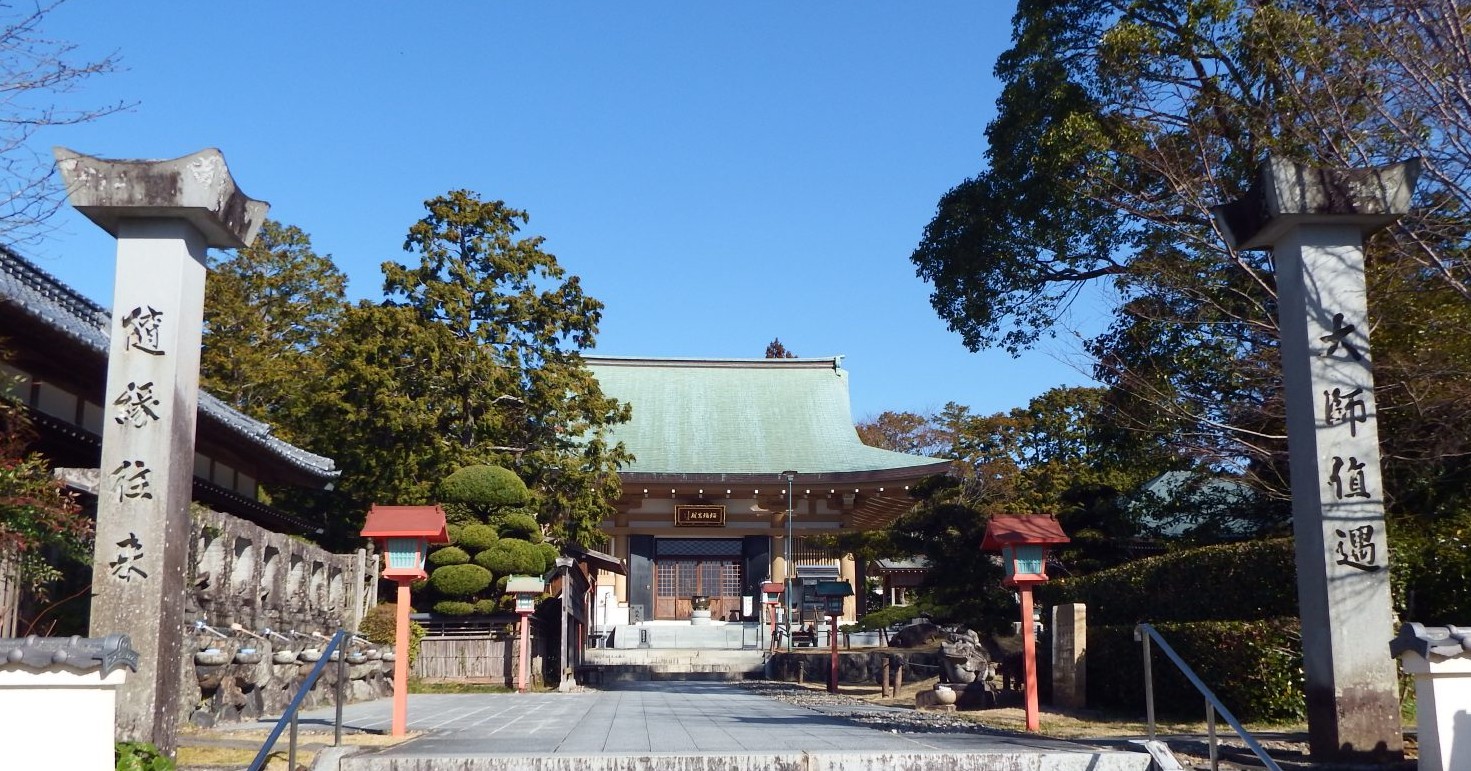
Image of Kanjizai-ji (観自在寺). Image source · CC-BY-SA-4.0
Station 40 of 88
Shikoku 88 Temple PilgrimageVisit essentials
A quick read before you go
- Duration
- 45 minutes to 1 hour for a thorough visit including the standard liturgy at both halls, the…
- Access
- Located at 1-1 Hirajō, Ainan-cho, Minamiuwa-gun, Ehime — the southernmost town in Ehime, facing…
Overview
Kanjizai-ji opens the Iyo section of the Shikoku 88. After Tosa's thirty-eight temples—the dōjō of shugyō, or ascetic discipline—pilgrims cross into Ehime at Temple 40 and enter the dōjō of bodai, the path of attaining enlightenment through Temple 65. Many describe this geographic, ritual, and inner threshold as a moment to assess what Tosa shaped and open to Iyo's different practice.
By tradition, Emperor Heizei asked Kūkai (Kōbō Daishi) to establish the temple in 807. Kūkai carved from one sacred tree the honzon Yakushi Nyorai, attendant Amida Nyorai, and Eleven-Headed Kannon Bodhisattva. Some Shingon readers connect this unity-in-multiplicity to trikāya: one source manifesting as Yakushi's healing, Amida's welcoming light, and Kannon's compassionate response. Kūkai is also said to have prayed here for Heizei's illness, beginning the continuing practice of dedicating hand-copied Heart Sutras (shakyō).
Heizei and Emperor Saga are recorded as annual visitors; Hirajō (平城), the surrounding place-name, uses the same characters as 'Heizei.'
Kanjizai (観自在), 'the one who sees freely', is a name of Avalokiteśvara (Kannon), invoked in the temple name although Yakushi is honzon. A separate octagonal hall, the Hōjuden Hakkaku-dō, houses Benzaiten of the Nanyo Seven Gods of Fortune, a folk-Shintō/Buddhist layer over the Shingon temple. At the Hattai-butsu Jūnishi Honzon, visitors pour water over their personal twelve-zodiac protector. Coastal Ainan's Uwa Sea setting feels open and bright after inner Tosa's mountain temples.
Why this place is sacred
What thins at Kanjizai-ji is the membrane between phases of the henro. Tosa is the long discipline; Iyo is the opening that follows. Pilgrims who have walked or driven the full Tosa stretch arrive at Kanjizai-ji with a body that has been worked. The temple's coastal Ainan setting — facing the Uwa Sea, southernmost in Ehime — feels open and bright after the cape wildness of Cape Ashizuri.
Many pilgrims describe a sense of accomplishment at reaching the first Iyo temple, and a different register of attention as they begin the next phase.
The temple's image of three statues from one tree gives the threshold a doctrinal frame. Yakushi for healing of body. Amida for welcome at the end of life. Eleven-Headed Kannon for the compassionate response that meets every kind of suffering. Three faces of compassion from one wood — the same compassion meeting different needs.
Some readers within Shingon connect this to the trikāya doctrine of the three bodies of the Buddha; some pilgrims simply experience it as the calm sense that the Buddha's response is multiple but unified.
The Heart Sutra deposit tradition extends the threshold theme. Kūkai prayed at this temple for an emperor's healing. The hand-copied sutras pilgrims bring or write here continue that gesture — placing a personal prayer into a long line of personal prayers. The Hattai-butsu Jūnishi Honzon adds a participatory layer: each visitor finds their birth-zodiac deity and pours water over it, a practice that turns the threshold into a moment of personal address.
Founded in 807 by Kūkai at the request of Emperor Heizei as a Shingon temple housing three statues — Yakushi Nyorai (honzon), Amida Nyorai, and Eleven-Headed Kannon — said to have been carved from a single sacred tree. Foundation was associated with prayers for Emperor Heizei's healing.
Visited annually by both Emperor Heizei and his successor Emperor Saga, giving the surrounding area the place-name Hirajō. Continued under Iyo regional patronage through the medieval and early modern periods. Today functions as an active Shingon temple, the first temple of the Iyo section of the Shikoku 88, a center of Heart Sutra dedication, and a node on the local Nanyo Seven Gods of Fortune circuit through its Benzaiten in the octagonal hall.
Experience and orientation
Pilgrims approaching from Enkō-ji follow about twenty-eight kilometers west, crossing the Kōchi-Ehime prefectural border into Ainan. The change of prefecture is felt — the road, the coastline, the small differences in shrine and temple signage all signal Iyo. Kanjizai-ji sits in Hirajō, with the Uwa Sea visible nearby. Small parking is available on grounds.
The Niōmon opens onto a precinct that is more compact than many Shikoku 88 temples but visually rich. The Hondō (housing the Yakushi Nyorai, Amida Nyorai, and Eleven-Headed Kannon), the Daishi-dō, the octagonal Hōjuden Hakkaku-dō (housing Benzaiten), and the Hattai-butsu Jūnishi Honzon (twelve-zodiac honzon) are arranged through the grounds.
The standard Shikoku henro liturgy proceeds at the Hondō and Daishi-dō: bonshō rung once on entering, hands and mouth washed at the chōzuya, candle and three sticks of incense, fudasho-fuda placed in the wooden box, Heart Sutra and the Kōbō Daishi mantra (Namu Daishi Henjō Kongō), coin offering, repeated at the Daishi-dō. The nōkyō stamp is received at the temple office.
What is distinct at Kanjizai-ji is what surrounds the standard liturgy. Pilgrims often bring or copy a Heart Sutra (shakyō) to deposit at the temple — a practice continuing Kūkai's prayer for Emperor Heizei. The temple typically accepts shakyō dedications. The Hattai-butsu Jūnishi Honzon is freely participatory: visitors find their birth-sign deity among the twelve zodiac honzon and pour water over it, a personal protective gesture.
The octagonal Benzaiten hall draws visitors interested in the Nanyo Seven Gods of Fortune circuit.
Many pilgrims explicitly use Kanjizai-ji for stocktaking — a coastal pause between the Tosa walking discipline and the Iyo phase to come.
The temple sits at 1-1 Hirajō in Ainan-cho, Minamiuwa-gun, Ehime — the southernmost town in Ehime, facing the Uwa Sea. The precinct includes the Hondō, the Daishi-dō, the octagonal Hōjuden Hakkaku-dō (housing Benzaiten), and the Hattai-butsu Jūnishi Honzon area. Small parking is available on grounds; bus service operates from regional centers.
Context and lineage
By temple tradition, Emperor Heizei requested in 807 CE that Kūkai (Kōbō Daishi) establish a temple. Kūkai responded by carving three statues from a single sacred tree — the principal Yakushi Nyorai, an attendant Amida Nyorai, and an Eleven-Headed Kannon Bodhisattva — and enshrined them. Kūkai is said to have prayed at the temple for the healing of Emperor Heizei's illness, beginning a tradition in which pilgrims dedicate hand-copied Heart Sutras at the temple.
Both Emperor Heizei and his successor Emperor Saga are said to have visited the temple annually, and the surrounding area came to be called Hirajō (平城) — written with the same characters as 'Heizei.' The temple continued under Iyo regional patronage through the medieval and early modern periods. The Benzaiten in the octagonal Hōjuden Hakkaku-dō is part of the local Nanyo Seven Gods of Fortune circuit, a folk-Shintō / Buddhist syncretic layer that overlays the Shingon temple.
The Hattai-butsu Jūnishi Honzon (twelve-zodiac honzon) is a participatory feature in which visitors pour water over their birth-sign deity.
Shingon Buddhism. The temple's formal name is Heijōzan Yakushiin Kanjizai-ji. Specific sub-branch (Daikakuji-ha or other) is not pinpointed in available English sources beyond 'Shingon.'
Kūkai (Kōbō Daishi)
Founder, carver of the three statues
Emperor Heizei
Imperial patron, founding requester
Emperor Saga
Imperial patron
Traditions and practice
Yakushi Nyorai healing services; copied Heart Sutra dedication (shakyō); goma fire rituals; Kōbō Daishi memorial services. The Hattai-butsu Jūnishi Honzon water-pouring practice is performed by visitors at any time.
Pilgrims chant the Heart Sutra and Kōbō Daishi mantra at both halls, light candles and incense, place fudasho-fuda, and receive nōkyō. Many pilgrims deposit hand-copied Heart Sutras (shakyō) here in continuation of Kūkai's prayer for Emperor Heizei; the temple typically accepts these dedications. The Benzaiten in the octagonal hall is approached by those interested in the Nanyo Seven Gods of Fortune circuit.
Visitors find their birth-zodiac deity among the twelve honzon and pour water over it as a personal protective gesture.
If you are crossing into Iyo here, give yourself time. After the standard liturgy at both halls, find your birth-zodiac honzon and pour water over it — the practice is participatory and quiet, and many pilgrims describe it as a useful moment of personal address. If you have brought or copied a Heart Sutra, deposit it; if you have not, the temple office can advise on local practice. The octagonal Benzaiten hall is a short additional visit.
Sit for a few minutes by the Hondō before leaving — Tosa is closing, Iyo is opening.
Shingon Buddhism
ActiveShingon temple founded by Kūkai in 807 at imperial request — the only Shikoku 88 temple known to have been visited annually by both Emperor Heizei and Emperor Saga. Marks the entry of pilgrims into Iyo Province (Ehime), the dōjō of bodai (the path of attaining enlightenment, temples 40–65).
Standard Shingon henro liturgy; Yakushi Nyorai healing devotion; copying and depositing of the Heart Sutra; veneration of the twelve-zodiac honzon Hattai-butsu Jūnishi Honzon.
Nanyo Seven Gods of Fortune (Shichifukujin) — Benzaiten devotion
ActiveKanjizai-ji houses Benzaiten in the Hōjuden Hakkaku-dō (octagonal hall) — one of the Nanyo Seven Gods of Fortune. Benzaiten is venerated as the deity of treasure, music, and the arts. This local seven-deity circuit overlays a folk-Shintō / Buddhist syncretic layer on the Shingon temple.
Benzaiten devotion in the octagonal hall; arts, music, and wealth prayers.
Perspectives and open questions
Kanjizai-ji is read as the gateway to Iyo, an imperial-Shingon foundation site, and a node on the regional Nanyo Seven Gods circuit — three identities that hold together at this coastal precinct.
Scholarly perspective
Scholars accept the 807 imperial founding as part of Kūkai's early-ninth-century network of imperially patronized temples in southwestern Japan. The annual visits attributed to Emperors Heizei and Saga and the place-name origin (Hirajō from 平城/Heizei) are treated as temple-and-locale tradition with broader plausibility given the imperial connections of the period. The shakyō (sutra-copying) practice associated with Kanjizai-ji is consistent with widespread Heart-Sutra copying customs that grew across Heian-period Japan.
Living and traditional perspectives
Local Ainan-region devotion treats Kanjizai-ji as a center of imperial-Shingon memory and as a node in the Nanyo Seven Gods circuit; the twelve-zodiac honzon water-pouring is broadly used by visiting families. Within the Shikoku henro tradition, the temple is the first stop of the Iyo bodai dōjō, marking the major mid-pilgrimage threshold.
Alternative interpretations
The carving of three statues — Yakushi, Amida, and Eleven-Headed Kannon — from a single sacred tree can be read as a Shingon embodiment of the trikāya doctrine: a single source manifesting as healing (Yakushi), as welcoming light (Amida), and as compassionate response (Kannon). Kanjizai-ji's name itself (観自在 = Avalokiteśvara, 'the one who sees freely') invokes Kannon as the underlying figure even though the honzon is Yakushi.
Open questions
The current statuary's continuity with Kūkai's original carvings is not conclusively documented; many such statues throughout Shikoku have been replaced or repaired across centuries.
Plan your visit
Access and arrival
Located at 1-1 Hirajō, Ainan-cho, Minamiuwa-gun, Ehime — the southernmost town in Ehime, facing the Uwa Sea. By road from Temple 39 Enkō-ji is approximately 28 km west, crossing the Kōchi/Ehime prefectural border. Bus service operates from regional centers; small parking is available on grounds. The next stage to Temple 41 Ryūkō-ji is approximately 50 km north toward Uwajima.
No shukubō at Kanjizai-ji itself. Pilgrim and standard lodging is available in Ainan and along the southern Ehime coast. Walking pilgrims often plan a Hirajō or Ainan overnight to consolidate at the start of the Iyo stretch.
Respectful visit
Modest, respectful clothing. Pilgrim hakui not required for casual visitors; nōkyōchō (stamp book) is carried by most henro pilgrims. Remove hats inside halls.
Permitted on grounds. Interior altar photography is not allowed. Do not photograph other pilgrims' deposited Heart Sutras.
Standard henro offerings — candle, three sticks of incense, fudasho-fuda placed in the box, coin offering. The distinctive offering at Kanjizai-ji is the hand-copied Heart Sutra (shakyō).
Do not ring the bonshō on leaving (Shikoku 88 convention). Do not enter restricted altar areas.
Heart Sutra deposit is a personal devotional act; treat the deposit boxes and the practice with respect. The twelve-zodiac honzon water-pouring is freely participatory but not a tourist attraction; quiet conduct is appropriate. The bonshō rings on entering only — never on leaving.
Current practical details
Address
2253-1 Mishōhirajō, Ainan, Minamiuwa District, Ehime 798-4110, Japan
Phone
Hours
Hours, fees, and access can change — verify on the official source before you travel. Practical details last checked Jun 2026.
Location
Map loads as you approach this section.
Pilgrim reflections
A portrait of encounter, not a score
Pilgrims describe what they felt, how present they could become, and whether the place would shape a journey. There are no stars and no ranking of traditions.
No reviewed reflections yet
The first pilgrims can help describe the character of being here.
Share a reflection
Available after an account-backed “Been there.” Every reflection is reviewed before publication.
Watch deeper
Films, episodes, and recorded talks for visitors who want more context before or after a visit. Speculative and alternative-history entries are labelled as perspectives, not as sources for established claims.
Nearby sacred places
Explore other sacred places in the region. Proximity does not establish access or travel time; check each place’s guidance.



References
Sources consulted for this page. Source categories describe the publication, not a guarantee that every claim is verified. Traditional accounts and outside interpretations may differ.
- 01Kanjizai-ji - Wikipedia — Wikipedia contributorsencyclopediaCore history; Heizei/Saga imperial connection
- 02Temple 40 – Kanjizaiji - Ainan, Ehime Prefecture — Henro.orgguidePilgrim guide
- 03Temple 40, Kanjizaiji|What to See & Do — Shikoku TourismofficialFirst temple in Ehime / Iyo
- 04Visiting the southernmost temple on the Shikoku pilgrimage route — MATCHAguideAtmosphere and seven-gods devotion
- 05Kanjizai-ji Temple, Temple No. 40 of the Sacred Temples of Shikoku — Shikoku Pilgrimage NewsguideThree-statue carving narrative
Pilgrim glossary
- Honzon
- The principal Buddhist deity enshrined as a temple's central object of worship.
- Kannon
- The bodhisattva of compassion, central to many East Asian pilgrimage routes.
- Bodhisattva
- An enlightened being who postpones full nirvana to help others toward awakening.
- Sutra
- A canonical Buddhist scripture, often chanted as part of practice.
- Mantra
- A sound, word, or phrase repeated as part of meditation or ritual.
- Shingon
- An esoteric Japanese Buddhist school emphasizing ritual, mantra, and mandala practice.
Share a photo
Help visitors recognize Kanjizai-ji. Every submission is reviewed before publication.