Ryuukou-ji
Where a vermilion torii guards a Buddhist temple and Inari watches from the hill
Understand sacred places, explore living traditions, and learn how to engage respectfully with Pilgrim Map.
Access has not been verified. Check current local guidance before planning a visit.
Uwajima, Ehime Prefecture, Japan
Read the sources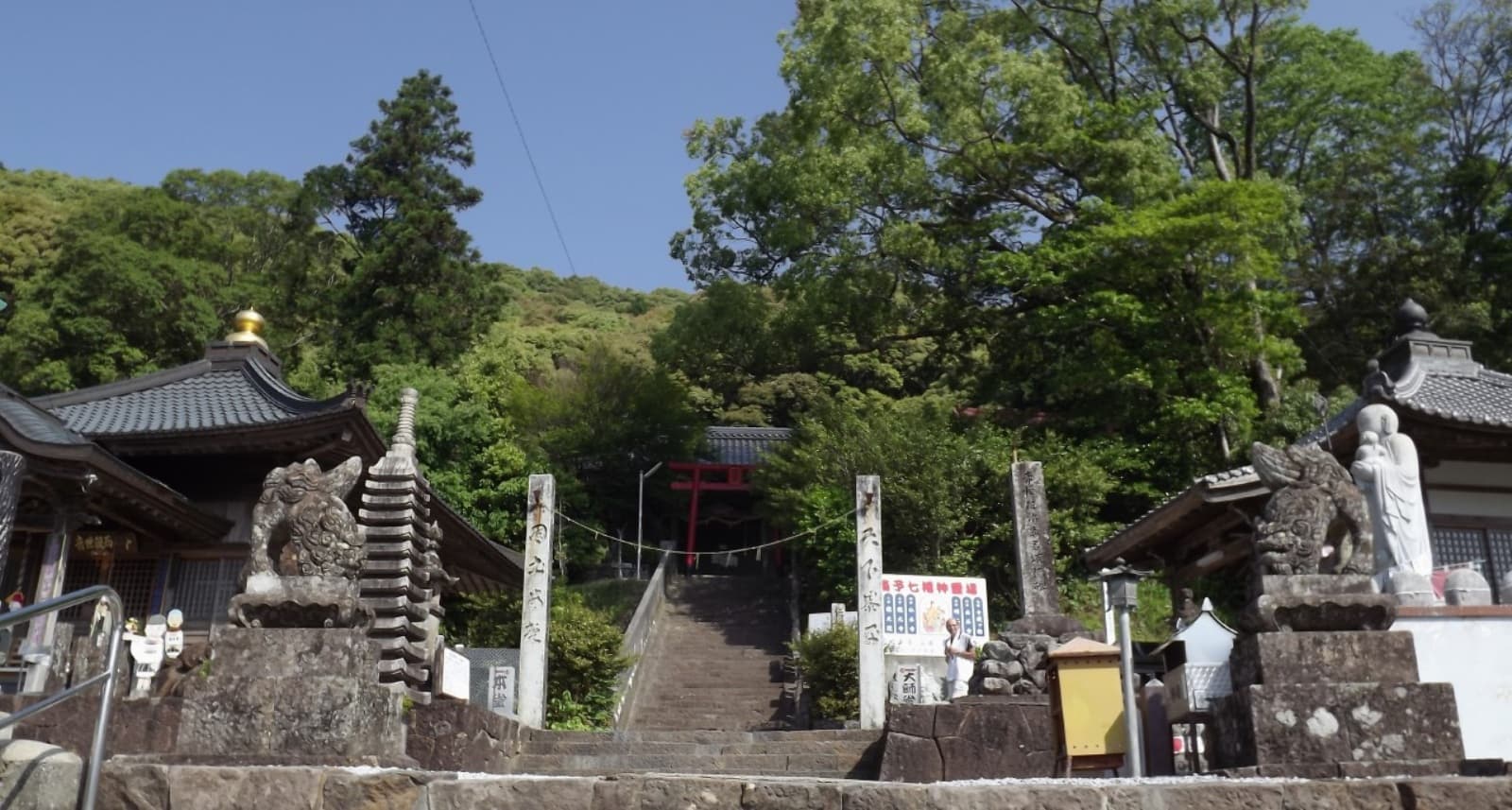
Image of Ryuukou-ji (竜光寺). Image source · CC-BY-SA-4.0
Station 41 of 88
Shikoku 88 Temple PilgrimageVisit essentials
A quick read before you go
- Duration
- 30-45 minutes for a contemplative visit including both the Buddhist halls and the Inari shrine…
- Access
- Approximately 3 km from JR Mukaibara station.
Overview
Ryūkō-ji greets Shikoku pilgrims with a Shinto torii rather than a Buddhist sanmon. It is a clear surviving instance of shinbutsu-shūgō, in which kami and Buddha share sacred ground: the Buddhist Hondō and Daishi-dō stand below an Inari shrine approached past stone foxes. The two devotional registers alternate rather than compete. Ryūkō-ji retained this layered identity through the 1868 Meiji separation decrees; locals call it Mima-no-Oinari-san and often give the rice-deity shrine primary devotional weight.
Temple tradition says that in 807 CE Kūkai met a white-haired man carrying rice who declared he protected the Dharma. Recognizing Inari, Kūkai established shrine and temple and carved Inari with Jūichimen Kannon. The Buddhist principal's eleven faces look in all directions; in Shingon mikkyō, Inari is sometimes understood as the fox-riding tantric Dakini-ten.
Why this place is sacred
The thinness pilgrims report at Ryūkō-ji is structural rather than atmospheric. Most Shikoku 88 sites concentrate their devotional weight on a single Buddhist principal of veneration. Here, two devotional vocabularies are stacked. The lower terrace holds the Hondō and the Daishi-dō, where pilgrims chant the Heart Sutra, deposit a name slip, and place three sticks of incense and a candle.
A flight of stone steps leads to the upper terrace, where the Inari shrine receives rice, sake, and prayers framed in entirely different terms — harvest, business success, household protection.
Walking from one to the other in five minutes, pilgrims pass through a small but felt change of register. The vermilion of the torii and shrine fence saturates the upper precinct in a way Buddhist halls below do not match. Fox statues replace bodhisattvas as the visual rhythm. The same body that just chanted in Sanskrit-derived mantra now bows in front of a kami. For pilgrims trained on later, separated traditions, the proximity is disorienting in a useful way.
The site teaches what shinbutsu-shūgō meant by inhabitation rather than description.
Founded in 807 CE according to temple tradition as a combined Inari shrine and Buddhist temple, with Kūkai carving images of Inari Myōjin alongside Jūichimen Kannon, Fudō Myōō, and Bishamon-ten. The original name Inarizan Gokokuin signals the Inari-led identity from the start.
The temple survived the 1868 shinbutsu-bunri decrees that forced most syncretic sites to choose between Shinto and Buddhist identity. Ryūkō-ji kept both. In the Meiji period the formal Buddhist registration was preserved while the Inari shrine continued to receive harvest offerings from the surrounding Mima farming community. The local name Mima-no-Oinari-san emerged from that continuity.
The current Main Hall and Daishi-dō stand below the Inari shrine on the hillside; rebuilds occurred under various local patrons through the Edo and modern periods.
Experience and orientation
The first surprise is the gate. Most pilgrims arriving from Temple 40 Kanjizai-ji or by car from Uwajima have just left a circuit of Niō-guarded sanmon entrances. At Ryūkō-ji a vermilion torii rises instead, and the first guardians are not Niō but stone komainu. The hillside ahead climbs gently. Stone foxes mark the path; weathered, lichened, some carrying scrolls or jewels in their mouths.
The Buddhist precinct opens first. The Hondō houses Jūichimen Kannon as honzon and a Daishi-dō nearby holds the standing image of Kōbō Daishi. Pilgrims in white hakui pause at the chōzuya to wash hands and mouth, then complete the seven-step ritual at each hall: bow, candle, three incense sticks, fudasho-fuda deposit, saisen, sutra chanting, bow. The chanting is the Heart Sutra, the temple's go-eika, and the mantra of Kōbō Daishi (Namu-Daishi-Henjō-Kongō).
The kongō-zue staff rests outside the hall with its tassel cover removed, signaling it is at rest.
The Inari ascent begins after the Buddhist obligations are met. A flight of stone stairs climbs through a tunnel of small torii. The shrine at the top is modest in scale but vivid in color — vermilion fence, white shimenawa, paired stone foxes flanking the offering box. Pilgrims who continue up can leave a small offering of rice or sake. From the top terrace the Mima plain spreads below, rice paddies in summer green or autumn gold depending on season.
Pilgrims often spend longer here than at the Buddhist halls, less because of doctrine than because the view rewards staying.
Approach through the vermilion torii at the base; the Buddhist precinct (Hondō and Daishi-dō) sits on the lower terrace. The Inari shrine is reached by stone steps rising behind and above the Buddhist halls. The nōkyō-jō for the goshuin stamp is located near the Buddhist precinct. Bow at the torii on entry and again on departure; bow once more on returning to the lower precinct from the Inari shrine.
Context and lineage
Temple tradition records that in 807 CE Kūkai climbed this hillside in the Mima area south of Uwajima and met a white-haired old man holding a sheaf of rice. The old man declared that he had remained there to protect the Dharma and benefit beings. Kūkai recognized him as a manifestation of Inari, the rice deity, and established both an Inari shrine and a Buddhist temple on the spot.
He is said to have carved a statue of Inari Myōjin alongside Jūichimen Kannon, Fudō Myōō, and Bishamon-ten. The original name was Inarizan Gokokuin, signaling the Inari-mountain identity from the founding.
Shingon Buddhism, Kōyasan school. The temple is part of the Shikoku 88-temple circuit attributed to Kūkai. The Inari shrine on the precinct is held in shinbutsu-shūgō relation to the Buddhist temple, an arrangement that survived the Meiji separation decrees of 1868 and continues under unified temple administration.
Kūkai (Kōbō Daishi)
Founder per temple tradition; carver of the principal images
Inari (as kami)
Tutelary deity of the upper shrine; rice and harvest deity
The white-haired old man of the founding legend
Manifestation of Inari encountered by Kūkai
Traditions and practice
The pilgrim's seven-step ritual at each Buddhist hall: bow at the threshold, place a lit candle in the candle stand, light three sticks of incense, deposit a fudasho-fuda name slip in the box, place a saisen coin in the offering box, chant the Heart Sutra and the temple's go-eika and the mantra of Kōbō Daishi, then bow on departure.
At the Inari shrine the offerings shift to rice or sake and the prayer terms shift to harvest, business prosperity, household protection. The kongō-zue staff is set down with the tassel cover removed before entering temple grounds, signaling rest.
Daily Shingon liturgy is performed by resident priests. Inari festival days bring additional offerings of rice and sake from local Mima farming families. Pet blessings and household prayers occur informally year-round. Pilgrim traffic is steady on the Shikoku 88 circuit, with most visitors completing both the Buddhist seven-step ritual and the climb to the upper Inari shrine.
Allow time for both registers. Complete the Buddhist halls first if you are walking the pilgrimage, then climb to the Inari shrine without rushing. The view from the upper terrace over the Mima plain rewards a longer pause than the Buddhist precinct alone. If you are not familiar with chanting the Heart Sutra, a silent gasshō at each hall is acceptable. Bring a small bag of rice or a coin offering for the Inari shrine separately from the Buddhist saisen.
Shingon Buddhism
ActiveTemple 41 of the Shikoku 88-temple pilgrimage attributed to Kūkai. Belongs to the Shingon school of esoteric Buddhism founded by Kūkai in early 9th-century Japan.
Heart Sutra and Hannya Shingyō chanting; lighting incense and candles; depositing fudasho-fuda at the Hondō and Daishi-dō; receiving the goshuin stamp.
Inari worship and Shinbutsu-shūgō
ActiveRyūkō-ji is one of the clearest surviving examples of Shinto-Buddhist syncretism on the Shikoku pilgrimage. The temple gate is a vermilion torii; komainu replace the usual Niō; an active Inari shrine sits above the Buddhist halls. Locally known as Mima-no-Oinari-san.
The Inari shrine receives rice, sake, and prayers for harvest, business prosperity, and household protection. Inari festival days bring additional offerings from local farming families.
Perspectives and open questions
Ryūkō-ji is read variously by scholars, local devotees, esoteric Buddhists, and pilgrims, with substantive disagreement on what the kami-Buddha amalgamation means.
Scholarly perspective
Pilgrimage scholars cite Ryūkō-ji as a textbook surviving instance of shinbutsu-shūgō that escaped the strict Meiji-era shinbutsu-bunri decrees of 1868. The site is studied as evidence of pre-Meiji Japanese religious life, in which kami and Buddha were not separate religions but ranked manifestations within a single field of devotion.
Living and traditional perspectives
Local Mima-area tradition treats the site as Mima-no-Oinari-san, the Inari of Mima, with the Buddhist temple identity functionally secondary. Harvest blessings and household prosperity are the dominant frames of folk practice; the Buddhist halls are visited and respected, but the Inari shrine carries the everyday devotional weight for surrounding farming families.
Alternative interpretations
Within Shingon mikkyō, Inari is sometimes equated with Dakini-ten, a fox-riding tantric deity associated with esoteric Buddhist transmission. Read this way, the kami at Ryūkō-ji becomes a manifestation of an esoteric Buddhist principle rather than a separate religion, and the apparent duality at the site collapses into a single mikkyō field with two surfaces.
Open questions
The exact pre-Kūkai history of Inari worship at this hilltop is not documented. Whether the site was already a kami sanctuary that Kūkai overlaid with Buddhism, or vice versa, remains a matter of legend rather than archaeological fact.
Plan your visit
Access and arrival
Approximately 3 km from JR Mukaibara station. Walking pilgrims arrive on foot from Temple 40 Kanjizai-ji, about 50 km north over the Uwajima area. Car park on site. Local taxi service available from JR Mukaibara.
Pilgrim minshuku and small inns in Uwajima city, ~10 km southwest, including options around Uwajima Castle. Some shukubō (temple lodging) on other parts of the circuit; contact the temple network for current bookings.
Respectful visit
Traditional pilgrim attire of white hakui, sugegasa, kongō-zue, wagesa stole, and nōkyōchō is welcomed but not required. Modest casual dress is acceptable. Comfortable footwear for the stone steps up to the Inari shrine.
Outdoor photography of grounds, torii, and statues is generally permitted. Avoid photographing the honzon inside the Main Hall and any private prayer. Ask before photographing priests or pilgrims at close range.
At the Buddhist halls: three incense sticks, one candle, a fudasho-fuda, a saisen coin. At the Inari shrine: rice or sake plus a saisen coin. A pilgrim sponsoring a goshuin stamp pays the standard nōkyō fee at the office.
Silence inside the Buddhist halls during chanting. Do not step on the threshold beams. Do not photograph the honzon. Remove the kongō-zue staff's tassel cover when on temple grounds. Stay on marked paths and steps; do not climb on the Inari shrine fence or fox statues.
Photography of the honzon inside the Main Hall is discouraged. Avoid stepping on the threshold beam of the gate. Do not photograph other pilgrims mid-prayer. Voices stay low inside the halls during chanting.
Current practical details
Address
173 Mimachō Togari, Uwajima, Ehime 798-1115, Japan
Phone
Hours
Hours, fees, and access can change — verify on the official source before you travel. Practical details last checked Jun 2026.
Location
Map loads as you approach this section.
Pilgrim reflections
A portrait of encounter, not a score
Pilgrims describe what they felt, how present they could become, and whether the place would shape a journey. There are no stars and no ranking of traditions.
No reviewed reflections yet
The first pilgrims can help describe the character of being here.
Share a reflection
Available after an account-backed “Been there.” Every reflection is reviewed before publication.
Watch deeper
Films, episodes, and recorded talks for visitors who want more context before or after a visit. Speculative and alternative-history entries are labelled as perspectives, not as sources for established claims.
Nearby sacred places
Explore other sacred places in the region. Proximity does not establish access or travel time; check each place’s guidance.



References
Sources consulted for this page. Source categories describe the publication, not a guarantee that every claim is verified. Traditional accounts and outside interpretations may differ.
- 01Ryukoji – Uwajima, Ehime Prefecture, Shikoku — Henro.orgguideComprehensive English-language Shikoku pilgrimage reference
- 02Inarizan Gokokuin Ryukoji – Shikoku 88 Temple Pilgrimage — Shikoku 88 Temple Pilgrimage OfficialofficialOfficial temple network site
- 03Customs and Etiquette of the Shikoku Pilgrimage — Henro.orgguidePilgrim etiquette reference
- 04Temple 41, Ryūkōji — QR TranslatorguideTranslated temple signage
- 05Ryuko-ji is temple No. 41 - More Shinto than Buddhist? — Japan TravelblogFirst-person visitor account
Pilgrim glossary
- Honzon
- The principal Buddhist deity enshrined as a temple's central object of worship.
- Kannon
- The bodhisattva of compassion, central to many East Asian pilgrimage routes.
- Sutra
- A canonical Buddhist scripture, often chanted as part of practice.
- Mantra
- A sound, word, or phrase repeated as part of meditation or ritual.
- Dharma
- The teachings of the Buddha; also the universal law underlying them.
- Torii
- The traditional Japanese gate marking the entrance to a Shinto sacred area.
- Shimenawa
- A sacred straw rope marking the boundary of a Shinto holy place.
- Shingon
- An esoteric Japanese Buddhist school emphasizing ritual, mantra, and mandala practice.
Share a photo
Help visitors recognize Ryuukou-ji. Every submission is reviewed before publication.