Yashima-ji
A plateau temple of compassion, war memory, and a folk-spirit tanuki
Understand sacred places, explore living traditions, and learn how to engage respectfully with Pilgrim Map.
Access has not been verified. Check current local guidance before planning a visit.
Takamatsu, Kagawa Prefecture, Japan
Read the sources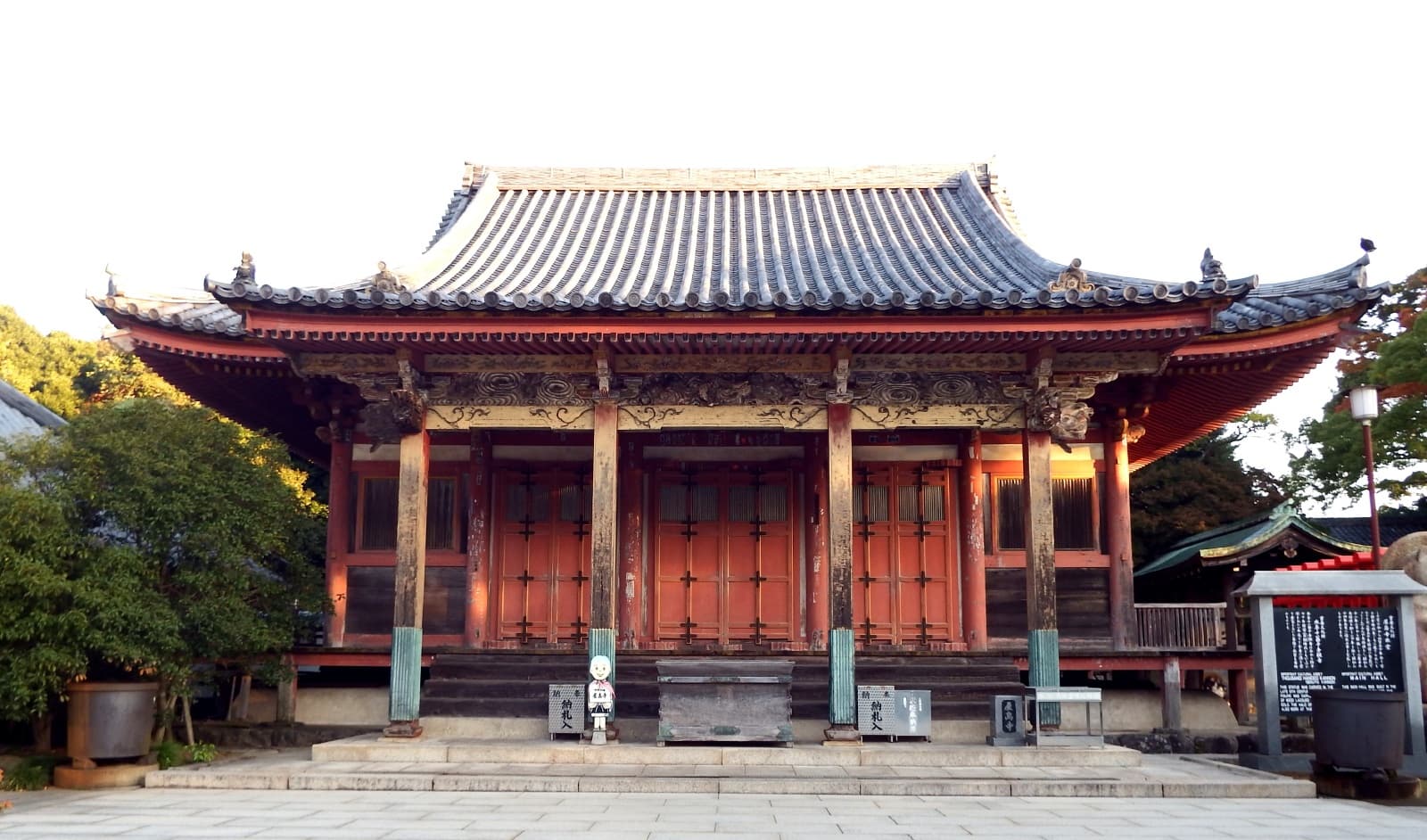
Image of Yashima-ji (屋島寺). Image source · CC-BY-SA-4.0
Station 84 of 88
Shikoku 88 Temple PilgrimageVisit essentials
A quick read before you go
- Duration
- Sixty to ninety minutes for the temple.
- Access
- Kotoden Kotohira Line to Yashima Station, then the Yashima Mountain Cruise bus or a 30–40 minute…
Overview
The plateau itself decides the visit. Yashima rises sharply from the coast east of central Takamatsu — a long, level mesa whose vertical sides are cloaked in forest. From its top, the Inland Sea opens in three directions.
The site has held two histories at once for nearly a thousand years: the Buddhist temple founded by Ganjin in 753 and reconfigured by Kūkai in 815, and the field of the 1185 Battle of Yashima, a turning point in the Genpei War. Both are present in the precinct.
Ganjin, the Chinese vinaya master who brought Tang Buddhist precepts to Japan, is said to have seen an auspicious cloud over Mt. Yashima while travelling from Kyushu to Nara in 753 and to have built the original Fugen Hall on the northern peak. In 815, at Emperor Saga's request, Kūkai relocated the temple from the northern to the southern ridge, carved the principal Eleven-Faced Thousand-Armed Kannon, and consolidated it as a Shingon site.
The current Main Hall, dating from 1618, is a designated Important Cultural Property and preserves Kamakura-period materials.
A further story runs through the precinct. By tradition, Kūkai was guided through mist to the summit by an old man in a straw cape who turned out to be a tanuki — the Yashima-no-hage tanuki, now enshrined as Minoyama Daimyōjin near the Main Hall. Two stone tanuki stand among the Buddhist statuary.
The Treasure House holds Genpei-period scrolls and the Battle of Yashima folding screen, including the imagery of Nasu no Yoichi's famous arrow shot through a fan held by a Taira lady on a swaying boat. Yashima-ji asks pilgrims to hold compassion, warfare, and folk memory in one frame — a meditation on impermanence with both Buddhist and historical depth.
Why this place is sacred
The thinness at Yashima-ji is layered. A long stone-paved approach climbs the plateau through cedar and pine. The Niō Gate is dramatic; the precinct broadens beyond it. The pair of stone tanuki at the Minoyama Daimyōjin shrine are unmistakable. The Treasure House sits within the precinct and is an unusual addition for a Shikoku 88 temple. From certain points on the plateau the Inland Sea appears in long, quiet horizontals.
The combination — Kannon halls, tanuki, and battle-dead — gives the site a sacred-and-secular density not often matched on the route.
Originally an eighth-century Buddhist temple founded by Ganjin in the Vinaya/Kegon stream associated with Tōdai-ji and Saidai-ji in Nara, anchored on the northern peak of Yashima.
Relocated to the southern ridge by Kūkai in 815 and converted to Shingon. By 1391 it was listed as a sub-temple of Saidai-ji. The Main Hall was rebuilt in 1618 using Kamakura-period materials. The Yashima-no-hage tanuki cult and the Genpei War memorial dimensions accumulated alongside the Buddhist core.
Experience and orientation
The temple is reached on the southern ridge of the plateau. The Niō Gate sets the scale. Standard henro practice is followed at the Main Hall and Daishi-dō: bow at the gate, hands and mouth purified at the chōzuya, candle and three sticks of incense lit, an osamefuda nameslip dropped, the Heart Sutra recited, and the Senju Kannon mantra (On bazara taramaki riku) sounded. The Kōbō Daishi mantra closes the rite at the Daishi-dō.
Near the Main Hall stands the shrine of Minoyama Daimyōjin — the Yashima-no-hage tanuki — flanked by two stone tanuki statues. Visitors offer prayers here particularly for marital harmony, family safety, and business prosperity. The Treasure House, separately ticketed, holds Genpei-period scrolls and the famous Battle of Yashima folding screen, plus statuary listed as Important Cultural Property. Beyond the temple, footpaths lead to Yoichi's Mato and the Heike-no-Tomoshibi sites associated with the 1185 battle.
The plateau's long views are at their best near sunset.
The Main Hall and Daishi-dō are at the centre of the precinct on the southern ridge. The Minoyama Daimyōjin tanuki shrine stands close by. The Treasure House is within the temple grounds. The Niō Gate marks the southern entrance; battlefield sites are reached on plateau footpaths beyond.
Context and lineage
Yashima-ji was founded in 753–754 by the Tang Chinese vinaya master Ganjin (Jianzhen, 688–763), who, en route to Nara's Tōdai-ji, sensed an auspicious light from the summit of Mt. Yashima and built the Fugen Hall on the northern peak with a Fugen Bodhisattva statue brought from China. In 815, at Emperor Saga's request, Kūkai relocated the temple from the northern to the southern ridge of Yashima, carved the principal Eleven-Faced Thousand-Armed Kannon, and converted the temple to Shingon.
The current Main Hall (1618) preserves materials from a Kamakura-period predecessor and is a designated Important Cultural Property. The 1185 Battle of Yashima — including Nasu no Yoichi's celebrated arrow shot through a fan held by a Taira lady on a boat — was fought on and around the plateau, leaving the precinct entwined with the Heike monogatari narrative.
Shingon Buddhism since 815. Earlier Vinaya / Kegon / Saidai-ji lineage at the eighth-century founding.
Ganjin (Jianzhen)
Founder
Kūkai (Kōbō Daishi)
Relocator and re-consecrator
Yashima-no-hage tanuki
Folk-deity guide
Nasu no Yoichi
Genpei War archer
Traditions and practice
Pilgrims follow the standard henro rite. After bowing at the Niō Gate and purifying at the chōzuya, a candle is lit and three sticks of incense placed at the Main Hall. An osamefuda nameslip is deposited, the Heart Sutra recited, and the Senju Kannon mantra (On bazara taramaki riku) sounded. The same rite is repeated at the Daishi-dō, ending with the Kōbō Daishi mantra. The nōkyō calligraphy stamp is collected at the temple office.
Daily Shingon services continue. The Treasure House is open daily for an admission fee of approximately ¥500. Annual memorial services for the Genpei dead are held. Many visitors add a separate prayer at Minoyama Daimyōjin for marriage, family, and business.
Set aside two to three hours: the temple itself, the Treasure House, and a slow walk on the plateau to one or two of the battlefield sites. The plateau is best entered with the awareness that it is at once a Buddhist sanctuary, a folk shrine, and a war memorial. Sunset from the western edge is among the strongest moments on the route.
Shingon Buddhism
ActiveConverted to Shingon by Kūkai in 815 after its initial Vinaya/Kegon-style founding under Ganjin. Remains Shingon today.
Daily Shingon services; pilgrim chanting of Heart Sutra and Senju/Jūichimen Kannon mantras; nōkyō.
Ritsu / Saidai-ji lineage (historical)
HistoricalThe original eighth-century foundation under Ganjin connected Yashima-ji to Saidai-ji in Nara. By 1391 it was listed as a Saidai-ji sub-temple before its medieval reorientation toward Shingon.
Historical only.
Local Sanuki folk Buddhism (Yashima-no-hage tanuki cult)
ActiveThe Yashima-no-hage tanuki, one of the Three Famous Tanuki of Japan, is enshrined as Minoyama Daimyōjin near the Main Hall — a local protective deity who, by legend, guided Kūkai through mist to the summit.
Visitors offer prayers for marital harmony, family safety, and business prosperity at the tanuki shrine.
Perspectives and open questions
Yashima-ji is read as a layered cultural-historical site: an eighth-century Vinaya foundation, a Shingon mountain temple, a Genpei battlefield, and a folk-spirit shrine.
Scholarly perspective
Yashima-ji is recognised as one of the older eighth-century foundations on the Shikoku 88, distinctive for its non-Kūkai origin (Ganjin) and for occupying a militarily and culturally significant plateau. Its dual identity as Buddhist temple and Genpei battlefield is a frequent topic in Japanese cultural-history scholarship.
Living and traditional perspectives
Local Takamatsu tradition treats the entire Yashima plateau as a single sacred zone — temple, battle dead, and the Yashima-no-hage tanuki are honoured together, especially during the Bon season.
Alternative interpretations
In Shingon esoteric reading, Yashima's mesa form, a rising platform over the sea, is associated with the lotus throne of the cosmic Buddha. Kūkai's relocation of the temple from the northern to the southern peak in 815 ritually re-aligned it with solar and Mahāvairocana orientation.
Open questions
The historicity of the tanuki-as-guide encounter is folkloric. The Treasure House contains items whose Genpei provenance, in a few cases, is traditional rather than archaeologically established.
Plan your visit
Access and arrival
Kotoden Kotohira Line to Yashima Station, then the Yashima Mountain Cruise bus or a 30–40 minute walk up the Yashima Skyway path. By car, roughly 20 minutes from JR Takamatsu Station via the Yashima Driveway. The pilgrim foot path from Ichinomiya-ji (T83) is approximately 14 km.
Plentiful in central Takamatsu and along the Yashima foot of the plateau. There is no shukubō at Yashima-ji.
Respectful visit
Modest dress. Pilgrim attire welcomed.
Permitted in the grounds. No flash in halls or Treasure House.
Incense, candles, coins, osamefuda. Nōkyō fee ¥500/book. Treasure House admission separate.
Do not climb on the Niō Gate or stone statues. Do not touch displayed cultural properties.
Some Treasure House items relate to specific war dead and are treated as sensitive.
Current practical details
Address
1808 Yashima Higashimachi, Takamatsu, Kagawa 761-0111, Japan
Phone
Hours
Hours, fees, and access can change — verify on the official source before you travel. Practical details last checked Jun 2026.
Location
Map loads as you approach this section.
Pilgrim reflections
A portrait of encounter, not a score
Pilgrims describe what they felt, how present they could become, and whether the place would shape a journey. There are no stars and no ranking of traditions.
No reviewed reflections yet
The first pilgrims can help describe the character of being here.
Share a reflection
Available after an account-backed “Been there.” Every reflection is reviewed before publication.
Watch deeper
Films, episodes, and recorded talks for visitors who want more context before or after a visit. Speculative and alternative-history entries are labelled as perspectives, not as sources for established claims.
Nearby sacred places
Explore other sacred places in the region. Proximity does not establish access or travel time; check each place’s guidance.


References
Sources consulted for this page. Source categories describe the publication, not a guarantee that every claim is verified. Traditional accounts and outside interpretations may differ.
- 01Yashima-ji — WikipediaencyclopediaConcise overview with citations; founding by Ganjin and Kūkai's later relocation
- 02The 84th Temple Yashimaji Temple — Sanuki History & Culture GuideguideLocal cultural guide
- 03Nanmenzan Senkoin Yashimaji – Shikoku 88 Temple Pilgrimage — Shikoku 88 Temple Pilgrimage ReizōkaiofficialOfficial pilgrimage site
- 04Walking the pilgrimage road – all YASHIMA tourism guide — Yashima-Navi (Takamatsu City)guideLocal visitor route information
- 05Customs and Etiquette of the Shikoku Pilgrimage — Henro.orgguidePilgrim etiquette
- 06Yashima-ji, 84th Temple of the Shikoku 88-Temples Pilgrimage — Japan Wonder TravelblogDetail on tanuki statues and Yashima-no-hage tanuki legend
- 07Yashima-ji Temple — Japan ExperienceguideTreasure house and Genpei battle overview
Pilgrim glossary
- Kannon
- The bodhisattva of compassion, central to many East Asian pilgrimage routes.
- Bodhisattva
- An enlightened being who postpones full nirvana to help others toward awakening.
- Sutra
- A canonical Buddhist scripture, often chanted as part of practice.
- Mantra
- A sound, word, or phrase repeated as part of meditation or ritual.
- Shingon
- An esoteric Japanese Buddhist school emphasizing ritual, mantra, and mandala practice.
Share a photo
Help visitors recognize Yashima-ji. Every submission is reviewed before publication.