Yakuriji Temple, Yakuri
Where celestial swords fell and roasted chestnuts grew on the Shikoku pilgrimage
Understand sacred places, explore living traditions, and learn how to engage respectfully with Pilgrim Map.
Access has not been verified. Check current local guidance before planning a visit.
Takamatsu, Kagawa Prefecture, Japan
Read the sources
Visit essentials
A quick read before you go
- Duration
- 30 minutes to 1 hour for temple visit; longer if combining with cable car ride and contemplation
- Access
- Open 7:00 AM - 5:30 PM.
Overview
On Shikoku's northern coast, Mount Goken's five peaks rise like fingers toward heaven. Spiritual seekers have come to the 'Mountain of Five Swords' since Kōbō Daishi practiced Gumonjiho here in 829 CE, an esoteric discipline said to perfect memory and wisdom. Tradition says five swords fell from the sky and the mountain deity Zaō Gongen appeared, declaring a Buddhist sanctuary.
Kūkai buried the celestial swords, carved Dainichi Nyorai, the Cosmic Buddha illuminating all existence, and before leaving for China planted eight roasted chestnuts to test the mountain's spiritual power. Returning years later, he found them miraculously sprouted. He renamed the temple Yakuri-ji, 'Temple of Eight Chestnuts,' and made it a waypoint on the developing Shikoku pilgrimage.
Today walkers on Shikoku's 1,200-kilometer circuit reach Temple 85 for a stamp and continue a journey associated with Kōbō Daishi for twelve centuries. A cable car assists those unable to climb, while the high Mount Goken setting preserves an ascent toward blessing. Kangiten, deity of bliss and worldly success, also draws devotees seeking help with material challenges.
Why this place is sacred
The thinness at Yakuriji crystallized in specific miraculous events. When five swords fell from the heavens during Kobo Daishi's practice, they marked this mountain as a place where divine reality could break through. The appearance of Zao Gongen, the fierce protector deity, provided verbal confirmation of what the falling swords demonstrated: here the boundary between worlds is permeable.
The roasted chestnuts that sprouted despite being dead seeds offered a second proof. What cannot happen according to natural law happened here, demonstrating that Mount Goken operates by different rules. The temple's name itself, Eight Chestnuts, commemorates this ongoing impossibility.
For pilgrims walking the Shikoku circuit, Yakuriji represents not just the 85th stop but an encounter with the documented presence of Kobo Daishi himself. Shikoku pilgrimage tradition holds that Kukai accompanies all pilgrims, walking beside them in spirit. At Yakuriji, this presence gains particular intensity because here he received divine confirmation of his path. The mountain that taught Kukai teaches those who follow.
Kukai established the temple in 829 CE as a place of esoteric practice, specifically Gumonjiho meditation for developing wisdom and memory. The divine revelations he received confirmed the mountain's power and led to its inclusion in the pilgrimage circuit.
The temple was destroyed during the invasion of Shikoku in 1585 and rebuilt in the 1590s. The oldest surviving structure, the bell tower, dates from 1791. The temple has continuously served Shikoku pilgrims for nearly 1,200 years. A cable car now provides access for those unable to climb, broadening participation while maintaining the temple's elevated position.
Experience and orientation
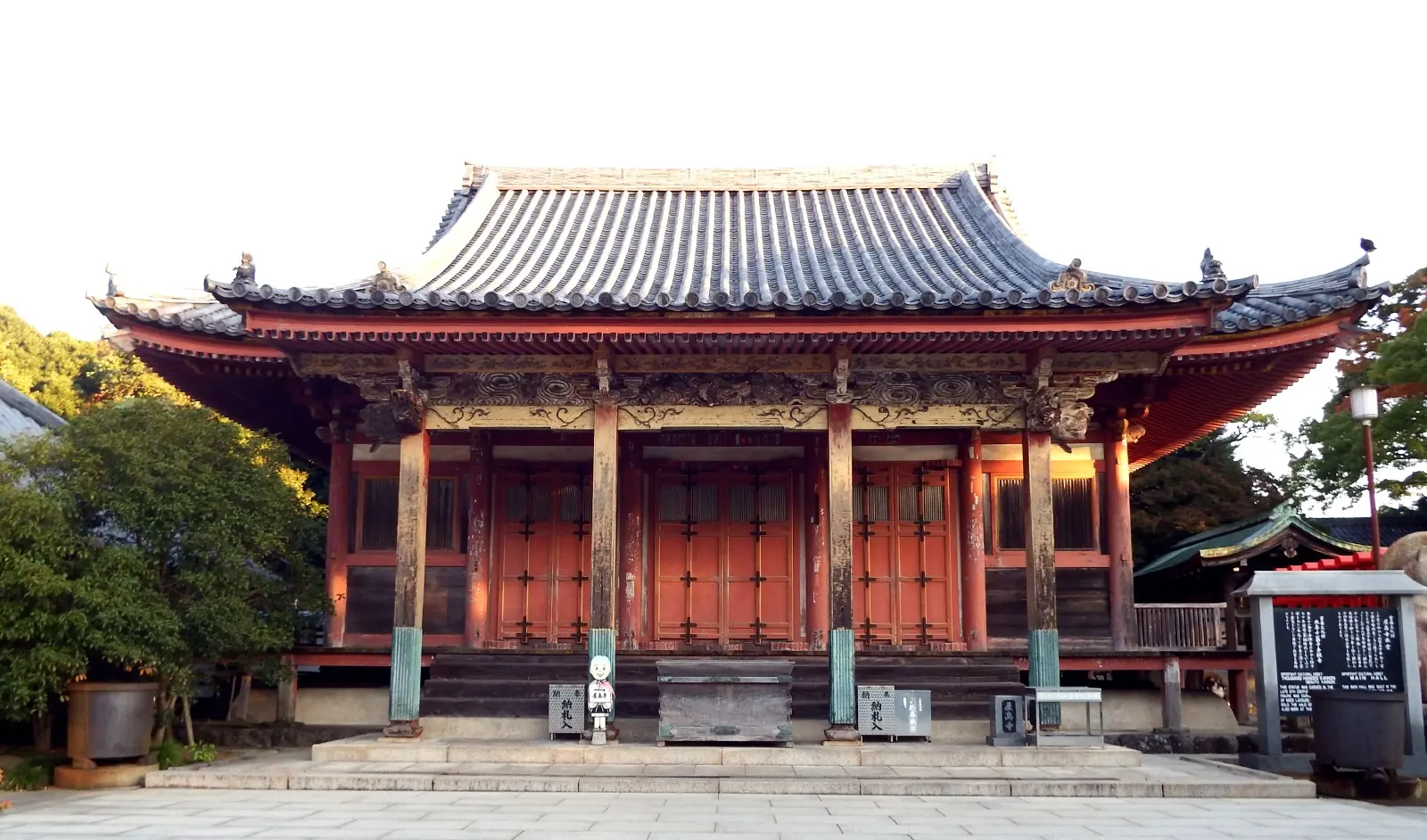
Arriving at Yakuriji, whether by cable car or the traditional walking path, one first notices the dramatic mountain setting. The five peaks of Mount Goken create a distinctive silhouette against the sky, their pointed forms echoing the celestial swords of the founding legend. The temple buildings cluster on the mountain slopes, their traditional architecture harmonizing with the natural setting.
For pilgrims completing the Shikoku circuit, Yakuriji represents the 85th encounter in a journey that transforms through accumulation. Each temple visit follows similar ritual patterns: ringing the bell, lighting incense and candles, chanting the Heart Sutra and Kobo Daishi's mantra, making offerings, and receiving the temple stamp in the pilgrim's book. These repeated forms create deepening familiarity while each location adds its particular character.
The temple's association with Kangiten draws worshipers seeking worldly success, particularly in business and academic achievement. This deity of bliss occupies a special hall where devotees can pray for practical blessings. The combination of high spiritual meaning and practical assistance reflects Japanese religious pragmatism.
The cable car ride itself becomes part of the experience, offering panoramic views as pilgrims rise toward the temple. Looking down at Shikoku's northern coast, one gains perspective on the journey completed and remaining.
If walking the pilgrimage, approach from Temple 84 (Yashimaji). If arriving by cable car, use the ascent for mental preparation. Upon arrival, follow standard pilgrimage protocol: main hall first, then Daishi hall. Receive your stamp. Allow time to absorb the mountain setting before continuing to Temple 86.
Context and lineage
In 829 CE, Kobo Daishi came to Mount Goken to practice Gumonjiho, an esoteric discipline for developing perfect memory and wisdom. During his practice, five swords fell from the heavens and the mountain deity Zao Gongen appeared, declaring this mountain would be a sacred place of Buddhism. Kukai buried the celestial swords and carved an image of the Cosmic Buddha. Before traveling to China, he planted eight roasted chestnuts as a test.
Upon returning, he found they had miraculously grown despite being roasted, proving the mountain's spiritual power. He named the temple Yakuri-ji, Temple of Eight Chestnuts.
Yakuriji belongs to the Shingon sect of Buddhism founded by Kobo Daishi. The temple is the 85th stop on the Shikoku 88 Temple Pilgrimage, one of the world's great pilgrimage circuits. The temple preserves esoteric teachings and practices transmitted from Kukai through generations of practitioners.
Kobo Daishi (Kukai)
Founder
Zao Gongen
Mountain deity
Traditions and practice
The temple historically practiced Gumonjiho, the esoteric meditation for developing memory and wisdom that brought Kobo Daishi here. Pilgrimage rituals following Kukai's circuit have continued for nearly 1,200 years. Kangiten worship for worldly blessing represents another established practice.
Daily Buddhist services maintain continuous practice. Pilgrims receive stamps in their nokyocho books, mark completion of Temple 85, and pray at both main hall and Daishi hall. Incense offerings, bell ringing, and sutra chanting follow traditional forms. Omamori protective amulets are available.
Approach as pilgrimage whether or not completing the full circuit. Follow the traditional sequence: ring the bell, light incense and candle, offer prayers at the main hall, then at the Daishi hall. Chant the Heart Sutra if you know it, or simply sit with intention. Consider what you are carrying on your journey and what you hope to receive or release. Let the mountain setting work on you.
Shingon Buddhism
ActiveYakuriji was founded by Kobo Daishi during his practice of Gumonjiho esoteric meditation. The temple preserves Shingon teachings and serves as the 85th temple on the pilgrimage circuit Kukai established.
Shingon Buddhist services, pilgrimage rituals, prayer for worldly success through Kangiten, incense offerings, sutra chanting
Shikoku Pilgrimage
ActiveYakuriji is Temple 85 of the Shikoku 88 Temple Pilgrimage, a 1,200-kilometer journey around Shikoku island. The pilgrimage connects pilgrims to Kobo Daishi's sacred geography through physical walking and ritual practice.
Temple visitation, receiving nokyocho stamps, prayers at main hall and Daishi hall, pilgrimage fellowship, walking meditation
Perspectives and open questions
Yakuriji invites contemplation through both scholarly understanding and traditional faith.
Scholarly perspective
Yakuriji represents the integration of mountain worship, esoteric Buddhism, and pilgrimage that characterizes Japanese religion. The temple's location on dramatic Mount Goken reflects Shingon emphasis on practice in sacred natural settings. The Shikoku Pilgrimage itself is recognized as one of the world's great pilgrimage routes, comparable to the Camino de Santiago in cultural and spiritual significance.
Living and traditional perspectives
In Shingon tradition, Kobo Daishi genuinely received divine revelation at this mountain, and his presence continues through his vow to aid all beings until Maitreya Buddha's coming. Pilgrims walk 'with Kobo Daishi' (dogyoninin), accompanied by his spiritual presence. The miraculous events of the founding, the falling swords and growing chestnuts, remain living realities rather than historical curiosities.
Open questions
The location of the five celestial swords buried by Kobo Daishi remains unknown. The original forms of Gumonjiho practice conducted here have not been fully transmitted to modern times.
Plan your visit
Access and arrival
Open 7:00 AM - 5:30 PM. Free admission; cable car fee separate. Walking distance from Temple 84 (Yashimaji). Cable car available from base of mountain.
Pilgrim lodgings (henro-yado) available along the Shikoku circuit. Takamatsu city offers full range of accommodations. Temple lodging available at some other temples on the pilgrimage.
Respectful visit
Traditional pilgrimage attire (white jacket, sedge hat, walking staff) optional but meaningful. Otherwise, respectful casual attire.
Permitted in outdoor areas. Restrictions inside main buildings. Check signage.
Coins for offering boxes. Incense available for purchase. These offerings support the temple and connect you to pilgrimage tradition.
{"Remove shoes when entering buildings","Maintain quiet in worship areas","Follow Shikoku pilgrimage etiquette","Observe photography restrictions in main halls"}
This is an active Buddhist temple. Maintain appropriate respect in all areas. Photography is restricted inside main buildings.
Current practical details
Address
3416 Murechō Mure, Takamatsu, Kagawa 761-0121, Japan
Phone
Hours
Hours, fees, and access can change — verify on the official source before you travel. Practical details last checked Jun 2026.
Location
Map loads as you approach this section.
Pilgrim reflections
A portrait of encounter, not a score
Pilgrims describe what they felt, how present they could become, and whether the place would shape a journey. There are no stars and no ranking of traditions.
No reviewed reflections yet
The first pilgrims can help describe the character of being here.
Share a reflection
Available after an account-backed “Been there.” Every reflection is reviewed before publication.
Nearby sacred places
Explore other sacred places in the region. Proximity does not establish access or travel time; check each place’s guidance.


References
Sources consulted for this page. Source categories describe the publication, not a guarantee that every claim is verified. Traditional accounts and outside interpretations may differ.
- 01Temple 85, Yakuriji - Tourism Shikoku — Tourism ShikokuSource contextOfficial tourism information
- 02Yakuriji - Henro.org — Henro.orgguideDedicated pilgrimage resource
- 03Yakuri-ji - Wikipedia — Wikipedia contributorsencyclopediaComprehensive overview
- 04The 85th Temple Yakuriji Temple - Sanuki History & Culture Guide — Sanuki History & Culture GuidespiritualRegional history source
Pilgrim glossary
- Sutra
- A canonical Buddhist scripture, often chanted as part of practice.
- Mantra
- A sound, word, or phrase repeated as part of meditation or ritual.
- Shingon
- An esoteric Japanese Buddhist school emphasizing ritual, mantra, and mandala practice.
Share a photo
Help visitors recognize Yakuriji Temple, Yakuri. Every submission is reviewed before publication.