Shido-ji
A seaside Kannon temple keeping the grave of a diving woman who gave her life for a jewel
Understand sacred places, explore living traditions, and learn how to engage respectfully with Pilgrim Map.
Access has not been verified. Check current local guidance before planning a visit.
Sanuki, Kagawa Prefecture, Japan
Read the sources
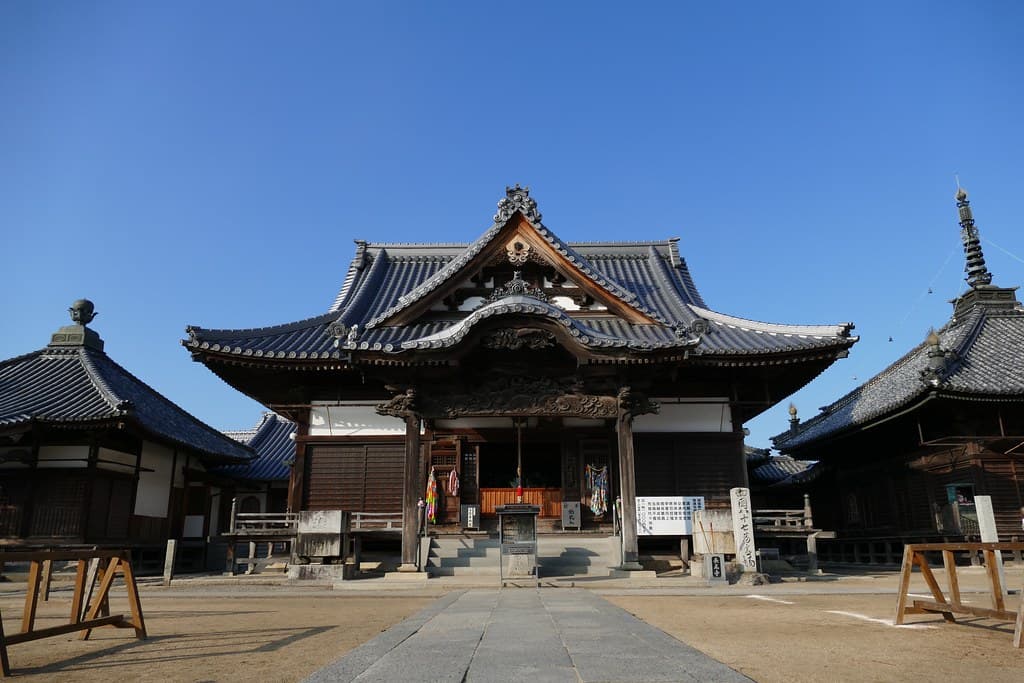
Image of Shido-ji (志度寺). Image source · CC-BY-SA-4.0
Station 86 of 88
Shikoku 88 Temple PilgrimageVisit essentials
A quick read before you go
- Duration
- Forty-five to seventy-five minutes for the temple and gardens.
- Access
- Kotoden Shido Line or JR Kōtoku Line to Shido Station, then a 10-minute walk.
Overview
Shido-ji is an early Kannon temple on the Shikoku circuit and a living Shingon site shaped by Fujiwara memorial tradition. Temple tradition dates its founding to 625, when the nun Oshino Sonoko found a luminous log at Shido Bay, carved an Eleven-Faced Kannon, and built a hall; historians treat the date as legendary and the eighth-century Fujiwara horizon as the first secure period.
The Tamatori-hime account begins with Fujiwara no Kamatari's death in 669 and links Fuhito, Fusasaki, a local ama, Ryūjin, the Menkōfuhai-no-tama jewel, her death, and the thousand memorial pagodas; the Noh play 'Ama' is its best-known literary elaboration. Today the Important Cultural Property Niō Gate and Main Hall, Eleven-Faced Kannon, Muromachi stream garden, Mirei Shigemori's Shōwa-period Muzentei garden, thousand pagodas, and the ama's modest grave hold architectural, devotional, literary, and ancestral meanings together.
Why this place is sacred
Shido-ji joins architecture, literature, living devotion, and ancestral memory. Its listed gate and hall, Muromachi stream garden—deep green with moss and water in late June—Shōwa-period Muzentei, thousand pagodas, and modest ama grave belong to different periods but one precinct. The Tamatori-hime story's sacrifice and Kannon's compassionate vow remain tradition and interpretation, not verified biography; its force survives without retelling every scene in every field.
Originally, by tradition, a small Kannon hall built in 625 by the nun Oshino Sonoko around the carving of an Eleven-Faced Kannon from a luminous log washed ashore at Shido Bay.
Significantly expanded in the early eighth century by Fujiwara no Fuhito and his son Fujiwara no Fusasaki in memory of the ama who recovered the lost jewel. Repaired and re-consecrated under Kūkai in the early ninth century. Various medieval and Edo-period rebuildings followed; the current Main Hall and Niō Gate are designated Important Cultural Properties. The twentieth-century Muzentei dry garden was added by Mirei Shigemori during the Shōwa period.
Experience and orientation
Enter through the Niō Gate into the cedar-and-camphor precinct. Complete the henro rite at the Main Hall and Daishi-dō, then collect the nōkyō stamp. Walk both gardens from their paths: the Muromachi meandering-stream garden invites quiet viewing, while Mirei Shigemori's Muzentei is viewed around, never entered. The thousand pagodas and the ama's grave occupy a quieter corner under old trees; pay respects briefly and let the Tamatori-hime tradition remain a community memory rather than a spectacle.
Salt air from Shido Bay carries through the grounds.
The Niō Gate fronts the south side of the precinct. The Main Hall and Daishi-dō are at the centre. The Muromachi garden lies to one side, the Shigemori Muzentei to the other. The thousand-pagoda area and the ama's grave are in a quieter back corner of the compound.
Context and lineage
Founding tradition: in 625, the nun Oshino Sonoko found a luminous log washed ashore at Shido Bay, carved an Eleven-Faced Kannon from it, and built a hall to enshrine the image. Tamatori-hime tradition: in the late seventh century, when Fujiwara no Kamatari died, his daughter — a Tang imperial consort — sent a ship from China carrying the Menkōfuhai-no-tama jewel and other treasures for his memorial. Ryūjin, the Dragon King, stole the jewel near Shido.
Fujiwara no Fuhito travelled to Shido in disguise, married a local ama, and asked her to recover the gem. She dove to the dragon palace, retrieved the jewel, and died. Their son Fusasaki later expanded the temple and built a thousand stone pagodas in her memory. Historians treat the 625 founding as legendary and the eighth-century Fujiwara involvement as the first historically secure horizon. Repaired and re-consecrated under Kūkai in the early ninth century.
Shingon Buddhism (Daikaku-ji branch lineage) since Kūkai. Active Fujiwara memorial tradition through the Tamatori-hime cult and the thousand stone pagodas.
Oshino Sonoko
Legendary founder
Fujiwara no Fuhito
Eighth-century patron; husband of the ama in the Tamatori-hime legend
Tamatori-hime (the ama)
Diving woman who recovered the jewel
Fujiwara no Fusasaki
Eighth-century expander of the temple
Kūkai (Kōbō Daishi)
Re-consecrated the temple as Shingon
Mirei Shigemori
Designer of the Muzentei garden
Traditions and practice
Pilgrims follow the standard henro rite. After bowing at the gate and purifying at the chōzuya, a candle is lit and three sticks of incense placed at the Main Hall. An osamefuda nameslip is deposited, the Heart Sutra recited, and the Jūichimen Kannon mantra (On maka kyaronikya sowaka) sounded. The same rite is repeated at the Daishi-dō, ending with the Kōbō Daishi mantra. The nōkyō calligraphy stamp is collected at the temple office.
Daily Shingon services continue. The Shidodera Festival (4–6 July) commemorates the Tamatori-hime legend with offerings and a procession. Lotus Sutra memorial recitations continue in the Fujiwara tradition. The temple receives both Shikoku pilgrims and visitors drawn to the gardens and the ama's grave.
Allow time after the henro rite to walk both gardens and the thousand-pagoda area. Pause at the grave of the ama. The Tamatori-hime story sits naturally with the Kannon tradition; pilgrims often think here of those — mothers, fathers, others — who gave themselves so that they could arrive at this point on the route.
Shingon Buddhism
ActiveAffiliated with Shingon throughout its medieval and modern history. Remains a Shingon temple within the Shikoku 88.
Daily Shingon services; pilgrim rite at Main Hall and Daishi-dō; Lotus Sutra recitation associated with the Fujiwara memorial tradition.
Fujiwara memorial cult / Tamatori-hime ama tradition
ActiveThe temple preserves the tomb of the ama said to have recovered the Menkōfuhai-no-tama jewel from the Dragon King and given her life for her son Fujiwara no Fusasaki. The thousand stone pagodas tradition initiated by Fusasaki is foundational to the temple's identity and is the basis of the Noh play 'Ama'.
Memorial offerings at the ama's grave; Lotus Sutra recitations; the Shidodera Festival (4–6 July) commemorates the legend.
Perspectives and open questions
Shido-ji is read as a paradigmatic site of medieval engi (origin) literature, a Fujiwara memorial centre, and a quiet living folk-Buddhist precinct.
Scholarly perspective
Shido-ji is studied as a paradigmatic site of medieval engi literature. Its founding stories were elaborated through Noh — the play 'Ama' — and through the Shidodera engi engraved on the Fujiwara memorial steles. Historians treat the Oshino Sonoko founding as legendary and the eighth-century Fujiwara involvement as the first historically secure horizon.
Living and traditional perspectives
Local ama (female diver) communities along the Setouchi coast remember Tamatori-hime as a spiritual ancestor. The temple festival continues to draw fishing families and their descendants.
Alternative interpretations
Within Shingon esoteric reading, the recovery of the jewel from the Dragon King is read as a parable of the dharmadhātu jewel hidden in the unconscious mind, recovered only through self-offering. The ama's death enacts the Bodhisattva path.
Open questions
The historicity of the jewel-recovery and the exact role of Fujiwara no Fuhito at Shido cannot be verified. The relationship between the Shidodera engi and the Noh play 'Ama' represents centuries of literary elaboration on a kernel that may or may not have any historical basis.
Plan your visit
Access and arrival
Kotoden Shido Line or JR Kōtoku Line to Shido Station, then a 10-minute walk. By car, roughly 30 minutes from JR Takamatsu Station. The pilgrim foot path from Yakuri-ji (T85) is approximately 7 km along the coast.
Available in the Shido area and in central Takamatsu. There is no shukubō at Shido-ji.
Respectful visit
Modest dress. Pilgrim attire is common.
Permitted in grounds and gardens. No flash inside halls. Be considerate at the ama's grave.
Incense, candles, coins, osamefuda. Nōkyō fee ¥500/book. Small donations welcomed at the thousand-pagoda area.
Do not enter the Muzentei stone bed. Do not touch the historic stone pagodas. Stay on garden paths.
Do not enter the Muzentei stone bed. Do not touch the historic stone pagodas. Stay on garden paths. The ama's grave is small and respectful approach is expected.
Current practical details
Address
1102 Shido, Sanuki, Kagawa 769-2101, Japan
Phone
Hours
Hours, fees, and access can change — verify on the official source before you travel. Practical details last checked Jun 2026.
Location
Map loads as you approach this section.
Pilgrim reflections
A portrait of encounter, not a score
Pilgrims describe what they felt, how present they could become, and whether the place would shape a journey. There are no stars and no ranking of traditions.
No reviewed reflections yet
The first pilgrims can help describe the character of being here.
Share a reflection
Available after an account-backed “Been there.” Every reflection is reviewed before publication.
Watch deeper
Films, episodes, and recorded talks for visitors who want more context before or after a visit. Speculative and alternative-history entries are labelled as perspectives, not as sources for established claims.
Nearby sacred places
Explore other sacred places in the region. Proximity does not establish access or travel time; check each place’s guidance.


References
Sources consulted for this page. Source categories describe the publication, not a guarantee that every claim is verified. Traditional accounts and outside interpretations may differ.
- 01Shido-ji — WikipediaencyclopediaOverview with sourcing
- 02The 86th Temple Shidoji Temple — Sanuki History & Culture GuideguideDetailed legend of Oshino Sonoko, Fujiwara no Fuhito and Fujiwara no Fusasaki
- 03Shidoji – Sanuki, Kagawa Prefecture — Henro.orgguidePilgrim reference
- 04The True History of Shido Temple — Asian Ethnology (Nanzan)academicAcademic article on Shidodera engi and Tamatorihime narrative
- 05Customs and Etiquette of the Shikoku Pilgrimage — Henro.orgguidePilgrim ritual
- 06Tamatori-hime — Yokai.comguideFolkloric overview of the diving princess and the Menkōfuhai-no-tama jewel
Pilgrim glossary
- Kannon
- The bodhisattva of compassion, central to many East Asian pilgrimage routes.
- Bodhisattva
- An enlightened being who postpones full nirvana to help others toward awakening.
- Sutra
- A canonical Buddhist scripture, often chanted as part of practice.
- Mantra
- A sound, word, or phrase repeated as part of meditation or ritual.
- Shingon
- An esoteric Japanese Buddhist school emphasizing ritual, mantra, and mandala practice.
Share a photo
Help visitors recognize Shido-ji. Every submission is reviewed before publication.