Nagao-ji
The penultimate temple, where the road softens before the final climb
Understand sacred places, explore living traditions, and learn how to engage respectfully with Pilgrim Map.
Access has not been verified. Check current local guidance before planning a visit.
Sanuki, Kagawa Prefecture, Japan
Read the sources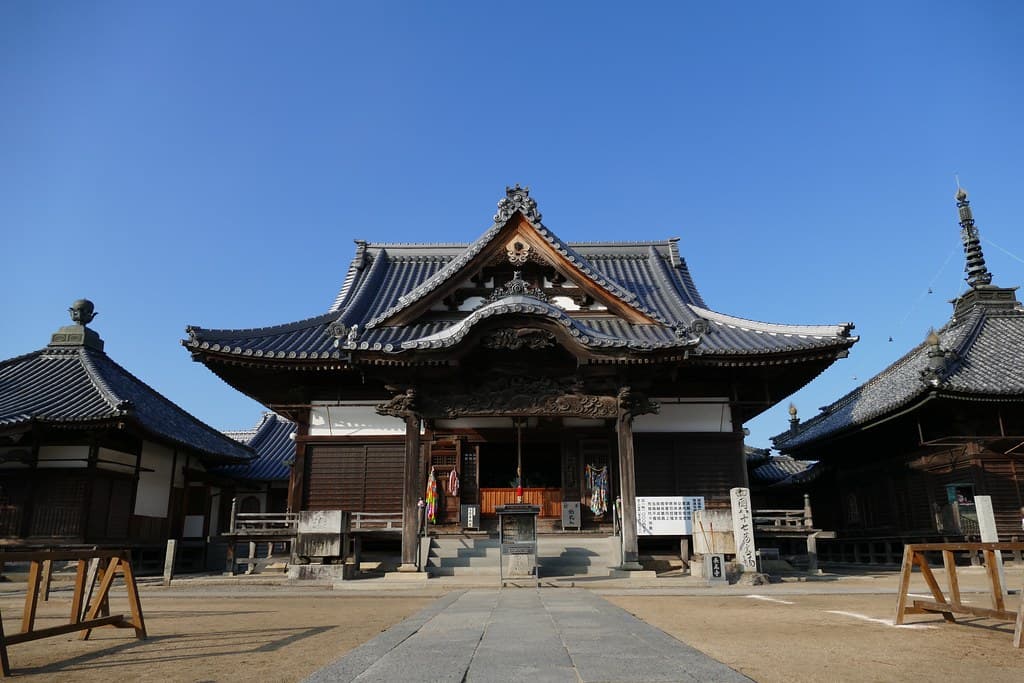
Image of Nagao-ji (長尾寺). Image source
Station 87 of 88
Shikoku 88 Temple PilgrimageVisit essentials
A quick read before you go
- Duration
- Thirty to forty-five minutes.
- Access
- Kotoden Nagao Line to Nagao Station, then a 5-minute walk.
Overview
Nagao-ji is Shikoku pilgrimage temple eighty-seven: eighty-six stops behind, one mountain temple ahead. Its Niō Gate stands under a great camphor tree, opening to a broad courtyard in a small Sanuki town. Many pilgrims describe an unexpected emotional softening; the mood is pause rather than arrival.
Tradition places its beginning before Kūkai. In 739, Gyōki dreamed of a luminous willow, carved Shō Kannon from it, and founded the temple. Kūkai is said to have prayed here before sailing to Tang China in the early ninth century, an association carried in the Daishi-dō rite. The Niō Gate dates to 1670. In 1681–1683, Takamatsu lord Matsudaira Yoritsune converted the Shingon temple to Tendai while designating the seven Sanuki Kannon temples; it has remained Tendai.
Nagao-ji's January Daihannya-e and Fukugaki-no-Gyōji, the “Lucky-Stick Ritual,” are famous in Sanuki and bring pilgrims and residents together to draw long bamboo poles for the year's blessings. The temple's integration into rice-cycle and New Year life is less marked at the route's mountain temples. Monks sometimes offer henro biscuits and tea as osettai. Its open courtyard, camphor, and awareness of the final climb make the stop a threshold.
Why this place is sacred
Nagao-ji's “thinness” lies in its openness. After ridge and mountain temples, the wide courtyard and great camphor invite pilgrims to pause before the 16-kilometre climb to Ōkubo-ji. The 1670 Niō Gate's three wooden ridge poles are architecturally unusual. Although the temple is Tendai, its Daishi-dō still receives the Kōbō Daishi mantra. Pilgrims often sit longer than planned at this second-to-last stop.
Originally a Shingon temple founded by Gyōki in 739 around the carving of a Shō Kannon from a willow tree seen in a dream. Used by Kūkai for prayers before his voyage to Tang China.
Rebuilt by the Ikoma clan during the Keichō era (1596–1615) and renamed Nagao Kannon-ji. The Niō Gate was built in 1670. In 1681–1683, Matsudaira Yoritsune converted the temple from Shingon to Tendai as part of the seven Sanuki Kannon designation, donating a pagoda. The temple has remained Tendai since while continuing as a Shikoku 88 stop.
Experience and orientation
Nagao Station on the Kotoden Nagao Line is a five-minute walk away; the drive from central Takamatsu takes about 40 minutes, and the pilgrim path from Shido-ji is approximately 7 km on quiet country roads.
The Niō Gate, beneath an enormous camphor and built with three unusual wooden ridge poles, opens to a broad courtyard. The Main Hall and Daishi-dō stand at the back of the compound. At both, standard henro practice is to bow at the gate, purify hands and mouth at the chōzuya, light a candle and three incense sticks, leave an osamefuda nameslip, and recite the Heart Sutra.
At the Main Hall, chant the Shō Kannon mantra, “On arorikya sowaka”; at the Daishi-dō, close with the Kōbō Daishi mantra. The chant style is Tendai, but the henro rite continues and the Daishi-dō remains the focal point of pilgrim devotion.
Monks sometimes offer biscuits and tea as osettai. Collect the nōkyō stamp at the office. Many pilgrims linger, knowing only Ōkubo-ji and its 16-kilometre climb remain.
The Niō Gate fronts the south side, beneath the great camphor tree. The wide courtyard runs north to the Main Hall and Daishi-dō. The 1681 pagoda donated by Matsudaira Yoritsune stands within the compound.
Context and lineage
Founding traditionally dated to 739, when the monk Gyōki dreamt of a luminous willow tree, carved an image of Shō Kannon from the wood, and founded the temple. Kūkai is said to have performed prayers here prior to his voyage to Tang China in the early ninth century. The temple was rebuilt by the Ikoma clan during the Keichō era (1596–1615) and renamed Nagao Kannon-ji. The Niō Gate was built in 1670.
In 1681–1683, Matsudaira Yoritsune converted the temple from Shingon to Tendai, designated it one of the seven Sanuki Kannon temples, and donated a pagoda.
Tendai Buddhism (Sanmon school) since 1681–83. Foundational Shingon tradition retained at the practitioner level through Daishi-dō practice and the Shikoku 88 framework.
Gyōki
Founder
Kūkai (Kōbō Daishi)
Pre-China prayer site
Matsudaira Yoritsune
Edo-period domain reformer; converted the temple to Tendai
Traditions and practice
Pilgrims follow the standard henro rite. After bowing at the gate and purifying at the chōzuya, a candle is lit and three sticks of incense placed at the Main Hall. An osamefuda nameslip is deposited, the Heart Sutra recited, and the Shō Kannon mantra (On arorikya sowaka) sounded. The same rite is repeated at the Daishi-dō, ending with the Kōbō Daishi mantra. The nōkyō calligraphy stamp is collected at the temple office.
Daily Tendai services in the Lotus Sutra-centred mode continue. The Daihannya-e and Fukugaki-no-Gyōji ('Lucky-Stick Ritual') in January draw strong local participation. Ongoing osettai of biscuits and tea is offered to passing henro by the temple and by local people.
Sit for a while in the courtyard before chanting. The temple invites pause more than activity. Pilgrims often use the visit to gather intentions for the final climb to Ōkubo-ji, sometimes writing a final osamefuda or revisiting the names of those they have walked for. If visiting in early January, the Fukugaki ritual is a striking encounter with local Sanuki religious life.
Tendai Buddhism (Sanmon school)
ActiveConverted from Shingon to Tendai in 1681–1683 under Takamatsu lord Matsudaira Yoritsune as part of his designation of the seven Sanuki Kannon temples. Remains Tendai today.
Daily Tendai services (Lotus Sutra-centred); pilgrim chanting at Main Hall and Daishi-dō.
Shingon Buddhism (historical)
HistoricalFoundational tradition. Kūkai is said to have performed rituals at this site before travelling to Tang China; pilgrims continue to chant the Kōbō Daishi mantra at the Daishi-dō.
Pilgrim Daishi-dō chanting persists.
Local Sanuki folk Buddhism (Fukugaki / 'lucky-stick' New Year ritual)
ActiveNagao-ji is locally famous for the Daihannya-e and the Fukugaki-no-Gyōji ('Lucky-Stick Ritual') held in the New Year period, when pilgrims and locals draw long bamboo poles to receive blessings for the year.
January Fukugaki and Daihannya rites, drawing crowds from across Sanuki.
Perspectives and open questions
Nagao-ji is read as a clear example of how Edo-period domain politics reshaped temple sectarian affiliation, and as the gathering threshold before the final temple.
Scholarly perspective
Nagao-ji is a clear example of how Edo-period domain politics reshaped temple sectarian affiliation: a Shingon temple absorbed into the Tendai network for political-administrative reasons under Takamatsu domain reform, while retaining its identity as a Shikoku 88 stop.
Living and traditional perspectives
Local Sanuki tradition treats Nagao-ji as a community temple woven into rice-cycle and New Year ritual life. The Fukugaki ritual is a folk-religious survival within Buddhist precincts.
Alternative interpretations
Despite the formal Tendai affiliation, the pilgrimage logic remains Shingon at the practitioner level: the Daishi-dō and the Kōbō Daishi mantra anchor the Shingon framework. Nagao-ji thus stands as a small living example of Tendai-Shingon ecumenism.
Open questions
Documentary evidence for Kūkai's pre-China rituals at this exact site is traditional rather than archival. Gyōki's willow-dream story is engi literature.
Plan your visit
Access and arrival
Kotoden Nagao Line to Nagao Station, then a 5-minute walk. By car, roughly 40 minutes from JR Takamatsu Station. The pilgrim foot path from Shido-ji (T86) is approximately 7 km along quiet country roads.
Available in the Nagao district and in central Takamatsu. There is no shukubō at Nagao-ji. Pilgrims walking on to Ōkubo-ji often plan an overnight stay near the Maeyama Dam interpretive centre.
Respectful visit
Modest dress. Pilgrim attire is common.
Permitted in the grounds. No flash inside the halls.
Incense, candles, coins, osamefuda. Nōkyō fee ¥500/book.
Do not climb on the Niō Gate or its supporting pillars. Treat the great camphor with respect.
Do not climb on the Niō Gate or its supporting pillars. Treat the great camphor with respect.
Current practical details
Address
653 Nagaonishi, Sanuki, Kagawa 769-2302, Japan
Phone
Hours
Hours, fees, and access can change — verify on the official source before you travel. Practical details last checked Jun 2026.
Location
Map loads as you approach this section.
Pilgrim reflections
A portrait of encounter, not a score
Pilgrims describe what they felt, how present they could become, and whether the place would shape a journey. There are no stars and no ranking of traditions.
No reviewed reflections yet
The first pilgrims can help describe the character of being here.
Share a reflection
Available after an account-backed “Been there.” Every reflection is reviewed before publication.
Watch deeper
Films, episodes, and recorded talks for visitors who want more context before or after a visit. Speculative and alternative-history entries are labelled as perspectives, not as sources for established claims.
Nearby sacred places
Explore other sacred places in the region. Proximity does not establish access or travel time; check each place’s guidance.



References
Sources consulted for this page. Source categories describe the publication, not a guarantee that every claim is verified. Traditional accounts and outside interpretations may differ.
- 01Nagao-ji — WikipediaencyclopediaOverview
- 02The 87th Temple Nagaoji Temple — Sanuki History & Culture GuideguideLocal cultural guide; covers Gyōki, Kūkai pre-China rituals, and 1681–83 conversion to Tendai
- 03Temple 87, Nagao-ji — Shikoku ToursguideTour-operator guide
- 04Nagaoji – Sanuki, Kagawa Prefecture — Henro.orgguidePilgrim reference
- 05Customs and Etiquette of the Shikoku Pilgrimage — Henro.orgguidePilgrim ritual
- 06Nagao-ji, the 87th Temple of the Shikoku Pilgrimage — Setouchi ExplorerblogUseful first-hand atmosphere details: camphor tree, Niō gate
Pilgrim glossary
- Kannon
- The bodhisattva of compassion, central to many East Asian pilgrimage routes.
- Sutra
- A canonical Buddhist scripture, often chanted as part of practice.
- Mantra
- A sound, word, or phrase repeated as part of meditation or ritual.
- Shingon
- An esoteric Japanese Buddhist school emphasizing ritual, mantra, and mandala practice.
- Tendai
- A Japanese Buddhist school based on the Lotus Sutra, foundational to many later traditions.
Share a photo
Help visitors recognize Nagao-ji. Every submission is reviewed before publication.