Ōkubo-ji
Kechigan — vow-fulfillment, where the staff is laid down at journey's end
Understand sacred places, explore living traditions, and learn how to engage respectfully with Pilgrim Map.
Access has not been verified. Check current local guidance before planning a visit.
Sanuki, Kagawa Prefecture, Japan
Read the sources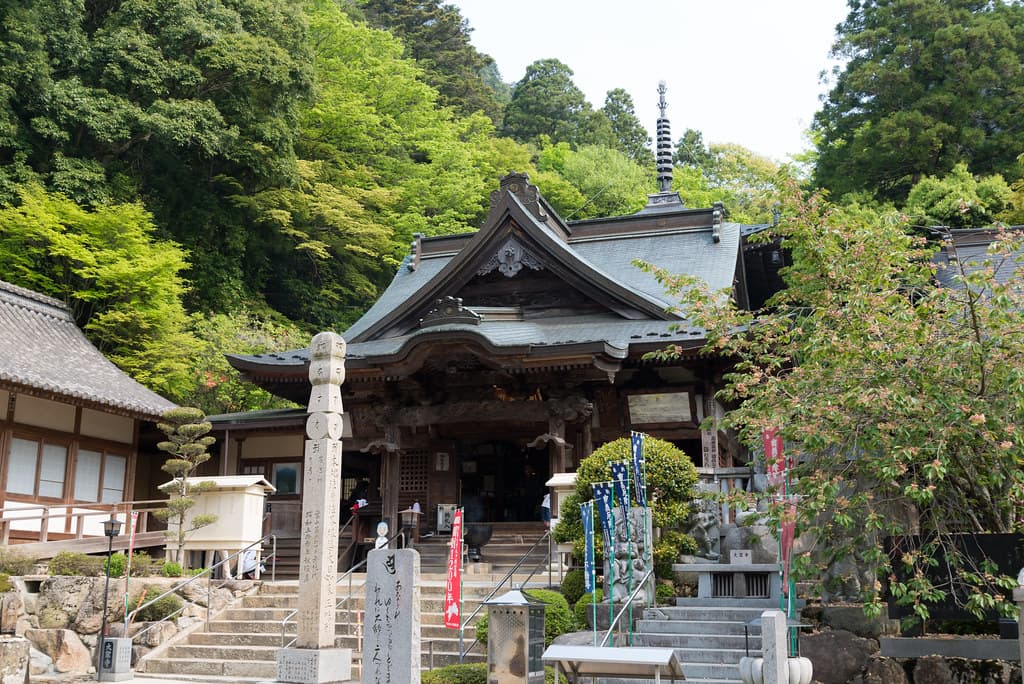
Image of Ōkubo-ji (大窪寺). Image source
Station 88 of 88
Shikoku 88 Temple PilgrimageVisit essentials
A quick read before you go
- Duration
- Sixty to ninety minutes for the temple itself.
- Access
- From JR Shido Station or JR Tokushima, take a bus to the Ōkubo-ji bus stop (~70–90 minutes from…
Overview
Ōkubo-ji is where many pilgrims lay down the Shikoku journey. After 1,200 km and eighty-seven temples, they reach the eighty-eighth in a remote valley between sword-shaped peaks; many weep and describe it as the circuit's most affecting temple. The complete Gyōki 717 and Kūkai 815 foundation tradition remains in the origin account. Kūkai's hidden Yakushi Nyorai holds a conch horn rather than a medicine jar, symbolizing the dharma's voice in all directions; a substitute is displayed.
The kongō-zue is treated as Kūkai's body under dōgyō ninin, 'two walking together.' Pilgrims may deposit staff and hat among thousands in the repository. Spring and summer burning releases Daishi-presence and accumulated attachments, and the office issues the kechigan-shō. Many return to Temple 1, Ryōzen-ji, to close the circle, then report completion at Kūkai's mausoleum on Mt. Kōya in Wakayama.
Why this place is sacred
The thinness at Ōkubo-ji is built from several layers at once: the geographic remoteness — a valley at 450 metres surrounded by sword-shaped peaks, far from any city; the unique conch-horn iconography of the Yakushi Nyorai; and the emotional weight of journey's end. Pilgrims often arrive after a long uphill walk from Maeyama Dam or by bus from Shido. The Niō Gate is broad.
The staff-repository hall is lined with thousands of kongō-zue, each marked with a pilgrim's name and the journey's accumulated grime. The valley closes the day's light early. Many pilgrims describe an exhaustion that is also a softening; the temple seems to take whatever has been carried.
Originally a small hermitage built by Gyōki in 717 around a heavenly revelation, then the site of Kūkai's cave practice on Mt. Nyotai in 815 and the consecration of the conch-Yakushi.
Repeatedly damaged and reconstructed across the medieval and early-modern periods. The kechigan (vow-fulfilling) function was consolidated as the Shikoku 88 circuit took its modern form; the staff-and-hat depositing tradition and the kechigan-shō certificate are key parts of the present-day pilgrim culture, whose institutional and ritual forms continue to evolve.
Experience and orientation
Reach the temple by bus from JR Shido Station or JR Tokushima; travel from Takamatsu with transfer is roughly 70–90 minutes. Driving from JR Takamatsu takes 60–70 minutes via Sanuki and Nagao roads. The approximately 16 km foot route from Nagao-ji offers a longer road via Maeyama Dam or shorter ridge path; mountain weather changes quickly.
At the Main Hall, bow, purify at the chōzuya, light one candle and three incense sticks, leave osamefuda, recite the Heart Sutra, and close with the Yakushi mantra (On korokoro sendari matōgi sowaka). Repeat the rite at the Daishi-dō and close with the Kōbō Daishi mantra. The honzon is hidden; a substitute is displayed. Completers may deposit staff and hat, receive kechigan-shō, return to Temple 1 Ryōzen-ji, and continue to Mt. Kōya.
The Niō Gate fronts the south side of the precinct. The Main Hall and Daishi-dō are at the centre. The staff-deposit hall stands within the precinct, its rows of kongō-zue immediately visible. The temple office issues the kechigan-shō. The valley walls of Mt. Yahazu and Mt. Nyotai close the precinct on either side.
Context and lineage
Traditionally founded in 717 when the monk Gyōki visited the area, received a heavenly revelation, and built a small hermitage. In 815, Kūkai practised in a cave on Mt. Nyotai, then built a hall in the valley hollow — the 'great hollow' that gives the temple its name — and enshrined a Yakushi Nyorai he had carved by his own hand.
The image holds a conch-shell horn rather than the standard medicine jar, an iconographic feature unique among Shikoku temples and said to symbolise the dharma's voice spreading in all directions. The temple was repeatedly damaged and reconstructed across the medieval and early-modern periods.
As the Shikoku 88 circuit took its modern form, Ōkubo-ji's role as the kechigan-no-fuda-sho — the vow-fulfilling final temple — was consolidated, with the staff-and-hat depositing practice, the kechigan-shō certificate, and the spring-and-summer burning ritual emerging as the embodied culmination of pilgrim culture.
Shingon Buddhism (Daikaku-ji branch lineage). Foundational to the modern Shikoku 88 pilgrimage as the kechigan (vow-fulfilling) final temple. Closely connected to the dōgyō ninin teaching — pilgrim and Daishi walking together — and to the kongō-zue staff tradition.
Gyōki
Founder
Kūkai (Kōbō Daishi)
Builder of the temple and carver of the conch-Yakushi
Yakushi Nyorai (conch-horn iconography)
Principal image
Traditions and practice
Pilgrims follow the standard henro rite. After bowing at the gate and purifying at the chōzuya, a candle is lit and three sticks of incense placed at the Main Hall. An osamefuda nameslip is deposited, the Heart Sutra recited, and the Yakushi Nyorai mantra (On korokoro sendari matōgi sowaka) sounded. The same rite is repeated at the Daishi-dō, ending with the Kōbō Daishi mantra.
At journey's end, pilgrims who wish to may deposit their kongō-zue and sugegasa in the staff repository, and collect the kechigan-shō certificate from the temple office.
Daily Shingon services continue. Pilgrim completions are received year-round. The accumulated staffs and hats are ritually burned in spring and summer. Many pilgrims continue from Ōkubo-ji back to Temple 1, Ryōzen-ji in Tokushima, to formally close the circle, and then to Mt. Kōya in Wakayama to report completion at Kūkai's mausoleum.
If you intend to deposit your staff, do so deliberately. The staff has been your second body for the route — the Daishi has walked with you in the form of the kongō-zue. The act is the practice. After the rite, sit in the precinct for as long as you need. The road back from this valley will be different from the road in.
Shingon Buddhism
ActiveFounded in Shingon and remains Shingon. As the kechigan-no-fuda-sho — the vow-fulfilling final temple of the Shikoku 88 — Ōkubo-ji is the institutional and emotional capstone of the pilgrimage.
Daily Shingon services; pilgrim chanting; staff-and-hat depositing ritual; issuance of the kechigan-shō completion certificate.
Kongō-zue / Kūkai's living-presence devotion (dōgyō ninin)
ActiveThe pilgrim staff, treated as Kūkai's body itself, is left at Ōkubo-ji upon completion — a ritual surrender of the journey's companion. Kūkai's traditional teaching that the pilgrim walks 'with two' — themselves and the Daishi — culminates here.
Staff deposit at the kongō-zue repository; sugegasa hat deposit; ritual burning in spring and summer.
Perspectives and open questions
Ōkubo-ji is read in three frames: as the institutional and ritual capstone of the Shikoku 88, as a deep folk-religious threshold, and as an esoteric site of Kūkai-presence and surrender.
Scholarly perspective
Ōkubo-ji is studied as the institutional and ritual capstone of the Shikoku 88 — both the practical end-point of the circuit and the site where embodied pilgrim culture is most concentrated, including the staff-and-hat depositing practice, the dōgyō ninin doctrine, and the kechigan-shō certification.
Living and traditional perspectives
Local Sanuki tradition treats the Mt. Nyotai–Mt. Yahazu valley as a sacred end-of-the-world threshold — the literal furthest point of the henro path before the symbolic return to the beginning. The conch-horn Yakushi is venerated as a healer of pilgrim exhaustion.
Alternative interpretations
Within Shingon esoteric reading, depositing the kongō-zue at Ōkubo-ji is the surrender of self into the dharmadhātu: the staff is the pilgrim's body, marked with a name and the journey's accumulated grime. The annual burning releases the pilgrim's accumulated attachments. The conch-Yakushi's horn proclaims the dharma to all directions, audible especially from the end of the journey.
Open questions
The historicity of Gyōki's heavenly revelation and Kūkai's cave practice on Mt. Nyotai is religious legend. The original Yakushi image is hibutsu and not displayed; its date is traditional rather than documentary. The precise annual schedule of the staff-and-hat burning ritual is not fully documented in English; it is generally noted as held in spring and summer.
Plan your visit
Access and arrival
From JR Shido Station or JR Tokushima, take a bus to the Ōkubo-ji bus stop (~70–90 minutes from Takamatsu via bus and transfer). By car, ~60–70 minutes from JR Takamatsu Station via the Sanuki and Nagao roads. The pilgrim foot path from Nagao-ji (T87) is ~16 km, with two route options: the longer mountain road via Maeyama Dam, or the shorter ridge path.
Limited near the temple; pilgrims often plan an overnight stay in Sanuki, near Maeyama Dam, or in central Takamatsu. Some pilgrims stay at the Maeyama Ohenro Kōryū Salon facilities or local minshuku. There is no shukubō at Ōkubo-ji.
Respectful visit
Pilgrim attire (white hakui, wagesa, sugegasa) is common at completion. Modest dress otherwise.
Permitted in grounds and the staff repository. No flash inside halls. Be considerate of other pilgrims who may be emotional.
Incense, candles, coins, osamefuda. Nōkyō fee ¥500/book. Kechigan-shō certificate fee separate.
Do not remove or rearrange deposited staffs and hats. Do not enter the burning area. Do not handle the displayed Yakushi substitute.
Do not remove or rearrange staffs and hats deposited by other pilgrims. Do not enter the burning area. Do not handle the displayed Yakushi substitute. Other pilgrims arriving at the eighty-eighth may be emotional; quiet is the most useful courtesy.
Current practical details
Address
96 Tawakanewari, Sanuki, Kagawa 769-2306, Japan
Phone
Hours
Hours, fees, and access can change — verify on the official source before you travel. Practical details last checked Jun 2026.
Location
Map loads as you approach this section.
Pilgrim reflections
A portrait of encounter, not a score
Pilgrims describe what they felt, how present they could become, and whether the place would shape a journey. There are no stars and no ranking of traditions.
No reviewed reflections yet
The first pilgrims can help describe the character of being here.
Share a reflection
Available after an account-backed “Been there.” Every reflection is reviewed before publication.
Watch deeper
Films, episodes, and recorded talks for visitors who want more context before or after a visit. Speculative and alternative-history entries are labelled as perspectives, not as sources for established claims.
Nearby sacred places
Explore other sacred places in the region. Proximity does not establish access or travel time; check each place’s guidance.


References
Sources consulted for this page. Source categories describe the publication, not a guarantee that every claim is verified. Traditional accounts and outside interpretations may differ.
- 01Ōkubo-ji — WikipediaencyclopediaOverview
- 02The 88th Temple Okuboji Temple — Sanuki History & Culture GuideguideLocal cultural guide; founding by Gyōki, Kūkai's cave practice, conch-horn Yakushi
- 03Iouzan Henjyoukouin Okuboji – Shikoku 88 Temple Pilgrimage — Shikoku 88 Temple Pilgrimage ReizōkaiofficialOfficial pilgrimage site
- 04Okuboji – Sanuki, Kagawa Prefecture — Henro.orgguidePilgrim reference
- 05Kongō-zue — WikipediaencyclopediaDefinitive overview of the pilgrim staff and its Kūkai symbolism
- 06Customs and Etiquette of the Shikoku Pilgrimage — Henro.orgguidePilgrim etiquette
- 07Sayonara Henro: Okuboji Temple 88 of the Shikoku Pilgrimage — Japan TravelguideFirst-hand account of completion ritual and kechigan-shō
Pilgrim glossary
- Honzon
- The principal Buddhist deity enshrined as a temple's central object of worship.
- Sutra
- A canonical Buddhist scripture, often chanted as part of practice.
- Mantra
- A sound, word, or phrase repeated as part of meditation or ritual.
- Dharma
- The teachings of the Buddha; also the universal law underlying them.
- Shingon
- An esoteric Japanese Buddhist school emphasizing ritual, mantra, and mandala practice.
- Zen
- A Japanese Buddhist school emphasizing seated meditation and direct insight.
Share a photo
Help visitors recognize Ōkubo-ji. Every submission is reviewed before publication.