Konzō-ji
A Tendai birthplace on a Shingon route
Understand sacred places, explore living traditions, and learn how to engage respectfully with Pilgrim Map.
Access has not been verified. Check current local guidance before planning a visit.
Zentsūji, Kagawa Prefecture, Japan
Read the sources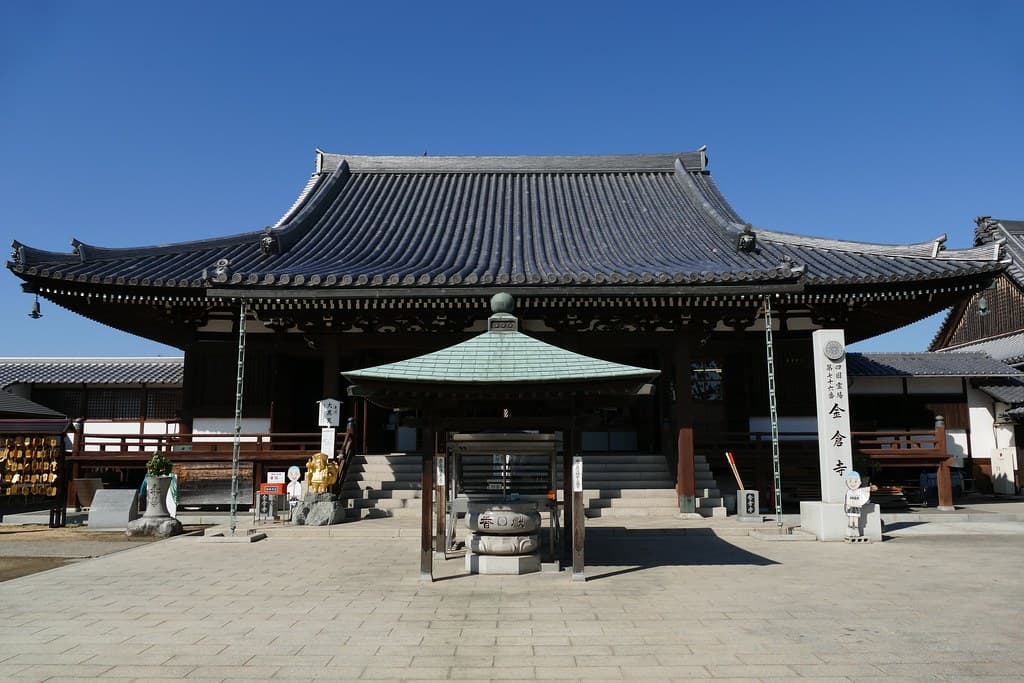
Image of Konzō-ji (金倉寺). Image source
Station 76 of 88
Shikoku 88 Temple PilgrimageVisit essentials
A quick read before you go
- Duration
- 30–45 minutes for the precinct including the Kishimojin Hall.
- Access
- Zentsūji City, Kagawa; close to JR Konzōji Station on the Dosan Line.
Overview
Konzō-ji is unusual among the eighty-eight Shikoku temples: it belongs to Tendai Jimon-shū rather than Shingon. Chishō Daishi Enchin (814–891), founder of that Tendai branch and fifth abbot of Enryaku-ji on Mt Hiei, was born here. Like Kūkai, he trained in esoteric Buddhism at Qinglong Temple in Chang'an, then returned to rebuild his family temple on its Chinese model and carve the Yakushi Nyorai still enshrined as honzon.
The site began earlier as Jizaiōdō, built in 774 by Enchin's grandfather Wake Dōzen. It became the government temple Dōzenji in 851 and later Konzō-ji. Tradition calls Enchin's childhood self Nichidōmaru: at age two a halo is said to have shone from him, and at five Kishimojin (Hāritī) appeared and foretold his priestly future. A Kishimojin Hall preserves that story and remains a place of women's and family blessings, especially for safe childbirth and child protection.
For pilgrims accustomed to Kūkai, the temple presents Enchin as a complementary Chinese-trained founder of another esoteric lineage. Their Saeki-family connection, rather than a later overlay, explains Konzō-ji's place on the route. A thirty-to-forty-five-minute visit includes standard henro liturgy at the main hall and Daishi-dō, with a separate brief offering at the Kishimojin Hall for those carrying family intentions.
Why this place is sacred
Konzō-ji's atmosphere comes from holding two lineages in one precinct without forcing them into a single narrative. The main hall preserves Enchin's Yakushi Nyorai and the Tendai Jimon line he founded. The Daishi-dō receives standard Shikoku Henro liturgy for Kūkai. The Kishimojin Hall holds the founding vision of a five-year-old child receiving a goddess. Each layer is acknowledged but kept distinct.
Pilgrims raised on the standard Kūkai-centred henro narrative often find Konzō-ji a corrective surprise: Heian esotericism had two great Chinese-trained masters, both with deep roots in Sanuki Province, and the Shikoku route quietly preserves that doubled origin. The thinness here is the absence of polemic — two traditions rest in the same ground without competing.
Built in 774 by Wake Dōzen as Jizaiōdō; rebuilt by his grandson Enchin on his return from Tang China and modelled on Qinglong Temple in Chang'an. Renamed Dōzenji in 851 as a government temple, then Konzō-ji.
Sengoku-period fires destroyed 132 sub-halls; the surviving precinct preserves the main lineage but at reduced scale. The temple operates today under Tendai Jimon-shū with full reception of Shikoku pilgrims following the Shingon-style henro liturgy.
Experience and orientation
Konzō-ji is reached easily from JR Konzōji Station or by car within Zentsūji City. The precinct opens flat and broad, with a dignified main hall toward the centre and the Daishi-dō to the side. The standard henro liturgy proceeds as elsewhere on the route — bell, incense, candle, osamefuda, Heart Sutra — at both halls.
The addition specific to Konzō-ji is the Kishimojin Hall, set toward the rear of the precinct. The hall is smaller than the main one and quieter; pilgrims, often women, approach with family intentions — safe childbirth, the wellbeing of children, the recovery of a relative. A brief offering and a moment of silence are common. The Tendai lineage is expressed elsewhere through the morning service, when sutra chanting (notably the Lotus Sutra) follows Tendai rather than Shingon patterns.
Most henro do not attend the morning service; they receive the nōkyō stamp at the office and continue toward Temple 77 Dōryū-ji to the north. For visitors interested in the dual-lineage aspect of the site, lingering at the Enchin birth-site memorial near the main hall opens the site's specific weight.
Enter the gate, complete liturgy at the main hall (Yakushi-dō) and the Daishi-dō. Continue to the Kishimojin Hall toward the rear of the precinct for a brief offering before receiving the nōkyō stamp.
Context and lineage
Wake Dōzen built the original Jizaiōdō hall in 774 (5th year of Hōki). His grandson Enchin was born here in 814; at age two a halo is said to have shone from his body, and at five the goddess Kishimojin appeared and predicted his vocation. Enchin trained at Enryaku-ji on Mt Hiei, travelled to Tang China, and on his return rebuilt the temple modelled on Qinglong (Blue Dragon) Temple in Chang'an. He carved the Yakushi Nyorai still enshrined as honzon.
The temple was renamed Dōzenji as a government temple in 851 and later became Konzō-ji.
Tendai Jimon-shū (Tendaijimon-shū) — one of very few non-Shingon temples on the Shikoku 88 route. Pilgrims also follow standard Shikoku Henro Shingon-style liturgy at the Daishi-dō.
Chishō Daishi Enchin
Founder of Tendai Jimon-shū; born here
Wake Dōzen
Original founder; Enchin's grandfather
Kishimojin (Hāritī)
Tutelary deity
Yakushi Nyorai (Medicine Buddha)
Honzon (principal image)
Traditions and practice
At the main hall (Yakushi-dō): bell, candle, three incense sticks, osamefuda, coin, Heart Sutra, and the Yakushi mantra. Repeat at the Daishi-dō for Kūkai. Receive nōkyō at the stamp office. Tendai-affiliated devotees may add Lotus Sutra recitation; Shikoku henro generally do not.
Daily Tendai morning services with Lotus Sutra chanting; reception of pilgrims; periodic blessings tied to the Kishimojin cult, particularly for safe childbirth and child rearing.
Plan thirty to forty-five minutes. Visit the Kishimojin Hall after the standard liturgy. If carrying family intentions — childbirth, children's wellbeing — bring those to the Kishimojin offering rather than to the main hall.
Tendai Jimon Buddhism (Tendaijimon-shū)
ActiveOne of very few non-Shingon temples on the Shikoku 88 route. The temple is the birthplace of Chishō Daishi Enchin (814–891), founder of the Jimon branch of Tendai and 5th abbot of Enryaku-ji on Mt Hiei.
Tendai liturgy with Lotus Sutra chanting; Kishimojin worship for safe childbirth and child protection.
Shikoku Henro Shingon devotion (overlay)
ActiveAlthough the resident order is Tendai, pilgrims observe standard Shingon-style Shikoku Henro liturgy at the Daishi-dō for Kūkai.
Heart Sutra recitation, osamefuda offering at main hall and Daishi-dō.
Perspectives and open questions
Konzō-ji is the clearest example on the Shikoku route of the doubled Heian origins of esoteric Buddhism in Japan; readings of the site mostly differ on how to interpret that doubling.
Scholarly perspective
Enchin's birth at Konzō-ji is well attested in Tendai records. He was related to Kūkai through the Saeki family connections, which explains why a Tendai-affiliated site sits on a Shingon-dominated route — the temple precedes the standardisation of the pilgrimage and reflects family kinship rather than later doctrinal compromise.
Living and traditional perspectives
Tendai Jimon tradition reads Konzō-ji as the seedbed of its founding; Kishimojin is invoked as the protector who first marked Enchin's vocation. The Lotus Sutra orientation of the morning service preserves the school's distinct emphasis.
Alternative interpretations
The Kūkai/Enchin parallel is sometimes interpreted as the dual axis of Heian esotericism — Shingon's mandalic pole and Tendai's Lotus pole — both rooted in Sanuki Province. The Shikoku route's quiet inclusion of Konzō-ji preserves this doubling.
Open questions
The exact relationship between the original Jizaiōdō hall and the present Konzō-ji buildings is unclear; many records were lost in Sengoku-period fires when 132 sub-halls were destroyed.
Plan your visit
Access and arrival
Zentsūji City, Kagawa; close to JR Konzōji Station on the Dosan Line. On-site car parking. Flat walking from the station.
Pilgrim minshuku and small hotels in Zentsūji City; Temple 75 Zentsū-ji offers shukubō by reservation.
Respectful visit
Modest dress. Pilgrim hakui jacket welcomed but not required.
Permitted in the outdoor precinct. Ask before photographing inside halls. Avoid photographing private prayer at the Kishimojin Hall.
Osamefuda at both the main hall (Yakushi-dō) and the Daishi-dō. Small offerings at the Kishimojin Hall are common.
Avoid loud conversation during chanting. Do not enter clergy-only zones.
Avoid loud conversation during chanting. The Tendai-style services follow a different liturgical pattern from Shingon; pilgrims joining a service should follow the leading priest rather than improvising.
Current practical details
Address
1160 Konzōjichō, Zentsuji, Kagawa 765-0031, Japan
Phone
Hours
Hours, fees, and access can change — verify on the official source before you travel. Practical details last checked Jun 2026.
Location
Map loads as you approach this section.
Pilgrim reflections
A portrait of encounter, not a score
Pilgrims describe what they felt, how present they could become, and whether the place would shape a journey. There are no stars and no ranking of traditions.
No reviewed reflections yet
The first pilgrims can help describe the character of being here.
Share a reflection
Available after an account-backed “Been there.” Every reflection is reviewed before publication.
Watch deeper
Films, episodes, and recorded talks for visitors who want more context before or after a visit. Speculative and alternative-history entries are labelled as perspectives, not as sources for established claims.
Nearby sacred places
Explore other sacred places in the region. Proximity does not establish access or travel time; check each place’s guidance.


References
Sources consulted for this page. Source categories describe the publication, not a guarantee that every claim is verified. Traditional accounts and outside interpretations may differ.
- 01Keisokuzan Hodoin Konzoji – Shikoku 88 Temple Pilgrimage — Shikoku 88 Temple ReijokaiofficialOfficial temple-association entry.
- 02The 76th Temple Konzoji Temple — Sanuki History & Culture GuideguideDetailed founding and Enchin biography.
- 03Temple 76, Konzōji — Tourism ShikokuofficialGovernment tourism portal.
- 04Konzoji – Zentsuji, Kagawa Prefecture — Henro.orgguidePilgrim community reference.
- 05Customs and Etiquette of the Shikoku Pilgrimage — Henro.orgguideEtiquette and visiting hours.
- 0676 Konzoji Temple — Shikoku Pilgrimage NewsguideVisitor info and history.
- 07Enchin — Japanese Wiki CorpusencyclopediaBiography of Chisho Daishi.
Pilgrim glossary
- Honzon
- The principal Buddhist deity enshrined as a temple's central object of worship.
- Sutra
- A canonical Buddhist scripture, often chanted as part of practice.
- Mantra
- A sound, word, or phrase repeated as part of meditation or ritual.
- Shingon
- An esoteric Japanese Buddhist school emphasizing ritual, mantra, and mandala practice.
- Tendai
- A Japanese Buddhist school based on the Lotus Sutra, foundational to many later traditions.
- Zen
- A Japanese Buddhist school emphasizing seated meditation and direct insight.
Share a photo
Help visitors recognize Konzō-ji. Every submission is reviewed before publication.