Motoyamaji Temple, Motoyama
Where the fierce Horse-Headed Kannon guards the path to nirvana on a temple built in a single night
Understand sacred places, explore living traditions, and learn how to engage respectfully with Pilgrim Map.
Access has not been verified. Check current local guidance before planning a visit.
Mitoyo, Kagawa Prefecture, Japan
Read the sources
Visit essentials
A quick read before you go
- Duration
- 30 minutes to 1 hour for a thoughtful visit
- Access
- Open 7:00 AM - 5:00 PM.
Overview
At the entrance to Sanuki Province, where the Saita River flows past ancient foundations, stands Motoyamaji Temple - the 70th station on the Shikoku 88 Temple Pilgrimage. Here begins the final stage of the journey: the 'entering nirvana' (nehan) portion of the pilgrimage, where temples 66 through 88 guide the pilgrim toward spiritual completion.
Legend tells that in 807 CE, by order of Emperor Heijo, the great master Kobo Daishi visited this site. In a single night, he built the entire temple and carved its principal image: Bato Kannon, the Horse-Headed Kannon. This fierce form of compassion, with a horse head emerging from its crown, is unique among the 88 temples - nowhere else on the pilgrimage will you encounter this wrathful expression of enlightened care.
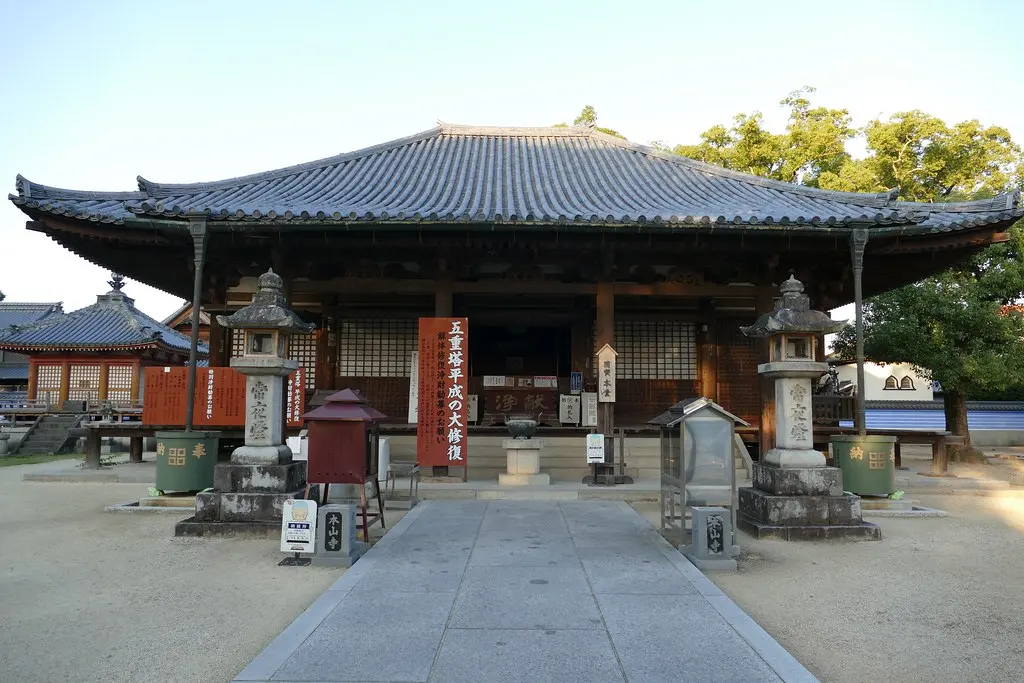
The main hall (hondo) that stands today dates to 1300 CE, rebuilt in the elegant Nara style during the Kamakura period. This nearly 700-year-old structure has been designated a National Treasure - the only such designation among the 88 temples' main halls. Its survival through centuries of change testifies to something protected here.
That protection revealed itself dramatically during the Tensho era (1592-1598). When soldiers from Chosokabe's army attacked the temple, blood fell from the right hand of the Amida Nyorai statue. The warriors fled in terror. The statue became known as 'Tachiuke no Amida' - the Amida who receives the sword. The temple survived.
Today, the five-story pagoda rises as a landmark visible across the Saita River plain, calling pilgrims to this station where fierce compassion guards the approach to liberation.
Why this place is sacred
The thinness of Motoyamaji reveals itself through contrasts. The gentle Saita River flows past foundations where fierce Bato Kannon resides. The wrathful horse-headed deity dwells in a temple known for miraculous protection. Speed of creation (one night) meets depth of endurance (over 1,200 years).
Bato Kannon's presence is central to the site's character. Unlike the serene forms of Kannon encountered elsewhere on the pilgrimage, the Horse-Headed manifestation appears wrathful. The horse head that crowns the deity represents the vigor with which compassion pursues liberation for all beings - including those suffering in the animal realm. This is not gentle care but fierce determination to overcome every obstacle to awakening.
The temple's placement in the 'entering nirvana' portion of the pilgrimage (temples 66-88) adds another dimension. Pilgrims who reach Motoyamaji have walked far - both physically and spiritually. The fierce compassion of Bato Kannon arrives not as the journey begins but as it nears completion, suggesting that the final stages of awakening require not softness but intensity.
The miracle of the bleeding Amida statue reinforces the sense that something here watches, protects, and intervenes. Temples do not survive centuries by accident. The National Treasure main hall, nearly 700 years old, stands because something has kept it standing.
Motoyamaji was established by Kobo Daishi as a station on what would become the Shikoku 88 Temple Pilgrimage. Originally named Chofukuji, the temple was intended to enshrine Bato Kannon's fierce compassion along the pilgrim's path - specifically at the transition point between the 'awakening of wisdom' (hannya) and 'entering nirvana' (nehan) stages of the journey.
The temple's evolution from Chofukuji to Motoyamaji (Honzan-ji) came after the miracle of the bleeding Amida statue. The Kamakura-period reconstruction created the main hall that stands today as a National Treasure. The five-story pagoda was rebuilt in 1910. Through these changes, the essential purpose - enshrining Bato Kannon's fierce compassion on the path to nirvana - has remained constant.
Experience and orientation
Motoyamaji announces itself from a distance. The five-story pagoda rises above the Sanuki plain, visible from across the Saita River - a beacon for pilgrims who have walked from Temple 69 or who approach from the train station.
The temple's Nio Gate introduces another distinctive element. Unlike most temple gates built in a single architectural style, this gate combines three traditions: Wayo (Japanese), Karayo (Chinese/Song), and Daibutsuyo (Great Buddha style). This eclecticism hints at the temple's character - a place where different streams flow together.
Passing through the gate, pilgrims enter grounds where the nearly 700-year-old main hall commands attention. The Kamakura-period Nara-style architecture embodies elegance and solidity. This is the only National Treasure main hall among the 88 temples - a distinction worth pausing to appreciate.
Inside, Bato Kannon waits. The Horse-Headed Kannon is not always on display - some principal images are hidden (hibutsu) - but statuary throughout the grounds references this unique deity. Life-size horse statues appear in unexpected places, reminding visitors of the Kannon's distinctive form.
The temple's atmosphere tends toward peaceful despite Bato Kannon's fierce nature. Perhaps the ferocity has done its work, clearing the space of obstacles. Or perhaps the centuries of pilgrim devotion have softened the edges. Either way, pilgrims often report a sense of protection here, of being watched over by something powerful yet benevolent.
Motoyamaji stands in Mitoyo City, Kagawa Prefecture, along the Shikoku 88 Temple Pilgrimage route. It lies approximately 2 kilometers from JR Motoyama Station. Temple 69 (Kannonji) is approximately 9 kilometers to the southeast; Temple 71 (Iyadaniji) is approximately 12 kilometers to the west.
Context and lineage
In 807 CE, by order of Emperor Heijo, the great master Kobo Daishi traveled to this site in Sanuki Province. According to temple legend, he built the entire complex in a single night. He carved the principal image himself: Bato Kannon, the Horse-Headed Kannon. The temple was originally named Chofukuji.
Centuries later, during the Tensho era (1592-1598), the temple faced destruction. Soldiers from Chosokabe's army attacked the head priest inside the main hall. But then something impossible occurred: blood fell from the right hand of the Amida Nyorai statue. The warriors, terrified by this miracle, fled without completing their destruction. The statue became known as 'Tachiuke no Amida' - the Amida who receives the sword. The temple was renamed Honzan-ji (Motoyamaji).
Motoyamaji belongs to the Shingon Buddhist tradition, founded by Kobo Daishi himself. As the 70th temple on the Shikoku pilgrimage, it represents the transition into the 'entering nirvana' stage of the journey. The temple maintains the distinctive Bato Kannon veneration that sets it apart from all other temples on the pilgrimage route.
Kobo Daishi (Kukai)
Temple founder
Traditions and practice
Traditional practice at Motoyamaji follows the Shikoku pilgrimage protocol: ritual purification at the water basin, approach to the main hall, prayer and sutra recitation, offering of incense, prayer at the Daishido (hall dedicated to Kobo Daishi), and receiving the nokyocho (pilgrimage stamp). The temple's unique focus on Bato Kannon adds distinctive prayers for protection and liberation from suffering.
Contemporary practice maintains the pilgrimage rituals. Pilgrims receive their stamps, offer prayers, and continue on the path. The temple's National Treasure main hall receives visitors who appreciate both its spiritual and historical significance. The life-size horse statues scattered through the grounds serve as reminders of Bato Kannon's distinctive form.
Visitors seeking spiritual experience at Motoyamaji might approach with awareness of the temple's placement in the 'entering nirvana' portion of the pilgrimage. Even those not completing the full 88 temples can enter this final stage mindfully. Consider Bato Kannon's fierce compassion - not gentle comfort but vigorous determination to overcome obstacles to liberation. What obstacles in your own life require fierce rather than gentle care?
Shingon Buddhism / Shikoku Pilgrimage
ActiveMotoyamaji was founded by Kobo Daishi in 807 by order of Emperor Heijo. As Temple 70 of the Shikoku 88 Temple Pilgrimage, it falls within the 'entering nirvana' (nehan) stage of the journey (temples 66-88). The temple is unique for enshrining Bato Kannon (Horse-Headed Kannon) as its principal image - the only such temple on the pilgrimage.
Pilgrimage rituals, prayer to Bato Kannon, receiving nokyocho stamps, Buddhist services
Perspectives and open questions
Motoyamaji's unique position on the pilgrimage and its Horse-Headed Kannon invite multiple interpretations.
Scholarly perspective
Scholars recognize Motoyamaji's Kamakura-period main hall as an outstanding example of Nara-style architecture, justifying its National Treasure designation. The temple's unique dedication to Bato Kannon among the 88 temples reflects the diversity of Buddhist devotion on the pilgrimage route. The Nio Gate's combination of three architectural styles demonstrates the sophisticated eclecticism of medieval Japanese temple architecture.
Living and traditional perspectives
In Buddhist teaching, Bato Kannon uses fierce appearance to overcome obstacles to liberation. The horse head atop the deity's crown symbolizes the vigor with which compassion pursues liberation for all beings - especially those suffering in the animal realm. The temple's placement in the 'entering nirvana' portion of the pilgrimage suggests that fierce determination is needed in the final stages of the spiritual journey.
Open questions
The details of the single-night construction legend remain mysterious - what kind of power could build an entire temple in hours? The origin and mechanics of the bleeding Amida miracle are unexplained. Why Kobo Daishi chose Bato Kannon for this specific temple, when other forms of the deity might have served, is not recorded.
Plan your visit
Access and arrival
Open 7:00 AM - 5:00 PM. Free admission. Located approximately 2 kilometers from JR Motoyama Station. Walking distance along the pilgrimage route from Temple 69 (9 km) and to Temple 71 (12 km).
Lodging available in the Sanuki region; temple stays possible at some pilgrimage temples along the route
Respectful visit
Traditional pilgrimage attire—a white coat, conical hat, and walking staff—is respected but not required; respectful casual attire is acceptable. Shoes are removed when entering buildings.
Exterior photography generally permitted; interior restrictions may apply. Be mindful of pilgrims engaged in worship.
Coins for offering boxes, incense for offering.
{"Remove shoes when entering buildings","Maintain quiet in worship areas","Follow Shikoku pilgrimage etiquette if participating","Inner sanctuary areas may be restricted"}
The temple is an active pilgrimage site. During peak seasons, many pilgrims pass through. The main hall's status as a National Treasure means special care should be taken in its presence.
Location
Map loads as you approach this section.
Pilgrim reflections
A portrait of encounter, not a score
Pilgrims describe what they felt, how present they could become, and whether the place would shape a journey. There are no stars and no ranking of traditions.
No reviewed reflections yet
The first pilgrims can help describe the character of being here.
Share a reflection
Available after an account-backed “Been there.” Every reflection is reviewed before publication.
Nearby sacred places
Explore other sacred places in the region. Proximity does not establish access or travel time; check each place’s guidance.

References
Sources consulted for this page. Source categories describe the publication, not a guarantee that every claim is verified. Traditional accounts and outside interpretations may differ.
- 01The 70th Temple Motoyamaji Temple - Sanuki History & Culture Guide — Sanuki History & Culture GuidespiritualRegional history source
- 02Temple 70, Motoyamaji - Tourism Shikoku — Tourism ShikokuSource contextOfficial tourism information
- 03Temple 70, Motoyamaji — 88temples.infoguidePilgrimage information
- 04Temple No. 70 of the 88 Sacred Temples of Shikoku — Shikoku Pilgrimage NewsguidePilgrimage information
Pilgrim glossary
- Kannon
- The bodhisattva of compassion, central to many East Asian pilgrimage routes.
- Sutra
- A canonical Buddhist scripture, often chanted as part of practice.
- Shingon
- An esoteric Japanese Buddhist school emphasizing ritual, mantra, and mandala practice.
Share a photo
Help visitors recognize Motoyamaji Temple, Motoyama. Every submission is reviewed before publication.