Mangan-ji
Where the Genji clan prayed and Kintarō's tomb stands among the cedars
Understand sacred places, explore living traditions, and learn how to engage respectfully with Pilgrim Map.
Access has not been verified. Check current local guidance before planning a visit.
Hyogo Prefecture, Japan
Read the sources
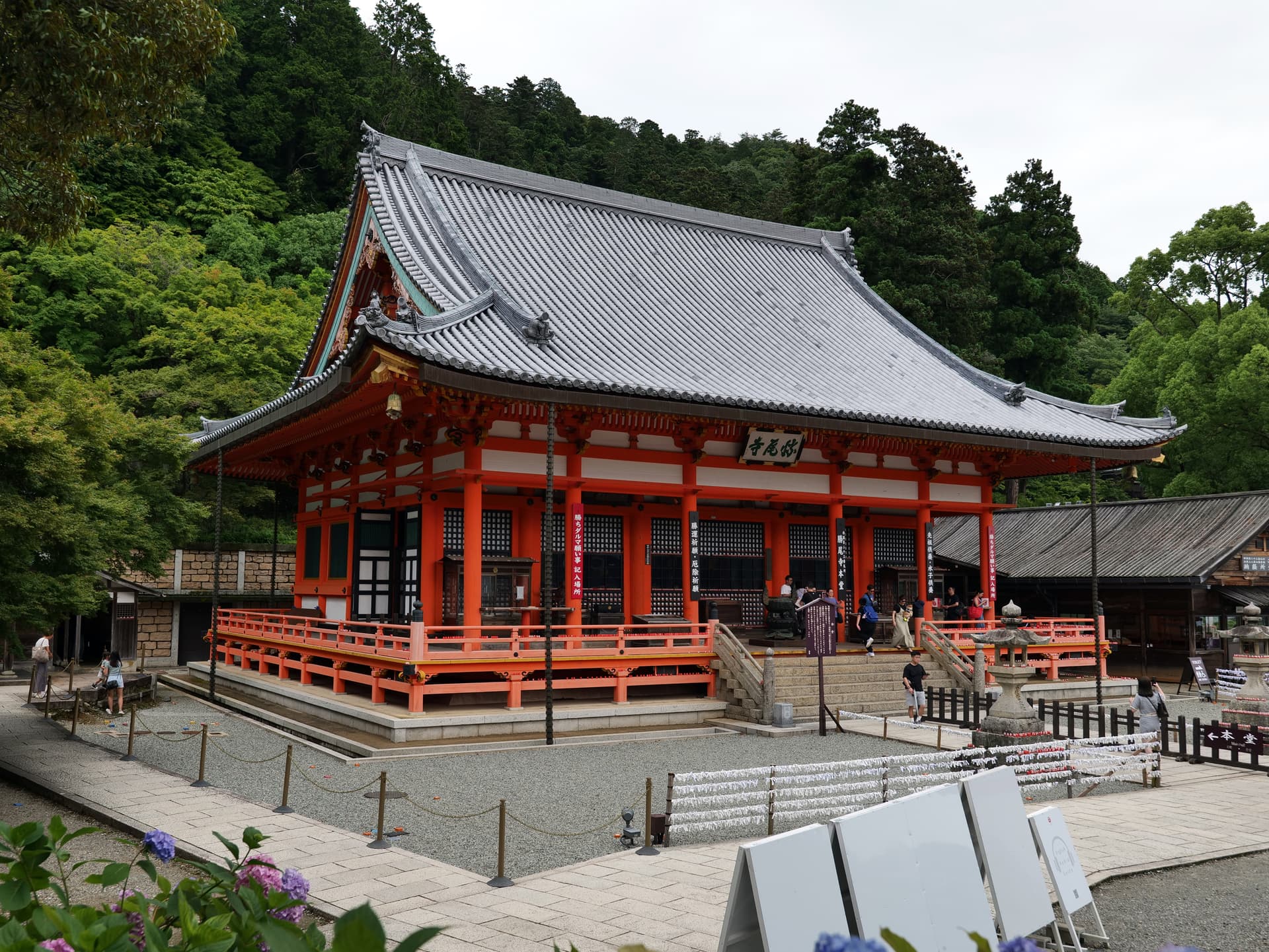
Image of Mangan-ji. Image source · Public Domain
Station 13 of 33
New Saigoku Kannon PilgrimageVisit essentials
A quick read before you go
- Duration
- 1 to 1.5 hours at Mangan-ji alone; half-day for the combined Mangan-ji and Tada Shrine…
- Access
- From Hankyu Takarazuka Line, transfer at Kawanishi-Noseguchi to local bus; alternatively from…
Overview
Mangan-ji means “Temple Where All Wishes Are Fulfilled”; Manju-ji is another reading of a name that announces its founding purpose as a vow-completion site. Emperor Shōmu's edict established it in the Nara-period Jinki era (724–728 CE) through the priest Shōdō, also traditionally credited with opening Mount Nikkō. The temple occupies a Kawanishi exclave surrounded by Takarazuka City, reached by a sudden, steep wooded approach to a high precinct overlooking the Settsu hills.
From 968 CE, when Minamoto no Mitsunaka (912–997) based the Seiwa-Genji warrior lineage at Tada, modern Kawanishi, Mangan-ji served as its family prayer temple. Mitsunaka is said to have carved a Bishamonten image and richly endowed the complex, which reached 49 sub-temples by the Muromachi period. Today it preserves the designated-cultural-property Senju Kannon (Sahasrabhuja, Thousand-Armed Kannon) and nine-storied stone pagoda; the Shoin garden is admired for spring satsuki azaleas.
Mangan-ji also holds the tomb of Sakata Kintoki, historical retainer of Mitsunaka's son Minamoto no Yorimitsu and the figure who became the red-skinned, bear-wrestling mountain boy Kintarō in folklore. Imperial founding, a thousand-year clan-prayer history, Senju Kannon devotion, and a folk-tale tomb thus meet in one precinct. The temple has served as New Saigoku #13 since 1932. It is not Tochigi's Mangan-ji, the eastern Japanese temple at Bandō #4.
Why this place is sacred
Most Japanese temples accumulate one or two strong threads of identity. Mangan-ji holds at least four. The Nara-period founding under Emperor Shōmu's edict by the priest Shōdō places the temple among the imperial-decree foundations of early Japanese Buddhism — a category that includes the Kokubun-ji provincial temples and the major Yamato establishments. The 10th-century Genji-clan adoption gave the temple a thousand years of warrior-aristocratic patronage. The Senju Kannon — wish-fulfilling Thousand-Armed Avalokiteśvara — provides the pilgrimage focus.
And the burial of Sakata Kintoki, the historical figure behind the folk-hero Kintarō, adds a layer of popular story that is typically unusual in formal pilgrimage temples.
The geography reinforces the layered quality. Mangan-ji sits in a Kawanishi exclave surrounded by Takarazuka City — administratively isolated, physically embedded in wooded hills above the Inagawa river plain. The approach climbs through cedars; the precinct opens onto a small main hall, the Kannon-dō, the Shoin garden, the nine-storied stone pagoda, and — at one edge — Kintoki's tomb.
Visiting families with children familiar with the Kintarō folktale often pause at the tomb longer than at the Kannon hall; pilgrims tracing samurai ancestry, especially Minamoto-descended lineages, find Mangan-ji a place of return. For general visitors, the layered legend-history-Kannon devotion produces a precinct that resists single-frame summary.
Founded in the Jinki era (724–728), Nara period, by imperial decree of Emperor Shōmu, as a vow-completion temple — a prayer site dedicated to fulfilling all wishes (mangan).
Adopted from 968 CE as the prayer temple of the Seiwa-Genji warrior clan after Minamoto no Mitsunaka established his base at Tada. The complex grew to 49 sub-temples by the Muromachi period, and the New Saigoku Kannon Pilgrimage role was established in 1932. The temple continues as a Kōyasan Shingon institution with active daily ritual.
Experience and orientation
From Hibarigaoka-Hanayashiki Station the bus climbs the wooded slopes north of Kawanishi proper. The bus stop sits a short walk below the temple gate; the final approach is on foot through cedars. The precinct opens at altitude — a contrast to the suburban valley below.
The main hall sits forward, with the Kannon-dō housing the Senju Kannon nearby; the Shoin garden, famed for its satsuki azaleas in May, opens to the side; the nine-storied stone pagoda anchors the rear of the precinct.
Kintoki's tomb sits at one edge. Approach is straightforward — a marked stone with offerings and small items left by visitors familiar with the Kintarō folktale. Children frequently leave small wrestling-related tokens. The historical Sakata Kintoki, retainer of Minamoto no Yorimitsu, is securely attested; the elaborated folk-hero Kintarō — the red-skinned mountain boy who wrestled bears — is a medieval-Edo accretion that has become the more famous version of his story.
For visitors with Minamoto-descended ancestry or interest in samurai history, Mangan-ji functions as a clan pilgrimage. The Tada Shrine — the Seiwa-Genji main clan shrine — sits within reach, and a half-day circuit pairing the two produces an unusually concentrated encounter with the warrior lineage that produced the Kamakura shogunate. The Kannon devotional thread runs in parallel rather than competing: pilgrims of the New Saigoku circuit visit the Senju Kannon in the Kannon-dō and receive their stamp at the office.
From the bus stop, walk up to the temple gate and enter the precinct. Begin at the main hall and Senju Kannon, then move through the Shoin garden, the nine-storied pagoda, and finally Kintoki's tomb. Pair with Tada Shrine for a Genji-clan circuit.
Context and lineage
Emperor Shōmu, having vowed to spread Buddhism through provinces, dispatched the monk Shōdō — the priest also traditionally credited with opening Nikkō and Mount Nantai — to found Mangan-ji in the Settsu hills as a place 'where all wishes are fulfilled'. In 968, Minamoto no Mitsunaka, head of the rising Seiwa-Genji warrior lineage, established his clan base at Tada (modern Kawanishi), took refuge at Mangan-ji, and made it the family prayer temple.
He is said to have carved its Bishamonten image himself. Sakata Kintoki, the historical retainer of Mitsunaka's son Minamoto no Yorimitsu who in folklore became Kintarō, is buried in the temple precinct.
Shingon Buddhism (Kōyasan branch). The temple is foundational among Settsu-region Shingon establishments and a long-standing prayer site of the Seiwa-Genji clan.
Traditions and practice
Senju Kannon devotion at the Kannon-dō is the temple's primary pilgrimage focus. Goma fire rituals on the Kōyasan Shingon pattern continue periodically. Genji-clan ancestor memorial services connect the temple to its 1,000-year warrior-aristocratic patronage. Sakata Kintoki memorial observances acknowledge the folk-cultural layer.
Daily Kōyasan Shingon liturgy continues. Pilgrim stamps for the New Saigoku #13 station and the Kawanishi-Settsu Kannon circuit are issued at the office. The Shoin azalea garden opens annually in May during peak satsuki bloom. Tada Shrine and Mangan-ji are jointly visited by pilgrims tracing Seiwa-Genji history.
Begin at the main hall and Senju Kannon — this is the formal pilgrimage focus. Move slowly through the Shoin azalea garden if visiting in May, or the wooded approach in autumn. Pause at Kintoki's tomb regardless of season; the layered legend-history of his burial here is one of the temple's distinctive features. Pair with Tada Shrine for a complete Seiwa-Genji clan circuit.
Shingon Buddhism (Kōyasan branch)
ActiveMangan-ji is one of the foundational Settsu-region Shingon temples, founded under imperial decree of Emperor Shōmu in the Nara period. Its name 'Mangan-ji' literally means 'Temple Where All Wishes Are Fulfilled', reflecting its purpose as a prayer site for vow-completion. From the 10th century it became the family prayer temple of the Seiwa-Genji (Minamoto) clan after Minamoto no Mitsunaka established his base at Tada in 968.
Perspectives and open questions
Mangan-ji's record combines well-documented imperial founding, securely traceable Seiwa-Genji clan patronage, and a layered folk-cultural element around the Sakata Kintoki tomb. The Kintarō folk-hero accretion is medieval-Edo elaboration on a historical figure.
Scholarly perspective
Mangan-ji's 8th-century founding under Shōdō and 10th-century Genji-clan re-endowment are documented in temple records and clan histories. The Sakata Kintoki figure is securely historical as a retainer of Minamoto no Yorimitsu. The Senju Kannon and the nine-storied stone pagoda are nationally and prefecturally designated cultural properties. The Kintarō folk-tale layer is medieval-Edo elaboration on the historical Kintoki.
Living and traditional perspectives
Within Shingon devotion, Mangan-ji is treated as a particularly powerful wish-fulfillment site — the literal meaning of its name reinforcing its function. Senju Kannon's thousand arms are read as the literal capacity to extend assistance in any direction.
Alternative interpretations
Some folklore-oriented visitors read the convergence of warrior-clan, mountain-strongman, and Senju Kannon at this site as a single mountain-god mandala in which warrior virtue and protective mercy occupy the same field. The unusual exclave geography — administratively Kawanishi but physically embedded in Takarazuka — has occasionally been cited as a structural sign of the temple's old-stratum identity.
Open questions
How much of the original 8th-century structure survived through later rebuildings is unclear; the original Sakata Kintoki burial contents have not been excavated, leaving the question of the burial's exact contents open. The transition from the historical Kintoki to the elaborated Kintarō folk-hero remains a topic of ongoing folklore scholarship.
Plan your visit
Access and arrival
From Hankyu Takarazuka Line, transfer at Kawanishi-Noseguchi to local bus; alternatively from Hibarigaoka-Hanayashiki Station via Hankyū bus (about 10 minutes). Free parking available. The final approach from the bus stop is on foot through wooded slopes.
Day-trip access from Osaka or Kobe is straightforward. Limited local lodging in Kawanishi; most pilgrims base in Osaka or Takarazuka.
Respectful visit
Modest, comfortable clothing. Layered for variable weather. Comfortable shoes for the wooded approach and gravel paths.
Permitted outdoors; ask before photographing the Senju Kannon and other interior images.
Incense, saisen, pilgrim slips at the Kannon-dō.
Quiet near the Sakata Kintoki tomb | Do not step into the satsuki azalea beds
Quiet near Kintoki's tomb. Photography near interior images requires permission. Spring azalea garden visits should respect the planted areas; do not step into the beds.
Current practical details
Address
7-1 Manganjichō, Kawanishi, Hyogo 665-0891, Japan
Phone
Hours
Hours, fees, and access can change — verify on the official source before you travel. Practical details last checked Jun 2026.
Location
Map loads as you approach this section.
Pilgrim reflections
A portrait of encounter, not a score
Pilgrims describe what they felt, how present they could become, and whether the place would shape a journey. There are no stars and no ranking of traditions.
No reviewed reflections yet
The first pilgrims can help describe the character of being here.
Share a reflection
Available after an account-backed “Been there.” Every reflection is reviewed before publication.
Nearby sacred places
Explore other sacred places in the region. Proximity does not establish access or travel time; check each place’s guidance.



References
Sources consulted for this page. Source categories describe the publication, not a guarantee that every claim is verified. Traditional accounts and outside interpretations may differ.
- 01満願寺 (川西市) — Japanese Wikipedia — Wikipedia contributorsofficialHyōgo Pref., Kawanishi City, Manganji-chō; mountain name Shinshū-zan; Kōyasan Shingon-shū; honzon Senju Kannon (千手観音); founded Nara period under Emperor Shōmu by the monk Shōdō; Minamoto (Genji) clan prayer site; tomb of Sakata Kintoki (Kintarō) on the precinct; nine-storied pagoda.
- 02Mangan-ji — Hyogo Tourism (Official) — Hyogo Prefectural Tourism AssociationofficialSenju Kannon and nine-storied stone pagoda are nationally and prefecturally designated cultural properties; Sakata Kintoki tomb; Shoin garden famed for satsuki azaleas.
- 03Birthplace of the Seiwa Genji: Visiting Tada Shrine and Mangan-ji — att.JAPANguideConfirms Genji clan patronage from Minamoto no Mitsunaka (968 CE), Bishamonten image carved by Mitsunaka himself, and surrounding historical sites of the Seiwa Genji.
- 04Shinshū-zan Mangan-ji — Noseden Railway Spot Guide — Nose Electric Railway (Noseden)guideAccess information confirming Hibarigaoka-Hanayashiki Station bus connection.
Pilgrim glossary
- Kannon
- The bodhisattva of compassion, central to many East Asian pilgrimage routes.
- Mandala
- A symbolic diagram of the cosmos used in meditation and ritual.
- Shingon
- An esoteric Japanese Buddhist school emphasizing ritual, mantra, and mandala practice.
Share a photo
Help visitors recognize Mangan-ji. Every submission is reviewed before publication.