Enkō-ji (Myō-ō-in)
A medieval Shingon temple holding two National Treasures and a Kannon shown once every thirty-three years
Understand sacred places, explore living traditions, and learn how to engage respectfully with Pilgrim Map.
Access has not been verified. Check current local guidance before planning a visit.
Fukuyama, Hiroshima Prefecture, Japan
Read the sources
Visit essentials
A quick read before you go
- Duration
- 45–75 minutes for the temple alone; up to three hours including the Kusado Sengen archaeological…
- Access
- From JR Fukuyama Station on the Sanyō Shinkansen line, about 15 minutes by taxi or local bus to…
Overview
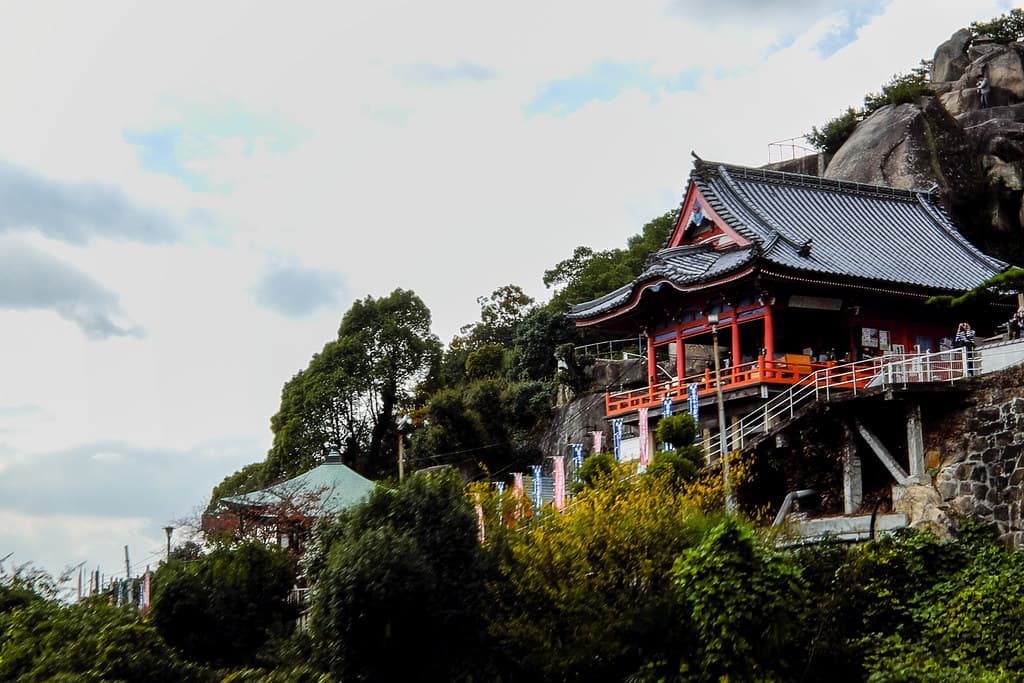
Enkō-ji Myō-ō-in is among the Chūgoku 33 route's most architecturally significant Kannon temples. Its 1321 main hall is the oldest surviving Japanese Buddhist hall in a singular blend of wa-yō, dai-butsu-yō, and zen-shū-yō, while its 1348 five-story pagoda is Japan's fifth-oldest National Treasure pagoda. Both arose with the adjacent Kusado Sengen river port, whose remains, called the “Pompeii of medieval Japan,” lie downhill.
Tradition credits Kūkai with placing a Kannon on Atago-yama in 807 CE; the original Ritsu temple was Saikō-zan Richi-in Jōfuku-ji. Edo reorganization established the present name and Daikakuji-ha Shingon affiliation, sustained by Mizuno and Abe patronage. The Eleven-Faced Kannon honzon, attributed to Dengyō Daishi (Saichō), is hibutsu: opened about once every thirty-three years, most recently November 1–4, 2024 and reportedly next around 2057. Here pilgrims encounter architecture itself as teaching.
Why this place is sacred
Enkō-ji Myō-ō-in's thinness rests on the unusual concentration of medieval craftsmanship still in active worship. The hondō and pagoda are not museum pieces but functioning ritual spaces — pilgrims enter the same wooden frame whose carpentry was completed in 1321 and 1348. The Japan-Chinese mixed-style architecture of the main hall is a unique survival; nothing else in Japan combines the same architectural vocabulary in the same proportions.
The thirty-three-year hibutsu cycle gives the Eleven-Faced Kannon honzon a quality of concealed presence that intensifies rather than diminishes the temple's gravity. The riverside cliff setting at the foot of Atago-yama provides the spatial framing that medieval temple-builders sought.
Founded as a Ritsu-school temple under Kūkai's foundation tradition in 807 CE, the original site served as a Kannon enshrinement for travellers passing through the medieval Kusado Sengen river port. The geomantic logic — Kannon overlooking the harbour — embedded the temple in the prosperity of the settlement below.
After the destruction of original structures, the present 1321 main hall and 1348 five-story pagoda emerged during the prosperous Kamakura-Nanbokuchō period of the Kusado Sengen river port. The Edo-period reorganisation under Mizuno and Abe lord patronage gave the temple its present 'Enkō-ji Myōō-in' name and Shingon Daikakuji-ha affiliation. The 1981 establishment of the Chūgoku 33 Kannon Pilgrimage placed the temple as #8.
Experience and orientation
From JR Fukuyama Station, take a taxi or local bus (~15 minutes) to the Atago-yama / Kusado Sengen area. The approach climbs gently from the river toward the temple precinct. Enter through the gate. The main hall (1321) presents itself first — pause and look at the proportions, the joinery, the eclectic combination of architectural styles: pillar bases in dai-butsu-yō, ceiling treatment in wa-yō, doorway elements in zen-shū-yō.
Inside, the Eleven-Faced Kannon honzon is concealed except during the thirty-three-year openings; the next opening is reportedly around 2057.
Walk to the five-story pagoda (1348). The pagoda is the fifth-oldest National Treasure pagoda in Japan; the five stories represent the five great elements (godai) — earth, water, fire, wind, void. Combine the temple visit with the Kusado Sengen archaeological park downhill, where the medieval river-port settlement that funded these buildings has been excavated and partially preserved. The combined visit takes a long morning or afternoon.
Begin at the main hall, then visit the five-story pagoda. Walk the precinct slowly. Forty-five to seventy-five minutes for the temple alone; longer if combining with the Kusado Sengen archaeological park.
Context and lineage
Kūkai is said to have placed a Kannon statue on Atago-yama in 807 CE while travelling through the region. The original temple was named Saikō-zan Richi-in Jōfuku-ji and belonged to the Ritsu sect. After loss of earlier structures, the present 1321 main hall and 1348 five-story pagoda emerged during the prosperous river-port era of the adjacent Kusado Sengen settlement. The 'Enkō-ji Myōō-in' name and Daikakuji-branch Shingon affiliation were established during the Edo-period reorganisation.
Shingon-shū Daikakuji-ha. Within the broader Shingon tradition, the Daikakuji branch traces from the Heian-period imperial Shingon centre at Daikakuji in Kyoto. The temple's pre-Edo Ritsu-school identity was reorganised into the Daikakuji-ha during the Edo-period restructuring.
Traditions and practice
Daily Eleven-Faced Kannon liturgy includes darani recitation and offerings at the main altar. Goma fire rites are performed in the Shingon esoteric mode for protective and purificatory ends. The thirty-three-year hibutsu opening (gokaihi) is the temple's principal periodic ritual event — the most recent opening was November 1–4, 2024. Annual pilgrimage and memorial services continue through the year.
Modern pilgrim hospitality, goshuin issuance, and public viewing of the National Treasure halls run year-round. The temple is a major architectural-pilgrimage destination as well as a Kannon devotional site, drawing both pilgrims and architectural-history visitors.
Pause at the gate to take in the main hall's eclectic architectural vocabulary. Light incense at the main altar facing the concealed Eleven-Faced Kannon. Walk to the five-story pagoda and circle it once. Receive the goshuin. Combine the visit with the Kusado Sengen archaeological park downhill if time allows.
Shingon-shū Daikakuji-ha Buddhism
ActiveEsoteric Buddhist temple whose architectural ensemble — main hall (1321) and five-story pagoda (1348) — are both National Treasures. The main hall is the oldest existing Japanese Buddhist hall built in a unique Japan-Chinese mixed style. The Eleven-Faced Kannon honzon is attributed to Dengyō Daishi (Saichō) and is hibutsu, shown approximately once every thirty-three years.
Chūgoku 33 Kannon Pilgrimage
ActiveEnkō-ji Myō-ō-in is Temple #8 of the modern Chūgoku 33 Kannon circuit, located near the Kusado Sengen archaeological site (a major medieval river-port settlement). The eighth station marks the route's transition from rural Okayama into the Inland-Sea cultural sphere of eastern Hiroshima.
Perspectives and open questions
Enkō-ji Myō-ō-in invites overlapping readings: as one of Japan's primary case studies in medieval Buddhist architecture, as a Kūkai-tradition Kannon enshrinement on a sacred mountain, and as the Chūgoku 33 station where the route's architectural and devotional registers converge.
Scholarly perspective
Japanese architectural-history scholarship treats Enkō-ji Myō-ō-in as one of the most important medieval Buddhist sites in western Japan. The hondō's eclectic Japan-Chinese mixed style is a primary case study in Japanese architectural history; no other surviving hall combines the same architectural vocabulary. The five-story pagoda's status as the fifth-oldest National Treasure pagoda in Japan places it among the country's principal pre-modern wooden structures.
Living and traditional perspectives
Local tradition holds Kūkai as the founder; the Kannon-on-Atago-yama story sanctifies the mountain itself. Within the broader Kūkai tradition, Atago-yama joins the network of mountains across western Japan whose sanctity is read through the founder's reputed travels.
Alternative interpretations
In Shingon mikkyō, the eleven faces of the honzon address every direction of suffering. The five-story pagoda's stories represent the five great elements (godai) — earth, water, fire, wind, void — making the pagoda itself a vertical mandala. The combined hondō-and-pagoda geometry enacts a doctrinal teaching in built form.
Open questions
Pre-Kamakura history is poorly documented; the surviving 1321 hondō represents the earliest physical evidence on the site. Detailed iconography of the hibutsu Kannon remains partial given the rarity of public viewings.
Plan your visit
Access and arrival
From JR Fukuyama Station on the Sanyō Shinkansen line, about 15 minutes by taxi or local bus to the Atago-yama / Kusado Sengen area. Mobile signal is reliable in this urban-fringe location. No specialised access arrangements required.
Standard accommodation in Fukuyama City within a short taxi ride. Wider options available in Onomichi (~30 minutes by train) for pilgrims combining stations #8 and #9 in a single trip.
Respectful visit
Modest, covered clothing with comfortable shoes for the stone steps.
Outer precinct OK; honzon photography prohibited even during openings.
Saisen at the main hall, incense at the appropriate stand, pilgrim stamp fee at the temple office.
Hibutsu accessible only at scheduled openings (next ~2057) | No photography of the Eleven-Faced Kannon honzon at any time | Quiet expected during liturgy | Careful walking around the National Treasure wooden structures
Hibutsu honzon is accessible only at scheduled openings (next around 2057). Photography of the honzon is prohibited even during openings. Quiet expected during liturgy. The slope from the road to the temple involves stone steps.
Current practical details
Address
1473 Kusadochō, Fukuyama, Hiroshima 720-0831, Japan
Phone
Hours
Hours, fees, and access can change — verify on the official source before you travel. Practical details last checked Jun 2026.
Location
Map loads as you approach this section.
Pilgrim reflections
A portrait of encounter, not a score
Pilgrims describe what they felt, how present they could become, and whether the place would shape a journey. There are no stars and no ranking of traditions.
No reviewed reflections yet
The first pilgrims can help describe the character of being here.
Share a reflection
Available after an account-backed “Been there.” Every reflection is reviewed before publication.
Nearby sacred places
Explore other sacred places in the region. Proximity does not establish access or travel time; check each place’s guidance.



References
Sources consulted for this page. Source categories describe the publication, not a guarantee that every claim is verified. Traditional accounts and outside interpretations may differ.
- 01明王院(みょうおういん)- 福山市ホームページ — Fukuyama CityofficialOfficial municipal page on the temple
- 02Myooin Temple — Fukuyama Hidden Heritage — Western Japan Wide-area Tourism Cooperation Promotion Council for the Utilization of Cultural PropertiesofficialEnglish official page on cultural properties
- 03Myooin Temple - Travel Japan — Japan National Tourism Organization (japan.travel)officialJNTO English page
- 04【国宝】明王院 — Fukuyama Tourism & Convention AssociationofficialLocal tourism page on National Treasure status
- 05明王院 (福山市) - Wikipedia — Wikipedia (Japanese)academicFounding by Kūkai, 1321 hondō, 1348 five-story pagoda, two National Treasures
- 0611/1~4 明王院 33年に一度本尊御開帳 — butsuzo.mokuren.ne.jpguideDocuments the November 2024 33-year hibutsu opening
Pilgrim glossary
- Honzon
- The principal Buddhist deity enshrined as a temple's central object of worship.
- Kannon
- The bodhisattva of compassion, central to many East Asian pilgrimage routes.
- Mandala
- A symbolic diagram of the cosmos used in meditation and ritual.
- Shingon
- An esoteric Japanese Buddhist school emphasizing ritual, mantra, and mandala practice.
- Zen
- A Japanese Buddhist school emphasizing seated meditation and direct insight.
Share a photo
Help visitors recognize Enkō-ji (Myō-ō-in). Every submission is reviewed before publication.