Jōdo-ji (Daijōritsu-in)
An Onomichi hilltop temple over the Inland Sea harbour, with two National Treasures and an Ashikaga Takauji dedication
Understand sacred places, explore living traditions, and learn how to engage respectfully with Pilgrim Map.
Access has not been verified. Check current local guidance before planning a visit.
Onomichi, Hiroshima Prefecture, Japan
Read the sources
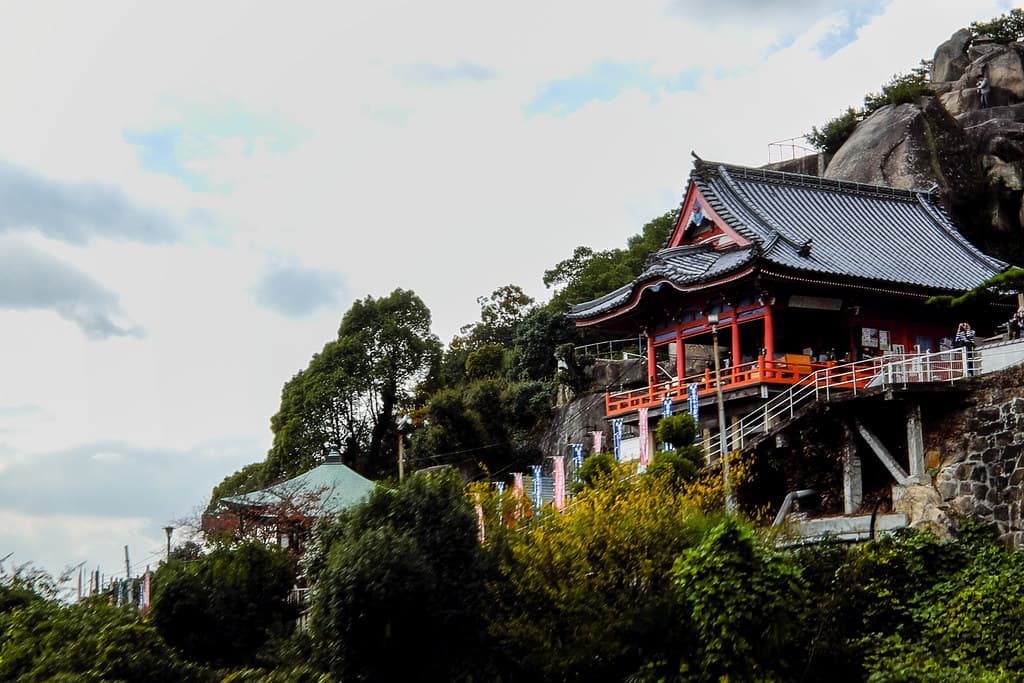
Image of Jōdo-ji (Daijōritsu-in). Image source · CC-BY-SA-3.0
Station 9 of 33
Chūgoku 33 Kannon PilgrimageVisit essentials
A quick read before you go
- Duration
- 60–90 minutes for Jōdo-ji alone; about three hours including the Shichi-Butsu walk and the…
- Access
- From JR Onomichi Station, about 15 minutes' walk eastward along the harbour, then up the slope.
Overview
Onomichi's Jōdo-ji—distinct from the Ehime/Matsuyama temple on Shikoku 88—is a Shingon-shū Sennyūji-ha temple on the Chūgoku 33 route and station #1 of the Onomichi Shichi-Butsu circuit. Its Shōtoku-Taishi foundation tradition begins in 616 CE; its medieval lineage runs through Jōshō and the Saidai-ji-Eison Shingon-Ritsu revival, reflected in the Daijō-in / Daijōritsu-in subsidiary. The Eleven-Faced Kannon honzon attributed to Shōtoku Taishi is hibutsu.
The 1327 hondō and 1328 tahōtō survive as National Treasures, rebuilt through Dōren and Dōshō's lay leadership and named carpenters before Ashikaga Takauji's 1336 national-peace dedication. For Onomichi, Jōdo-ji remains the spiritual heart of its Japan-Heritage port landscape and a townspeople-supported covenant with Kannon for harbour safety.
Why this place is sacred
Jōdo-ji's thinness rests on the convergence of architecture, geography, and continuous covenant. The hilltop position over the Onomichi waterway gives the precinct its visual frame — the harbour spreads below, ships move on the channel, and the temple watches over commerce that has sustained the town for centuries.
The 1327 main hall and 1328 two-storied tahōtō are not separated by museum glass from the present; the worship continues in the same rooms whose carpentry was completed during the early fourteenth century. The continuous lay-and-clerical co-stewardship — anchored in the named lay leadership of Dōren and Dōshō after the 1325 fire — has carried the temple through political reorganisations and economic shifts that erased many similarly old sites elsewhere.
Founded in tradition by Prince Shōtoku in 616 CE, the original Ritsu-school temple served as a spiritual anchor for the developing Onomichi port. The Kamakura-era refounding under Jōshō (a disciple of Eison of Saidai-ji in Nara) brought the temple into the Shingon Ritsu (precept) revival, integrating Mahayana precept observance with esoteric Kannon devotion.
After the 1325 fire that destroyed earlier structures, lay leaders Dōren and Dōshō coordinated the rebuilding. The hondō was completed in 1327 by carpenters Fujiwara Tomokuni and Fujiwara Kunisada; the tahōtō followed in 1328. Ashikaga Takauji's 1336 dedication of thirty-three poems and his selection of Jōdo-ji as one of the Ankoku-ji 'national peace' temples cemented the site's status.
Modern affiliation places the temple within the Shingon-shū Sennyūji-ha; the 1981 establishment of the Chūgoku 33 Kannon Pilgrimage placed it as #9, while the temple also anchors the Onomichi Shichi-Butsu pilgrimage as #1.
Experience and orientation
From JR Onomichi Station, walk eastward along the harbour for about fifteen minutes, then up the slope to the temple. The climb is short but the change in atmosphere is real: street-level Onomichi gives way to the wooded approach, the gate appears, and the hondō presents itself across an enclosed courtyard.
Pause at the gate. Enter the precinct, light incense at the main hall, and take time with the two National Treasure structures: the 1327 hondō and the 1328 tahōtō (two-storied multi-treasure pagoda). The hondō houses the concealed Eleven-Faced Kannon honzon. The tahōtō's interior walls hold paintings of Dainichi Nyorai with the Eight Patriarchs — a doctrinal programme central to Shingon mikkyō. Outside, the views over Onomichi channel and Mukaijima frame the temple as harbour-watcher.
Climb to the Okuno-in observation deck above the temple if time allows. The Shimanami Kaidō cycling route makes Jōdo-ji a popular cyclist-pilgrim stop in temperate seasons; the Onomichi Shichi-Butsu walk through the historic port town extends the pilgrim experience to a broader local circuit.
Begin at the main hall facing the concealed honzon, then walk to the tahōtō. Climb to the Okuno-in observation deck if walking the full Onomichi route. Sixty to ninety minutes for Jōdo-ji alone; about three hours including the Shichi-Butsu walk and the observation deck.
Context and lineage
Prince Shōtoku is said to have founded the temple in 616 CE while travelling — the connection grounds Jōdo-ji in Japan's earliest Buddhist horizon. After centuries of decline, the temple was refounded mid-Kamakura by Jōshō, a disciple of Eison of Saidai-ji in Nara and a Shingon-Ritsu monk. After a 1325 fire, the lay couple Dōren and Dōshō led the rebuild — an unusual record of named lay leadership in medieval Japanese Buddhism.
Ashikaga Takauji's 1336 visit and 33-poem dedication coincided with the temple's hondō and pagoda being completed, a moment when imperial-level politics and Kannon devotion converged.
Shingon-shū Sennyūji-ha. The medieval lineage traces to the Saidai-ji-Eison Shingon-Ritsu revival via the founding-priest Jōshō; the Daijō-in / Daijōritsu-in subsidiary signals this Mahayana-precept tradition. Modern affiliation places Jōdo-ji within the broader Sennyūji-ha umbrella centred at Sennyūji in Kyoto.
Traditions and practice
Daily Eleven-Faced Kannon liturgy includes darani recitation and offerings at the main altar. Annual memorial services and the Onomichi Shichi-Butsu seasonal observances tie the temple to the broader Onomichi pilgrimage culture. Shingon Ritsu precept observance continues in the temple's underlying ceremonial logic.
Modern pilgrim hospitality, goshuin issuance, treasure-hall and garden viewing (with admission fee) run year-round. The temple participates in the Chūgoku 33 Kannon and Onomichi Shichi-Butsu networks, and the Shimanami Kaidō cycling route makes it a popular stop for cyclist-pilgrims in temperate seasons.
Pause at the gate. Light incense at the main hall facing the concealed Eleven-Faced Kannon. Walk to the tahōtō and circle it once, considering the Dainichi Nyorai with Eight Patriarchs interior programme. Receive the goshuin. Climb to the Okuno-in observation deck for the view if time allows. For deeper pilgrim work, plan the full Onomichi Shichi-Butsu walk over a half-day.
Shingon-shū Sennyūji-ha Buddhism (with Ritsu-school heritage)
ActiveModern affiliation Shingon Sennyūji-ha; medieval lineage traces to the Saidai-ji-Eison Shingon-Ritsu revival via the founding-priest Jōshō. The Daijō-in / Daijōritsu-in subsidiary signals this Mahayana-precept tradition. Honzon: Eleven-Faced Kannon (hibutsu, attributed to Shōtoku Taishi).
Chūgoku 33 Kannon Pilgrimage
ActiveJōdo-ji is Temple #9 of the modern Chūgoku 33 Kannon circuit. Pilgrims often combine the visit with the Onomichi Shichi-Butsu walk through the historic port town, weaving the Kannon route through the local seven-temple circuit.
Onomichi Shichi-Butsu Pilgrimage
ActiveJōdo-ji is station #1 of Onomichi's local seven-Buddhas circuit, deeply integrated with the port-town's Japan-Heritage cultural landscape. The Shichi-Butsu walk threads through the historic streets, hillside temples, and harbourfront alleys that define Onomichi's cultural identity.
Perspectives and open questions
Jōdo-ji invites overlapping readings: as a Shōtoku-Taishi foundation tying the temple to Japan's earliest Buddhist horizon, as a Kamakura-era Shingon-Ritsu refounding tied to the Eison precept-revival movement, as an Ashikaga Takauji Ankoku-ji dedication, and as Onomichi's harbour-watcher whose National Treasure architecture is one of the finest medieval Japanese ensembles still in worship.
Scholarly perspective
Japanese architectural-history scholarship treats the two National Treasure structures (1327 hondō, 1328 tahōtō) as a primary case study in early-Kamakura/early-Muromachi Japanese architecture. The Ashikaga Takauji dedication is documented through extant records, and the lay-leadership of Dōren and Dōshō after the 1325 fire is unusually well attested for medieval Japanese Buddhism.
Living and traditional perspectives
Local tradition emphasises continuous townspeople-stewardship: Onomichi is a temple-city, and Jōdo-ji's prosperity is the harbour's prosperity. Within the Shōtoku Taishi tradition, the temple is among the earliest provincial sites tying western Japan into the imperial Buddhist horizon.
Alternative interpretations
Within Shingon Ritsu, the joint architectural symbolism of hondō and tahōtō enacts the union of compassion (Eleven-Faced Kannon) and wisdom (Dainichi Nyorai with the Eight Patriarchs depicted on the pagoda's interior walls). The pilgrim's walk between the two structures becomes a circumambulation of the bodhisattva-buddha pair at the heart of esoteric devotion.
Open questions
Pre-616 sacred history of the hill is likely — earlier maritime worship probably existed at this strategic point above the harbour — but is unrecorded. The original 7th-century founding building has been entirely lost, with the surviving fabric dating from 1327–1328 onwards.
Plan your visit
Access and arrival
From JR Onomichi Station, about 15 minutes' walk eastward along the harbour, then up the slope. Onomichi is reachable by Sanyō Shinkansen via Shin-Onomichi plus local rail. Mobile signal is reliable throughout central Onomichi. Cyclists arriving on the Shimanami Kaidō can rack their bikes in the temple parking area.
Accommodation throughout central Onomichi within walking distance, ranging from business hotels to ryokan and pilgrim-oriented guesthouses. Cyclist-pilgrims often base in Onomichi for multi-day Shimanami Kaidō trips.
Respectful visit
Modest, covered clothing with closable shoes for the stone steps.
Outer precinct OK; not in the hibutsu sanctum or the treasure hall during ritual.
Saisen at the main hall, incense at the appropriate stand, pilgrim stamp fee at the temple office, treasure-hall admission fee at the entrance.
Honzon ordinarily concealed | No photography of the Eleven-Faced Kannon honzon | Quiet expected during services | Treasure hall has admission fee and handling rules
The hibutsu honzon is shown only at scheduled openings. Photography is restricted in the hibutsu sanctum and in the treasure hall during ritual. Stone steps on the slope require closable shoes. Onomichi can be busy on weekends, especially during cherry-blossom and autumn-maple weeks.
Current practical details
Address
20-28 Higashikubochō, Onomichi, Hiroshima 722-0043, Japan
Phone
Hours
Hours, fees, and access can change — verify on the official source before you travel. Practical details last checked Jun 2026.
Location
Map loads as you approach this section.
Pilgrim reflections
A portrait of encounter, not a score
Pilgrims describe what they felt, how present they could become, and whether the place would shape a journey. There are no stars and no ranking of traditions.
No reviewed reflections yet
The first pilgrims can help describe the character of being here.
Share a reflection
Available after an account-backed “Been there.” Every reflection is reviewed before publication.
Nearby sacred places
Explore other sacred places in the region. Proximity does not establish access or travel time; check each place’s guidance.



References
Sources consulted for this page. Source categories describe the publication, not a guarantee that every claim is verified. Traditional accounts and outside interpretations may differ.
- 01Cultural Property: Jodoji Temple Main Hall and Two-Storied Multi-treasure Pagoda — Japan Heritage Onomichi (Onomichi City)officialOfficial Japan Heritage page
- 02Jodoji — Hiroshima Prefecture Tourism Federation (dive-hiroshima.com)officialOfficial tourism English page
- 03Onomichi: A Historic Port City Perfect for Wandering — Japan National Tourism Organization (japan.travel)officialJNTO Japan Heritage feature on Onomichi
- 04浄土寺〔真言宗〕 — Onomichi Tourism (ononavi.jp)officialLocal tourism page; Shōtoku Taishi, Ashikaga, Genji-monogatari connections
- 05Jōdo-ji (Onomichi) - Wikipedia (English) — WikipediaacademicFounding 616 trad., Kamakura rebuilding, two National Treasures, Ashikaga Takauji
- 06浄土寺 (尾道市) - Wikipedia (Japanese) — Wikipedia (Japanese)academicSennyūji-ha affiliation, Daijō-in subsidiary, Eleven-Faced Kannon honzon, Chūgoku 33 #9
Pilgrim glossary
- Honzon
- The principal Buddhist deity enshrined as a temple's central object of worship.
- Kannon
- The bodhisattva of compassion, central to many East Asian pilgrimage routes.
- Bodhisattva
- An enlightened being who postpones full nirvana to help others toward awakening.
- Shingon
- An esoteric Japanese Buddhist school emphasizing ritual, mantra, and mandala practice.
- Pure Land
- A Buddhist tradition focused on rebirth in Amida Buddha's western paradise through devotional practice.
Share a photo
Help visitors recognize Jōdo-ji (Daijōritsu-in). Every submission is reviewed before publication.