Senkō-ji
Onomichi's red cliff-side Kannon hall above the Inland Sea
Understand sacred places, explore living traditions, and learn how to engage respectfully with Pilgrim Map.
Access has not been verified. Check current local guidance before planning a visit.
Onomichi, Hiroshima Prefecture, Japan
Read the sources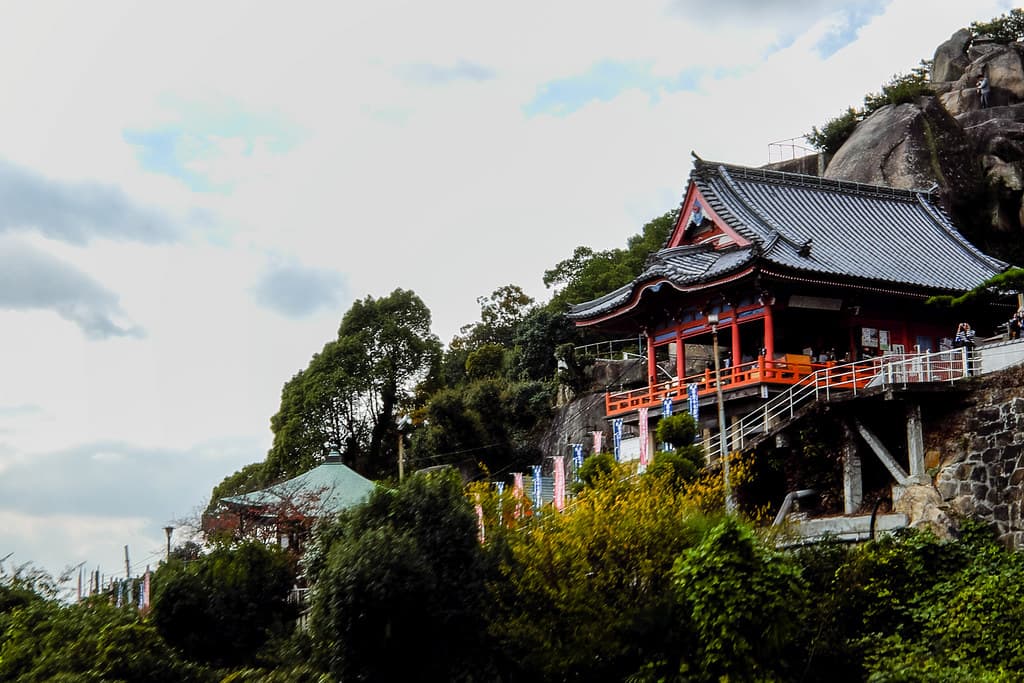
Image of Senkō-ji. Image source
Station 10 of 33
Chūgoku 33 Kannon PilgrimageVisit essentials
A quick read before you go
- Duration
- 60–90 minutes for the temple alone; add 1–2 hours to walk down through Senkōji Park and the…
- Access
- Address: 15-1 Higashi-Tsuchidō-chō, Onomichi, Hiroshima Prefecture.
Overview
Senkō-ji occupies a cliff-side terrace midway up Mt. Senkō, the hill shaping Onomichi's vertical townscape. Its full name, Daihōzan Gongen-in Senkō-ji, joins “Great Treasure Mountain,” the in-go Gongen-in, and “Thousand-Light Temple,” recalling its luminous-jewel legend. The vermilion 1686 Akadō (Red Hall), built in projecting butai-zukuri (“stage-style”), is its most photographed feature and an iconic Seto Inland Sea silhouette.
Founding tradition dates the temple to 806 CE (Daidō 1), when Kūkai (Kōbō Daishi, 774–835) returned from Tang-dynasty China. He is said to have founded it after seeing a luminous jewel guide ships into Onomichi harbor at night; Tama-no-Iwa (“Jewel Rock”), one of a cluster of named sacred stones in the precinct, supposedly held the jewel. This founder attribution is devotional tradition, not documented fact. The first firmly attested phase is Tada Mitsunaka's 10th-century restoration.
Senkō-ji is #10 on the Chūgoku 33 Kannon route, the Onomichi leg's first numbered station before Special Sacred Temple Saigoku-ji and Jōdo-ji. Its honzon, Senju Kannon (Thousand-Armed Avalokiteśvara), is traditionally attributed to Prince Shōtoku. This hibutsu appears only once every 33 years, next in 2045. Residents venerate it as “Hibuse no Kannon,” historically praying to the fire-quenching Kannon for their harbor town's wooden buildings.
Why this place is sacred
Senkō-ji's quality of thinness is best understood through the meeting of cliff, stone, and sea. The 1686 (Jōkyō 3) Akadō — built in butai-zukuri, the same 'stage-style' as Kiyomizu-dera in Kyoto — projects from the cliff face on a wooden scaffold, so that worship inside the hall is inseparable from the view of harbor, islands, and shipping lanes outside.
The structure registers as both architectural object and viewing platform; visitors describe a sense of suspension between sea and sky from its veranda.
The precinct's named boulders — Tama-no-Iwa ('Jewel Rock'), Kuzariwa, Pochi-Iwa, and others — form a natural cluster around the halls. Some practitioners read them as a natural mandala; some local readings suggest Tama-no-Iwa was a yorishiro (kami-dwelling stone) before the temple was founded, though this is plausible rather than documented. The stones' contemporary devotional life is lightly maintained: visitors pause at each in turn, and Tama-no-Iwa is illuminated at night for visibility from the harbor below.
The temple's institutional course is layered onto these natural features. The traditional 806 founding by Kūkai is undocumented; the 10th-century restoration by Tada Mitsunaka is the first attested phase. The current Akadō dates from 1686; the bell tower, the 33-Kannon hall, and the various subsidiary structures were rebuilt or refurbished across the Edo and modern periods. The honzon Senju Kannon is hibutsu, opened to the public once every 33 years (next 2045).
Through every cycle of Onomichi's commercial expansion, fires, and post-WWII urban changes, Senkō-ji's silhouette above the harbor has remained the city's principal devotional icon.
By temple tradition, Senkō-ji was founded in 806 CE (Daidō 1) by Kūkai (Kōbō Daishi) following his return from Tang-dynasty China, on a site already marked by a luminous jewel said to guide ships into Onomichi harbor. The honzon Senju Kannon is attributed by legend to Prince Shōtoku (574–622), a stock attribution in older Japanese temple traditions. The 806 date and Kūkai involvement are devotional tradition rather than corroborated history; the first firmly attested phase is the 10th-century restoration.
The temple's institutional course shows successive phases: traditional 806 founding by Kūkai; 10th-century restoration by Tada Mitsunaka; medieval Onomichi-port commercial patronage; 1686 (Jōkyō 3) construction of the standing Akadō; 19th-century literary attention through Hayashi Fumiko (1903–1951), who wrote of seeing 'the red Senkō-ji pagoda' from her childhood window in Hōrōki (Diary of a Vagabond); modern designation of Senkōji Park as one of Japan's Top-100 cherry-blossom sites.
Sectarian affiliation is now independent (tantai, 単立); the Senju Kannon devotion at the heart of the temple has remained constant.
Experience and orientation
Senkō-ji is reached two ways. From JR Onomichi Station, walk fifteen minutes uphill to the Senkōji ropeway base; the three-minute ropeway lifts to the summit, from which a ten-minute walk down through Senkōji Park brings the visitor to the Akadō. Alternatively, the temple-walk path climbs 25–30 minutes from the harbour through Onomichi's stepped backstreets and sub-temples. The path approach is steeper but rewards each landing with a different angle on the strait.
The Akadō opens at the cliff-edge platform. Inside, the principal devotion is to the Senju Kannon altar; the inner sanctuary is closed, the honzon a hibutsu shown only once every 33 years. Outside the hall, the cluster of named boulders begins. Tama-no-Iwa stands prominently above the path, its boulder face illuminated at night.
The 33-Kannon Hall houses thirty-three small Kannon images arrayed for those who cannot make the full Saigoku 33 pilgrimage; visitors strike the kachi-kachi-juzu (clacking-bead rosary) and recite a brief Kannon prayer.
Senkōji Park surrounds the temple at the summit. Roughly 1,500 cherry trees cover the slopes, and the park is designated one of Japan's Top-100 cherry-blossom sites. The Literature Path, descending through the park back toward the harbour, is lined with stone monuments inscribed with passages from the writers — Hayashi Fumiko, Shiga Naoya, and others — who lived or wrote in Onomichi.
From JR Onomichi Station, walk fifteen minutes east along the harbour to the Senkōji ropeway base; ride three minutes up; walk ten minutes down through Senkōji Park to the Akadō. (Alternatively, climb the temple-walk path directly — 25–30 minutes.) Pause at Tama-no-Iwa. Light incense at the Akadō, drop a coin in the saisen box, and recite the Heart Sutra if equipped. Ring the kachi-kachi-juzu rosary at the 33-Kannon Hall.
Pilgrims request the Chūgoku 33 #10 nōkyō at the temple office during posted hours.
Context and lineage
By temple tradition, in 806 CE (Daidō 1) — the year of Kūkai's return from Tang-dynasty China — the priest founded Senkō-ji on the cliff-side mid-slope of Mt. Senkō. Local legend tells that the boulder Tama-no-Iwa ('Jewel Rock') had once held a luminous jewel that guided ships into Onomichi harbor at night; the temple grew up around the rock. The honzon Senju Kannon is attributed by legend to Prince Shōtoku (574–622).
Kūkai's personal involvement is devotional tradition rather than documented fact. The first firmly attested phase is the 10th-century restoration by the warrior-aristocrat Tada Mitsunaka (Minamoto no Mitsunaka, 912–997), founder of the Settsu Genji line. Through the medieval centuries the temple flourished as Onomichi grew into a major Inland Sea trading port; commercial patronage from harbor merchants supported its halls and rituals.
The current Akadō dates from 1686 (Jōkyō 3), built in butai-zukuri stage-style projecting from the cliff. In the modern era, Hayashi Fumiko's Hōrōki (Diary of a Vagabond, 1930) — written from her Onomichi childhood — included the iconic image of 'the red Senkō-ji pagoda' visible from her window, securing the temple's place in 20th-century Japanese literature.
The temple's ropeway opened in 1957, making the precinct accessible to ordinary visitors year-round; Senkōji Park around the summit was designated one of Japan's Top-100 cherry-blossom sites.
Senkō-ji is currently an independent (tantai, 単立) Shingon temple — a single-temple lineage rather than a sub-branch of a larger Shingon school. Its esoteric ritual program is recognizably Shingon: mantras, hand-seals, periodic goma fire offerings. The temple's distinct identity is anchored in the Onomichi Seven-Buddha pilgrimage, of which it is #1, and in its long-standing role as the city's principal devotional icon.
Kūkai (Kōbō Daishi, 774–835)
Traditional founder
Founder of Shingon Buddhism in Japan and one of the most influential religious figures in Japanese history. Temple tradition places his founding visit at 806 CE on his return from Tang-dynasty China. Personal involvement at this site is devotional tradition rather than documented fact, but Kūkai's broader 9th-century activity in the western provinces is well-attested.
Prince Shōtoku (574–622)
Legendary creator of the honzon
Asuka-period regent traditionally credited with foundational Buddhist patronage in Japan. The Senju Kannon honzon at Senkō-ji is attributed by legend to his hand — a stock attribution in older Japanese temple traditions and not independently documented.
Tada Mitsunaka (912–997)
10th-century restorer
Warrior-aristocrat (also known as Minamoto no Mitsunaka), founder of the Settsu Genji line. Restored Senkō-ji in the 10th century — the first firmly attested phase of the temple's documented history.
Hayashi Fumiko (1903–1951)
20th-century literary witness
Novelist who spent her childhood in Onomichi and wrote of seeing 'the red Senkō-ji pagoda' from her window in Hōrōki (Diary of a Vagabond, 1930). Her writing established the temple as a key node of modern Japanese literature.
Postwar resident clergy and Onomichi parish community
Contemporary stewards
The community responsible for maintaining the 1686 Akadō, the cluster of named boulders, the 33-Kannon Hall, and the Senkōji ropeway-era visitor infrastructure, while continuing the daily devotional and pilgrimage life of the temple.
Traditions and practice
The temple's liturgy follows Shingon esoteric forms — recitation of the Hannya Shingyō and the Senju Kannon mantra ('On bazara tarama kiriku' in transliteration; variants apply). Goma fire rituals (homa) are performed periodically. The kachi-kachi-juzu in the 33-Kannon Hall is a working pilgrim rosary: visitors strike the beads against the central post in counted sequence, accumulating recitation merit. Fire-protection o-fuda are issued for households, continuing a centuries-old tradition tied to the densely built wooden townscape below.
Pilgrims arrive year-round for the Chūgoku 33 #10 stamp and the Onomichi Seven-Buddha #1 stamp; many combine the visit with Saigoku-ji (Special) and Jōdo-ji on the same day. Cherry blossom in late March to early April fills Senkōji Park; autumn maple in November draws additional visitors. Sunset hours, when the harbor lights come on and Tama-no-Iwa is illuminated, are particularly photographed.
Allow 60 to 90 minutes for the temple precinct alone; add 1–2 hours to walk down through Senkōji Park and the Literature Path. Pause at each named boulder. At the Akadō, light incense, offer at the saisen box, and recite or listen to the Heart Sutra. Ring the kachi-kachi-juzu at the 33-Kannon Hall for a brief Kannon recitation. Pilgrims should bring their nōkyō-chō to the temple office for the #10 stamp.
Early morning, before the ropeway opens at 09:00, gives the Akadō veranda the quietest atmosphere of the day.
Buddhism
ActiveSenkō-ji is an independent Shingon temple following 9th-century Kōbō Daishi tradition. By temple legend, it was founded in 806 CE by Kūkai (Kōbō Daishi) following his return from Tang-dynasty China; the honzon Senju Kannon is attributed by legend to Prince Shōtoku. As Chūgoku 33 #10 and Onomichi Seven-Buddha #1, the temple is the first numbered station on the Onomichi pilgrimage leg. The Senju Kannon is venerated as the 'fire-quenching Kannon' (Hibuse no Kannon), continuing a centuries-old harbor-town devotion to protect the wooden townscape from fire.
Chūgoku 33 Kannon Pilgrimage
Active#10 of the Chūgoku 33 Kannon Pilgrimage and the first numbered station on the Onomichi leg. The pilgrimage honzon is Senju Kannon (Thousand-Armed Avalokiteśvara).
Onomichi Seven-Buddha Pilgrimage
Active#1 of the Onomichi Seven-Buddha (七佛) pilgrimage — a local route linking seven of Onomichi's principal mountain temples in a one-day or weekend circuit. Senkō-ji is the route's iconic opening station.
Perspectives and open questions
Senkō-ji is a temple where founding legend, harbor-town devotion, and modern literary memory meet on the same cliff. The site rewards visitors who hold the luminous-jewel story, the fire-protection prayer, and Hayashi Fumiko's red pagoda all open at once.
Scholarly perspective
Modern scholarship treats the 806 founding by Kūkai as devotional tradition. Documentary record of the temple begins with the 10th–11th-century restorations by Tada Mitsunaka. The 1686 Akadō is a representative example of butai-zukuri ('stage-style') hall architecture, comparable in technique to Kiyomizu-dera in Kyoto, and is a securely dated piece of late-17th-century Japanese architecture.
Living and traditional perspectives
Local Onomichi devotion treats the Senju Kannon as a maritime protector preventing fires in the densely built wooden townscape below. The 'Hibuse no Kannon' (fire-quenching Kannon) framing is centuries old and continues in the issuing of fire-protection o-fuda for households. The Senju Kannon's hibutsu status — unveiled only once every 33 years — concentrates devotional attention on the rare openings.
Alternative interpretations
Some practitioners read the cluster of named boulders as a natural mandala, with Tama-no-Iwa as a yorishiro (kami-dwelling stone) predating the Buddhist temple and the surrounding stones forming a circumambulation route. The luminous-jewel legend, undateable in itself, is sometimes read as a memory of pre-Buddhist beacon-lighting at the harbor mouth.
Open questions
{"Whether Kūkai personally founded this site is unknowable on present evidence","Pre-Buddhist use of the cluster of named boulders is plausible but undocumented","The luminous-jewel legend cannot be dated; its narrative origin is unknown","Detailed liturgical content of internal Shingon goma rituals at this site is not documented in retrieved English sources"}
Plan your visit
Access and arrival
Address: 15-1 Higashi-Tsuchidō-chō, Onomichi, Hiroshima Prefecture. From JR Onomichi Station: 15-minute walk uphill to Senkōji ropeway base; 3-minute ropeway up; 10-minute walk down to the Akadō. Alternative: 25–30 minute climb up the temple-walk path. Phone: 0848-23-2310. Mobile phone signal is reliable on all major Japanese carriers in central Onomichi.
Onomichi offers a range of guesthouses, business hotels, and renovated machiya within walking distance of the temple walk. Many pilgrims base themselves in central Onomichi for one to two days to complete the temple walk and continue to Ikuchijima.
Respectful visit
Modest casual; sturdy walking shoes for the rocky paths between the named boulders. Pilgrim coat (hakui), sedge hat (sugegasa), and walking stick (kongō-zue) appropriate for those on the Chūgoku 33 or Onomichi Seven-Buddha circuits.
Exterior photography of the Akadō, the named boulders, and the harbor view is welcomed. No flash on the Akadō veranda or inside any hall. Do not photograph past the closed inner sanctuary. Respect worshippers in the Akadō and at the 33-Kannon Hall.
Coin offerings at the Akadō saisen box; candles and incense in the votive shed; pilgrims may purchase fire-protection o-fuda for households. Stamp fee paid at the temple office.
Senju Kannon honzon is a hibutsu, unveiled only once every 33 years (next 2045) | Do not climb on Tama-no-Iwa or any of the named boulders | Stay on marked paths between sacred rocks | Quiet voice expected on the Akadō veranda; no flash photography near worshippers | Ropeway hours apply; the temple itself is more accessible by foot path outside ropeway hours
The Senju Kannon honzon is a hibutsu, unveiled only once every 33 years (next 2045). Do not climb on Tama-no-Iwa or any of the named boulders — they are devotional objects. Photography of the Akadō exterior is welcomed; interior altar photography is generally discouraged. The cliff-side terrace can become crowded around midday; early morning or late afternoon are best for solitude. Sturdy footwear is recommended for the rocky paths between the named stones.
Current practical details
Address
15-1 Higashitsuchidōchō, Onomichi, Hiroshima 722-0033, Japan
Phone
Hours
Hours, fees, and access can change — verify on the official source before you travel. Practical details last checked Jun 2026.
Location
Map loads as you approach this section.
Pilgrim reflections
A portrait of encounter, not a score
Pilgrims describe what they felt, how present they could become, and whether the place would shape a journey. There are no stars and no ranking of traditions.
No reviewed reflections yet
The first pilgrims can help describe the character of being here.
Share a reflection
Available after an account-backed “Been there.” Every reflection is reviewed before publication.
Nearby sacred places
Explore other sacred places in the region. Proximity does not establish access or travel time; check each place’s guidance.


References
Sources consulted for this page. Source categories describe the publication, not a guarantee that every claim is verified. Traditional accounts and outside interpretations may differ.
- 01Senkōji official site — Senkō-ji TempleofficialAuthoritative for honzon, founding, Tama-no-iwa legend
- 02千光寺 — Chūgoku Kannon Reijō #10 — Chūgoku 33 Kannon Pilgrimage AssociationofficialConfirms Bangō 10, Senju Kannon honzon
- 03Senkoji Temple — Dive! Hiroshima — Hiroshima Prefecture TourismofficialTourist-bureau details on Akadō, ropeway
- 04Senkoji Park — Japan National Tourism Organization — JNTOguideTop-100 cherry-blossom designation, Mt. Senkō views
- 05Senkō-ji (Onomichi) — Wikipedia — WikipediaofficialSect, founder, dates
- 06Senkoji — Joy in Hiroshima — Joy in HiroshimaguideLayout and ascent description
- 07Senkō-ji — Travel Quest — Travel QuestguideTama-no-iwa legend retelling
Pilgrim glossary
- Honzon
- The principal Buddhist deity enshrined as a temple's central object of worship.
- Kannon
- The bodhisattva of compassion, central to many East Asian pilgrimage routes.
- Mandala
- A symbolic diagram of the cosmos used in meditation and ritual.
- Sutra
- A canonical Buddhist scripture, often chanted as part of practice.
- Mantra
- A sound, word, or phrase repeated as part of meditation or ritual.
- Shingon
- An esoteric Japanese Buddhist school emphasizing ritual, mantra, and mandala practice.
- Pure Land
- A Buddhist tradition focused on rebirth in Amida Buddha's western paradise through devotional practice.
Share a photo
Help visitors recognize Senkō-ji. Every submission is reviewed before publication.