Iyo Kokubun-ji
Iyo Province's 8th-century state temple, where pagoda foundation stones still mark a vanished seven-storey complex
Understand sacred places, explore living traditions, and learn how to engage respectfully with Pilgrim Map.
Access has not been verified. Check current local guidance before planning a visit.
Imabari, Ehime Prefecture, Japan
Read the sources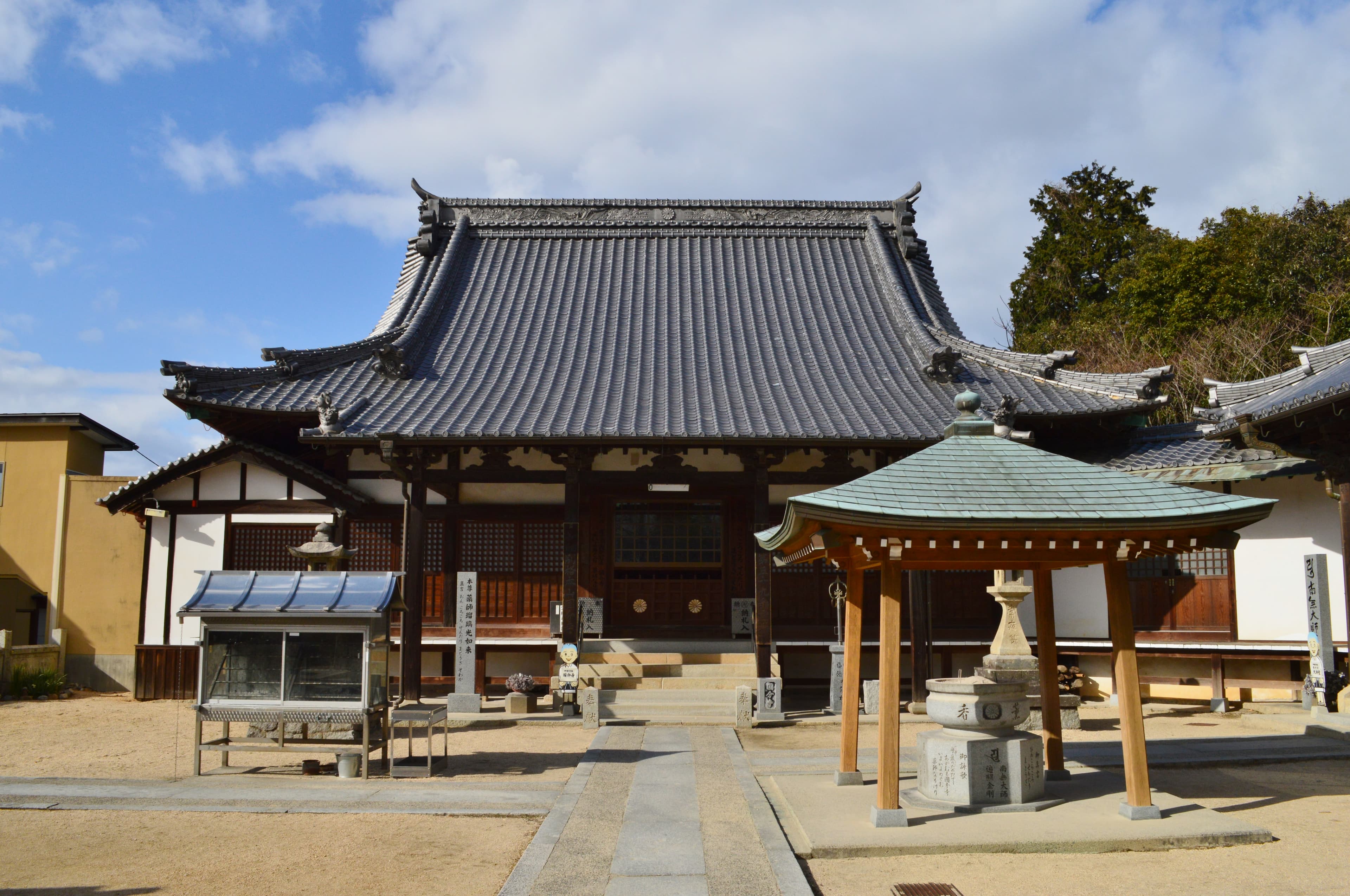
Image of Iyo Kokubun-ji (伊予国分寺). Image source · CC0
Station 59 of 88
Shikoku 88 Temple PilgrimageVisit essentials
A quick read before you go
- Duration
- 30–45 minutes for the precinct; add ~15 minutes for the pagoda foundation stones east of the…
- Access
- On the eastern plain of Imabari, easily reached by car or bicycle.
Overview
Iyo Kokubun-ji belongs to a category older than the Shikoku pilgrimage itself. In 741 CE, after a smallpox epidemic devastated Japan, Emperor Shōmu issued an edict for each province to construct a state temple (kokubunji) and a state nunnery (kokubun-niji), each to anchor the recitation of the Konkōmyō Saishōō-kyō (Golden Light Sutra) for the protection of the realm. Iyo Province's temple was built at this site, traditionally established by Gyōki.
Yakushi Nyorai, the Buddha of healing—chosen pointedly after the smallpox crisis—was enshrined as honzon, where the wash basin's water still flows from a stylised medicine jar. What followed was repeated destruction. The temple burned in 939 during Fujiwara Sumitomo's revolt, in 1184 during the Genpei War, in 1364 during Hosokawa Yoriyuki's Northern–Southern Courts campaigns, and again in the late 16th century under Chōsokabe Motochika's Shikoku unification. Fire returned in 1689. The current Hondō was rebuilt in 1789.
None of this is hidden. About a hundred meters east of the modern precinct, in an open field, the foundation stones of the original seven-storey pagoda survive—massive, weathered, ringed by rope. Pilgrims who walk the short distance from the Hondō find themselves standing among the residue of a much grander 8th-century complex of which the present temple is a survivor. Kūkai later visited and the site became the 59th fudasho on the route.
For walking henro, the precinct is a relief after the mountain-top climb to Senyū-ji: flat, broad, easy. The Yakushi water basin and the foundation stones make this temple a rare opportunity on the route to think in centuries rather than in walking days—what survives, what does not, what the absence of a building still teaches.
Why this place is sacred
Iyo Kokubun-ji's thinness is layered in time. The current Hondō, rebuilt in 1789, is a competent Edo-period structure—nothing visually striking. The thinness is in what surrounds the building: the Yakushi water basin shaped from a medicine jar, the open field east of the precinct where the foundation stones of the lost pagoda lie, the implicit memory of the smallpox crisis that prompted Emperor Shōmu's edict in 741.
The site is part of a national network—every province had its kokubunji—and this is one of the relatively few where physical traces of the original 8th-century complex remain visible in the landscape. The contemplative weight is not in the buildings but in what the buildings refer back to: a state-Buddhism imagination where each province was supposed to chant the Golden Light Sutra to protect the realm, and the resulting infrastructure that briefly knit the country into a single ritual map.
A state temple founded by Emperor Shōmu's 741 edict to anchor recitation of the Golden Light Sutra for protection of Iyo Province and the realm; the seven-storey pagoda housed the relics that the edict required.
Founded 741 under Shōmu's kokubunji system, traditionally established by Gyōki. Burned 939 (Sumitomo revolt), 1184 (Genpei War), 1364 (Hosokawa campaigns), late 16th c. (Chōsokabe), 1689 (fire). Current Hondō rebuilt 1789. Designated the 59th fudasho on the Shikoku route through Kūkai's later association. The kokubunji system itself lost political force long before the Edo period; the site survived as a continuous ritual hall and pilgrimage temple.
Experience and orientation
The descent from Senyū-ji opens onto the broad eastern plain of Imabari, and Iyo Kokubun-ji sits among rice paddies and small roads. The precinct is flat and broad: the Hondō, the Daishi-dō, a wash basin styled as a medicine jar, the bell tower, a stamp office. Pilgrims often pause first at the basin, where the spout takes the form of Yakushi's medicine container; many leave a small slip of paper at the basin asking specifically for healing.
The Hondō and Daishi-dō are visited in turn following the standard fudasho sequence. After the formal pilgrim sequence, most visitors walk the short distance east to the foundation stones of the original seven-storey pagoda. The stones lie in an open field, partially excavated, ringed by simple rope. They are the visible bones of a much larger 8th-century complex.
Pilgrims often spend more time here than at the Hondō—touching nothing, just standing among the stones, taking in the proportion of what was once here. The juxtaposition of the modest current building with the broken stones of the older complex is what most pilgrims carry away. The visit takes 30–45 minutes for the precinct; another 15 minutes if you walk to the foundation stones, which most do.
Walking pilgrims continue from Senyū-ji (T58) across paddy land to the southeast. Small parking lot at the gate. The pagoda foundation stones lie ~100 m east of the precinct.
Context and lineage
In 741, after a devastating smallpox epidemic, Emperor Shōmu ordered each province to construct a state temple (kokubunji) and nunnery (kokubun-niji) for the recitation of the Golden Light Sutra to protect the realm. Iyo Kokubun-ji was Iyo Province's temple, traditionally founded by Gyōki. Yakushi Nyorai, the Buddha of healing, was enshrined as honzon. Kūkai later visited and the site became the 59th fudasho on the Shikoku pilgrimage.
Shingon Risshu—a sub-school within Shingon Buddhism that integrates Vinaya monastic discipline with esoteric practice. Some sources list the temple as Shingon Buzan; the Shingon Risshu affiliation is the more commonly cited. The kokubunji-era state-Buddhism layer is no longer practiced in its original form.
Emperor Shōmu
Imperial founder of the kokubunji system.
Gyōki
Traditional founder of Iyo Kokubun-ji.
Kūkai (Kōbō Daishi)
Later visitor whose association established the temple as 59th fudasho.
Traditions and practice
Heart Sutra, Yakushi shingon (On koro koro sendari matōgi sowaka), Daishi gohōgo, osamefuda, candle and incense at both Hondō and Daishi-dō. Healing prayers for specific ailments are common at the Yakushi water basin. Goma fire rituals on Yakushi's commemorative days. The original 8th-century practice of state-sponsored Konkōmyō Saishōō-kyō recitation is now commemorated rather than performed in original form.
Active fudasho with daily stamp office. Healing-related goma services are held on Yakushi commemorative days. Many visitors walk the short distance to the historic pagoda foundation as a contemplative coda to the formal visit.
After the standard pilgrim sequence at the two halls, walk east to the foundation stones in the open field. Stand among them for several minutes. The stones make explicit what most ruined sites only imply: that the contemporary buildings sit on top of much larger, much older intentions. The walk back to the Hondō becomes a different kind of return.
Shingon Buddhism (Shingon Risshu)
Active59th fudasho on the Shikoku 88 route. Iyo Province's official kokubunji under Emperor Shōmu's 741 edict, giving it national-political-religious significance distinct from most other temples on the route.
Daily liturgy at Hondō and Daishi-dō; Yakushi healing prayers; standard fudasho pilgrim reception.
Imperial state Buddhism (kokubunji system)
HistoricalFounded as part of the 8th-century network of state-protection temples, each anchoring a province with a Yakushi or Shaka image and a seven-storey pagoda.
Originally hosted state-sponsored sutra recitation (Konkōmyō Saishōō-kyō) for protection of the realm; now commemorated, not actively performed in original form.
Perspectives and open questions
Iyo Kokubun-ji is unusually well-attested historically: it is one of the documented kokubunji of the 8th-century Nara state, with surviving archaeological evidence of its original scale. The interpretive perspectives mostly converge.
Scholarly perspective
Securely identified as one of the 8th-century kokubunji by archaeological evidence (the pagoda base stones) and the imperial decree system of Emperor Shōmu. Documentary records become solid only from the medieval period after repeated destruction; the Nara/Heian-period sangha records were lost in the medieval fires.
Living and traditional perspectives
Local memory frames the temple as the 'province's prayer hall'—even after the kokubunji system lost its political force, the building has been maintained as a community symbol. The Yakushi water basin's healing function continues to draw devotees beyond the formal pilgrimage circuit.
Alternative interpretations
Shingon Risshu reading layers Yakushi's healing function with Kōbō Daishi's compassion, making the temple a site for both bodily and karmic healing. The juxtaposition of the modest 1789 Hondō with the ruined 8th-century pagoda foundation can be read as a built-form meditation on impermanence.
Open questions
The original Nara/Heian-period sangha records were lost in the medieval fires; the precise layout of the original seven-bay complex is reconstructed only from foundation stones and parallel kokubunji sites. The exact number of times the temple was burned varies between four and five across sources.
Plan your visit
Access and arrival
On the eastern plain of Imabari, easily reached by car or bicycle. Walking pilgrims continue from Senyū-ji (T58) southeast across paddy land. Small parking lot at the gate.
No shukubo at the temple. Imabari city has standard hotel and minshuku options; Senyū-ji's shukubo is the nearest temple lodging.
Respectful visit
Modest attire; pilgrim white if undertaking the formal henro.
Permitted in the precinct and at the pagoda foundation field. Not inside the Hondō or directly at the honzon.
Standard pilgrim offerings (coin, candle, incense, osamefuda) at both halls. Many visitors leave a small slip at the Yakushi basin asking specifically for healing.
Do not climb on the pagoda foundation stones. Treat the open field as part of the historical precinct. No departure bell.
Do not climb on the foundation stones; treat the field as part of the historical precinct. Standard fudasho cautions apply: no photography of the honzon, no departure bell.
Current practical details
Address
4-chōme-1-33 Kokubu, Imabari, Ehime 799-1533, Japan
Phone
Hours
Hours, fees, and access can change — verify on the official source before you travel. Practical details last checked Jun 2026.
Location
Map loads as you approach this section.
Pilgrim reflections
A portrait of encounter, not a score
Pilgrims describe what they felt, how present they could become, and whether the place would shape a journey. There are no stars and no ranking of traditions.
No reviewed reflections yet
The first pilgrims can help describe the character of being here.
Share a reflection
Available after an account-backed “Been there.” Every reflection is reviewed before publication.
Watch deeper
Films, episodes, and recorded talks for visitors who want more context before or after a visit. Speculative and alternative-history entries are labelled as perspectives, not as sources for established claims.
Nearby sacred places
Explore other sacred places in the region. Proximity does not establish access or travel time; check each place’s guidance.


References
Sources consulted for this page. Source categories describe the publication, not a guarantee that every claim is verified. Traditional accounts and outside interpretations may differ.
- 01Kokubunji – Imabari, Ehime Prefecture, Shikoku — Henro.orgguidePilgrim grounds layout and pagoda foundation stones.
- 02Temple 59, Iyo Kokubun-ji — Shikoku ToursofficialYakushi water-jar wash basin detail; Daishido description.
- 03Iyo Kokubun-ji — WikipediaencyclopediaCross-referenced citation set; documents Shōmu founding and Edo-period rebuild.
- 04Kokubun-ji, Temple No.59, is the temple for the province of Iyo — Japan TravelguideEmperor Shōmu's provincial temple system context.
Pilgrim glossary
- Honzon
- The principal Buddhist deity enshrined as a temple's central object of worship.
- Sutra
- A canonical Buddhist scripture, often chanted as part of practice.
- Sangha
- The community of Buddhist practitioners, traditionally monks and nuns.
- Shingon
- An esoteric Japanese Buddhist school emphasizing ritual, mantra, and mandala practice.
Share a photo
Help visitors recognize Iyo Kokubun-ji. Every submission is reviewed before publication.