Daihō-ji
The symbolic midpoint of the Shikoku 88, set among centuries-old cedars
Understand sacred places, explore living traditions, and learn how to engage respectfully with Pilgrim Map.
Access has not been verified. Check current local guidance before planning a visit.
Kumakōgen, Ehime Prefecture, Japan
Read the sources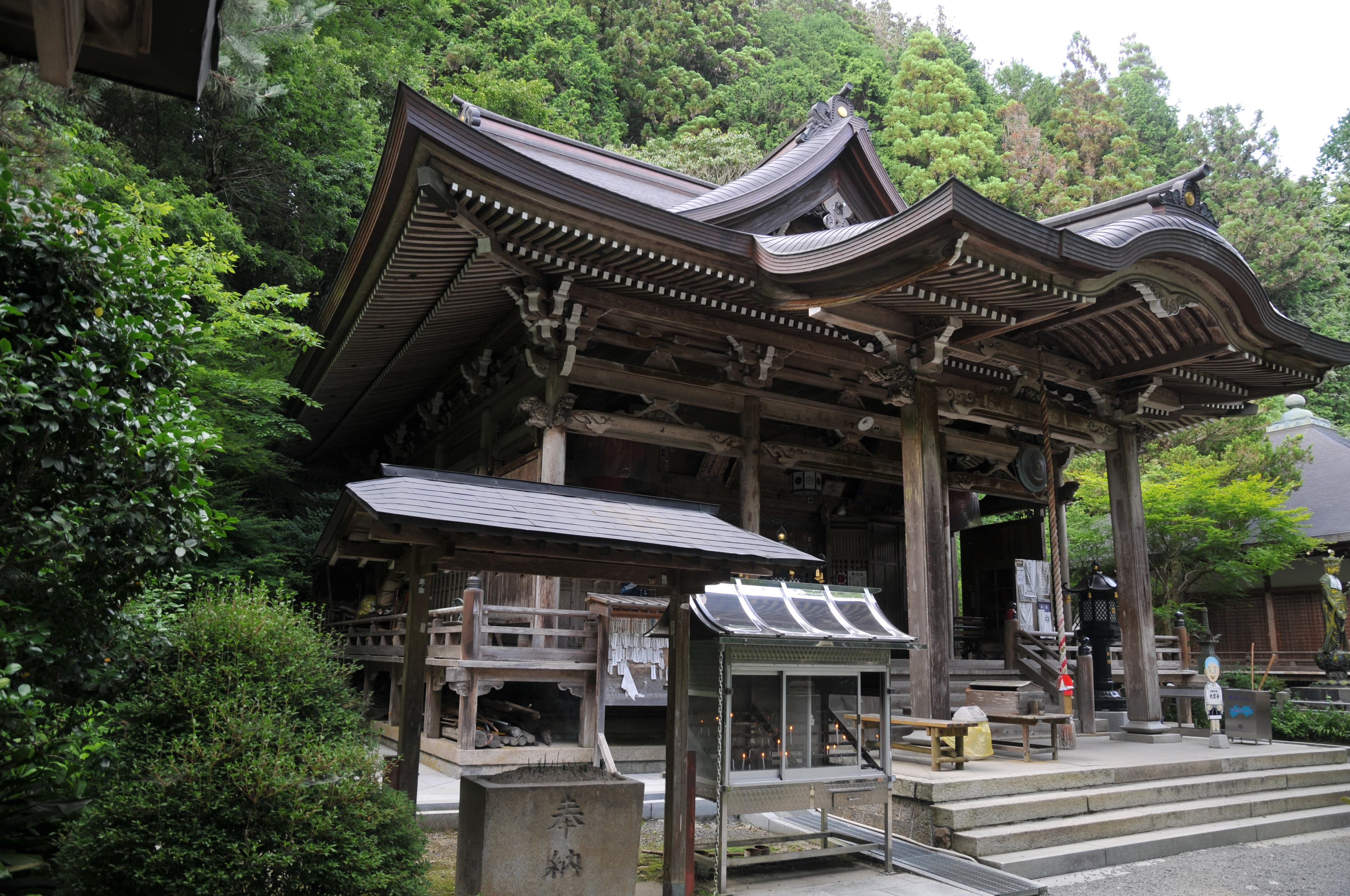
Image of Daihō-ji (大宝寺). Image source · CC-BY-SA-3.0
Station 44 of 88
Shikoku 88 Temple PilgrimageVisit essentials
A quick read before you go
- Duration
- 45-60 minutes including the cedar-grove walk and the climb to the Hondō.
- Access
- Mountain location in Kumakōgen.
Overview
Daihō-ji is Shikoku temple 44, the Nakafudasho or “middle stamp office” of the roughly 1,200-kilometer, 88-temple circuit. Pilgrims often pause here to take stock of one half completed and one half ahead.
In the central Ehime Kuma Highlands, the temple occupies a high gorge beneath old sugi cryptomeria and hinoki cypress. Deep shade, steep stone steps, woodpeckers, distant water, moss, and a still microclimate surround the Hondō and Daishi-dō; pilgrims often circle the grove before worship.
Tradition says two hunter brothers from Aki found a Jūichimen Kannon in grass in 701 and built a hermitage. Emperor Monmu ordered its enlargement and named it for the Daihō era. Kūkai visited in 822. Another legend says he gave a river to the lonely local woman Kuma so crops and farmers could come; Kumakōgen bears her name.
The Kannon's eleven faces look toward the path traveled and the path ahead. Many ohenro mark the midpoint by tying a special fudasho-fuda at the Daishi-dō as personal recommitment.
Why this place is sacred
Daihō-ji's force lies in forest and midpoint. Its cedar and cypress trees are reported as centuries old, though individual ages are undocumented. Their canopy keeps summer air cool, thickens moss, and dampens sound; pilgrims describe a sudden hush.
Nakafudasho belongs to the circuit's 17th-century systematization, not the temple's foundation. Yet after forty-three temples and weeks of walking, the designation creates a real reckoning for tired bodies and accumulated practice. The eleven-faced Kannon matches a backward-and-forward gaze.
Pilgrims often report a stronger emotional shift here than at other single temples as the route turns on itself beneath the cedars.
Founded according to temple tradition in 701 CE under Emperor Monmu (founding the Daihō era, after which the temple is named) when two hunter-brothers, Myōjin Ukyō and Myōjin Hayato, found a Jūichimen Kannon image in the grass and built a hermitage to worship it. Emperor Monmu issued a decree to enlarge the hermitage into a temple. Restored and incorporated into the Shikoku circuit by Kūkai in 822 CE.
The temple's identity as Nakafudasho — the symbolic midpoint of the Shikoku 88 — emerged with the 88-temple circuit's 17th-century systematization. The pre-Buddhist mountain Kannon cult continues under Shingon institutional overlay. The temple has weathered cycles of destruction and rebuilding; the current halls reflect later reconstruction. The folk Kuma-and-Kūkai miracle-river story remains tied to local naming and to the surrounding mountain-water cult.
Experience and orientation
Walking pilgrims arrive at Daihō-ji after one of the longest stretches on the circuit, a high-mountain crossing from Temple 43 Meiseki-ji about 80 kilometers to the southwest. The Kuma Highlands sit at significant elevation; the air is cooler, the slope is steeper, and the surrounding forest changes character from the lowland cedars near Uwajima to the mixed cedar-cypress-broadleaf canopy of the highlands. The car park sits at the trailhead. Stone steps climb steeply from there into the grove.
The ascent itself is contemplative. Old-growth sugi line both sides of the path; their bark is grooved and lichened; the canopy closes overhead. Pilgrim accounts often mention woodpeckers and the muted sound of distant water. The temple precinct opens at the top of the climb, set among the tallest cedars. The Hondō houses Jūichimen Kannon as honzon.
The seven-step ritual proceeds: bow at the threshold, light a candle, place three sticks of incense, deposit a fudasho-fuda, place a saisen coin, chant the Heart Sutra and the Jūichimen Kannon mantra (Onmaka-kyaronikya-sowaka) and the mantra of Kōbō Daishi (Namu-Daishi-Henjō-Kongō), bow on departure.
The Daishi-dō receives an unusual amount of pilgrim attention here. The midpoint identity invites a recommitment ritual; many pilgrims tie a special fudasho-fuda or pause longer in the hall, naming what they hope the second half of the circuit will work on. Outside, a marker designates the Nakafudasho. Pilgrims sometimes sit on the stone steps and look back down the climb before continuing.
The cedar grove's circuit is part of the experience too — a slow walk under the canopy, attentive to moss, root systems, and the quality of mountain shade. The goshuin stamp is taken at the nōkyō-jō. Continuing pilgrims face the next leg up to Temple 45 Iwaya-ji, about 9 kilometers away over a high ridge.
Approach via the trailhead car park; stone steps climb steeply through the cedar grove to the precinct. The Hondō and Daishi-dō form the main devotional axis at the top; the Nakafudasho marker is on the precinct. The nōkyō-jō for the goshuin stamp is near the Hondō. Pilgrims often walk a quiet circuit of the cedar grove before or after the formal devotion. Mountain-grade footwear and warm layers are essential in winter.
Context and lineage
Temple tradition records that in 701 CE, two hunter brothers from Aki Province (Hiroshima), Myōjin Ukyō and Myōjin Hayato, found a Jūichimen Kannon statue in the grass in this gorge and built a hermitage to worship it. Emperor Monmu, hearing of the discovery, issued a decree to enlarge the hermitage into a temple, naming it for the Daihō era — the era name from which the temple takes its name.
Kūkai restored and consecrated the temple in 822 CE, incorporating it into the Shikoku circuit. A separate folk legend tells of Kuma, a lonely woman of the area to whom Kūkai miraculously gave a river so crops and farmers could come; the town Kumakōgen is named after her, and the area's mountain-water cult is intertwined with the temple's sanctity.
Shingon Buddhism. The temple is part of the Shikoku 88-temple circuit attributed to Kūkai. The current sect-school designation within Shingon is not always specified in available sources. The pre-Buddhist mountain Kannon cult that pre-dates the Shingon overlay continues to inflect the temple's local identity through the Kuma legend and the surrounding mountain-water sanctity.
Myōjin Ukyō and Myōjin Hayato
Hunter-brothers credited with finding the Jūichimen Kannon image and founding the original hermitage
Emperor Monmu
Imperial sponsor of the original temple foundation
Kūkai (Kōbō Daishi)
Restorer in 822 CE; the figure who incorporated Daihō-ji into the Shikoku circuit
Kuma
Local woman of legend to whom Kūkai miraculously gave a river
Traditions and practice
The seven-step pilgrim ritual at each main hall: bow at the threshold, light a candle, place three sticks of incense, deposit a fudasho-fuda in the slip box, place a saisen coin, chant the Heart Sutra and the Jūichimen Kannon mantra at the Hondō (Onmaka-kyaronikya-sowaka) and the mantra of Kōbō Daishi at the Daishi-dō (Namu-Daishi-Henjō-Kongō), bow on departure. Many pilgrims tie a special fudasho-fuda on the Daishi-dō to mark the midpoint of the circuit.
A quiet circuit of the cedar grove and a pause at the Nakafudasho marker are common.
Daily Shingon liturgy is performed by resident priests. Goma fire-rite is held on Fudō festival days. Pilgrim midpoint commemoration continues through the modern era. The goshuin stamp is issued at the nōkyō-jō.
Allow a longer stay than at most temples. Walk the cedar-grove circuit before approaching the halls, attentive to old-growth canopy and mossy ground. At the Daishi-dō, pause longer than usual; the midpoint identity invites a private stocktaking — what has the half-circuit moved, what does the second half need to address. Mountain-grade clothing is essential in winter. If you are walking the circuit, plan an overnight in or near Kumakōgen before the next leg.
Shingon Buddhism
ActiveTemple 44 of the Shikoku 88-temple pilgrimage; designated Nakafudasho, the symbolic midpoint of the circuit. Kūkai performed esoteric rituals here in 822 and the Shingon institutional frame traces to his visit.
Heart Sutra; Jūichimen Kannon mantra (Onmaka-kyaronikya-sowaka); goma fire ritual on festival days; midpoint commemorative chants; daily Shingon liturgy.
Pre-Buddhist mountain Kannon cult
ActivePredates the Shingon overlay. A Korean (Kudara/Baekje) monk is said to have brought a Jūichimen Kannon image to this mountain in the Yamato court period. Two hunter-brothers later refound the cult in 701, leading to the imperial decree of Emperor Monmu and the original temple foundation.
Jūichimen Kannon devotion; mountain veneration; hunter and forester offerings. The continuity of the cult is visible in the local Kuma legend and in the surrounding mountain-water sanctity.
Perspectives and open questions
Daihō-ji is read variously as a paradigm Shikoku mountain temple, a midpoint stocktaking site, and an old-growth-cedar grove of independent ecological value.
Scholarly perspective
Daihō-ji is studied as a paradigm Shikoku mountain temple — pre-Buddhist Kannon cult overlaid with imperial sponsorship and Kūkai-Shingon institutionalization. Its identity as Nakafudasho is a pilgrimage-internal device that emerged with the 88-temple route's 17th-century systematization rather than a feature of the original founding tradition.
Living and traditional perspectives
Kumakōgen folk tradition links the temple to the woman Kuma and to Kūkai's miracle-river. The area's mountain-water cult is intertwined with the temple's sanctity; the local naming of the town and the river preserves the legendary substrate that surrounds the formal Buddhist institution.
Alternative interpretations
Shingon mikkyō reads Jūichimen Kannon's eleven faces as the eleven directions of compassionate gaze. Combined with the midpoint position, the temple becomes a spatial mandala for the entire pilgrimage — the eleven directions embracing both halves of the circuit, the body of the pilgrim at the center turning in time with the Kannon's faces.
Open questions
Whether 822 was the precise year of Kūkai's visit is debated. The 'midpoint' designation may have been applied retroactively when the modern 88-temple sequence stabilized; specific cedar tree ages are reported as 'hundreds of years' but not individually documented. The current sect-school designation within Shingon is not always specified in available sources.
Plan your visit
Access and arrival
Mountain location in Kumakōgen. From JR Matsuyama, take JR limited express plus local bus to the Kuma area, then taxi or pilgrim-bus shuttle. Walking pilgrims arrive over the long climb from Temple 43 Meiseki-ji (~80 km) or onward to Temple 45 Iwaya-ji (~9 km). Car park at the trailhead, then steep stone steps up to the precinct.
Pilgrim minshuku and small inns in Kumakōgen and along the route to Temple 45. Walking pilgrims often plan an overnight in Kumakōgen before continuing the high-elevation segment to Iwaya-ji. Mountain-grade clothing recommended in winter.
Respectful visit
Pilgrim's white hakui welcomed. In winter, mountain-grade warm clothing essential — Kuma Highland is at high elevation and snow is likely. Sturdy footwear for the steep stone steps.
Permitted on grounds and in the cedar grove. Avoid the honzon. Tripods discouraged on the stone steps during pilgrim flow. Do not photograph other pilgrims mid-prayer.
Three incense sticks, one candle, a fudasho-fuda, a saisen coin at each of the Hondō and Daishi-dō. Many pilgrims add a special name slip on the Daishi-dō to mark the midpoint of the circuit.
Stay on paths to protect moss and root systems of the old-growth cedars. Quiet voices in the forest. Photography of the honzon not permitted. No tripods on the steps during pilgrim flow.
Stay on marked paths to protect moss and root systems of the old-growth cedars. Quiet voices in the forest. Tripods discouraged on the steps during pilgrim flow. Photography of the honzon is not permitted.
Current practical details
Address
2-1173-2 Sugou, 久万高原町 Kumakogen, Kamiukena District, Ehime 791-1205, Japan
Phone
Hours
Hours, fees, and access can change — verify on the official source before you travel. Practical details last checked Jun 2026.
Location
Map loads as you approach this section.
Pilgrim reflections
A portrait of encounter, not a score
Pilgrims describe what they felt, how present they could become, and whether the place would shape a journey. There are no stars and no ranking of traditions.
No reviewed reflections yet
The first pilgrims can help describe the character of being here.
Share a reflection
Available after an account-backed “Been there.” Every reflection is reviewed before publication.
Watch deeper
Films, episodes, and recorded talks for visitors who want more context before or after a visit. Speculative and alternative-history entries are labelled as perspectives, not as sources for established claims.
Nearby sacred places
Explore other sacred places in the region. Proximity does not establish access or travel time; check each place’s guidance.

References
Sources consulted for this page. Source categories describe the publication, not a guarantee that every claim is verified. Traditional accounts and outside interpretations may differ.
- 01Daihoji – Kumakogen, Ehime Prefecture, Shikoku — Henro.orgguideStandard reference
- 02About the Shikoku Pilgrimage – Kumakogen Tourism — Kumakōgen-chō Tourism AssociationofficialOfficial local tourism site with temple detail
- 03Temple 44, Daihōji - Tourism Shikoku — Tourism ShikokuofficialRegional tourism authority
- 04Temple 44, Daihōji — QR TranslatorguideTranslated temple signage
- 05Daihoji Temple 44 on the Shikoku Ohenro Pilgrimage — Ojisanjake (Jake Davies)blogFirst-person walking pilgrim account
Pilgrim glossary
- Honzon
- The principal Buddhist deity enshrined as a temple's central object of worship.
- Kannon
- The bodhisattva of compassion, central to many East Asian pilgrimage routes.
- Mandala
- A symbolic diagram of the cosmos used in meditation and ritual.
- Sutra
- A canonical Buddhist scripture, often chanted as part of practice.
- Mantra
- A sound, word, or phrase repeated as part of meditation or ritual.
- Shingon
- An esoteric Japanese Buddhist school emphasizing ritual, mantra, and mandala practice.
Share a photo
Help visitors recognize Daihō-ji. Every submission is reviewed before publication.