Cathedral of Saint John the Baptist — Shroud of Turin
Turin's Renaissance cathedral, custodian of the Shroud
Turin, Turin, Piedmont, Italy
Plan this visit
Practical context before you go
45–60 minutes for the cathedral. Add 60 minutes for the Guarini Chapel (via the Musei Reali ticket) and a further 60–90 minutes for the Museo della Sindone nearby.
Central Turin, 15 minutes' walk from Porta Nuova station (or 5 minutes from Porta Susa via tram). The cathedral is step-free at the south entrance. The Chapel of the Holy Shroud is accessed through the Royal Palace / Musei Reali, on a separate ticket; book online to avoid queues. The Shroud itself is not visible outside an Ostensione.
Modest dress required throughout. Silence in front of the reliquary and in the Guarini chapel. No flash photography; no photography at all when the Shroud is exposed.
At a glance
- Coordinates
- 45.0729, 7.6857
- Type
- Cathedral
- Suggested duration
- 45–60 minutes for the cathedral. Add 60 minutes for the Guarini Chapel (via the Musei Reali ticket) and a further 60–90 minutes for the Museo della Sindone nearby.
- Access
- Central Turin, 15 minutes' walk from Porta Nuova station (or 5 minutes from Porta Susa via tram). The cathedral is step-free at the south entrance. The Chapel of the Holy Shroud is accessed through the Royal Palace / Musei Reali, on a separate ticket; book online to avoid queues. The Shroud itself is not visible outside an Ostensione.
Pilgrim tips
- Shoulders and knees covered. No swimwear, beach attire, or athletic clothing. Hats removed by men inside the cathedral.
- Permitted without flash in the cathedral nave. Strictly forbidden when the Shroud is exposed and inside the Guarini Chapel during liturgies.
- Communion is reserved to Catholics in good standing. During an Ostensione, free timed-entry reservations are required and are often booked out weeks ahead. Photography during exposition is strictly forbidden.
Overview
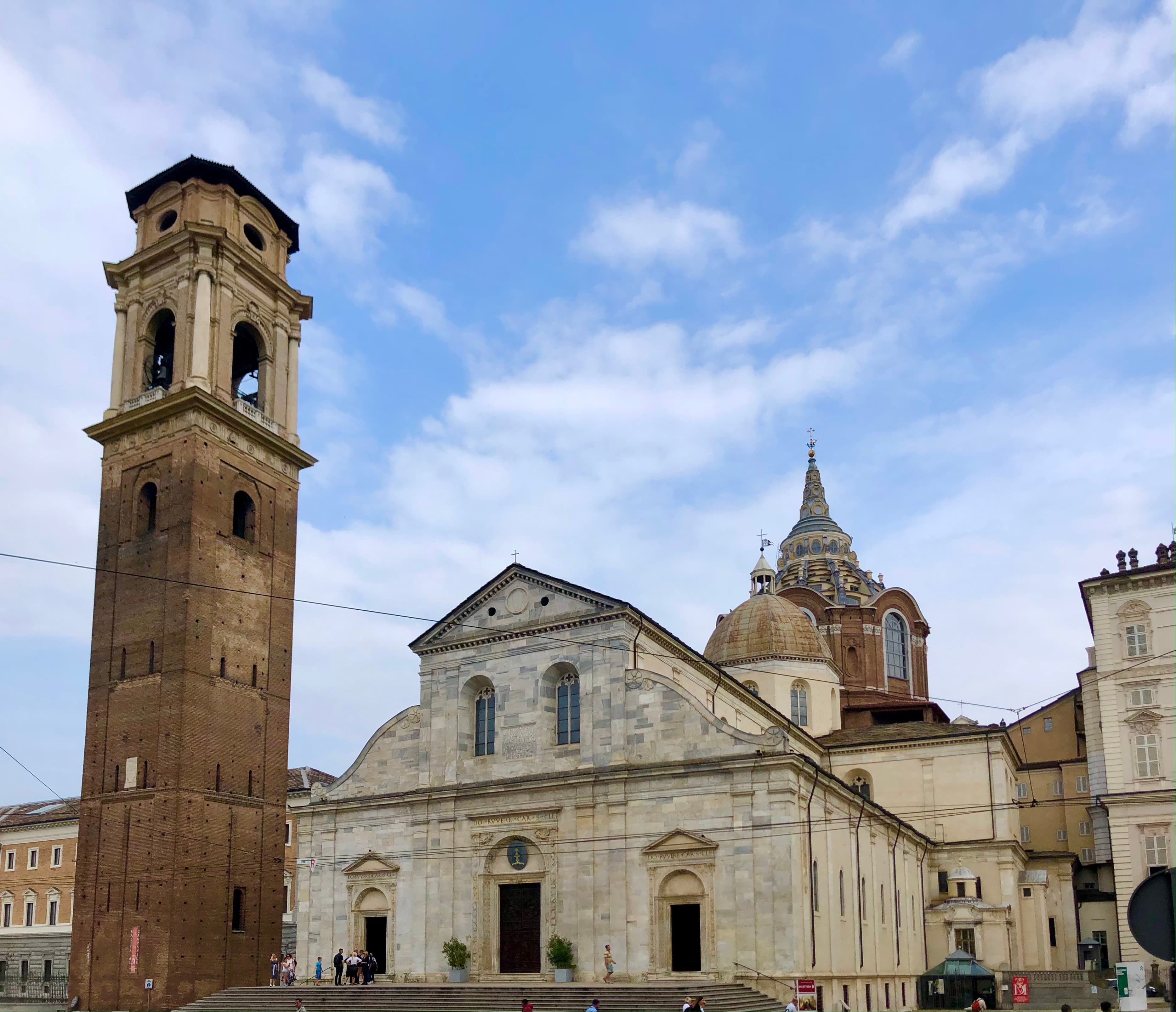
Turin Cathedral was built between 1491 and 1498 and adjoined by Guarino Guarini's Baroque Chapel of the Holy Shroud in the late 17th century. The Sacra Sindone — a linen cloth bearing the front-and-back image of a crucified man — has been kept here since 1578. Its authenticity is genuinely contested; the Vatican has never formally ruled.
Turin Cathedral is one of the most studied places in Christianity. Behind its plain Renaissance façade, completed in 1498, sits a relic that has shaped pilgrimage, science, and theology for four and a half centuries: the Sacra Sindone, a 4.4-by-1.1-metre linen cloth bearing the faint negative image of a crucified man, front and back. The cloth has been kept at Turin since 1578, when Emanuele Filiberto of Savoy moved it from Chambéry to shorten St. Charles Borromeo's pilgrimage from Milan. Adjoining the cathedral is the Chapel of the Holy Shroud designed by Guarino Guarini between 1668 and 1694 — a Baroque interior of geometric astonishment, almost destroyed in the 1997 fire and only fully reopened in 2018. The Shroud itself is not normally visible. It is housed in a sealed climate-controlled reliquary behind the high altar and shown publicly only at long jubilee intervals. The 1988 radiocarbon dating by three independent laboratories placed the textile in 1260–1390 AD; subsequent studies have argued for both earlier and later dates, and no peer-reviewed consensus has overturned the 1988 result. The Vatican has venerated the cloth without ever declaring it authentic. Pilgrims continue to come — to a relic the Church itself frames as an icon.
Context and lineage
Cardinal Domenico della Rovere commissioned the present cathedral between 1491 and 1498, replacing three earlier churches on the site. The Sacra Sindone has its own, separate history. Documented public exhibition begins in Lirey, France, in the 1350s, where Geoffroi de Charny showed the cloth — though older traditions, particularly those defended by Ian Wilson, attempt to identify it with the Mandylion / Image of Edessa kept in Constantinople until the Fourth Crusade of 1204. These earlier identifications are disputed. In 1453 Marguerite de Charny gave the cloth to the House of Savoy, who kept it in the Sainte-Chapelle of Chambéry, where it was damaged in a 1532 fire. In 1578 Emanuele Filiberto transferred it to Turin to shorten St. Charles Borromeo's pilgrimage from Milan. It has remained here ever since. Guarino Guarini's chapel, built 1668–1694, was designed specifically to house the relic with appropriate liturgical and political prominence. In 1997 a fire damaged the chapel severely; the Shroud was rescued by firefighters and survived intact.
Roman Catholic, Latin Rite. Metropolitan cathedral of the Archdiocese of Turin; the Archbishop serves ex officio as Custodian of the Holy Shroud, appointed by the Pope.
Meo del Caprino (Amedeo di Francesco da Settignano)
Tuscan architect of the cathedral, 1491–1498
Cardinal Domenico della Rovere
Patron of the cathedral's construction
Guarino Guarini
Theatine priest and architect of the Chapel of the Holy Shroud (1668–1694), one of the great Baroque interiors of Europe
Emanuele Filiberto, Duke of Savoy
Transferred the Shroud from Chambéry to Turin in 1578
Pope Benedict XVI
Venerated the Shroud during the 2010 Ostensione and described it as an 'icon' — the Vatican's characteristic non-declarative framing
Why this place is sacred
Few sacred spaces hold so many kinds of attention at once. The cathedral nave is Renaissance in proportion, restrained in ornament. The Guarini chapel, when accessible from the Royal Palace side, rises through layered hexagonal rings to a 'starburst' oculus that almost no photograph reads correctly — it must be stood under. The reliquary of the Shroud sits behind the high altar, sealed and ordinarily invisible, and yet most visitors pause there longest. The thinness of Turin Cathedral is partly liturgical — five and a half centuries of unbroken Mass on this spot — and partly something stranger. The presence of an object whose nature cannot be settled has accumulated a particular quality of attention. Turin is also a city of layered spiritual heritage: Don Bosco, Cottolengo, Pier Giorgio Frassati. The cathedral sits at the centre of that web. Pilgrims often arrive ready to argue one way or the other about the cloth and leave with the question changed.
Built 1491–1498 by the Tuscan architect Meo del Caprino on the site of three earlier churches (San Salvatore, Santa Maria de Dompno, San Giovanni Battista) as the metropolitan cathedral of Turin, dedicated to John the Baptist. The Chapel of the Holy Shroud was added 1668–1694 specifically to house the relic that the House of Savoy had brought to the city.
The cathedral has remained the seat of the Archdiocese of Turin since 1498. Successive architects refined it (Vittone, Juvarra). The Guarini chapel was nearly destroyed in the 1997 fire; the Shroud itself was saved by firefighters and a 21-year restoration of the chapel concluded with its reopening in 2018. The Archbishop of Turin serves ex officio as Custodian of the Holy Shroud, appointed by the Pope.
Traditions and practice
Public expositions of the Shroud — the Ostensioni — have historically punctuated the spiritual calendar of Catholic Europe. During an Ostensione, pilgrims pass before the displayed cloth in silence, in timed groups. The Confraternita del SS. Sudario, founded in 1598, holds its own prayer cycle around the relic. Solemn Pontifical Mass is celebrated on the feast of the Holy Shroud (4 May, Turin regional calendar). Stational liturgies and processions accompany Ostensione years.
Daily Mass and Divine Office continue in the cathedral year-round. Multilingual confessions are offered, especially in exposition years. The Diocesan Commission for the Shroud hosts catechetical and academic conferences. Between Ostensioni, devotion at the cathedral takes the quieter forms of candle, sit, intercession. The next public Ostensione has not been fixed as of 2026; the 2025 jubilee included a digital exposition with brief in-person showings to select pilgrim groups.
Most visits will not coincide with an Ostensione. This is fine. Approach the reliquary behind the high altar slowly. Whatever you think about the cloth, the practice of standing in front of an unresolved question for ten quiet minutes has its own value. Then walk through to the Guarini chapel via the Royal Palace — the chapel itself is a contemplative encounter independent of the relic question. The Museo della Sindone is best visited last; the cumulative weight of the photographic and scientific record is easier to absorb after the cathedral itself.
Roman Catholic (Latin Rite)
ActiveCustody of the Sacra Sindone — venerated by Catholics as the burial cloth of Jesus Christ or, in the more cautious formulation favoured by recent popes, as a unique icon of the Passion. Center of one of the most-attended devotional pilgrimages in Europe during exposition years.
Daily Mass and Divine Office; private veneration before the sealed reliquary year-round; public Ostensione at jubilee intervals; annual feast of the Holy Shroud (4 May, regional calendar); prayer cycle of the Confraternita del SS. Sudario.
Experience and perspectives
The cathedral entrance opens directly off the Piazza San Giovanni, in the historic core of Turin. The interior is calmer than visitors who expect Italian Baroque excess often anticipate — pale Renaissance proportion, three nave bays, restrained altars. Move slowly toward the high altar. The reliquary of the Shroud is set into the wall behind it, sealed and ordinarily invisible. Even without the cloth being shown, this is the spiritual heart of the building. Sit. Many pilgrims report a quality of attention here unlike other shrine visits. The Chapel of the Holy Shroud — Guarini's masterpiece — is no longer entered from the cathedral itself; the connecting door was sealed after the 1997 fire. Access is now via the Musei Reali / Royal Palace, on a separate ticket. The ascent into the chapel is staged: dark vestibule, then the slow rising of geometry to the oculus. Allow time. After the cathedral and chapel, the nearby Museo della Sindone holds the definitive scientific and devotional archive of the cloth — photographs, replicas, the long history of study.
Cathedral entrance from Piazza San Giovanni; reliquary behind the high altar; Guarini chapel via the Royal Palace / Musei Reali ticket; Museo della Sindone a few minutes' walk away.
The Shroud of Turin is genuinely contested. Honest engagement requires holding several frames in tension: the documentary record begins in 14th-century Lirey, the 1988 radiocarbon study placed the textile in 1260–1390, the image-formation mechanism is unresolved, and the Vatican has never formally declared authenticity.
Mainstream art history and the 1988 radiocarbon study by Oxford, Zurich, and Arizona laboratories (published in Nature, Damon et al. 1989) placed the cloth's textile in AD 1260–1390 at 95% confidence. Subsequent statistical re-analyses (Riani, Atkinson, Crosilla, Fanti 2013), the 2022 WAXS study by Giulio Fanti and colleagues, and the 2024 X-ray study by Liberato De Caro et al. at CNR have argued for an earlier date but have not produced a peer-reviewed consensus overturning the 1988 result. The image-formation mechanism — a high-resolution negative image at micron-thin depth in the linen fibres — has not been satisfactorily replicated by either authenticity-affirming or skeptical hypotheses. The cathedral as a building is securely dated to 1491–1498; the Guarini chapel to 1668–1694.
Catholic tradition, especially in Piedmont, holds the Shroud as the genuine burial cloth of Christ — a position never formally defined by the Magisterium. Recent popes (John Paul II, Benedict XVI, Francis) have venerated the cloth and described it as a powerful 'mirror of the Gospel' or 'icon' while leaving authenticity to scientific inquiry. Benedict XVI's 2010 address called it an icon that 'speaks of blood, of suffering.' This non-declarative theological framing is itself a long-standing pastoral choice.
A wide alternative literature proposes Templar custody of the cloth between 1204 and 1357 (Wilson, Frale), image-formation by corona discharge or earthquake-related radiation, or Leonardo da Vinci photographic forgery. The Leonardo hypothesis is anachronistic and widely rejected; the other hypotheses are speculative and lack peer-reviewed confirmation.
The mechanism producing the image remains the genuine open question. No satisfactory laboratory replication has been achieved of all the image's features in combination. The cloth's history before its 14th-century appearance in Lirey is contested. Honest engagement holds these uncertainties open rather than collapsing them in either direction.
Visit planning
Central Turin, 15 minutes' walk from Porta Nuova station (or 5 minutes from Porta Susa via tram). The cathedral is step-free at the south entrance. The Chapel of the Holy Shroud is accessed through the Royal Palace / Musei Reali, on a separate ticket; book online to avoid queues. The Shroud itself is not visible outside an Ostensione.
Full hotel infrastructure in central Turin; book months ahead for any future Ostensione.
Modest dress required throughout. Silence in front of the reliquary and in the Guarini chapel. No flash photography; no photography at all when the Shroud is exposed.
Shoulders and knees covered. No swimwear, beach attire, or athletic clothing. Hats removed by men inside the cathedral.
Permitted without flash in the cathedral nave. Strictly forbidden when the Shroud is exposed and inside the Guarini Chapel during liturgies.
Candle stands and donation boxes throughout. Conservation of the Shroud is funded in part by these donations.
Silence during Mass and in front of the Shroud reliquary. No food, drink, or running. Groups asked to remain together and to follow stewards' instructions, especially during Ostensione.
Plan your visit
Address
Piazza San Giovanni, 10122 Torino TO, Italy
Phone
Hours
Hours, fees, and access can change — verify on the official source before you travel. Practical details last checked Jun 2026.
Nearby sacred places
Sacred places within a half-day’s reach. Pilgrims often visit them together: walk one, stay for the other.

References
Sources consulted when researching this page. Independent verification by readers is welcome.
- 01Sindone — Sito ufficiale della Santa Sede / Diocesi di Torino — Arcidiocesi di Torinohigh-reliability
- 02Cattedrale di Torino — Arcidiocesi di Torino — Arcidiocesi di Torinohigh-reliability
- 03Turin Cathedral — Wikipedia — Wikipedia contributorshigh-reliability
- 04Shroud of Turin — Wikipedia — Wikipedia contributorshigh-reliability
- 05Chapel of the Holy Shroud — Wikipedia — Wikipedia contributorshigh-reliability
- 06Shroud of Turin — Encyclopædia Britannica — Encyclopædia Britannica editorshigh-reliability
- 07Radiocarbon dating of the Shroud of Turin — P.E. Damon, D.J. Donahue, B.H. Gore et al.high-reliability
- 08Veneration of the Holy Shroud — Address of Benedict XVI — Pope Benedict XVIhigh-reliability
- 09Why Shrouds the Faithful — Smithsonian Magazine coverage — Smithsonian Magazine
- 10Museo della Sindone — Turin — Confraternita del SS. Sudario / Museo della Sindone
Key questions
What pilgrims usually ask
- Why is Cathedral of Saint John the Baptist — Shroud of Turin considered sacred?
- Turin Cathedral keeps the Shroud — a contested linen image of a crucified man. Visit the Renaissance nave, Guarini chapel, and Museo della Sindone.
- What should I wear at Cathedral of Saint John the Baptist — Shroud of Turin?
- Shoulders and knees covered. No swimwear, beach attire, or athletic clothing. Hats removed by men inside the cathedral.
- Can I take photos at Cathedral of Saint John the Baptist — Shroud of Turin?
- Permitted without flash in the cathedral nave. Strictly forbidden when the Shroud is exposed and inside the Guarini Chapel during liturgies.
- How long should I spend at Cathedral of Saint John the Baptist — Shroud of Turin?
- 45–60 minutes for the cathedral. Add 60 minutes for the Guarini Chapel (via the Musei Reali ticket) and a further 60–90 minutes for the Museo della Sindone nearby.
- How do you visit Cathedral of Saint John the Baptist — Shroud of Turin?
- Central Turin, 15 minutes' walk from Porta Nuova station (or 5 minutes from Porta Susa via tram). The cathedral is step-free at the south entrance. The Chapel of the Holy Shroud is accessed through the Royal Palace / Musei Reali, on a separate ticket; book online to avoid queues. The Shroud itself is not visible outside an Ostensione.
- What offerings are appropriate at Cathedral of Saint John the Baptist — Shroud of Turin?
- Candle stands and donation boxes throughout. Conservation of the Shroud is funded in part by these donations.
- What etiquette should visitors follow at Cathedral of Saint John the Baptist — Shroud of Turin?
- Modest dress required throughout. Silence in front of the reliquary and in the Guarini chapel. No flash photography; no photography at all when the Shroud is exposed.
- What is the history of Cathedral of Saint John the Baptist — Shroud of Turin?
- Cardinal Domenico della Rovere commissioned the present cathedral between 1491 and 1498, replacing three earlier churches on the site. The Sacra Sindone has its own, separate history. Documented public exhibition begins in Lirey, France, in the 1350s, where Geoffroi de Charny showed the cloth — though older traditions, particularly those defended by Ian Wilson, attempt to identify it with the Mandylion / Image of Edessa kept in Constantinople until the Fourth Crusade of 1204. These earlier identifications are disputed. In 1453 Marguerite de Charny gave the cloth to the House of Savoy, who kept it in the Sainte-Chapelle of Chambéry, where it was damaged in a 1532 fire. In 1578 Emanuele Filiberto transferred it to Turin to shorten St. Charles Borromeo's pilgrimage from Milan. It has remained here ever since. Guarino Guarini's chapel, built 1668–1694, was designed specifically to house the relic with appropriate liturgical and political prominence. In 1997 a fire damaged the chapel severely; the Shroud was rescued by firefighters and survived intact.