Santuario di N.S. di Oropa, Italy
Black Madonna of the Alps, crowned every hundred years
Understand sacred places, explore living traditions, and learn how to engage respectfully with Pilgrim Map.
Access has not been verified. Check current local guidance before planning a visit.
Biella, Biella, Italy
Read the sources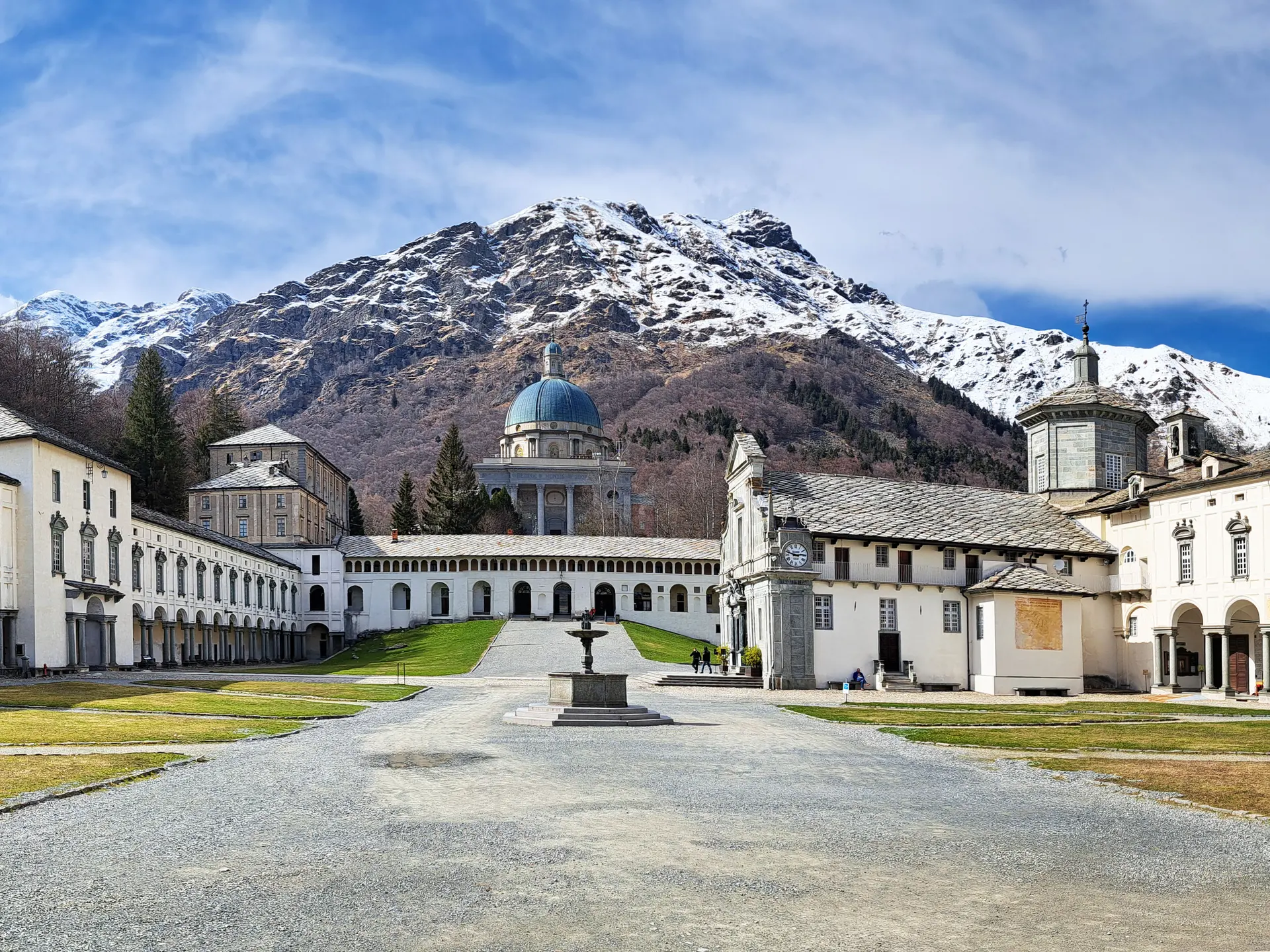
Image of Santuario di N.S. di Oropa, Italy. Image source · CC-BY-SA-4.0
Visit essentials
A quick read before you go
- Duration
- Half day to full day.
- Access
- Car: From Biella take SP144 (25 min).
Overview
Above Biella, through chestnut forest and mountain meadow, Oropa fills an Alpine valley at over a thousand meters. It is the Alps' largest sanctuary dedicated to the Virgin Mary and a centuries-old pilgrimage site.
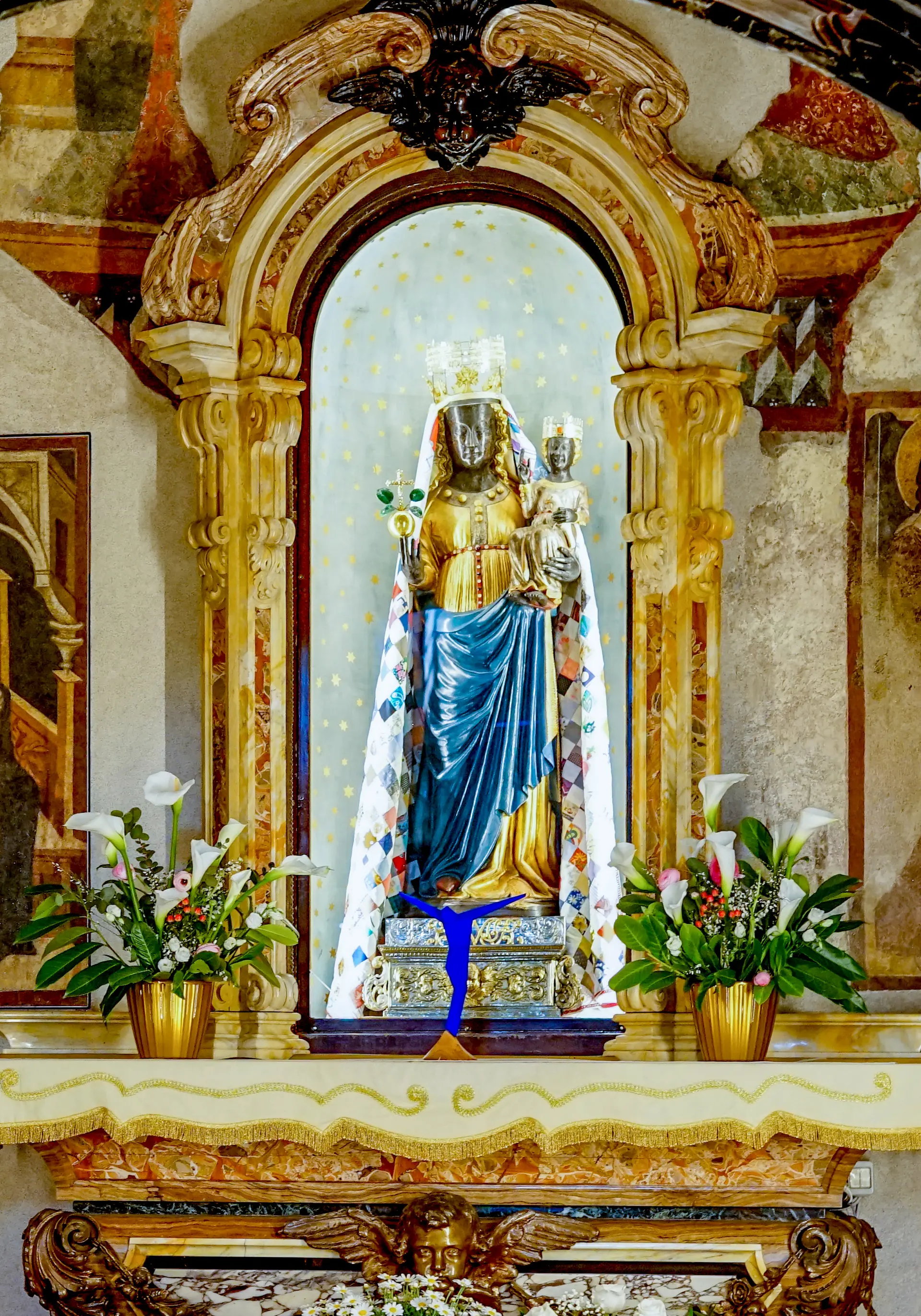
The Ancient Basilica, completed in 1620, holds the Black Madonna. Her dark face is worn smooth by veneration; tradition says pilgrims may touch her foot for blessing. Legend holds that Saint Eusebius of Vercelli brought the image from Jerusalem in the 4th century after divine revelation during Holy Land exile. Art historians instead date the Valle d'Aosta sculptor's carving to the 13th century. For eight hundred thousand annual pilgrims, she intercedes.
The first papal coronation came in 1620, when the plague that had ravaged Biella lifted, followed in 1720, 1820, 1920, and most recently 2021, granted by Pope Francis.
The 17th-century Ancient Basilica, Filippo Juvarra's 18th-century Royal Gate reflecting Savoy patronage, and Upper Basilica built from 1885 to 1960 chart the sanctuary's growth. The Upper Basilica's 80-meter dome shelters three thousand worshippers. Beside it, the UNESCO World Heritage Sacro Monte offers 19 chapels depicting Mary's life.
Sites inside
Why this place is sacred
The legend of Oropa begins with Saint Eusebius of Vercelli, the 4th-century bishop exiled to the Holy Land for opposing Arianism. During his time in Jerusalem, according to tradition, divine inspiration led him to three statues buried under ancient ruins—images carved by Saint Luke himself.
Returning to Italy, Eusebius distributed the statues: one to Crea in Monferrato, one to Cagliari in his native Sardinia, and the third to a cave at Oropa that was already, tradition claims, a pre-Christian holy site.
Art historians tell a different story: the Black Madonna of Oropa was carved in the 13th century by a sculptor from Valle d'Aosta, using Swiss pinewood (Pinus cembra). The statue shows the Virgin and Child in a style consistent with Gothic sacred sculpture. But the historical dating does not diminish the devotional reality. What matters to pilgrims is not when the statue was carved but what it has become through centuries of veneration—and what they experience before it.
Popular belief attributes miraculous qualities to the Madonna. Despite centuries of existence, the wooden statue reportedly shows no woodworm damage. The foot that countless pilgrims have touched remains unworn. Dust does not settle on the faces of Mother and Child. Whether these claims can withstand scientific examination is beside the point; they express devotion's conviction that this image is set apart.
The centennial coronations formalize what pilgrims have always known. In 1599, plague devastated Biella. The municipality vowed that if the epidemic ended, they would build a worthy sanctuary. The plague subsided; the Ancient Basilica was completed by 1620, and Pope Paul V authorized the first coronation. The tradition has continued every hundred years since—papal acknowledgment of an ongoing devotion.
The Sacro Monte adjacent to the sanctuary extends the devotional experience through 19 chapels (12 original, 7 added) depicting scenes from Mary's life. Created between 1617 and 1720, this path offers contemplative walking through the narrative of salvation—a Counter-Reformation response to the Protestant rejection of images, making the gospel story physically present.
The Alpine setting itself contributes to thinness. At 1,159 meters, Oropa is separated from the lowland world by altitude as well as intention. The road ascending from Biella passes through changing vegetation zones; the air cools; the mountains close in. Arriving at the sanctuary, pilgrims have already made a journey that sets the visit apart from ordinary experience.
Traditional: cave used as pre-Christian sacred site; 4th-century placement of Black Madonna by Saint Eusebius. Historical: 13th-century statue; sanctuary complex primarily 17th century onward, developed after 1599 plague vow.
Ancient Basilica completed 1620 with first papal coronation. 18th century: Royal Gate by Filippo Juvarra, Savoy royal apartments. 1617-1720: Sacro Monte chapels constructed. 1885-1960: Upper Basilica built. 2003: UNESCO World Heritage inscription. 2021: Pope Francis grants pontifical coronation.
Experience and orientation
The journey to Oropa begins with ascent. From Biella, the road climbs through 13 kilometers of mountain terrain—chestnut forests giving way to higher vegetation, views opening across the Biellese Alps. The sanctuary appears around a final turn, its buildings filling a small Alpine valley: courtyards, basilicas, hospitality buildings, the Sacro Monte rising above.
Entering the main courtyard, visitors encounter the accumulated architecture of centuries. The Ancient Basilica (17th century) stands to one side, relatively modest in scale but containing the essential object of pilgrimage. Inside, the Black Madonna occupies her shrine—a darkened wooden face, centuries of prayer concentrated in one image. Pilgrims approach to pray, to touch the foot if tradition allows, to light candles. The space is intimate, devotional, heavy with accumulated reverence.
The Upper Basilica, constructed 1885-1960, provides contrast: a monumental neo-Byzantine structure with an 80-meter dome, capable of holding 3,000 worshippers. On major feast days and pilgrimages, this space fills. The architecture speaks of 19th and 20th-century confidence—Marian devotion given monumental expression.
The Sacro Monte ascends the hillside above the sanctuary. Created 1617-1720 as part of the Counter-Reformation's use of devotional landscapes, the path leads through 19 chapels depicting scenes from Mary's life. Inside each chapel, life-sized sculptural scenes make the gospel narrative present. Walking the path takes one to two hours, combining physical pilgrimage with contemplative meditation.
The Alpine setting pervades the experience. At over 1,100 meters, Oropa is cool even in summer; winter brings snow. Mountain views surround the sanctuary. A cable car ascends to Lake Mucrone at 1,900 meters for those seeking higher peaks. A botanical garden showcases Alpine flora. The sanctuary offers hospitality for those staying overnight—monastic peace in the mountains.
The Sanctuary of Oropa lies in the Biellese Alps, 13 kilometers northwest of Biella at 1,159 meters elevation. The complex includes the Ancient Basilica (Black Madonna), Upper Basilica, courtyards, hospitality buildings, and the adjacent Sacro Monte UNESCO site.
Context and lineage
According to tradition, Saint Eusebius of Vercelli—exiled to the Holy Land in the 4th century for opposing Arianism—was divinely led to three statues buried under ancient ruins in Jerusalem. Returning to Italy, he placed one at Crea, one in Cagliari, and the third in a cave at Oropa that was already a pre-Christian sacred site. Art historians date the Black Madonna to the 13th century, the work of a sculptor from Valle d'Aosta using Swiss pinewood.
Whether 4th century or 13th, the devotion has grown across centuries, formalized by centennial papal coronations (1620, 1720, 1820, 1920, 2021) and visited by 800,000 pilgrims annually.
The Sanctuary of Oropa is administered by the Diocese of Biella. The Sacro Monte is part of the UNESCO-inscribed 'Sacri Monti of Piedmont and Lombardy' (2003). The sanctuary maintains Marian pilgrimage traditions going back centuries.
Saint Eusebius of Vercelli
Filippo Juvarra
Blessed Pier Giorgio Frassati
Pope Francis
Traditions and practice
Veneration of the Black Madonna, traditionally since the 4th century. Centennial papal coronations (1620, 1720, 1820, 1920, 2021). Sacro Monte devotional walks through scenes of Mary's life. Touching the Madonna's foot for blessing.
Daily Mass in Ancient and Upper Basilicas. Pilgrimage visits to Black Madonna. Sacro Monte contemplative walks. Overnight retreats in sanctuary hospitality. Cable car access to Lake Mucrone. Botanical garden visits.
Arrive in morning for quieter devotion. Begin with the Ancient Basilica to venerate the Black Madonna. Attend Mass if schedule permits. Walk the Sacro Monte path (1-2 hours) through the 19 chapels. Visit the Upper Basilica to appreciate its scale. Consider staying overnight for mountain retreat atmosphere.
Roman Catholicism
ActiveThe largest Marian sanctuary in the Alps. Black Madonna traditionally attributed to Saint Eusebius of Vercelli (4th century); art historically dated to 13th century. Centennial papal coronations (1620, 1720, 1820, 1920, 2021). 800,000 annual pilgrims. Sacro Monte UNESCO World Heritage Site. Blessed Pier Giorgio Frassati known for devotion here.
Daily Mass, veneration of Black Madonna, touching the Madonna's foot, Sacro Monte devotional walk, monastic hospitality, centennial coronation ceremonies.
Perspectives and open questions
Oropa offers encounter with Alpine Marian devotion at its most concentrated—Black Madonna, centennial coronations, Sacro Monte path, 800,000 annual pilgrims ascending the mountain.
Scholarly perspective
Art historians date the Black Madonna to the 13th century, attributing it to a sculptor from Valle d'Aosta—not to Saint Eusebius or Saint Luke as tradition holds. The sanctuary complex developed primarily from the 17th century after the plague vow. The Sacro Monte represents Counter-Reformation devotional landscape design, part of a network of similar sites across northern Italy inscribed as UNESCO World Heritage.
Living and traditional perspectives
Catholic tradition maintains that Saint Eusebius of Vercelli brought the statue from Jerusalem in the 4th century. The statue's miraculous preservation (no woodworm, no dust, unworn foot) testifies to divine favor. The centennial papal coronations confirm the Madonna's ongoing intercessory power. Blessed Pier Giorgio Frassati's devotion here exemplifies the site's spiritual potency.
Alternative interpretations
The pre-Christian sacred site tradition suggests continuity between earlier goddess veneration and the Black Madonna cult. The Black Madonna phenomenon across Europe has attracted various interpretations—connections to Isis, to earth-goddess worship, to the Magdalene tradition. Oropa's Alpine isolation and the statue's dark coloration invite such readings.
Open questions
The actual origins of devotion at this site before the historical record. Whether the cave was indeed a pre-Christian sacred place. The cause of the statue's darkening (age, smoke, intentional painting, or other). The nature of the alleged miraculous preservation.
Plan your visit
Access and arrival
Car: From Biella take SP144 (25 min). Free parking. Bus: #360 from Biella S. Paolo station (40 min). Train: FS to Biella S. Paolo, then bus.
Sanctuary hospitality offers overnight stays (Casa per Ferie). Hotels in Biella. Camper parking with facilities available.
Respectful visit
Modest dress required in basilicas—shoulders and knees covered. Mountain weather can be cool; dress warmly.
Photography generally permitted. No flash near the Black Madonna. No photography during Mass or services.
Candles available. Donations appreciated. Hospitality fees for overnight stays.
Quiet and reverence in basilicas | Appropriate dress in sacred spaces | Mountain weather precautions
Mountain weather can change quickly—dress appropriately. Winter brings snow and possible road closures. Major feast days (especially August 15) bring crowds.
Current practical details
Address
Via Santuario D'Oropa, 480, 13900 Oropa BI, Italy
Phone
Hours
Hours, fees, and access can change — verify on the official source before you travel. Practical details last checked Jun 2026.
Location
Map loads as you approach this section.
Pilgrim reflections
A portrait of encounter, not a score
Pilgrims describe what they felt, how present they could become, and whether the place would shape a journey. There are no stars and no ranking of traditions.
No reviewed reflections yet
The first pilgrims can help describe the character of being here.
Share a reflection
Available after an account-backed “Been there.” Every reflection is reviewed before publication.
Nearby sacred places
Explore other sacred places in the region. Proximity does not establish access or travel time; check each place’s guidance.

References
Sources consulted for this page. Source categories describe the publication, not a guarantee that every claim is verified. Traditional accounts and outside interpretations may differ.
- 01Home - Santuario di Oropa — Santuario di OropaofficialOfficial sanctuary website with hours and services
- 02Sacro Monte of Oropa — Sacri Monti OfficialofficialUNESCO Sacri Monti information
- 03Sanctuary of Oropa - Italia.it — ENIT - Italian National Tourist BoardofficialOfficial Italian tourism information
- 04Sanctuary of Oropa - Wikipedia — Wikipedia contributorsencyclopediaComprehensive overview of history and structures
- 05The Black Madonna of Oropa — Interfaith Mary PageSource contextBlack Madonna devotional context
Share a photo
Help visitors recognize Santuario di N.S. di Oropa, Italy. Every submission is reviewed before publication.