Sacro Monte di Varallo
A Renaissance New Jerusalem in the Alps, where 800 life-size figures enact the Passion in forty-five chapels
Understand sacred places, explore living traditions, and learn how to engage respectfully with Pilgrim Map.
Access has not been verified. Check current local guidance before planning a visit.
Varallo, Vercelli, Italy
Read the sources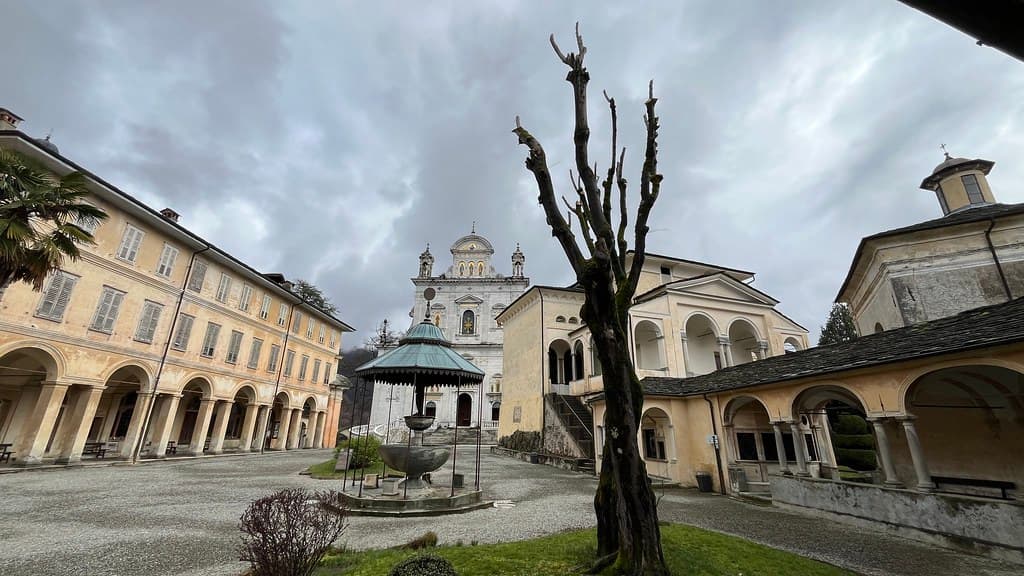
Image of Sacro Monte di Varallo. Image source
Visit essentials
A quick read before you go
- Duration
- 3-5 hours for all chapels; full day recommended with Varallo town
- Access
- Varallo is in the Valsesia valley, about 100 km north of Turin.
Overview
Sacro Monte di Varallo arose as Jerusalem became increasingly dangerous for Christian pilgrims under late-fifteenth-century Ottoman expansion. Bernardino Caimi, a Franciscan friar and former rector of the Palestinian Holy Places, returned to Italy determined to bring Jerusalem to those unable to reach it.
Beginning in 1491 on a mountainside above Varallo in the Valsesia valley, the complex grew over centuries to forty-five chapels narrating Christ's entire life and Passion. More than eight hundred life-size polychrome figures inhabit rooms integrated with illusionistic frescoes. Gaudenzio Ferrari, the Valsesian artist responsible for the earliest and greatest figures, combined sculpture and painting until representation seemed to merge with reality.
After 1565 Galeazzo Alessi recast the complex in a more ordered Renaissance idiom, although only parts of his plan were realized. The result layers medieval and Renaissance devotional ambition across five centuries. In 2003 UNESCO inscribed it as part of the nine Sacri Monti of Piedmont and Lombardy.
The Sacro Monte is not a museum. Its summit basilica holds regular services, while the pilgrimage route ascends from town through increasingly dense chapel clusters in its original devotional shape. Pilgrims move spatially through the Annunciation, Nativity, ministry, Passion, and Resurrection as inhabited rooms, an immersive sacred narrative that predates digital technology.
Why this place is sacred
The genius of the Sacro Monte di Varallo is spatial. Most sacred art addresses the viewer from a wall, an altar, or a frame. Here, the viewer steps into the scene. The chapels are rooms, and the figures within them are not representations of people — they are the size of people, modeled to resemble people, positioned as people would stand or kneel or suffer.
The frescoes on the surrounding walls extend the scenes beyond the edges of the sculptural groups, creating a continuous environment that the eye cannot entirely separate from reality.
Gaudenzio Ferrari understood this effect with uncanny precision. His Crucifixion chapel, created around 1513, is among the most overwhelming works of art in the Western tradition. Life-size soldiers, mourners, and criminals occupy a space that the fresco behind them extends into an illusionistic landscape. The boundary between the three-dimensional and the two-dimensional blurs. The viewer, standing behind a screen, becomes part of the crowd — neither fully inside the scene nor entirely outside it.
This threshold quality is the essence of the site's thinness. The chapels were designed to produce a specific spiritual effect: the dissolution of the distance between the pilgrim and the events of salvation history. Whether one experiences this as a religious encounter or as an encounter with the power of art, the effect is the same — the ordinary relationship between self and representation collapses, and something else takes its place.
The mountain setting amplifies this. The ascent from Varallo town creates a natural pilgrimage arc — leaving the everyday world, climbing through increasingly concentrated sacred space, arriving at the summit where the basilica marks the end of the narrative and the return to the present.
Conceived by Bernardino Caimi in 1491 as a substitute for the Holy Land pilgrimage — a 'New Jerusalem' where the faithful could walk through the life of Christ without crossing the Mediterranean.
From Caimi's original chapels through Ferrari's revolutionary art, Alessi's Renaissance redesign, and centuries of subsequent additions, the Sacro Monte has evolved from a Franciscan devotional experiment into a UNESCO World Heritage Site recognized as one of the most extraordinary achievements of European sacred art.
Experience and orientation
The approach begins in the town of Varallo, where a cable car or a walking path carries you up to the Sacro Monte complex. The transition from town to mountain, from commerce to contemplation, establishes the pilgrimage's fundamental rhythm.
The first chapels narrate the early life of Christ — Annunciation, Nativity, the Flight into Egypt — and the figures here are often gentler, more intimate. Rooms of modest scale contain domestic scenes rendered with remarkable tenderness. The polychrome statues, their faces painted with expressions that shift depending on your angle, seem to breathe. The frescoes on the walls behind them extend the scenes seamlessly, so that the three-dimensional figures appear to inhabit a continuous space.
As the narrative progresses toward the Passion, the emotional intensity increases. The chapels grow larger, the crowds of figures more dense, the expressions more anguished. Gaudenzio Ferrari's contributions — particularly the great Crucifixion wall, over ten metres wide and eight metres high — represent the summit of the art form. Here, painting and sculpture are so thoroughly integrated that the eye cannot immediately determine where one ends and the other begins.
The Crucifixion scene, with its crowd of life-size mourners and soldiers, produces an effect closer to theater than to gallery.
You view the chapels through protective screens, which create a sense of looking into another world rather than standing within it. This slight separation is itself part of the experience — the sacred narrative remains just beyond reach, close enough to feel but impossible to touch.
The basilica at the summit provides a conclusion to the ascent. Its interior is restrained compared to the chapels, as though the journey through narrative required a moment of architectural silence before the return.
Take the cable car or walk up from Varallo. Follow the chapels in narrative sequence — resist the temptation to skip ahead. Allow three to five hours for the full circuit. Spend the longest time at the Crucifixion scenes and Ferrari's masterworks. End at the basilica. The descent offers views of the Valsesia valley that provide a gentle re-entry into the ordinary world.
Context and lineage
Bernardino Caimi served as rector of the Palestinian Holy Places and as an ambassador to the Spanish court before returning to Italy with a vision. The Ottoman expansion was making the Holy Land increasingly dangerous for Christian pilgrims, and Caimi believed that the sacred geography of Jerusalem could be recreated in the Italian Alps.
He chose Varallo's mountainside and began building chapels that would physically embody the narrative of Christ's life — not as paintings on walls but as inhabited rooms filled with life-size figures.
The Sacro Monte di Varallo is the oldest and most artistically significant of the nine Sacri Monti of Piedmont and Lombardy. It initiated a movement that would spread across northern Italy, producing sacred mountains dedicated to various devotional themes. The concept of immersive sacred narrative — pilgrims walking through inhabited scenes — represents a unique contribution to the history of religious art and architecture.
Blessed Bernardino Caimi
Franciscan friar who founded the Sacro Monte in 1491 after serving as rector of the Holy Land
Gaudenzio Ferrari
Valsesian artist whose life-size polychrome sculptures and integrated frescoes represent the artistic summit of the Sacro Monte
Galeazzo Alessi
Renaissance architect commissioned after 1565 to redesign and expand the complex
Traditions and practice
The traditional practice is to walk the chapels in the order of Christ's life, pausing at each for prayer and contemplation. The pilgrimage route was designed to create a cumulative emotional and spiritual effect, moving from the joy of the Nativity through the agony of the Passion to the hope of the Resurrection. Holy Week observances at the basilica connect the site to the liturgical calendar.
The site is freely accessible year-round. The cable car from Varallo provides access for those unable to walk the ascent. Cultural tourism and art history visits complement the devotional tradition. The UNESCO designation has brought international attention and conservation investment.
Walk the chapels in narrative sequence, spending at least three hours. Pause at each chapel to read the scene before moving on. At the Crucifixion chapels, allow significant time — the artistry rewards sustained attention. If possible, visit on a weekday morning when the crowds are thinner and the silence allows the chapels to work their intended effect.
Roman Catholicism - Franciscan
ActiveThe oldest and most artistically significant of the nine Sacri Monti, founded to bring the Holy Land to northern Italy
Pilgrimage through 45 chapels depicting Christ's life; Mass in the basilica
Perspectives and open questions
The Sacro Monte di Varallo can be approached as a devotional pilgrimage, an art historical masterpiece, an experiment in immersive narrative, or all three simultaneously.
Scholarly perspective
Art historians regard the Sacro Monte as one of the most extraordinary achievements of northern Italian Renaissance art. Gaudenzio Ferrari's integration of sculpture and painting — the paragone between the arts — is recognized as a unique contribution to the history of representation. Scholars of the Counter-Reformation study the site as a key document of post-Tridentine spirituality, designed to make sacred narrative emotionally immediate.
Living and traditional perspectives
Within Catholic tradition, the Sacro Monte represents the Franciscan ideal of bringing the Holy Land to the faithful. The experience of walking through Christ's life spatially — encountering his birth, ministry, suffering, and resurrection as a physical journey — embodies a form of devotion that engages the whole body, not just the mind.
Alternative interpretations
Contemporary observers have noted parallels between the Sacro Monte and modern immersive art installations, virtual reality, and participatory theater. The chapel experience — standing before life-size figures in a painted environment, neither fully inside nor fully outside the scene — anticipates questions about representation, presence, and illusion that remain urgent in contemporary art.
Open questions
The degree to which Caimi's original layout intentionally mirrored the topography of actual Jerusalem remains debated. The relationship between the site's spiritual purpose and its artistic ambition — were Ferrari's masterworks primarily devotional tools or autonomous works of genius? — continues to generate productive disagreement.
Plan your visit
Access and arrival
Varallo is in the Valsesia valley, about 100 km north of Turin. Accessible by car (A26 motorway) or by train from Novara. A cable car runs from Varallo town center to the Sacro Monte.
Hotels and B&Bs in Varallo and surrounding Valsesia valley towns.
Respectful visit
Comfortable walking clothes and shoes for the mountain paths. Modest dress for the basilica.
Photography is permitted in most areas but the protective screens make interior shots challenging. Flash photography should be avoided.
Available in the basilica.
Do not attempt to enter the chapels or reach past the screens | Stay on marked paths | Respect the silence of the pilgrimage route | Some chapels may be closed for restoration
The full circuit requires several hours and involves significant walking on mountain paths. Some chapels may be closed for restoration. The protective screens can make photography difficult — accept that some experiences here resist capture.
Current practical details
Address
Piazza G. Testori, 13019 Varallo VC, Italy
Phone
Hours, fees, and access can change — verify on the official source before you travel. Practical details last checked Jun 2026.
Location
Map loads as you approach this section.
Pilgrim reflections
A portrait of encounter, not a score
Pilgrims describe what they felt, how present they could become, and whether the place would shape a journey. There are no stars and no ranking of traditions.
No reviewed reflections yet
The first pilgrims can help describe the character of being here.
Share a reflection
Available after an account-backed “Been there.” Every reflection is reviewed before publication.
Nearby sacred places
Explore other sacred places in the region. Proximity does not establish access or travel time; check each place’s guidance.

References
Sources consulted for this page. Source categories describe the publication, not a guarantee that every claim is verified. Traditional accounts and outside interpretations may differ.
- 01Sacro Monte of Varallo - Sacri Monti official site — Sacri MontiofficialOfficial Sacri Monti management body with detailed history and visitor info
- 02Sacri Monti of Piedmont and Lombardy - UNESCO — UNESCO World Heritage CentreofficialOfficial UNESCO listing with Outstanding Universal Value statement
- 03Reality or Illusion? Pilgrimage and Paragone at the Sacro Monte di Varallo — The CourtauldacademicAcademic analysis of the immersive pilgrimage experience and artistic paragone
- 04Sacro Monte di Varallo - Wikipedia — Wikipedia contributorsencyclopediaGeneral overview of history, art, and UNESCO status
- 05Visit the Sacred Mountain of Varallo - Valsesia Travel — Valsesia TravelofficialPractical visitor guide with cable car and access information
- 06Sacro Monte di Varallo – A 21st Century Pilgrimage — Backpackers in the WorldguideContemporary visitor account with practical details
Share a photo
Help visitors recognize Sacro Monte di Varallo. Every submission is reviewed before publication.