Aspendos
The best-preserved Roman theatre in the world — still standing as built, still echoing with human voices after eighteen centuries
Understand sacred places, explore living traditions, and learn how to engage respectfully with Pilgrim Map.
Access has not been verified. Check current local guidance before planning a visit.
Antalya, Turkey
Read the sources
Image of Aspendos. Image source
Station 2 of 7
St Paul TrailVisit essentials
A quick read before you go
- Duration
- 2 hours for a thorough site visit including theatre, acropolis, and aqueduct viewpoint.
- Access
- 47 km east of Antalya, 4 km north of the Mediterranean coast near Serik, on the banks of the…
Overview
Aspendos preserves an ancient theatre with unusual completeness: its two-story scaenae frons, niches, arched gallery, and curving cavea still answer one another as designed. Architects Zeno and Theodoros built it in the late 2nd or early 3rd century CE, when trade in salt, olive oil, and wool made the Pamphylian city prosperous.
In the 12th century the Seljuks reused part of the theatre as a palace and caravanserai, leaving red zigzag decoration on its interior walls; that continuing recognition helped the structure survive essentially intact. Beyond it, the ancient city extends over two hills and into the Eurymedon River valley, with an agora, basilica, temples, nymphaeum, and an exceptional Roman aqueduct whose water towers rise thirty meters against the Taurus Mountains.
Most Roman theatres survive as outlines; Aspendos still communicates the whole performance space.
Why this place is sacred
The founding legend of Aspendos matters more than it might seem. The city was established by Argive colonists under the seer Mopsus, who in different versions of the myth is either the son of Apollo and the prophetess Manto (herself the daughter of the blind seer Tiresias) or the son of Rhacius of Caria. In either version, Mopsus carries the lineage of oracular power — he is the offspring of prophecy, which in Greek thought was also a divine gift.
A city founded by such a figure was not merely settled but consecrated: its establishment was understood as divinely guided and therefore divinely sanctioned. The cults that the Argive colonists brought — Hera, Demeter, Apollo — reinforced this sacred foundation. The city's extraordinary prosperity (its name on coinage from the 5th century BCE onward; Alexander the Great demanding tribute in 333 BCE) was understood as evidence of divine favor. The theatre adds another layer of sacredness.
Greek theatrical performance originated as religious ritual — the festivals of Dionysus within which tragedy and comedy were performed were acts of collective worship. The Roman theatre that stands at Aspendos preserved this religious origin in its form even as the content of performances became more secular: the cavea still faces the stage in the disposition of a congregation before an altar, the performance still requiring collective presence and collective attention.
To sit in the Aspendos theatre today is to participate in a form whose sacred dimensions are structural, not incidental.
City founded under prophetic divine guidance by the legendary seer Mopsus; its theatrical, civic, and religious traditions were understood as unified aspects of a single divinely sanctioned community.
From post-Trojan War Argive colonial settlement (c.
1000–800 BCE) with Hera, Demeter, and Apollo cults → prosperous Pamphylian city with Alexander's passage (333 BCE) → Roman-period zenith with construction of the theatre, aqueduct, and civic monuments (2nd–3rd century CE) → decline after Arab raids (7th century CE) → Seljuk reuse of the theatre as palace/caravanserai (12th century CE) → abandoned ancient city with preserved theatre → modern archaeological site (excavations from 2008) and UNESCO Tentative List (2015) → annual international opera festival (from 1994).
Experience and orientation
The approach to Aspendos across the flat Pamphylian plain gives you the theatre's exterior walls and the distant silhouette of the Taurus mountains behind them — a composition that makes the scale of the structure apparent before you enter. Pass through the entrance gate and follow the path upward to the theatre's vaulted entrance tunnels. Step through.
The scaenae frons rises directly in front of you, two stories high, its rows of decorative niches (originally filled with statues) intact, the arched gallery of the upper story still holding its form. The orchestra floor, originally paved, shows the marks of centuries. The cavea seating rises in a single sweep to the top of the theatre, where the rear wall still stands with its upper gallery.
Look carefully at the lower interior walls and you can see the red zigzag geometric patterns applied by the Seljuks in the 12th century — a layer of history that the theatre absorbed and carries.
The acoustics of the theatre are legendary: voices carry from the stage to the uppermost seats with clarity, and the sound of the surrounding landscape — wind, birds, occasionally the distant sound of the Köprüçay River — enters the acoustic space and is shaped by it.
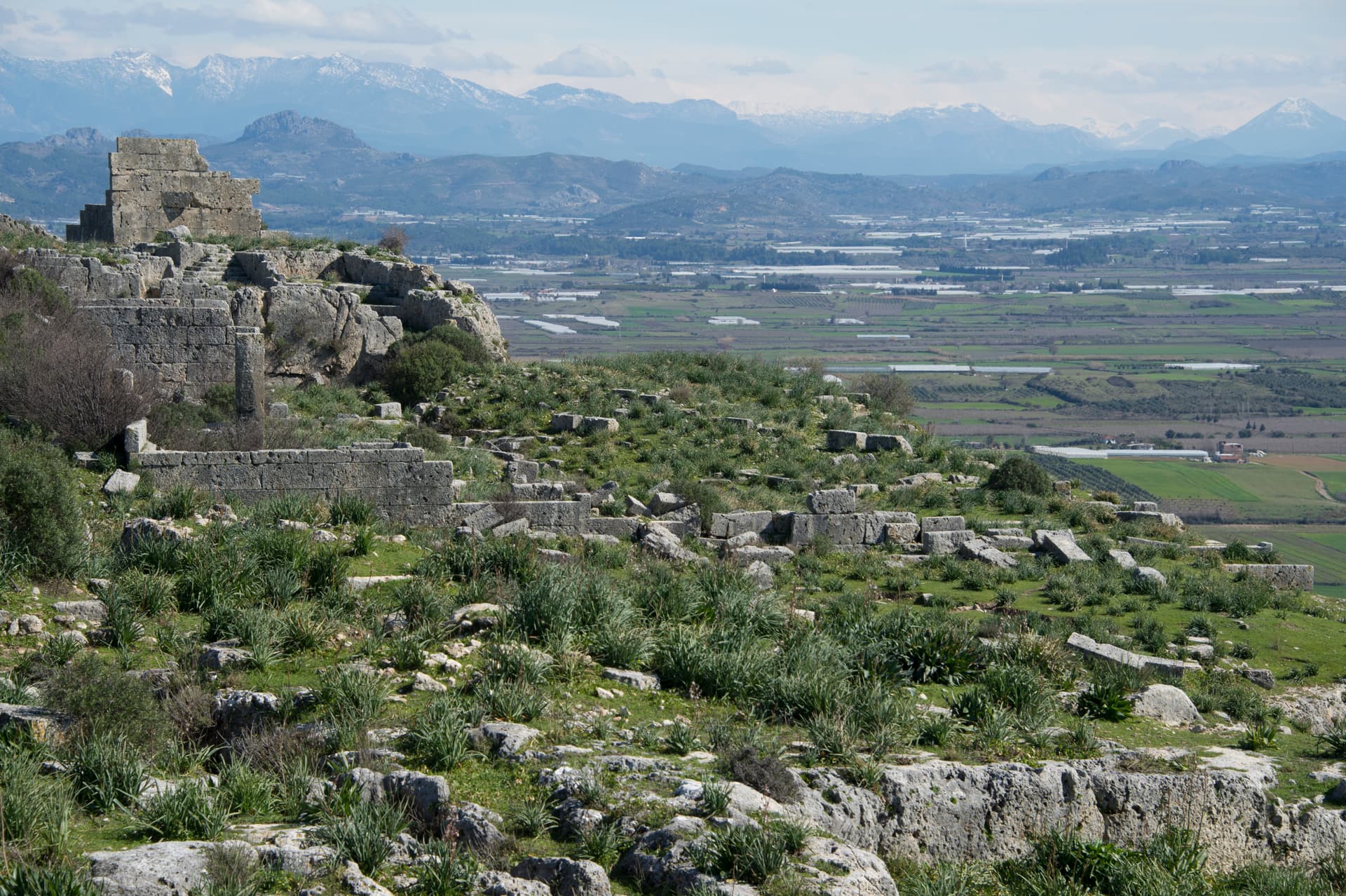
After the theatre, the acropolis hill behind it holds the ruins of the agora, basilica, and nymphaeum — worth the climb for the view of the aqueduct below and the river valley extending south toward the coast. The aqueduct's water towers, visible at a distance, are among the finest surviving examples of Roman hydraulic engineering.
Let them register as engineering at the service of life itself: fresh water crossing kilometers of valley on a structure that still stands, 1,800 years later.
Enter from the main site gate (parking available). The theatre is a 5-minute walk from the entrance. After the theatre, follow the path up to the acropolis for the agora and views. The aqueduct is visible from the acropolis and also accessible from the approach road. Entrance fee applies; audio guide strongly recommended due to limited on-site signage. No significant shade on site — bring water.
Context and lineage
Aspendos was founded by Argive colonists after the Trojan War under the leadership of the seer Mopsus — a figure who appears across multiple founding myths of Pamphylian and Cilician cities as the embodiment of oracular authority. Mopsus was the son of Apollo (the oracular god) and Manto (daughter of the blind prophet Tiresias), or in other versions the son of the Carian Rhacius.
A bilingual Phoenician-Luwian inscription from 8th-century BCE Karatepe in Turkey names a king from the 'Muksas' dynasty — a name closely cognate with Mopsus — suggesting that the founding legend preserves a genuine historical memory of a prophetic dynasty that colonized coastal Anatolia in the post-Bronze Age period. The Argive colonists brought with them the cults of Hera and Demeter from their Peloponnesian homeland, establishing the religious life of the new city in explicit continuity with their origin culture.
The city's prosperity — documented from its own coinage in the 5th century BCE — was understood throughout antiquity as evidence that this divine sanction had been honored and maintained.
Aspendos belongs to the same network of prophetically-founded Pamphylian cities as Perge (also attributed to Mopsus and Calchas) and shares the same era of Roman urban prosperity that produced Side's Apollo Temple and Perge's colonnaded streets. The theatre's survival is its most significant contribution: no other Roman theatre of comparable size has survived so completely, making Aspendos the primary global reference point for understanding what a Roman-period theatrical performance space looked and felt like.
Mopsus
Legendary founder; seer and son of Apollo (or Rhacius of Caria); the prophetic divine lineage he embodied gave the city's foundation its sacred character
Alexander the Great
Passed through Aspendos in 333 BCE and demanded a tribute of fifty talents of silver and horses for his army; the city's willingness to negotiate with Alexander rather than resist reflects its sophisticated political pragmatism
Zeno and Theodoros
Architects who designed and built the Roman theatre in the late 2nd–early 3rd century CE; the building is dedicated in an inscription to Marcus Aurelius or Septimius Severus
Prof. Veli Köse, Hacettepe University
Leading the systematic excavation program that began in 2008 and continues to reveal the full urban fabric of the ancient city
Seljuk rulers
Converted part of the theatre into a palace and caravanserai in the 12th century CE, applying geometric decorations still visible on the interior walls — an inadvertent act of preservation that helped the structure survive to the present
Traditions and practice
The religious life of ancient Aspendos centered on the cults of Hera, Demeter, and Apollo. Annual agricultural festivals of Hera and Demeter marked the seasons; Apollo's cult connected the city to the prophetic tradition of its founder Mopsus and to the oracular network of Pamphylia and Cilicia. The theatre's original performances — even in the Roman period — retained traces of their religious origins in the festival calendar within which they occurred.
Theatrical performance in the ancient world was not entertainment separate from religion; it was a mode of collective sacred attention to the forces that shaped human life.
The Aspendos International Opera and Ballet Festival (held annually in June–July since 1994) uses the ancient theatre for live performances. Attending a performance here is one of the most frequently described peak cultural experiences available in Turkey — the intact scaenae frons as backdrop, the ancient acoustic chamber as performance space, the Taurus mountains visible above the theatre walls. Archaeological excavation continues under Hacettepe University's ongoing program.
Enter the theatre and stand at the center of the orchestra floor. Look up at the full sweep of the cavea and the intact scaenae frons simultaneously. This is the disposition the ancient architects designed: the acoustic center, where the performer stood and from which sound radiated in every direction equally. Speak — even quietly — and listen to how the space holds your voice. The theatre is working even without an audience.
Before you climb to the seats, walk slowly around the orchestra perimeter and study the scaenae frons at eye level: the alignment of the niches, the proportions of the arched gallery, the Seljuk red zigzag patterns at the lower left. Each layer of use has left a mark that the structure absorbed without collapse. This is what two thousand years of continuous recognition looks like in stone.
Then climb to the upper seating tier and look out at the landscape: the valley, the river, the distant aqueduct towers, the Taurus mountains beyond. The theatre was built facing this view intentionally. It was designed to place the human voice at the center of a specific landscape.
Cult of Hera and Demeter
HistoricalThe founding religious cults of Aspendos, brought by Argive colonists from their Peloponnesian homeland. Hera as queen of the gods and Demeter as goddess of agriculture and cycles of life were deeply appropriate for a settlement establishing itself in fertile new territory.
Temple worship, agricultural festivals marking sowing and harvest seasons, sacrificial rites, civic ceremonial
Cult of Apollo
HistoricalApollo's cult at Aspendos was particularly significant given the city's founding by the seer Mopsus, son of Apollo in some versions of the myth. The Temple of Apollo at Aspendos connected the city to the wider network of Pamphylian Apollo sanctuaries and to the oracular tradition that the founding legend embodied.
Temple worship, oracular consultation, ritual sacrifice, festival observances
Seljuk Occupation and Adaptive Reuse
HistoricalAfter Arab raids in the 7th century CE reduced the city's importance, the Seljuks converted part of the Roman theatre into a caravanserai and palace in the 12th century CE, applying distinctive geometric decorations. This occupation, while not its original purpose, maintained the structure and contributed inadvertently to its survival.
Secular palace and caravanserai occupation; geometric architectural decoration applied to interior surfaces
Archaeological and Scholarly Heritage
ActiveAspendos is internationally recognized as the best-preserved Roman theatre in the world. UNESCO Tentative List nomination (2015) and ongoing excavation program (Hacettepe University from 2008) represent active scholarly investment. The annual Aspendos International Opera and Ballet Festival (from 1994) has established a living performance tradition in the ancient space.
Ongoing archaeological excavation and conservation; annual international festival (June–July); heritage tourism and academic research
Perspectives and open questions
Aspendos has been read through four distinct lenses: as an engineering and architectural achievement of the Roman world, as a city whose founding legend connects it to a broader prophetic sacred geography of Pamphylia and Cilicia, as a document of how Seljuk adaptive reuse contributed to preservation, and as evidence that the human aspiration to build communal spaces for collective experience — whether theatrical performance or religious ritual — has remained constant across the full span of recorded history.
Scholarly perspective
Scholars universally regard the Aspendos theatre as the best-preserved ancient theatre in the world. Hacettepe University's systematic excavation program (from 2008) has produced new findings including what excavators describe as an ancient commercial complex — a 2,000-year-old precursor to a commercial mall — suggesting that Aspendos's prosperity was even more elaborately organized than previously understood.
UNESCO's 2015 Tentative List nomination, specifically for 'The Theatre and Aqueducts of the Ancient City of Aspendos,' reflects the scholarly consensus on the site's outstanding universal value. The aqueduct system, which included a reverse siphon technique using water towers up to 30 meters high, is recognized as one of the finest examples of Roman hydraulic engineering.
Living and traditional perspectives
The founding legend of Mopsus connects Aspendos to a specifically Pamphylian tradition of sacred civic origins. Mopsus appears in founding myths across multiple cities of the region — Perge, Aspendos, and sites further east in Cilicia — suggesting a historical period (the post-Bronze Age colonization of Anatolia) in which prophetic authority was the basis for legitimate settlement. The Karatepe bilingual inscription's Muksas dynasty provides possible historical grounding for this legend, lending the Aspendos founding story a weight beyond mythology.
Alternative interpretations
The network of oracular and prophetically-founded cities in Pamphylia and Cilicia — Perge, Aspendos, Mopsuestia, and others — has attracted the interpretation that this coastal region constituted a sacred geography of connected oracular power sites. Mopsus as founding figure across multiple cities may represent not mythology but the historical memory of a genuine prophetic tradition that provided political legitimacy to post-Bronze Age colonial settlements across the region.
Open questions
The full extent of pre-Iron Age occupation at Aspendos continues to be investigated. The precise form of the earliest Argive-era sanctuary — where Hera and Demeter were first worshipped — is unknown. The complete Hellenistic-period city plan remains only partially excavated. The question of whether any significant structures existed at the site before the Argive colonists arrived is open.
Plan your visit
Access and arrival
47 km east of Antalya, 4 km north of the Mediterranean coast near Serik, on the banks of the Köprüçay (Eurymedon) River. Accessible by private car or organized tour from Antalya, Side, or Belek resort area. No direct public bus to the site — organized tour or taxi from Serik is the practical option without a car. Open daily 9:00–17:00. Entrance fee approximately 60 Turkish Liras (verify current price). Audio guide strongly recommended due to limited on-site signage.
Mobile phone signal is variable at the site — download offline maps before arriving. No emergency services at the site; the nearest significant town is Serik (4 km). Limited shade — bring substantial water.
Antalya city (47 km) and the Belek resort area (20 km) offer the widest accommodation range. Side (35 km) has direct beach resort accommodation with easy access to both Aspendos and the Side ruins.
Respectful visit
No dress code for daytime site visits. Evening performances at the festival may suggest smart-casual dress, consistent with standard opera and ballet audience convention.
Permitted throughout the site during normal visiting hours. Photography during festival performances may be restricted — check current festival guidelines.
Not applicable — there is no active religious practice.
Do not climb the ancient theatre seating structure or the scaenae frons. Follow marked paths throughout the site. The theatre is an active performance venue; access may be restricted during festival setup and performance days.
The site has limited shade and can be very hot in summer. The theatre seating stone is smooth and can be slippery. Bring water. For festival performances (June–July), tickets should be purchased well in advance as the festival is internationally popular.
Location
Map loads as you approach this section.
Pilgrim reflections
A portrait of encounter, not a score
Pilgrims describe what they felt, how present they could become, and whether the place would shape a journey. There are no stars and no ranking of traditions.
No reviewed reflections yet
The first pilgrims can help describe the character of being here.
Share a reflection
Available after an account-backed “Been there.” Every reflection is reviewed before publication.
Nearby sacred places
Explore other sacred places in the region. Proximity does not establish access or travel time; check each place’s guidance.


References
Sources consulted for this page. Source categories describe the publication, not a guarantee that every claim is verified. Traditional accounts and outside interpretations may differ.
- 01Aspendos - Wikipedia — Wikipedia contributorsencyclopediaFull historical, archaeological, and geographical overview
- 02Aspendus - Turkey, Map, & History — BritannicaencyclopediaAuthoritative encyclopedic entry
- 03The Theatre and Aqueducts of the Ancient City of Aspendos - UNESCO World Heritage Tentative List — UNESCOofficialUNESCO tentative list nomination (2015); formal heritage recognition
- 04Aspendos - Turkish Archaeological News — Turkish Archaeological NewsacademicTurkish archaeological context and ongoing excavations
- 05Ancient Mall Found in Famous Theater City of Aspendos — Ancient OriginsacademicRecent excavation findings (2000-year-old commercial complex)
- 06Aspendos - Ancient City Guide — Turkey Travel PlannerguidePractical visitor guide with historical context
- 07Exploring Aspendos - Images from a Wealthy City of Pamphylia — Following HadrianblogDetailed photographic and historical exploration of the site
- 08Aspendos Ancient City: Ultimate Guide to History and Visit — aspendosancientcity.comguideComprehensive site-specific guide
- 09Aspendos - Far More Than Just an Ancient Theatre — Alaturka InfoguideOverview of the full site beyond the theatre
Share a photo
Help visitors recognize Aspendos. Every submission is reviewed before publication.