Köprülü Canyon
A limestone gorge that still carries a Roman road toward Pisidia
Understand sacred places, explore living traditions, and learn how to engage respectfully with Pilgrim Map.
Access has not been verified. Check current local guidance before planning a visit.
Beşkonak, Manavgat, Antalya, Turkey
Read the sourcesStation 3 of 7
St Paul TrailVisit essentials
A quick read before you go
- Duration
- A rafting trip or visit to the Roman bridge takes a few hours.
- Access
- Entered via Beşkonak, Manavgat district, roughly 80-92 km northeast of Antalya by road.
Overview
The Köprüçay river has spent millennia cutting through limestone here, and the result is a gorge steep enough that its walls disappear into shadow long before the sun does. Fourteen kilometers of the canyon lie inside the national park established in 1973, protecting a Mediterranean cypress forest that still climbs the cliffs much as it did when Roman engineers first threaded a road through this corridor.
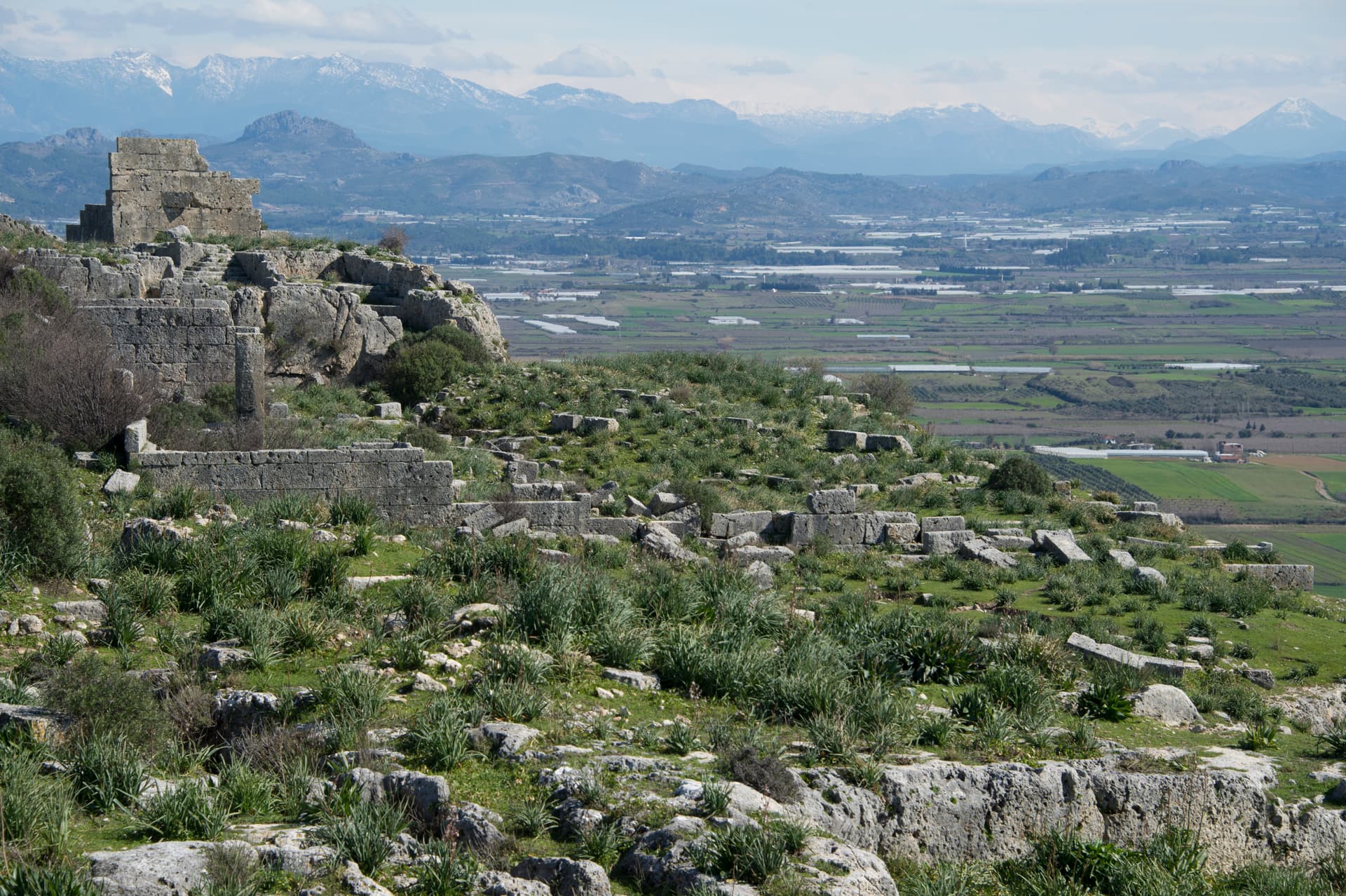
That road survives in stone. The Eurymedon Bridge — a single Roman arch dated to the 2nd century CE — still carries foot traffic across the river, part of a route that once connected the coast at Aspendos to the hill city of Selge, high on the canyon's western flank.
Selge's temples to Zeus and Artemis, and the more than two hundred votive reliefs its people left to a dozen different gods, gave this road real purpose: it was how offerings, traders, and travelers reached a city that took its cults seriously.
Since 2008 that same corridor has carried a different kind of traveler. The Beşkonak branch of the St Paul Trail enters the canyon at the park gate and follows the gorge north past Selge before rejoining the main route toward Antioch of Pisidia.
Walkers come for the scenery and the rafting as often as for any devotional reason — but those who come specifically to retrace Paul's first missionary journey find, in this gorge, a landscape that has changed less than almost anywhere else on the route.
Why this place is sacred
Nothing about Köprülü Canyon was built to be sacred, and that is part of what visitors find striking. This is geology first — a karst gorge carved by the Köprüçay through limestone, its walls variously measured. Most descriptions put the cliff faces at up to 100 meters; one geological account puts the total depth of the gorge at closer to 400 meters.
The two figures likely describe different things — a cliff face versus the full depth of the surrounding terrain — though which is which remains uncertain, and no source resolves the question.
What the gorge does have, uncontested, is the Eurymedon Bridge: a single Roman arch that has carried foot traffic for roughly nineteen centuries and still does. Standing on stone that old, over water that has not stopped moving in all that time, gives the site a directness that many older or more storied places lack.
There is no myth attached specifically to this stretch of river — the founding stories belong to Selge, up on the ridge, not to the canyon itself.
The trail's connection to Paul is real but should be stated carefully. The Culture Routes Society, which waymarked the St Paul Trail in 2008, describes the route as an attempt to let modern walkers experience the countryside of Paul's first missionary journey — not a claim that his exact footsteps are known. Acts records that journey by city, not by intervening terrain, and no ancient text places Paul inside this specific gorge.
What can be said is that this canyon lay on the most plausible corridor between the Pamphylian coast and the Pisidian highlands in the Roman period, and that walking it today puts a modern pilgrim on terrain contemporaries of Paul would recognize — plausibility, not proof.
Archaeological evidence indicates the canyon's Roman road and the Eurymedon Bridge served a practical function: moving people, goods, and offerings between the Pamphylian coast and the Pisidian hill city of Selge. No evidence suggests the canyon itself hosted temple worship or ceremony — that activity took place at Selge, on the ridge above.
The road fell out of formal use as the Roman and Byzantine road network declined, though the Eurymedon Bridge stayed serviceable enough that local traffic never fully abandoned it. The Turkish state declared the surrounding gorge a national park in 1973, protecting both the karst landscape and the Roman-era remains within it.
In 2008 the canyon acquired a new layer of meaning when the Culture Routes Society routed the Beşkonak branch of the St Paul Trail through it, adding a modern walking-pilgrimage function to a corridor that had already carried travelers for nineteen centuries.
Experience and orientation
Most people who come to Köprülü Canyon come for a few hours — a rafting trip, a look at the turquoise-green Köprüçay, the thrill of crossing or viewing the Roman bridge. Visitors and hikers consistently describe the scale and beauty of the gorge; that version of the visit is straightforwardly enjoyable, and rafting operators report high visitor satisfaction with the whitewater sections.
The other version takes days. Walkers on the St Paul Trail's Beşkonak branch enter at the park gate and stay in the gorge's general orbit until they reach Adada, several days and a substantial elevation gain later. Those accounts read differently from the day-trip ones — less about the view and more about the physical cost of the climb, which some trekkers connect, explicitly or not, to the hardship Paul describes enduring on his own travels.
Nobody claims the trail replicates his suffering. But covering the same kind of terrain, on foot, over multiple days, seems to change what people notice: the sound of the river fading as the trail climbs away from it, the forest thinning at altitude, the first views back down into the gorge from above.
That contrast says something real: this is a place that rewards direct physical engagement over passive viewing, whichever form that engagement takes.
If you have only a few hours, go to the Eurymedon Bridge and stay longer than a photograph requires — it is one thing to see a Roman bridge, another to notice it is still doing the job it was built for. If you have several days, consider walking rather than driving the Beşkonak branch, even a section of it. The trail's builders intended the walking itself, not any single viewpoint, to carry the experience.
Context and lineage
No origin myth attaches to the canyon itself. Selge, the city its Roman road served, had its own founding traditions — Strabo records a claim that it was settled by Spartan colonists, while another account credits Calchas, companion of the seer Mopsos, as founder. Both stories situate the region within Greek mythological geography, but neither concerns the gorge or the river directly; they belong to the city on the ridge, not the road beneath it.
What is documented rather than legendary is the road's function. Roman engineers built the Eurymedon Bridge — known locally as Oluk Köprü — in the 2nd century CE, part of a network connecting the coast at Aspendos to Selge and the Pisidian interior. Selge's own religious life was substantial: temples to Zeus and Artemis, and more than two hundred surviving votive reliefs dedicated to Zeus, Apollo, Artemis, Athena, the Nymphs, Asklepios, and a local banqueting hero.
In Roman times, the canyon existed primarily as the route that made that religious and civic life reachable from the coast.
For as long as Selge thrived — from roughly the 3rd century BCE into the Roman period — the canyon's road carried the ordinary traffic of a functioning religious and civic center: worshippers, traders, officials. That traffic thinned as the wider Roman and Byzantine road network declined, though the Eurymedon Bridge never fully lost its local use. The gorge settled into a quieter existence as a natural landmark until the Turkish state recognized its ecological value in 1973.
The St Paul Trail's arrival in 2008 restored something like the canyon's old function — a corridor deliberately walked by people making their way toward a destination with religious meaning — even though today's walkers come from a very different tradition than the one that built the road.
Zeus
deity
Selge's larger temple, dated to the 3rd century BCE, was dedicated to Zeus; the canyon's Roman road was the practical route by which offerings and worshippers reached his sanctuary.
Artemis
deity
A smaller temple at Selge honored Artemis alongside Zeus. Both temples sit on the ridge above the canyon rather than within the gorge itself.
Strabo
historical
The Greek geographer whose writings preserve Selge's founding legends, including the claim that it was settled by Spartan colonists — situating the region within a wider Greek mythological framework.
Kate Clow
modern
Long-distance walker and founder of the Culture Routes Society, which waymarked the St Paul Trail in 2008, routing its Beşkonak branch through Köprülü Canyon as a modern trekking reconstruction of the countryside Paul's first missionary journey plausibly crossed.
Traditions and practice
Roman-era religious practice connected to this corridor took place at Selge, not in the gorge: temple sacrifice and votive dedication to Zeus, Artemis, and a wider pantheon documented in the site's surviving reliefs. The canyon itself functioned as infrastructure for that practice rather than as a site of ceremony in its own right — no altar, shrine, or documented ritual site has been identified within the gorge.
Rafting, canyoning, and day-hiking are the canyon's dominant present-day activities, organized through licensed operators based in Beşkonak. Separately, the St Paul Trail's Beşkonak branch supports a walking-trekking practice usually undertaken over roughly eight days to Adada. Some Christian pilgrim groups traveling this branch pause at scenic overlooks or the Eurymedon Bridge for scripture readings from Acts 13-14 or group prayer, though no formal liturgy or clergy-led ceremony occurs within the park.
If the trail's devotional framing interests you, consider reading Acts 13-14 before setting out rather than at the bridge itself — arriving already familiar with the text changes what you notice along the way. At the Eurymedon Bridge, resist the urge to cross quickly for the photograph; stand on it long enough to register that Roman engineers solved the same problem you would solve today, and solved it well enough that their solution still works.
For those walking rather than rafting, consider taking at least one full day at a slower pace than the itinerary requires. The Beşkonak branch is usually covered in a fixed number of days; nothing prevents extending one stage to sit longer at a viewpoint or beside the river.
Christianity — Pauline Route (contemporary pilgrimage/trekking)
ActiveThis canyon lies on the Beşkonak branch of the St Paul Trail, a modern (2008) waymarked route created by Kate Clow and the Culture Routes Society — a scholarly-informed reconstruction of likely terrain rather than an archaeologically confirmed ancient pilgrim path — to let modern walkers cross countryside that may broadly overlap the corridor Paul's first missionary journey followed inland from the Pamphylian coast (Acts 13-14). It is a contemporary walking-pilgrimage tradition layered onto a real Roman-era road, not a documented first-century holy site.
Long-distance waymarked trekking, typically over several days; some Christian pilgrim groups pause for scripture reading or prayer at scenic overlooks or the Eurymedon Bridge. Secular hikers and rafters share the same trails and park infrastructure.
Hellenistic and Roman Polytheism (via ancient Selge)
HistoricalThe canyon served as the historic access corridor to Selge, a hill city with temples to Zeus and Artemis and more than two hundred surviving votive reliefs to a dozen deities. The Eurymedon Bridge, dated to the 2nd century CE, carried the road linking Selge to the Pamphylian coast and remains the canyon's clearest physical trace of that religious economy.
Temple worship and votive dedication occurred at Selge itself, outside the canyon; the gorge functioned as the transit and trade route serving that civic and religious life.
Perspectives and open questions
Köprülü Canyon supports at least three honest readings, and none require dismissing the others: a geologist's account of karst formation and disputed depth measurements, an archaeologist's account of a functioning Roman transit corridor, and a modern pilgrim's account of walking terrain that plausibly, but not provably, overlaps with Paul's first missionary journey.
Scholarly perspective
Archaeologists and historians agree that the canyon's Roman road and the Eurymedon Bridge formed a real, functioning 2nd-century CE transit route linking the Pamphylian coast to Pisidian hill cities including Selge. On the St Paul Trail's routing, scholarly opinion is more careful: the corridor is treated as a well-informed, plausible reconstruction of the kind of terrain Paul's first missionary journey would have crossed, without claiming certainty about his literal path.
The canyon's reported depth remains an open question in the sources consulted — most describe cliff walls up to 100 meters, while one geological account gives a total gorge depth of up to 400 meters, and nothing in the available literature resolves which figure describes what.
Living and traditional perspectives
For Christian trekking groups who walk the St Paul Trail as pilgrimage, the canyon's value lies in bodily continuity with scripture: according to the tradition, walking this stretch means covering ground of the same character Paul crossed on his way inland, and some groups read Acts 13-14 or pause for prayer at the Roman bridge as a way of holding that continuity in mind.
This framing does not depend on the canyon being Paul's literal, documented route — it treats the landscape itself, Roman-road-and-gorge together, as close enough in kind to carry devotional weight.
Alternative interpretations
Some hiking and wellness-tourism marketing describes the canyon in terms of general natural restorative qualities — language applied to river gorges broadly rather than anything specific to this site's history. This framing is promotional rather than a documented spiritual tradition, and it sits apart from both the archaeological record and the St Paul Trail's own more careful claims.
Open questions
Whether Paul's actual first-century route passed through this specific gorge, rather than one of the other passes through the Taurus range, cannot be verified from Acts or any other ancient text — his itinerary is recorded by city, not by the terrain between cities. The precise dating and function of the Roman road's various segments within the canyon — military, civic, or trade-focused — is also not fully resolved in the available sources.
And the discrepancy between the canyon's reported depths, 100 meters against 400 meters, remains uncertain rather than settled.
Plan your visit
Access and arrival
Entered via Beşkonak, Manavgat district, roughly 80-92 km northeast of Antalya by road. Park entry is free; rafting, canyoning, and guided tours require licensed operators. No permit is documented as required for day hikers on marked trails. Mobile signal is generally reliable near Beşkonak and along the lower canyon but grows unreliable on higher trail stretches toward Adada; hikers on multi-day sections should not assume coverage.
Beşkonak offers basic lodging oriented toward rafting tourism. Trekkers on the St Paul Trail typically camp or use small guesthouses along the multi-day route toward Adada; no lodging exists within the national park itself.
Respectful visit
Sturdy walking shoes with grip are essential; the terrain along the trail and near the Roman bridge is rocky and often wet. Layers help with the temperature swing between the gorge floor and higher trail sections toward Adada. No specific dress code applies for religious reasons, since the canyon hosts no active worship site.
Freely permitted throughout the park and along the trail, including at the Eurymedon Bridge. No restrictions specific to religious sensitivity apply, though the usual courtesy toward other hikers and rafters — not blocking narrow trail sections for photographs — is worth observing.
None are appropriate. No shrine or altar exists within the canyon, and anything left at the bridge or along the trail will be treated as litter. Visitors on the St Paul Trail who wish to mark the walk devotionally are better served by an internal gesture — prayer, reading, or reflection — than a physical offering.
Standard Turkish national park rules apply: no removal of flora, fauna, or archaeological material, stay on marked trails especially near cliff edges, and follow licensed-operator safety requirements for rafting and canyoning. No permit is documented as required for day hikers on marked trails.
The canyon has no shrine or altar, and no offerings should be left at the Roman bridge or anywhere else in the park — anything left behind will be treated as litter and removed. Rafting and canyoning should be arranged only through licensed operators; the Köprüçay's water levels and currents vary enough by season to make unguided attempts genuinely risky.
Hikers on the St Paul Trail's higher sections should check conditions before setting out outside the April-October window, when weather can close trail segments toward Adada.
Location
Map loads as you approach this section.
Pilgrim reflections
A portrait of encounter, not a score
Pilgrims describe what they felt, how present they could become, and whether the place would shape a journey. There are no stars and no ranking of traditions.
No reviewed reflections yet
The first pilgrims can help describe the character of being here.
Share a reflection
Available after an account-backed “Been there.” Every reflection is reviewed before publication.
Nearby sacred places
Explore other sacred places in the region. Proximity does not establish access or travel time; check each place’s guidance.



References
Sources consulted for this page. Source categories describe the publication, not a guarantee that every claim is verified. Traditional accounts and outside interpretations may differ.
- 01St Paul Trail | Culture Routes Society — Culture Routes SocietyofficialOfficial waymarked-trail authority; confirms Beşkonak/Köprülü Kanyon branch of the St Paul Trail, its 2008 opening by Kate Clow, and its stated intent to trace the countryside of Paul's first missionary journey; does not claim archaeological certainty about the exact ancient route
- 02Köprülü Canyon - Wikipedia — Wikipedia contributorsacademicCoordinates, park establishment date (1973), dimensions, Selge and Eurymedon Bridge references, IUCN Category II status
- 03Koprulu Canyon National Park — National Parks of TurkeySource contextPark history, area (366 km2), flora (Mediterranean cypress forest), founding rationale (protect watershed and Selge antiquities together)
- 04Eurymedon Bridge (Selge) | Turkish Archaeological News — Turkish Archaeological NewsacademicRoman bridge (Oluk Köprü) dimensions and 2nd-century CE dating; road network connecting Mediterranean coast to Pisidian highlands via Selge
- 05Selge | Turkish Archaeological News — Turkish Archaeological NewsacademicAncient city overview, road/fortress network along the Köprüçay/Eurymedon river within the canyon
- 06Selge Ancient City | ArticHaeology — ArtiChaeologyacademicSelge founding legends (Strabo), temples of Zeus and Artemis, 224 votive reliefs to Zeus, Apollo, Artemis, Athena, Nymphs, Asklepios
- 07Köprülü Canyon - rafting and Roman Bridge — Alaturka.infoSource contextDescribes Oluk Köprü as still in active local use; canyon rafting industry overview
- 08Köprülü Canyon National Park | KÜRE Encyclopedia — KÜRE EncyclopediaSource contextKarst geology detail: limestone canyon, karstic springs, caves, lapies; 'Adam (Satan) Rock' formations
Share a photo
Help visitors recognize Köprülü Canyon. Every submission is reviewed before publication.