Side
A Mediterranean peninsula where gods of light, wisdom, and fortune once shared the city's edge with the sea
Understand sacred places, explore living traditions, and learn how to engage respectfully with Pilgrim Map.
Access has not been verified. Check current local guidance before planning a visit.
Antalya, Turkey
Read the sources
Visit essentials
A quick read before you go
- Duration
- 30 minutes to 2 hours at the Apollo/Athena temple area for the sunset experience.
- Access
- Approximately 75 km east of Antalya; 7 km from Manavgat town.
Overview
Side's pre-Greek people had their own city-name, and the Sidetan language survives in stone inscriptions that remain only partly understood. When Aeolian settlers from Cyme arrived in the 7th century BCE, they encountered an Anatolian community and absorbed its sacred geography rather than empty ground.
They made Athena patron and built her temple at the peninsula's tip; Apollo later joined her at the water, creating the last threshold of divine protection for departing ships and the first sacred sight for returnees.
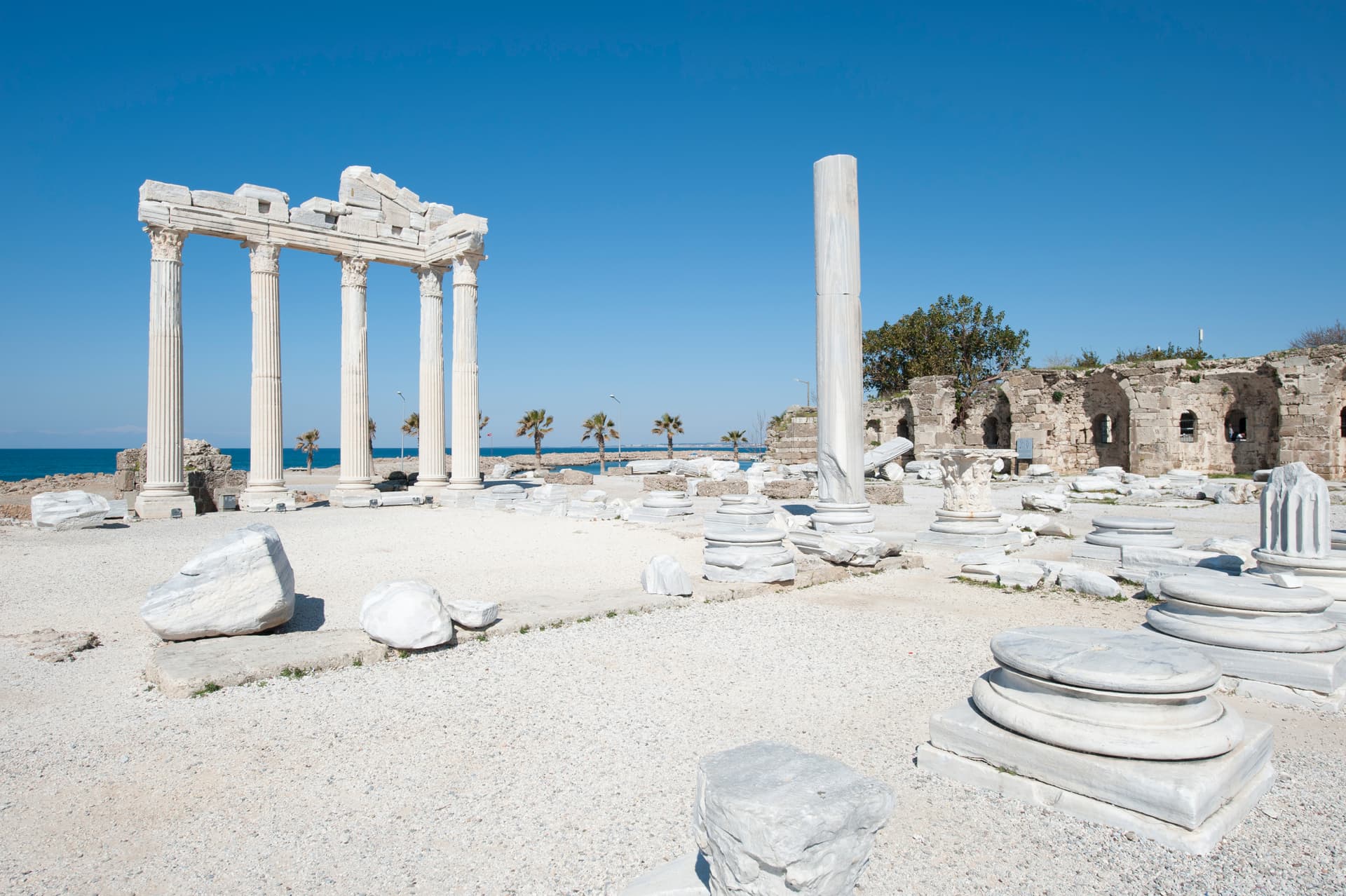
Behind them grew one of the eastern Mediterranean's most prosperous cities: a slave market and producer of salt and oil, shaped by theatre and imperial patronage. Today's Turkish tourist town remains a palimpsest of Roman streets, baths, theatre, and gate—ancient paving beside restaurants, the colonnaded agora behind market stalls. At the peninsula's end, Apollo's five columns shift with the afternoon light and turn gold at sunset.
Places within this site
Why this place is sacred
Side was a city of multiple divine presences operating simultaneously. Athena as civic protector, Apollo as guardian of sailors, Men as the Anatolian moon deity, Tyche as the goddess of fortune — all were worshipped here, and all inhabited the same dense peninsula where land ends and sea begins.
The harbor sacred area concentrated this multiplicity: three temples within a short distance of each other, all facing the water, all framing the same essential transaction between the human world of commerce and risk and the divine world of protection and fate.
For an ancient sailor in a wooden ship entering the harbor after weeks at sea, the sight of those temples on the promontory was not merely reassuring — it was a direct encounter with the forces that had sustained his survival. The pomegranate symbol embedded in the city's very name connects Side to ancient Near Eastern goddess traditions — the fruit of Persephone, of fertility and the underworld's threshold, of life through death.
Whether or not this etymology was consciously understood by Side's ancient inhabitants, it places the city within a much older symbolic landscape than its Greek founding suggests. The indigenous Sidetan language, still not fully deciphered, may preserve traces of a pre-Greek sacred tradition that the Greek overlay never entirely concealed.
Harbor city sacred area: a concentrated nexus of divine guardianship over maritime commerce and civic life, protecting both the city and those who sailed from it.
From a pre-Greek Anatolian settlement with indigenous religious traditions → 7th century BCE Greek colonial city with Athena as patron → Hellenistic period city under Seleucid and then local rule → major Roman-period city with construction of Apollo Temple (2nd century CE), theatre, baths, and triumphal arch → early Byzantine episcopal see, with Apollo Temple converted to basilica (5th–6th century CE) → medieval decline → modern tourist town built on and around ancient foundations.
Apollo Temple columns restored 1984–1990; both temples underwent major restoration 2024–2025.
Experience and orientation
Entering Side through the Vespasian Arch — the triumphal gate of the 1st century CE — you step from the modern highway into the ancient city. The scale of the Roman theatre to your right is the first indication of what this city was: 15,000 to 20,000 seats, its cavea still largely intact, carved into the flat ground (unusual for Roman theatres, which preferred hillsides) because Side's peninsula offered no hillside to cut into.
This is engineering in service of ambition. The colonnaded agora opens to the east; the Roman baths, now housing the Side Museum, hold sculptural collections that most visitors find unexpectedly rich. Walk north along the peninsula toward the water. The ancient streets narrow. The temples come into view not dramatically but gradually — first a glimpse of column through a gap between buildings, then the full grouping as you reach the harbor area.
The Apollo Temple sits closest to the sea, its five restored Corinthian columns rising from a rocky promontory directly above the water. The Athena Temple stands immediately adjacent, its own restoration completed in early 2025. Standing between them with the sea on three sides, you are at the exact point where the ancient city's sacred geography concentrated: the tip of the land, the start of the sea, the threshold where divine protection was sought and acknowledged.
The quality of light here in the late afternoon is particular — the columns cast long shadows eastward across the ancient paving, and then as the sun descends, they catch the last orange light against a blue-black sea.
Arrive from the east via the main road through the Vespasian Arch. The Side Museum (Roman baths) is near the entrance and worth visiting early. Walk the colonnaded street north toward the water. The Apollo and Athena temples are at the northwestern tip of the peninsula — free entry, open at all times. The walk from the entrance area to the temples takes about 15 minutes at a normal pace.
Context and lineage
When Aeolian colonists from Cyme landed on this flat Pamphylian peninsula in the 7th century BCE, they encountered a place that already had a name — Side — in a language that was neither Greek nor related to any other known Anatolian tongue. The colonists adopted the name. They also adopted the landscape's sacred associations, choosing Athena as their patron and building her the city's first temple at the water's edge.
The name 'Side' is generally interpreted as the Anatolian word for pomegranate — a fruit with deep symbolic resonance across the ancient Near East, linked to fertility, the underworld, and the cycles of life. Whether this etymology was consciously held by the city's inhabitants, or whether it simply persisted as an inherited place-name whose meaning had faded, cannot be determined.
But the continuity of the name across the transition from pre-Greek to Greek to Roman to Byzantine to modern ownership represents the kind of deep cultural persistence that characterizes this entire coastline.
Side's religious history runs from its pre-Greek Anatolian founding through Greek colonial patronage of Athena, the addition of Apollo's cult and temple, the convergence of multiple Olympian and Anatolian cults (Men, Tyche) in the prosperous Roman period, the Christianization and conversion of the Apollo temple into a Byzantine basilica, and finally the long medieval decline that left the city for centuries as a fishing village before modern archaeology and tourism restored its visibility.
Antiochus III
Seleucid king who used Side as a base and was defeated by the Rhodian fleet in the harbor in 190 BCE — a naval battle that ended his control of the Aegean
Pompey the Great
Defeated the Cilician pirates who had made Side their major slave market, c. 67 BCE; the destruction of this trade network transformed the city's economy
Vespasian
Roman emperor whose triumphal arch still marks the city's entrance; significant patron of construction in the 1st century CE
Antoninus Pius
Roman emperor during whose reign (138–161 CE) both the Apollo and Athena temples were constructed
Ministry of Culture and Tourism of Turkey
Undertook major restoration of both temples 2024–2025, with Apollo Temple completed November 2024 and Athena Temple reopening early 2025
Traditions and practice
The annual festivals of Athena, Apollo, Men, and Tyche marked the civic and agricultural calendar. Maritime sacrifices and prayers — offered at the harbor temples before and after long voyages — were among the most regular forms of religious practice in a port city of Side's importance. The Temple of Apollo likely supported some form of oracular consultation, consistent with his cult role across the Mediterranean.
The Temple of Men (moon god), a third structure in the harbor area, served the Anatolian lunar tradition that persisted under the Greek and Roman overlay. These traditions existed simultaneously, creating a religious life of unusual density in a small geographic space.
The temple area is free and open at all times. Photography is a dominant contemporary practice — Side's Apollo Temple at sunset is one of the most photographed ancient sites in Turkey. The annual Aspendos International Opera and Ballet Festival (35 km northwest) draws culturally interested visitors to the broader region in June–July.
Time your arrival at the Apollo Temple for the last 90 minutes before sunset. Walk to the temples through the ancient town rather than approaching directly from the parking area — the passage through the living-ancient overlay of the town creates the necessary context for what you encounter at the water's edge. At the temple, sit with your back to the town and face the sea. Let the sound of the water establish itself.
Notice the Medusa-head frieze on the entablature — the ancient protective function of the gorgon's face, warding evil from the sacred precinct, still reads clearly in the carved stone. Watch the light change on the columns over the course of an hour. This is not passive observation; it is the kind of attention that sacred sites were built to invite.
Cult of Athena
HistoricalOriginal divine patron of Side, chosen by the founding Greek colonists from Cyme. Athena was the city's protector, guarantor of civic order, and patron of practical wisdom — fitting for a trading city dependent on skilled seamanship and commercial intelligence. The Temple of Athena stood adjacent to the Temple of Apollo in the harbor sacred area.
Temple worship, civic ceremonial, sacrifices, festival processions
Cult of Apollo
HistoricalApollo was worshipped as protector of sailors and patron of light, prophecy, music, and healing. The Temple of Apollo (built c. 150 CE) stood in the harbor sacred area, its restored Corinthian columns among the most recognized images of ancient Turkey.
Temple worship, maritime prayers and sacrifices, festival processions, possibly oracular consultation
Cult of Men (Moon God)
HistoricalMen was an Anatolian moon deity whose worship was widely practiced across Pamphylia and Pisidia. His temple at Side, in the harbor sacred area alongside Apollo and Athena, reflects the persistence of Anatolian religious traditions within the Greek-period city.
Lunar cycle observances, temple worship
Early Christianity and Byzantine Continuity
HistoricalSide became an early episcopal see. The Apollo Temple was converted into a Byzantine basilica in the 5th–6th century CE — one of the most significant examples of the Christianization of a pagan harbor sanctuary in the eastern Mediterranean.
Christian liturgy in the converted temple; episcopal administration
Archaeological and Scholarly Heritage
ActiveActive archaeological research and major restoration work (2024–2025) on the Apollo and Athena temples. The Side Museum holds an important sculptural collection. The site is one of Turkey's most visited ancient cities.
Archaeological excavation, architectural restoration, museum presentation, heritage tourism
Perspectives and open questions
Side's meaning has been understood through four lenses: as a document of the persistence of pre-Greek Anatolian identity, as a model of how Roman imperial cities organized divine protection, as evidence of the continuity between paganism and Christianity in sacred geography, and as a living demonstration of how ancient sacred sites remain atmospherically powerful even without their original cultic context.
Scholarly perspective
Scholars regard Side as exceptional for two reasons: the survival of inscriptions in the Sidetan language (which remains only partially deciphered, preserving evidence of a pre-Greek religious and cultural layer), and the remarkable state of preservation of the Roman-period urban fabric. The Apollo Temple restoration completed November 2024 and the Athena Temple restoration reopening in early 2025 represent significant scholarly and conservation achievements.
The conversion of the Apollo Temple to a Byzantine basilica in the 5th–6th century CE is a well-documented example of the Christianization of prominent pagan sacred sites — a pattern repeated across the eastern Mediterranean.
Living and traditional perspectives
The indigenous Sidetan tradition — preserved in the language and in the choice to retain the pre-Greek name — represents a current of religious and cultural identity that the Greek and Roman layers absorbed but did not entirely replace. The city's patron goddess Athena was selected by Greek colonists, but the landscape they chose and the name they preserved were both pre-Greek inheritances.
The pomegranate symbolism of the name connects Side to the broader Anatolian sacred tradition of the fertile earth, the cycle of seasons, and the underworld's threshold.
Alternative interpretations
The convergence of multiple goddess figures in Side — Athena, Tyche, and the moon god Men's consort — alongside the pomegranate symbolism has been read by some writers as evidence of the underlying sacred feminine current that persisted across the Anatolian coast regardless of which gods were officially honored. The Apollo Temple's spectacular western sunset orientation adds a solar-sacred dimension that later Neoplatonist tradition would have read as the god's daily descent — the dying of light as divine act.
Open questions
The Sidetan language remains only partially understood and may contain religious terminology and divine names that would reshape our understanding of the city's pre-Greek sacred traditions. The full extent of the ancient harbor sacred precinct — including whether there were earlier, pre-Roman structures in the same location — is not yet completely excavated.
Plan your visit
Access and arrival
Approximately 75 km east of Antalya; 7 km from Manavgat town. Accessible by regular buses from Antalya (Otogar) or from Manavgat, or by private car or organized tour. The peninsula is compact and walkable. Temple area is free and open at all times. Side Museum (Roman baths building near the entrance) has a small entrance fee and standard opening hours. Mobile phone signal is good throughout the modern town. Parking is available at the edge of the old town peninsula.
Side and neighboring Manavgat offer accommodation across all price ranges. Staying within or adjacent to the old town peninsula allows walking access to the temple area at sunset without the crowds arriving by tour bus.
Respectful visit
No dress code for the outdoor archaeological areas. If visiting the Side Museum (housed in the Roman baths), modest dress is appropriate.
Freely permitted throughout the ancient city and temple area. The sunset at the Apollo Temple is one of Turkey's most photographed views.
Some visitors leave flowers or small tokens near the Apollo Temple columns — this is not organized but not discouraged. No formal offering practice exists.
Do not climb the columns or their platform. Standard archaeological site conduct applies — no scratching or carving ancient stonework.
Side is extremely busy in July and August; the Apollo Temple area, while free, can become crowded at sunset in high season. Late September through October offers most of the beauty with a fraction of the crowds. The ancient paving stones are uneven in places — watch your footing after dark.
Location
Map loads as you approach this section.
Pilgrim reflections
A portrait of encounter, not a score
Pilgrims describe what they felt, how present they could become, and whether the place would shape a journey. There are no stars and no ranking of traditions.
No reviewed reflections yet
The first pilgrims can help describe the character of being here.
Share a reflection
Available after an account-backed “Been there.” Every reflection is reviewed before publication.
Nearby sacred places
Explore other sacred places in the region. Proximity does not establish access or travel time; check each place’s guidance.


References
Sources consulted for this page. Source categories describe the publication, not a guarantee that every claim is verified. Traditional accounts and outside interpretations may differ.
- 01Side, Turkey - Wikipedia — Wikipedia contributorsencyclopediaFull historical, archaeological, and geographical overview
- 02Side - World History Encyclopedia — World History EncyclopediaencyclopediaScholarly summary of city history and significance
- 03Side - Ancient City, Mediterranean Coast — BritannicaencyclopediaAuthoritative reference entry
- 04Side - Turkish Archaeological News — Turkish Archaeological NewsacademicTurkish archaeological and cultural context
- 05Ancient temples and Byzantine basilica in Side — Turkish Archaeological NewsacademicSpecific focus on the temple complex and Byzantine reuse
- 06Side Apollo Temple - Best Sunset Spot in Side — Excursion SideguideDetailed visitor guide to the Apollo and Athena temples
- 07The Old Town of Side - Best Things to Do — Get Ready For AdventureguideContemporary visitor guide to Side
Share a photo
Help visitors recognize Side. Every submission is reviewed before publication.