Sillyon
The city that turned away Alexander the Great still commands the Pamphylian plain
Understand sacred places, explore living traditions, and learn how to engage respectfully with Pilgrim Map.
Access has not been verified. Check current local guidance before planning a visit.
Antalya, Turkey
Read the sources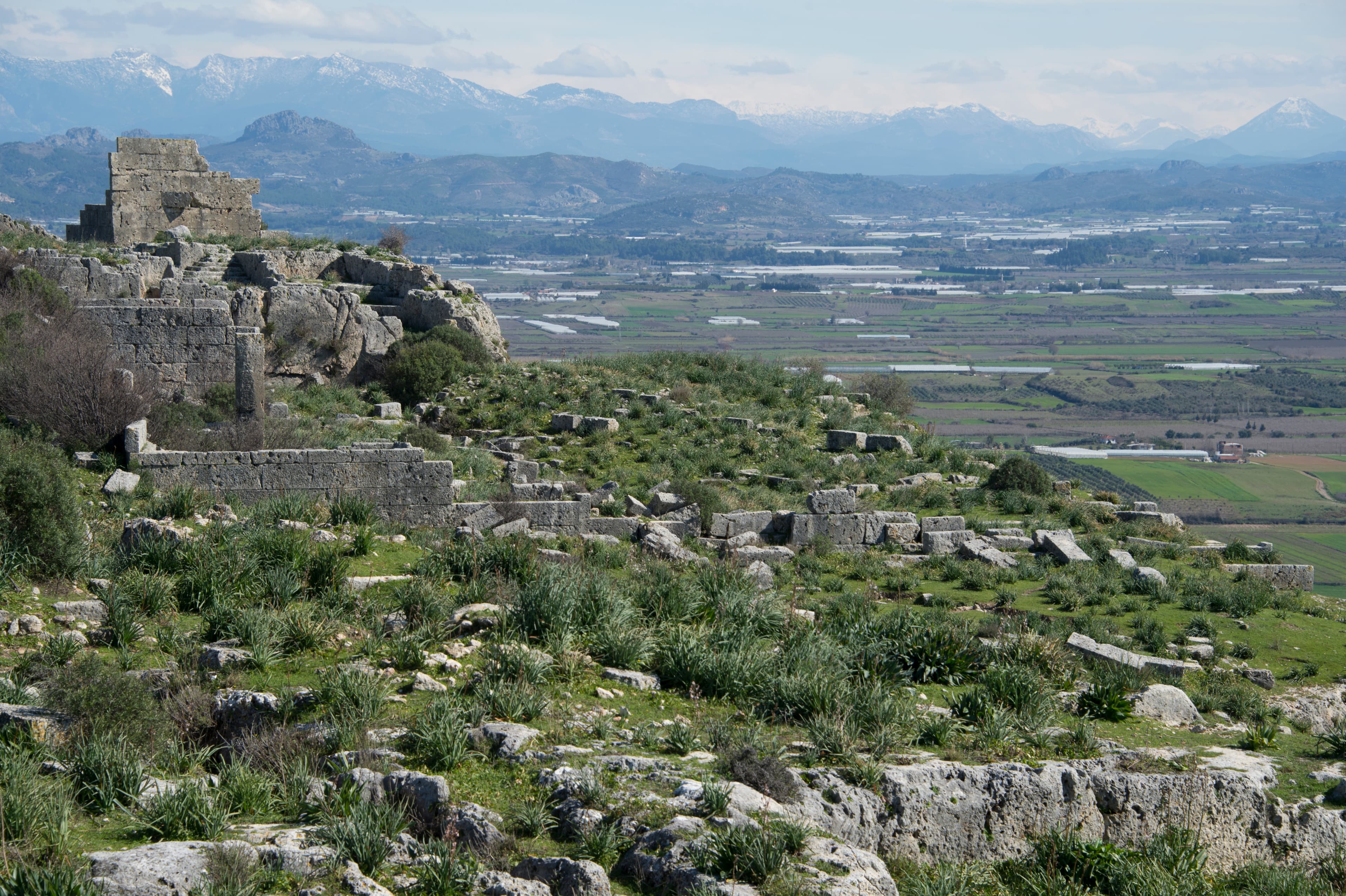
Visit essentials
A quick read before you go
- Duration
- 3–4 hours for a thorough visit.
- Access
- Located approximately 32.5 km northeast of Antalya city centre, in Serik district near Yanköy…
Overview
Sillyon's clifftop above modern Yanköy village successively held a Hittite community, Pamphylian Greek city-state, Hellenistic stronghold, Roman provincial city, Byzantine fortified settlement, Seljuk garrison, and Ottoman administrative post. Each left walls, streets, buildings, graves, or a mosque without destroying what came before. Excavations begun in 2020 are exposing a 1-kilometre main street spanning six eras of continuous human presence.
Alexander's story is the site's most famous episode, but the deeper question is why this clifftop held the loyalty of peoples with different gods and languages for so long. From the summit, the Pamphylian plain extends to the Mediterranean. Its height creates physical, spatial, and psychological clarity: an immense horizon and a comprehensible world below, the vantage that high places have long offered religious imagination.
Why this place is sacred
What makes Sillyon a thin place is less any single tradition than the fact of its continuous occupation across nearly four millennia — a continuity that suggests the site is doing something that human communities reliably recognise as valuable. Hellenistic worshippers of the Olympian gods climbed this hill. Roman civic religion was practiced on this plateau. Byzantine Christians built their churches here. Seljuk and Ottoman Muslims prayed in a mosque that still stands (or stood) on the hilltop.
The specific theological content of these traditions is different in almost every dimension. What they share is the choice of this specific elevation, this specific view, this specific removal from the plain below. That convergent choosing across vastly different cultural systems suggests the place itself is the operative factor — not the theology brought to it but the phenomenological conditions it creates.
The summit at 200 metres produces a visual field encompassing the entire Pamphylian plain, the mountains to the north, and the Mediterranean to the south. At that altitude, distances become comprehensible and one's own position within the landscape becomes apparent. This is the ancient mountain-sanctuary experience: the world made visible, the self made small, the divine made present in the spatial logic of elevation.
A high defensive position in a region of prosperous coastal cities, offering security, agricultural hinterland access, and the elevated visibility that commanded both protection and prestige.
From Hittite settlement through Pamphylian Greek city-state, Hellenistic stronghold, Roman provincial city, Byzantine fortification, and Seljuk and Ottoman use, the site accumulated structures, religious installations, streets, tombs, and civic infrastructure. Final abandonment at an unknown date. Active excavation since 2020 under Murat Taşkıran (Akdeniz University); wall restoration undertaken in 2026 under the Turkish Ministry of Culture 'Heritage for the Future' programme.
Experience and orientation
Park at the small shop at the base of the hill, fill your water, and begin the ascent on the goat paths that lead up through the scrub and limestone. The climb takes 20 to 40 minutes depending on pace and the condition of the paths. Do not rush it. The effort itself begins to organise your attention: you are watching where you place your feet, which means you are not thinking about whatever you were thinking about before.
This is the value of threshold difficulty — it clears the internal landscape before you arrive at the external one. At the top, the plateau opens. The Hellenistic defensive walls have been partially restored (2026), and their scale becomes immediately apparent: these were serious fortifications on serious cliffs. Begin on the main street, which the excavation team has cleared of millennia of accumulated debris, revealing a 1-kilometre spine through the city that changes architectural character as you move along it.
The Hellenistic and Roman sections show one urban vocabulary; the Byzantine sections show another; the Seljuk and Ottoman sections show a third. The street does not announce these transitions — you notice them in the quality of the masonry, the proportions of doorways, the style of carved decoration.
Near the centre of the plateau, the stadium is being excavated (254 metres long, 48 metres wide) — a civic monument of a scale that recalibrates your sense of the ancient city's ambition. The theatre and bath ruins, the aqueduct remnants, the tomb chambers scattered through the rock — each adds to the picture of a city that was, for many centuries, fully alive. At the mosque near the hilltop, stop.
The structure is ruined but identifiable, and the Muslim cemetery nearby contains graves — people who were buried here in the Ottoman period, who considered this hilltop a worthy resting place within living memory of the modern era. Stand at the highest accessible point and look south. The Pamphylian plain spreads below: the agricultural land, the distant glint of the Mediterranean, the Taurus ranges behind you. This is the view that has anchored six civilisations to this particular hill.
Stay with it.
Allow 3–4 hours minimum for a thorough visit: 20–40 minutes ascent, 2+ hours on the plateau (main street, stadium, fortifications, bath, mosque/cemetery, summit views), and the return descent. Carry at least 1.5 litres of water per person. Wear hiking footwear. The site is entirely inaccessible to those with mobility limitations. Small shop at the base of the hill; no facilities on the plateau.
Context and lineage
The origins of Sillyon extend into the 2nd millennium BC, with Hittite presence attested on the clifftop. The Pamphylian Greek city was established by the 6th century BC, part of the coastal settlement pattern of the fertile Pamphylian plain between the Taurus Mountains and the Mediterranean.
When Alexander the Great swept through Pamphylia in 333 BC on his way to conquering the Persian Empire, he took most of the cities of the region — Perge submitted, Aspendos submitted — but Sillyon refused. Alexander, who had no time for a prolonged siege, moved on. The city continued under Hellenistic successors, then under Roman provincial rule, accumulating the infrastructure of a prosperous polis: a stadium, theatre, bath complex, two main streets, multiple public buildings, and a necropolis.
Recent excavations have found tombs including one identified as belonging to a notable local philanthropist. Byzantine fortifications overlay the Hellenistic defences. Seljuk and Ottoman presence left the mosque and cemetery that survive near the summit. The city was finally abandoned, but no documentation records when or why.
Hittite settlement (2nd millennium BC) → Pamphylian Greek city-state (from c. 6th century BC) → Alexander's approach and refusal (333 BC) → Hellenistic city → Roman provincial city → Byzantine fortified settlement → Seljuk occupation → Ottoman use (mosque and cemetery) → final abandonment → excavation begun 2020
Alexander the Great
Approached Sillyon in 333 BC and was refused; moved on rather than besieging the clifftop city — the episode that defines Sillyon's historical identity
Murat Taşkıran
Head of the excavation team (Akdeniz University) since the formal excavations began in 2020
Traditions and practice
The religious life of Sillyon across its nearly four-thousand-year occupation was never unified under a single tradition. Pamphylian civic religion involved the Olympian gods and the local protective cults that a successful city-state required; the city's resistance to Alexander suggests a pride in civic identity that may have had a religious dimension (the gods of Sillyon protected Sillyon). Roman provincial religion brought the full infrastructure of imperial cult and civic polytheism.
Byzantine Christianity replaced these with ecclesiastical structures and community worship. The Seljuk and Ottoman mosque on the hilltop represents the most recent active religious tradition: a Muslim community that chose the same high place for the same reasons that the Greeks, Romans, and Byzantines had chosen it before them. The cemetery near the mosque is not merely historical — it holds the dead of specific people whose descendants may still be alive in the surrounding villages.
Active archaeological excavation under Akdeniz University has been ongoing since 2020. Wall restoration under the Turkish Ministry of Culture 'Heritage for the Future' programme was undertaken in 2026. Heritage tourism is growing as the site becomes more widely known. The Ottoman cemetery may receive occasional visits from Muslim community members.
Use the ascent as deliberate preparation. Walk the main street from one end to the other before turning aside for individual monuments — get the full length of it, the full horizontal sweep of six civilisational eras, before going deeper into any particular section. At the stadium, stop and consider the scale: 254 metres long, built to hold the civic pride of a city that had turned away Alexander.
At the mosque and cemetery, treat the space with the same care you would give any active place of Muslim worship or burial, regardless of its current state of use. At the summit, allow your eyes to do what they want to do — take in the full horizon, the sea, the mountains, the plain. Sit with this view for at least fifteen minutes. The altitude organises something in the mind that is not available at sea level.
Pamphylian Hellenistic and Roman Polytheism
HistoricalAs a major Pamphylian city-state from at least the 6th century BC, Sillyon hosted the civic and temple religion typical of Hellenistic and Roman Anatolia. The city's successful resistance to Alexander likely enhanced local pride and the cults of protective deities. Temples have not yet been conclusively identified in excavation, but their presence across the centuries of the city's prosperity is certain.
Civic temple religion; votive offerings; public festivals; sacrifices.
Byzantine Christianity
HistoricalSillyon continued into the Byzantine period as a fortified settlement, with Christian-era structures identified in excavation. The city served both ecclesiastical and military functions in the Byzantine provincial system.
Christian liturgy; episcopal or monastic community.
Islamic Use (Seljuk and Ottoman)
HistoricalThe ancient mosque and Muslim cemetery that remain on the hilltop demonstrate Seljuk and later Ottoman occupation and religious use. This is the most recent active tradition at the site, ending within the past few centuries rather than millennia ago.
Islamic prayer; burial of the Muslim dead.
Archaeological Heritage
ActiveExcavations begun in 2020 under Murat Taşkıran (Akdeniz University) have cleared a 1 km main street spanning six eras, partially uncovered the 254 m stadium, discovered Roman-era tombs, and supported a 2026 wall restoration project under the 'Heritage for the Future' programme. The site is in active scientific investigation.
Annual excavation campaigns; wall restoration; site development for heritage tourism.
Perspectives and open questions
Sillyon rewards four distinct approaches: as a military-historical site (the Alexander episode, the clifftop fortifications), as a long-term settlement study (nearly 4,000 years of continuous occupation), as a sacred landscape study (the same high place chosen by six different religious traditions), and as a live archaeological site still being excavated.
Scholarly perspective
Sillyon is understood as one of the best-preserved multi-period ancient cities in Pamphylia, and the excavations begun in 2020 under Murat Taşkıran (Akdeniz University) have opened a new chapter of systematic investigation. The cleared 1-kilometre main street, which spans Hellenistic to Ottoman eras, is considered a significant find for understanding long-term settlement continuity.
The city's unusual persistence across almost four thousand years — from Hittite through Ottoman — makes it exceptionally valuable for research into how sites maintain cultural authority across radical changes in political and religious regime.
Living and traditional perspectives
Turkish local tradition in the Serik region knows the site variously as Asar Köy (Ruin Village) and Yanköy Hisarı (Yanköy Fortress), preserving folk identification of the dramatic hilltop as a place of power and consequence. The Ottoman mosque and cemetery indicate that the site remained a place of active community significance within the past few centuries.
Alternative interpretations
Sillyon's ability to repel Alexander the Great — the figure who more than any other in antiquity embodied the idea of unstoppable force — has given the site a mythic quality that persists in popular consciousness. For those drawn to the idea of places that possess inherent protective power, a quality embedded in the site rather than in its human defenders, Sillyon offers a compelling case: the cliffs, not the soldiers, turned Alexander away.
The same geographic conditions that defeated Alexander also drew successive civilisations to the site — the high place retaining its authority independent of who occupied it.
Open questions
The pre-Hellenistic religious history of the hilltop — what Hittite communities understood the elevated site to mean — is largely undocumented. The full extent of the ancient city's temple complex has yet to be excavated. The specific reason for final abandonment is unknown. The 2020 excavations are still in early stages; the majority of the city has not been systematically investigated.
Plan your visit
Access and arrival
Located approximately 32.5 km northeast of Antalya city centre, in Serik district near Yanköy village. Accessible only by car or taxi; no bus service to the site. Follow signs toward Serik and then Yanköy village; the site is signposted from the village. Parking available at the small shop at the base of the hill. No admission fee. No audio guide; minimal but improving signage as excavations advance. Carry minimum 1.5 litres of water per person.
Entirely inaccessible for visitors with mobility impairments.
Antalya city (~32 km) offers full accommodation options across all price ranges. Serik town (~15 km) has more modest options. Belek coastal resort area (~20 km southwest) provides international-standard accommodation though in a very different atmosphere from the ruins.
Respectful visit
Sturdy hiking footwear mandatory. Water and sun protection essential. Comfortable, layered clothing appropriate for a strenuous climb followed by exposure on an elevated plateau.
Permitted and encouraged. The view from the summit, the main street with its layered architectural eras, and the partially restored Hellenistic walls all reward careful composition. At the mosque and cemetery, photograph with discretion.
Not applicable for the archaeological areas. At the mosque and cemetery, follow Islamic site conventions: remove shoes if you enter a mosque interior, approach the cemetery quietly.
Do not follow the marked goat paths off-trail — unexcavated structures may lie just below the surface of the entire plateau, and unauthorised foot traffic can damage subsurface remains. Do not disturb the Muslim cemetery: do not climb on grave markers, do not take photographs that might be considered disrespectful to the dead. Take no stones or artefacts. Do not enter areas marked as active excavation zones.
The site is entirely inaccessible to visitors with any mobility limitation — the goat paths require sure footing and physical stamina. The exposed plateau is very hot in summer; a 6am start in July and August is advisable. Carry significantly more water than you think you need. Do not disturb the Ottoman mosque ruins or the Muslim cemetery — treat both with the same respect appropriate to any active place of Islamic burial.
Take no artefacts or stones from the site.
Location
Map loads as you approach this section.
Pilgrim reflections
A portrait of encounter, not a score
Pilgrims describe what they felt, how present they could become, and whether the place would shape a journey. There are no stars and no ranking of traditions.
No reviewed reflections yet
The first pilgrims can help describe the character of being here.
Share a reflection
Available after an account-backed “Been there.” Every reflection is reviewed before publication.
Nearby sacred places
Explore other sacred places in the region. Proximity does not establish access or travel time; check each place’s guidance.




References
Sources consulted for this page. Source categories describe the publication, not a guarantee that every claim is verified. Traditional accounts and outside interpretations may differ.
- 01Sillyon | Turkish Archaeological News — Turkish Archaeological NewsacademicArchaeological site profile tracking excavation history and recent discoveries
- 02The massive stadium of Sillyon Ancient City is being uncovered — Anatolian ArchaeologyacademicAcademic news site reporting on stadium excavation dimensions
- 03Sillyon — Grokipedia — GrokipediaencyclopediaComprehensive overview of history, architecture, and Alexander the Great episode
- 04Excavation starts in ancient city unconquered by Alexander the Great — Hurriyet Daily NewsSource contextReports commencement of formal excavations in 2020; quotes excavation director Murat Taşkıran
- 05Sillyon's ancient main street brings six eras together in Türkiye's Antalya — Türkiye TodaySource contextReports on cleared 1 km main street spanning Hellenistic to Ottoman eras
- 064 Roman-era tombs unearthed at Sillyon ancient city in Antalya — Türkiye TodaySource contextReports on recent tomb discoveries including notable philanthropist tomb
- 07Alexander couldn't conquer Sillyon: Ancient walls revived for modern visitors — Türkiye TodaySource contextReports on 2026 wall restoration project under Ministry of Culture 'Heritage for the Future' programme
- 083,000-Year-Old City Of Sillyon That Alexander The Great Failed To Conquer — Ancient PagesSource contextOverview of the Alexander the Great episode and city history
- 09Sillyon Turkey Ancient City Guide — Turkey Travel PlannerguidePractical visitor guide with admission, transport, and what to see
Share a photo
Help visitors recognize Sillyon. Every submission is reviewed before publication.