Perge
A layered Anatolian city where a goddess older than Greece still presides over the hills
Understand sacred places, explore living traditions, and learn how to engage respectfully with Pilgrim Map.
Access has not been verified. Check current local guidance before planning a visit.
Antalya, Turkey
Read the sources
Station 1 of 7
St Paul TrailVisit essentials
A quick read before you go
- Duration
- 2–3 hours minimum for a thorough walk.
- Access
- Located 18 km east of Antalya city center, near Aksu village (signposted off the D400 road).
Overview
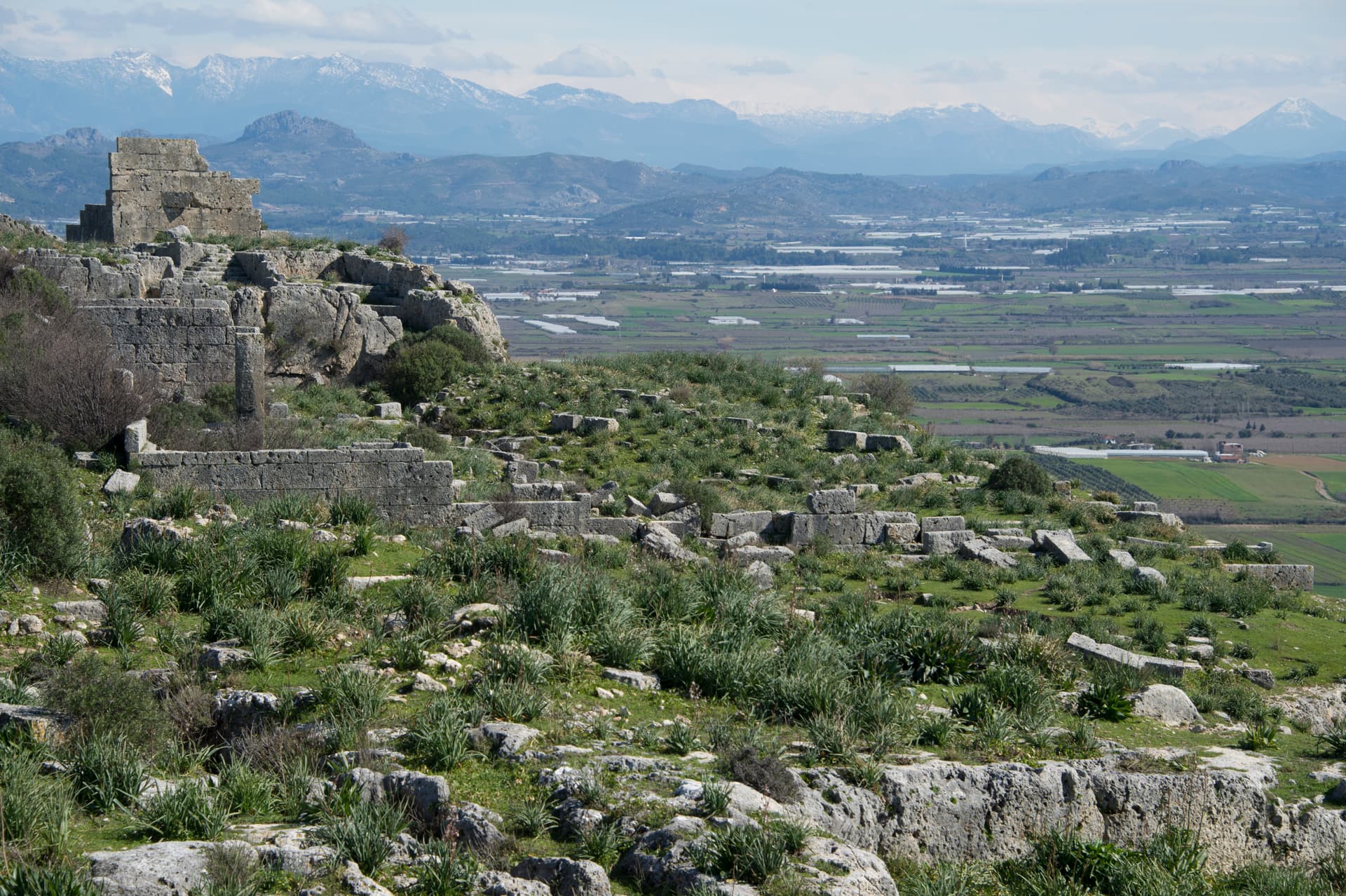
Before Alexander the Great's armies, Roman marble cutters, or the Apostle Paul arrived, Perge had already been sacred for two thousand years. Its acropolis rises above the Pamphylian plain; at its northern edge stood a hilltop sanctuary to a goddess the Greeks called Artemis but who was older than Greece—the Anatolian Wanassas Preia. Her sacred stone entered the Greek temple as a baetyl, divine presence incarnate in rock.
Perge was Pamphylia's religious capital. Its goddess's cult spread to Rhodes, Halicarnassus, Lindos, and other Aegean cities, while her priestesses held the ancient world's most powerful civic positions available to women. Hittite texts call the city Parha, and its acropolis was inhabited in the Chalcolithic period, around 4000–3000 BCE.
Today's visible city is Roman: the colonnaded cardo maximus and central water channel; Plancia Magna's monumental gate complex, funded by the 2nd-century-CE high priestess and civic benefactor; two sets of baths; theatre; and western Turkey's best-preserved stadium. Its extraordinarily abundant sculptures now fill the Antalya Archaeological Museum, one of the world's great ancient sculpture collections. The acropolis and vanished sanctuary site still carry accumulated centuries of reverence.
Why this place is sacred
The thinness of Perge is rooted in its continuity. The goddess of this place was not invented by Greek colonists — she was encountered by them. The Anatolian Wanassas Preia ('the Lady of Preia') was already worshipped here when the first Greek settlers arrived, and rather than displacing her they incorporated her: her sacred stone, the baetyl, was placed inside the new Artemis temple as the physical embodiment of divine presence.
This act of translation rather than replacement created a religious tradition with genuine depth, one that recognized the sacred character of a place and allowed it to persist through successive cultural overlays. For over a thousand years, from at least the Hittite period through to late antiquity, Perge's goddess was the most important divine patron of the Pamphylian region. Her sanctuary drew healing pilgrims, oracular seekers, and festival participants from across the eastern Mediterranean.
The city's proudest civic offices were held by women who served her. When Plancia Magna funded the reconstruction of the city's monumental gate complex in the 2nd century CE, she did so explicitly in her capacity as high priestess of Artemis Pergaia — the political, civic, and religious authority of the city were understood as dimensions of the same divine sanction.
The layer below all of this — the prehistoric acropolis, the baetyl, the unnamed devotion of the Chalcolithic and Bronze Age inhabitants — is never fully accessible. But its presence can be felt in the weight of the hilltop site and in the remarkable continuity that outlasted every change of political regime.
Hilltop sanctuary of the Anatolian goddess Wanassas Preia, later identified with Artemis; regional pilgrimage center and oracle.
From prehistoric sacred hilltop (Chalcolithic, c. 4000 BCE) to Hittite-period city (Parha), to Hellenistic Greek city (after Alexander, 333 BCE), to the Roman-period urban center whose remains visitors explore today. The Artemis cult persisted until the Christianization of the city in late antiquity; Perge became an episcopal see and contains early church remains. Systematic archaeological excavation began in 1946 and continues.
Experience and orientation
The approach to Perge sets the tone: the two round Hellenistic towers of the city gate, built in the 3rd century BCE, rise above the plain as you walk toward them. They are some of the best-preserved Hellenistic fortifications in Turkey, and stepping between them into the horseshoe courtyard beyond — the earlier entrance to the city before the Roman gateway was added — gives a first sense of the accumulated ages of this place.
The Roman monumental gate complex that follows is the work of Plancia Magna, whose portrait statues once stood in the niches of her own construction — a rare document of a woman funding and being honored for a major civic building in the ancient world.
Beyond the gate, the colonnaded cardo maximus stretches north toward the acropolis: a broad boulevard with a central water channel still visible, columns lining both sides, the ghost of a street that was once lined with statues of gods, emperors, and benefactors. The theatre sits to your right as you enter; the stadium, to the east, is the best-preserved in western Turkey, its seating still largely intact.
Give time to walk the full length of the main street and reach the foot of the acropolis — the hill itself is unexcavated and mostly inaccessible, but standing at its base and looking south over the city plan gives the best sense of how the sanctuary above once presided over the city below. The sculptures that made Perge famous are not here — they are in the Antalya Archaeological Museum, 18 km west.
Visit the museum to complete the picture.
Enter from the western parking area. The ticket booth is at the Hellenistic gate complex. Walk north up the colonnaded main street; the theatre is on your right, the agora and baths further along. Budget at least 2–3 hours for the main site; bring water and sun protection as shade is limited.
Context and lineage
Greek tradition held that Perge was founded after the Trojan War by the seers Mopsus and Calchas, who led colonists from Greece to the fertile Pamphylian plain. The city's Hittite name Parha, attested in Bronze Age texts, suggests this Greek founding legend was applied retroactively to a city that had existed for centuries before any Greek colonists arrived.
The sacred stone of the pre-Greek goddess — the baetyl of Wanassas Preia — was incorporated into the sanctuary that became the temple of Artemis Pergaia, a material acknowledgment of the indigenous religious tradition that the Greek settlers encountered and absorbed rather than displaced.
The founding myth's association with Mopsus, himself the son of Apollo according to some versions and a figure connected to oracular power throughout Pamphylia and Cilicia, indicates that Perge was understood from early in its history as a city of prophetic and sacred significance.
Perge's religious lineage runs: pre-Greek Anatolian mother-goddess cult (Wanassas Preia) → Greek Artemis syncretism (Hellenistic period) → Roman imperial cult and continued Artemis worship → early Christianity (Pauline mission field, then episcopal see) → Byzantine and medieval occupation → abandonment and archaeological rediscovery from 1946. The Antalya Archaeological Museum holds the primary collection of Perge statuary, including its famous Tyche, nymphaeum figures, and portrait statues of Plancia Magna.
Apollonius of Perga
Mathematician of the 3rd century BCE, author of the foundational work on conic sections — testimony to the intellectual life of the Hellenistic city
Plancia Magna
High priestess of Artemis Pergaia and civic benefactor of the 2nd century CE, who funded the reconstruction of the monumental city gate complex; the most prominent individual documented at Perge
Apostle Paul
Passed through Perge c. 46 CE and c. 48 CE during his First Missionary Journey (Acts 13:13–14; 14:25), preaching in the city on his return
Mopsus
Legendary co-founder; seer associated with oracular tradition across Pamphylia and Cilicia
Istanbul University Archaeological Teams
Conducting systematic excavations since 1946, producing one of the most scientifically documented major Anatolian cities
Traditions and practice
The cult of Artemis Pergaia was the religious engine of the city. Annual festivals drew participants from across Pamphylia and beyond — the cult's influence is documented as far as Rhodes, Halicarnassus, and Lindos. The goddess offered healing, oracular guidance, and divine protection. Prominent civic women — including Plancia Magna in the 2nd century CE — served as hereditary priestesses, making the religious office inseparable from political authority.
Sacrificial rituals, festival processions, and what appear to have been healing pilgrimages at the hilltop sanctuary all formed part of the cult's regular practice. The precise form of these practices is known primarily from inscriptions and indirect literary evidence; the sanctuary itself remains incompletely excavated.
Perge is regularly visited by Christian tour-pilgrimage groups following the footsteps of the Apostle Paul, for whom the site is a stop on the First Missionary Journey itinerary. Academic excavations by Istanbul University continue. The city's sculptural legacy — now in Antalya — draws scholars and museum visitors.
Walk the full length of the colonnaded main street from the gate complex to the foot of the acropolis without hurrying. Notice the water channel at the street's center — it was fed from a nymphaeum further north and would have filled the street with the sound of running water throughout the day, a sensory detail photographs cannot convey.
At the Hellenistic gate towers, step into the horseshoe courtyard between the towers and the Roman gate — this was itself a ritual space where visitors entered the city in stages. If time allows, spend a few minutes looking north from the acropolis base toward where the hilltop sanctuary stood: this is the geographic center of two thousand years of religious activity at Perge.
Then visit the Antalya Archaeological Museum afterward — the sculptures there complete the city you have walked through.
Cult of Artemis Pergaia
HistoricalThe defining religious institution of ancient Perge and of the Pamphylian region. Artemis Pergaia was a syncretic figure blending the Greek goddess with an older Anatolian mother-deity (Wanassas Preia). Her hilltop sanctuary drew pilgrims from across the eastern Mediterranean; her cult spread to Rhodes, Halicarnassus, Lindos, and other Aegean cities. Prominent civic women served as hereditary priestesses.
Temple worship, annual festivals, healing pilgrimages, oracular consultation, sacrificial rites; the sacred baetyl of Wanassas Preia was kept in the sanctuary as the physical presence of the divine
Early Christianity
HistoricalThe Apostle Paul visited Perge during his First Missionary Journey (Acts 13:13–14; 14:25), preaching in the city on his return journey. Perge later became an episcopal see. The city contains early church architectural remains.
Pauline preaching and early church gatherings; episcopal administration; Byzantine Christian worship
Archaeological and Scholarly Heritage
ActiveSystematic excavations since 1946 have made Perge one of the most thoroughly documented ancient cities in Anatolia. The sculptures recovered fill the Antalya Archaeological Museum — one of the world's great ancient sculpture collections. UNESCO Tentative List recognition (2009) reflects the site's outstanding universal value.
Ongoing excavation and conservation by Istanbul University; academic publication; museum presentation in Antalya
Perspectives and open questions
Perge's significance has been approached through four lenses: as a document of religious syncretism between Greek and Anatolian traditions, as a showcase of Roman urban planning at its peak, as a Pauline Christian heritage site, and as evidence of the profound civic power ancient women could hold through religious office.
Scholarly perspective
Scholars understand Perge as one of the most significant Pamphylian cities for documenting the interaction between Anatolian and Hellenic religious cultures. The Artemis Pergaia cult is recognized as a genuine religious syncretism — not simply a renaming but a real fusion in which the baetyl of the pre-Greek goddess was incorporated into the Greek sanctuary.
Istanbul University's excavations since 1946 have produced world-class findings, most notably the portrait statues of Plancia Magna and the extensive figural sculpture now in the Antalya Museum. UNESCO's 2009 Tentative List nomination acknowledged the site's outstanding universal value. The ongoing excavation program means new discoveries continue to be made.
Living and traditional perspectives
The pre-Greek Anatolian religious substratum at Perge — the Wanassas Preia cult, the baetyl, the priestly offices — represents a tradition of divine femininity that was already ancient when the first Greek colonists arrived. This tradition understood the goddess not as imported Greek Artemis but as the indigenous spirit of the landscape and its fertility, its water, and its protective power.
That this deep tradition was robust enough to persist through Greek, Hellenistic, and Roman cultural overlays — maintained by generations of civic women who served as hereditary priestesses — speaks to its genuine depth.
Alternative interpretations
The founding legend's connection to the seer Mopsus places Perge within a broader prophetic sacred geography across southern Anatolia. Mopsus appears in myths and inscriptions from Cilicia and Pamphylia as the founding figure for multiple cities, suggesting either a genuine historical dynasty of prophetic rulers or a widespread ancient need to locate civic origins in oracular divine guidance.
Either way, Perge's founding story ties it to a network of prophetically-sanctioned cities that understood themselves as connected to each other through shared sacred genealogy.
Open questions
The hilltop sanctuary of Artemis Pergaia, the most important sacred site at Perge, remains incompletely excavated. The exact form of the original Anatolian goddess cult and the precise nature of its healing and oracular practices are known only from indirect evidence. Whether any continuity exists between pre-Greek cult practices and what the historical-period Artemis sanctuary performed remains an open question in the scholarship.
Plan your visit
Access and arrival
Located 18 km east of Antalya city center, near Aksu village (signposted off the D400 road). Reachable by tram to the terminus and then taxi, or by private car or organized tour. Open daily: 8:00–17:00 (winter) / 8:00–19:00 (summer). Entrance fee applies. Mobile phone signal is generally adequate in the area but may be unreliable in parts of the site — download offline maps before visiting.
No specific emergency access concerns but the site is away from the city center; the nearest large hospital is in Antalya.
Antalya city offers accommodation across all price ranges. The site is most efficiently visited as a day trip from Antalya, possibly combined with Aspendos.
Respectful visit
No specific dress requirement. Comfortable walking shoes are essential given the site's size and uneven terrain.
Permitted freely throughout the site.
Not applicable — there is no active religious practice.
Do not climb or touch ancient stonework; some areas are fenced for active conservation. Stay on marked paths.
The site is large and almost entirely unshaded. Bring significant water and sun protection; morning visits are strongly recommended in summer. Comfortable walking shoes are essential — the ancient paving stones are uneven.
Location
Map loads as you approach this section.
Pilgrim reflections
A portrait of encounter, not a score
Pilgrims describe what they felt, how present they could become, and whether the place would shape a journey. There are no stars and no ranking of traditions.
No reviewed reflections yet
The first pilgrims can help describe the character of being here.
Share a reflection
Available after an account-backed “Been there.” Every reflection is reviewed before publication.
Nearby sacred places
Explore other sacred places in the region. Proximity does not establish access or travel time; check each place’s guidance.


References
Sources consulted for this page. Source categories describe the publication, not a guarantee that every claim is verified. Traditional accounts and outside interpretations may differ.
- 01Perga - Wikipedia — Wikipedia contributorsencyclopediaPrimary overview of city history, architecture, and excavations
- 02Perge - World History Encyclopedia — World History EncyclopediaencyclopediaScholarly summary of Perge's history and significance
- 03Archaeological Site of Perge - UNESCO World Heritage Tentative List — UNESCOofficialUNESCO tentative list nomination (2009); formal heritage recognition
- 04Perge - Turkish Archaeological News — Turkish Archaeological NewsacademicOngoing excavation news and site details
- 05Stele devoted to Artemis Pergaea - Archaeology Wiki — Archaeology WikiacademicDocuments the Artemis Pergaia cult and iconography
- 06Perge Ruins - What to Know about the Ancient City of Perge near Antalya — Turkey Travel PlannerguidePractical visitor information and site overview
- 07Plancia Magna and the role of a Roman benefactress in Perge — Following HadrianblogDetailed examination of Plancia Magna's role as priestess of Artemis Pergaia
- 08Statue of Woman Unearthed in Ancient Greek City of Perge — Greek ReporterSource contextRecent discovery news
Share a photo
Help visitors recognize Perge. Every submission is reviewed before publication.