Temple of Apollo and Athena at Side
Part ofSide
Five Corinthian columns at the sea's edge where Apollo's light meets the water at the close of day
Understand sacred places, explore living traditions, and learn how to engage respectfully with Pilgrim Map.
Access has not been verified. Check current local guidance before planning a visit.
Antalya, Turkey
Read the sources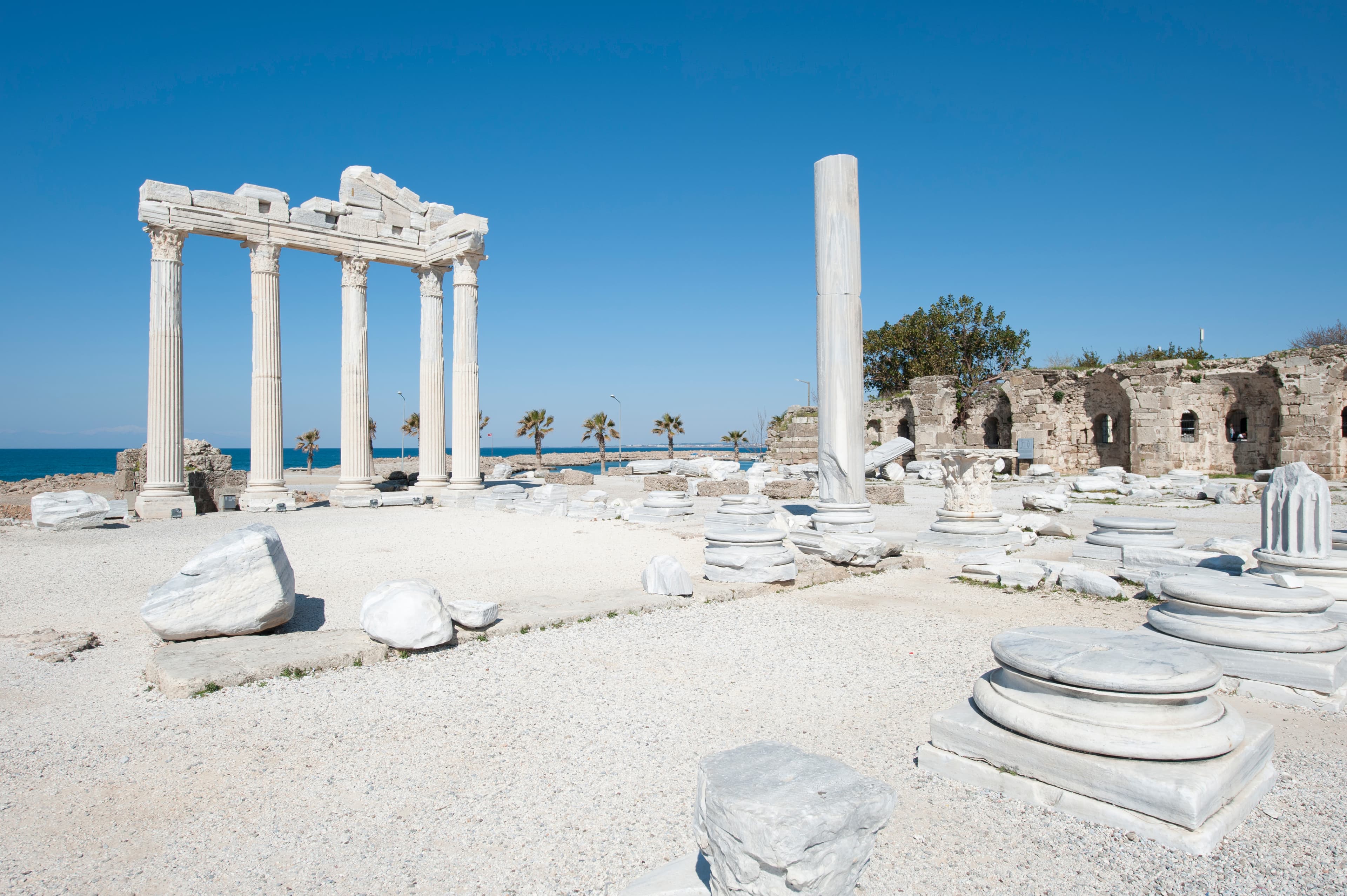
Image of Temple of Apollo and Athena at Side. Image source
Visit essentials
A quick read before you go
- Duration
- 30 minutes to 2 hours depending on how long you wish to stay for the sunset.
- Access
- Located at the western tip of the Side peninsula, within 10–15 minutes' walk from the Vespasian…
Overview
At the far end of the Side peninsula, where sea closes in from three sides, two Roman-period temples stand a few meters apart in a shared harbor precinct. The Temple of Apollo was built around 150 CE under Emperor Antoninus Pius, during the prosperous period that also produced Side's theatre, baths, and colonnaded streets. Its five remaining Corinthian columns, restored to standing in 1984–1990, define Side's image and form one of Turkey's most recognized ancient sites.
The adjacent Temple of Athena underwent a major restoration completed in early 2025.
Together the temples concentrated Side's most significant divine protections where city met open sea. Apollo's role as sailors' protector and god of light made his harbor-facing position intentional. Surviving fragments of a Medusa-head apotropaic frieze from the entablature show a literal protective function: the gorgon's face warded evil from the precinct and every vessel leaving under its sight. Both temples stood over or near earlier sacred ground.
Founding colonists had chosen the site for Athena's worship in the 7th century BCE, a choice Roman-period builders understood and continued.
Why this place is sacred
A promontory is a threshold: the last solid ground before the open water, the place where the measurable ends and the uncertain begins. Ancient maritime cultures placed temples at such points not merely as architectural statements but as functional devices — the gods needed to be physically present at the boundary where human control gave out. Apollo at the sea's edge was not symbolic; he was stationed there.
The harbor sacred area at Side made this theological logic spatially explicit: both temples faced west, toward the open water, so that the divine gaze and the divine protection were directed outward into the Mediterranean, into the sea-lanes where ships went and from which they might not return. The Medusa frieze amplified this: an apotropaic face at the edge of the sacred precinct, repelling malign forces before they could enter the harbor.
Over the course of a thousand years — from the 7th century BCE founding of the Athena cult through the Roman-period Apollo temple to the 5th–6th century CE conversion of the Apollo precinct into a Christian basilica — this point on the peninsula was continuously understood as charged. The Christians who converted the Apollo temple did not choose this location randomly; they recognized the accumulated sacred character of the ground and chose to continue rather than displace it.
Contemporary visitors who report a strong sense of presence at the Apollo temple columns, especially in the last light of day, are experiencing something that has been recognized at this location for roughly 2,700 years.
Harbor divine precinct: temples of Apollo and Athena providing divine protection for maritime commerce and the city's safety, positioned at the land-sea threshold of a prosperous Pamphylian port.
Pre-Greek Anatolian sacred landscape (pre-7th century BCE) → Greek colonial foundation with Athena temple (7th century BCE) → Roman-period construction of Apollo Temple and likely expansion of Athena Temple (2nd century CE) → Byzantine conversion of Apollo precinct to Christian basilica (5th–6th century CE) → abandonment and partial collapse → archaeological investigation and column restoration (1984–1990, Apollo; 2024–2025, both temples) → major international tourist site with ongoing heritage status.
Experience and orientation
Approach through the ancient town rather than directly from the road. The passage through Side's living streets — past the Side Museum in the Roman baths, along the remnants of the colonnaded agora, through the working alleys of the modern village — provides the necessary transition from ordinary time to the particular quality of attention the temples reward. When the columns come into view at the end of the peninsula, the sea is already present on both sides.
The air changes. Stand at the edge of the platform and look west: open water, the last light of afternoon, the five columns casting shadows that lengthen as you watch. The sound of the sea is constant here and surprisingly close — the platform sits only a few meters above the waterline. Notice the carved entablature fragments at the base of the restored columns. One of the Medusa-head apotropaic faces is visible, eroded but legible.
This was meant to be seen: the gorgon's gaze as active protection, directed outward from the sacred precinct into the sea where threats might come from. Let yourself sit with the columns for the full time it takes the light to change from afternoon gold to near-dark. Photography will document what you see; what the light does to your sense of time and presence is a different matter, and belongs entirely to the hour you spend here.
The temples are at the western tip of the Side peninsula. From the Vespasian Arch entrance, walk north through the town (15 minutes). Free entry, open at all times. No facilities at the temple area itself; the Side Museum (Roman baths, 10-minute walk back toward the entrance) has toilets and a café adjacent. Parking at the edge of the old town.
Context and lineage
When Aeolian colonists from Cyme founded Side in the 7th century BCE, they chose this tip of the peninsula — the point where the land was narrowest and the sea most immediately present — for Athena's temple. The choice was both practical and theological: Athena as city patron should stand at the city's most exposed point, watching over the harbor approaches from the highest ground available.
Five centuries later, during the reign of Antoninus Pius (138–161 CE), the Roman city at the height of its prosperity built a new temple to Apollo immediately adjacent to the existing Athena precinct. The two temples shared a podium and formed a unified divine precinct, the harbor sacred area, where the city's two most important protective deities were concentrated.
The construction of Apollo's temple at this location was not coincidental — Apollo's cult had almost certainly been present in Side from early in the city's history, given its maritime character; the 2nd-century CE building simply formalized and monumentalized that presence.
The harbor sacred area represents an unbroken sacred geography at this location from the 7th century BCE Athena temple foundation through the 2nd century CE Roman temple construction, the Byzantine basilica conversion, and the modern restoration. The site has been understood as sacred, in continuously shifting religious frameworks, for approximately 2,700 years.
Antoninus Pius
Roman emperor (138–161 CE) during whose reign both the Apollo and Athena temples were built or rebuilt in their current Corinthian form
Founding colonists from Cyme
Established the Athena cult and first temple at this location in the 7th century BCE, determining the sacred geography of the peninsula tip for all subsequent history
Turkey's Ministry of Culture and Tourism
Directed the 2024–2025 restoration of both temples; Apollo Temple restoration completed November 2024; Athena Temple restoration reopened early 2025
Byzantine church builders
Converted the Apollo temple precinct into a Christian basilica in the 5th–6th century CE, recognizing and continuing the sacred character of the site
Traditions and practice
The harbor sacred area hosted the religious practices most essential to a port city: maritime prayers and sacrifices before departure, thanksgiving offerings upon return, festival processions in honor of Apollo and Athena on their festival days, and — likely — some form of oracular consultation for those about to undertake dangerous sea voyages. The Medusa-head apotropaic friezes served a continuous protective function, active regardless of human ritual: the divine protection was built into the architecture itself.
In the Byzantine period, the converted Apollo precinct hosted Christian liturgy — a shift in the form of the practice but, arguably, a continuation of the impulse to seek divine protection at this precise point on the land-sea threshold.
The site has no organized religious or ceremonial use today. Contemporary Hellenic polytheist visitors — for whom the Apollo Temple at Side is recognized as one of the most accessible and atmospherically powerful Apollo sanctuaries in the world — occasionally bring personal devotional practices: flowers, offerings of oil or grain, meditative sitting. These practices are individual and informal. The site is also among Turkey's most photographed ancient locations, particularly at sunset.
Arrive at least 90 minutes before sunset. Spend the first 30 minutes walking the full harbor sacred area — the Apollo columns, the adjacent Athena temple remains, the Byzantine basilica outline still visible in the paving. Note how the three sacred layers (Athena, Apollo, Christian basilica) occupy almost exactly the same footprint, each recognizing the power of the same location. Then find a place to sit facing the sea and the Apollo columns. Do not rush this.
The light changes every ten minutes in the last hour before sunset, and each change is worth attending to. If you have any devotional practice, this is one of the places in the ancient world where that practice finds natural expression. If you do not, simple sustained attention — to the columns, the water, the light, the carved stone — is its own form of discipline.
Greco-Roman Cult of Apollo
HistoricalApollo was the central divine patron of the harbor sacred area. As god of music, prophecy, healing, and light, and crucially as protector of sailors, Apollo was ideally suited to a prosperous port city. The Medusa-head frieze on the entablature served an apotropaic function, warding off evil from the sacred precinct and the harbor approaches.
Temple worship, maritime prayers and sacrifices, festival processions, possibly oracular consultation
Greco-Roman Cult of Athena
HistoricalAthena was the original patron goddess of Side, honored by the founding Greek colonists from Cyme. The Athena Temple stood immediately adjacent to the Apollo Temple, forming a divine dyad — wisdom and warfare (Athena) alongside light, prophecy, and seafaring (Apollo) — that watched over the city's fortunes from the same harbor promontory.
Temple worship, civic ceremonial, sacrifices
Byzantine Christianity
HistoricalIn the 5th–6th century CE, the Apollo Temple was converted into a Byzantine basilica — one of the most significant examples of Christian sacred continuity at a major pagan harbor sanctuary. The conversion acknowledged the site's sacred power rather than attempting to erase it.
Christian liturgy in the converted temple precinct
Contemporary Hellenic Polytheism
ActiveThe Apollo Temple at Side is recognized by contemporary Hellenic polytheist and pagan communities as one of the most accessible and atmospherically powerful Apollo sanctuaries in the world. The site appears in pagan sacred-site guides and draws devotional visitors.
Meditative visits, personal devotional offerings (flowers, grain, oil), sacred-site pilgrimage within the contemporary polytheist community
Perspectives and open questions
The temples have been read through four lenses: as functional architecture in service of maritime safety, as the most visually powerful ancient sacred site on Turkey's Mediterranean coast, as a model of the Christianization of pagan sacred geography, and as a contemporary living sacred site within Hellenic polytheist tradition.
Scholarly perspective
The scholarly consensus dates both temples to approximately 150 CE, during the Antonine period. The choice of Corinthian order — the most ornate and expensive of the Greek orders — reflects Side's wealth and civic ambition at this moment. The Apollo Temple restoration (1984–1990) was archaeologically rigorous; the 2024–2025 restoration of both temples is the most recent and comprehensive intervention.
The conversion of the Apollo precinct to a Byzantine basilica in the 5th–6th century CE is one of the best-documented examples of this pattern in Pamphylia. The Medusa-head apotropaic frieze is an important example of Roman religious iconography in architectural context.
Living and traditional perspectives
The site's original religious logic was clear and immediate: divine protection placed at the point where human control ended. Sailors could not carry their gods aboard ship, but they could leave them stationed at the harbor mouth — watching, protecting, receiving thanks. The selection of Apollo specifically (alongside Athena) for this harbor precinct was not arbitrary.
Apollo's solar nature, his role as the god of clear sight and accurate aim, made him an ideal guardian for the sea-lanes where vision and navigation were survival skills.
Alternative interpretations
Apollo's deep association with solar divinity in later Neoplatonist thought makes the temple's western orientation and its famous sunset experience theologically coherent in ways the original builders may not have consciously intended but which Neoplatonist visitors in late antiquity would have understood. The setting sun as Apollo descending — withdrawing his light into the sea, promising to return — is a cosmological reading that aligns precisely with what contemporary visitors experience without theological preparation.
Contemporary Hellenic polytheist practitioners, for whom Side is one of the most accessible Apollo sanctuaries in the world, understand this atmospheric power in explicitly devotional terms.
Open questions
The Temple of Men (Anatolian moon god), which stood in the same harbor sacred area, has been less studied than the Apollo and Athena temples. The extent and form of the Hellenistic-period sacred precinct that preceded the Roman-era buildings remains incompletely understood. Whether there were earlier, Bronze Age sacred structures at this same tip of the peninsula — consistent with the indigenous Anatolian occupation of the city — is not yet established.
Plan your visit
Access and arrival
Located at the western tip of the Side peninsula, within 10–15 minutes' walk from the Vespasian Arch entrance to the old town. Free entry; open at all times. No booking required. Mobile phone signal is good throughout the Side peninsula. Parking at the edge of the old town. The Side Museum (Roman baths building, 10-minute walk from the temples) has toilets and a café nearby.
Side and Manavgat (7 km) offer accommodation across all price ranges. Staying in or near the old town peninsula allows walking access to the temples at any hour.
Respectful visit
No requirements for the outdoor temple area.
Freely permitted. The sunset here is one of Turkey's most photographed images; photography is a dominant visitor activity.
Some visitors leave flowers or small tokens near the Apollo columns. This is individual and informal. If you bring an offering, take away anything biodegradable to avoid attracting animals.
Do not climb the columns or their restoration platform. Standard archaeological site conduct — no scratching, carving, or removing any stone fragment.
The platform surface can be slippery in wet weather. The site is exposed to wind from the sea — in winter, conditions can be raw. In summer, bring water; the walk through the town is warm and there are no facilities at the temples themselves.
Location
Map loads as you approach this section.
Pilgrim reflections
A portrait of encounter, not a score
Pilgrims describe what they felt, how present they could become, and whether the place would shape a journey. There are no stars and no ranking of traditions.
No reviewed reflections yet
The first pilgrims can help describe the character of being here.
Share a reflection
Available after an account-backed “Been there.” Every reflection is reviewed before publication.
Nearby sacred places
Explore other sacred places in the region. Proximity does not establish access or travel time; check each place’s guidance.



References
Sources consulted for this page. Source categories describe the publication, not a guarantee that every claim is verified. Traditional accounts and outside interpretations may differ.
- 01Temple of Apollo (Side) - Wikipedia — Wikipedia contributorsencyclopediaPrimary reference on the temple's history, architecture, and excavation
- 02Ancient temples and Byzantine basilica in Side — Turkish Archaeological NewsacademicScholarly overview of all three temples and their Byzantine transformation
- 03Türkiye's iconic Athena, Apollo temples undergo restoration — Daily SabahSource contextDetails of 2024 restoration project
- 04Ancient Temple of Greek Goddess Athena in Turkey Reopens After Restoration — Greek ReporterSource contextAthena temple restoration completed 2025
- 05Temple of Apollo at Side: Ultimate Guide — BenayTourguideComprehensive visitor and historical guide
- 06Temples of Apollo - Athena — Antalya.com.trguideRegional tourism description of both temples
- 07Side Apollo Temple - Best Sunset Spot in Side (2026) — Excursion SideguidePractical visitor information and sunset experience description
- 08Temple of Apollo in Side - Pagan Places — Pagan PlacesspiritualPagan spiritual perspective on the site
Share a photo
Help visitors recognize Temple of Apollo and Athena at Side. Every submission is reviewed before publication.