Zeugma
A civilization recovered at the moment of its permanent disappearance beneath the Euphrates
Understand sacred places, explore living traditions, and learn how to engage respectfully with Pilgrim Map.
Access has not been verified. Check current local guidance before planning a visit.
Gaziantep, Turkey
Read the sources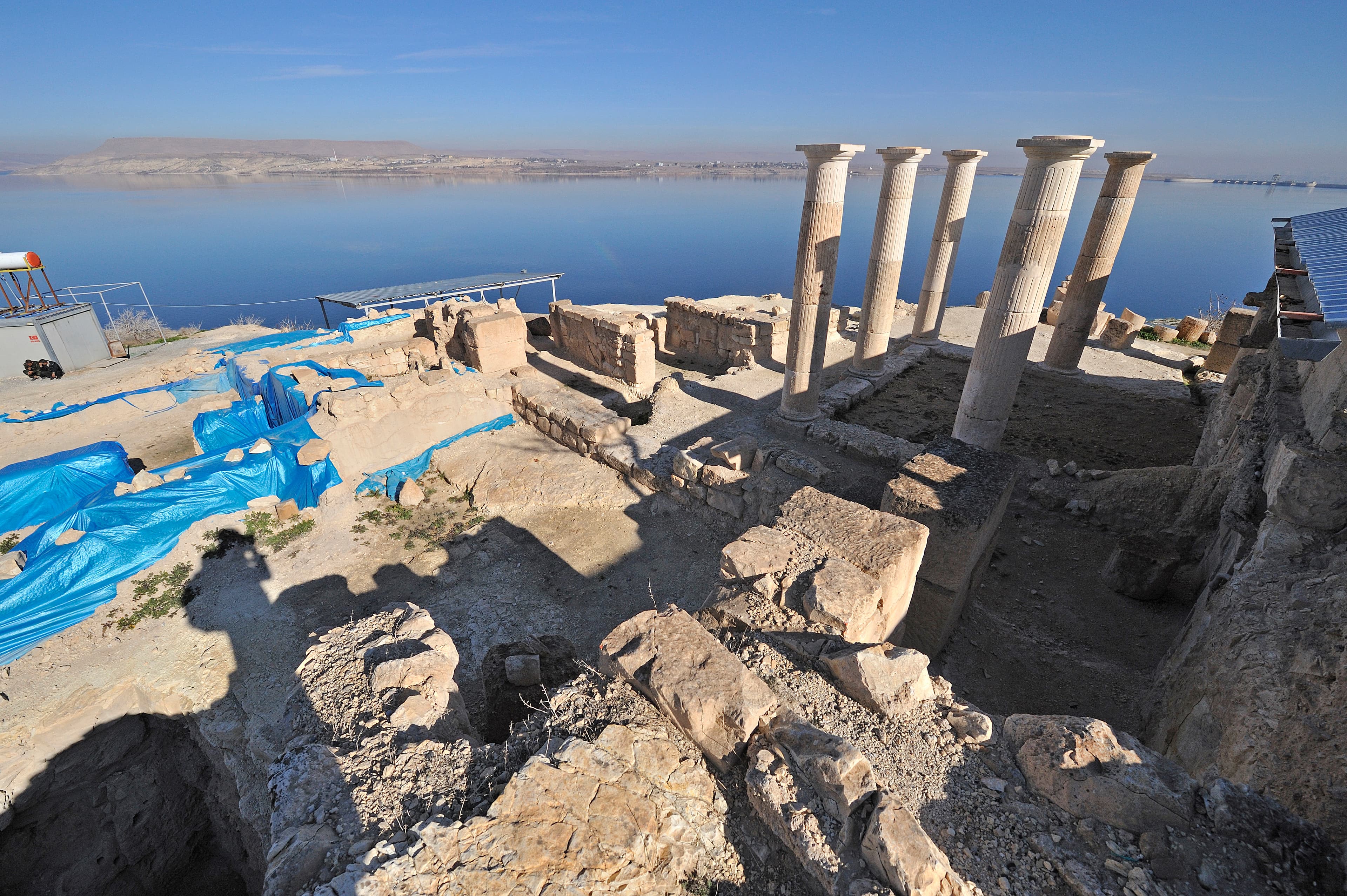
Image of Zeugma. Image source
Visit essentials
A quick read before you go
- Duration
- Belkıs Hill archaeological site: 1-2 hours.
- Access
- The Belkıs archaeological site is approximately 50 km northeast of central Gaziantep, near the…
Overview
Zeugma means “bridge” or “yoke”: a city at the Euphrates crossing where Hellenistic and Persian worlds met. Founded around 300 BCE by one of Alexander's successors, it blended Greek philosophy, Persian Zoroastrianism, and Commagenian syncretic theology. Domestic mosaics record urban sophistication equal to any in the Roman world. In 256 CE, the Sasanian king Shapur I destroyed the city; never fully rebuilt, it subsided into riverbank earth for over fifteen centuries.
In 1999, as the Birecik Dam reservoir rose, international teams began one of modern archaeology's most urgent rescues. They uncovered nearly intact villas and mosaics of gods, heroes, and ordinary Hellenistic life. The “Gypsy Girl,” a young woman with a sidelong gaze in tesserae smaller than a fingernail, became the symbol. She and dozens of mosaics moved to Gaziantep's purpose-built museum, which receives more annual visitors than any other site in southeastern Turkey.
Belkıs Hill preserves part of the city above water. Much remains beneath the reservoir—permanently submerged and largely unmapped—while the Euphrates flows over a former threshold between worlds.
Why this place is sacred
In ancient Near Eastern cosmology, the Euphrates was not simply a river — it was one of the four rivers of Eden, a boundary written into the origin of the world itself. To build a city straddling it was to occupy sacred geography, and the Commagenian rulers who held Zeugma in the centuries before Rome understood this.
Antiochus I of Commagene developed an extraordinary religious synthesis: he depicted himself on stone stelai in the act of dexiosis — the divine handshake — with the gods themselves, blurring the boundary between royal and divine in a theology that was neither purely Greek nor purely Persian but distinctively his own. Sanctuaries on Belkıs Hill above the crossing were consecrated to this merged pantheon, and the city's spiritual life carried the character of a threshold crossed simultaneously in both directions.
What lends Zeugma its particular poignancy now is a different kind of liminality: the tension between recovery and loss. The 2000 rescue excavations revealed beauty preserved far beyond what anyone expected — floors decorated with mythological tableaux, portraits of unidentified individuals whose private lives suddenly surfaced after fifteen centuries of silence.
The 'Gypsy Girl' mosaic carries this quality most intensely: she seems caught in the moment of turning away, or turning toward, and her expression — part apprehension, part defiance — speaks across the gap between her world and ours with unsettling directness. The dam water that closed over the rest of the city the same season she was lifted makes her survival feel contingent, almost miraculous.
A strategic river crossing and trading city, Zeugma also served as a sacred focal point for Commagenian ruler-cult worship, with sanctuaries where the syncretic theology of Antiochus I was enacted through sacrifice and ritual before the deity-portraits of the merged Greco-Persian pantheon.
From Seleucid military crossing-point, to Commagenian cult center, to a thriving Roman provincial city where domestic life reached extraordinary artistic refinement — before destruction in 256 CE, followed by fifteen centuries of slow burial, and then the modern drama of partial recovery at the moment of permanent loss.
Experience and orientation
Stand at the edge of the Birecik reservoir and you are looking at a submerged city. The water is ordinary-looking — brown-green, moving with the current — but beneath it, at depths that change with the dam's seasonal management, lie the ruins of villas, streets, and public buildings that were never fully excavated. Fishermen work the reservoir; a few small boats pass. Nothing marks what is underneath.
The excavated zone on Belkıs Hill above the waterline is less dramatic than the museum, but it carries the particular quality of standing in the original place. The hill overlooks the river and the Turkish-Syrian border region beyond; on clear days the landscape is expansive. The excavated structures are fragmentary — foundations, partial walls, sections of mosaic floor protected under shelters. The absence of crowds that attend more famous Turkish sites creates conditions for genuine attention.
The Zeugma Mosaic Museum in Gaziantep, about fifty kilometers from the site, is where the full weight of the place is felt. The museum was purpose-built to receive the rescued mosaics and is itself one of the best-designed archaeological museums in Turkey. The mosaics are displayed at floor level where possible, allowing visitors to stand above them in something like the spatial relationship of the original villa residents.
The 'Gypsy Girl' — in a small room off the main galleries — is invariably the encounter that stays longest. Her scale is smaller than photographs suggest; she is intimate rather than monumental. The sidelong gaze, the visible asymmetry of her expression, the quality of the tesserae work: these require sustained looking to yield what they hold.
The site and museum are separate experiences requiring separate visits. Arrive at the Belkıs Hill archaeological zone with some knowledge of the site's history; the interpretive signage is adequate but not comprehensive. At the Zeugma Mosaic Museum, allow at least two hours — the collection is large and the detail in the mosaics rewards slow attention. The museum shop carries scholarly publications.
Context and lineage
Around 300 BCE, Seleucus I Nicator — one of the generals who divided Alexander's empire after his death — established a military crossing on the Euphrates and named it for the bridge of boats that spanned the river there. 'Zeugma' in Greek means both bridge and yoke, and both meanings applied: this was a place where east and west were connected and held together under the same political authority. The settlement grew rapidly into a prosperous city.
Under the Kingdom of Commagene in the second and first centuries BCE, Zeugma became a cultural and religious center, with Antiochus I's syncretic theology encoded in stone reliefs on Belkıs Hill. Rome absorbed the Commagenian kingdom in 72 CE and Zeugma entered its most prosperous era: a legionary garrison city, a customs post on the eastern frontier, and a trading hub where wealth flowed freely enough to fund the extraordinary mosaic floors now in Gaziantep.
In 256 CE, the Sasanian king Shapur I destroyed the city. The site was never fully rebuilt.
Seleucid military post → Commagenian cult city → Roman frontier garrison and trade center → destruction 256 CE → gradual burial → partial submersion under Birecik reservoir 2000 CE → ongoing archaeological recovery
Seleucus I Nicator
Founder
Antiochus I of Commagene
Religious architect
Shapur I
Destroyer
Rescue excavation teams (2000)
Recoverers
Traditions and practice
The Commagenian sanctuaries on Belkıs Hill were centers of a unique religious synthesis: Antiochus I combined Greek gods (Zeus, Apollo, Hermes, Heracles, Ares) with Persian equivalents (Ahura Mazda, Mithras, Verethragna) into a unified pantheon, and performed the dexiosis ritual — depicted in stone reliefs — that established the king's personal relationship with each deity. Sacrifices, libations, and votive offerings accompanied the ruler-cult ceremonies.
Under Roman rule, these forms gave way to more conventional Greco-Roman temple worship and the Roman imperial cult.
No active religious practices take place at the site or in connection with it. The Zeugma Mosaic Museum in Gaziantep functions as a cultural heritage institution and is a significant point of civic pride for the city. The museum draws international scholarly attention and is a center of mosaic conservation research.
At the Belkıs Hill archaeological zone, walk slowly along the edge of the reservoir before entering the excavated area. The visual threshold where excavated earth meets the waterline marks the boundary between what was recovered and what was not — stand there long enough and the sheer quantity of what lies beneath becomes imaginatively present.
Inside the sheltered areas, look at the preserved mosaic fragments not for narrative content first but for technique: the tiny stone pieces, their color gradations, the way the tesserae create an illusion of continuous tone. This attention transfers directly to the museum, where the full mosaics can be read with the vocabulary built on-site. At the Zeugma Mosaic Museum, resist the impulse to go immediately to the Gypsy Girl.
Move through the larger galleries first, letting the scale and variety of the collection build. When you finally enter her room, take a seat on the low bench provided and let your eyes adjust to the intimate space. Notice the uncertainty in her expression — it is genuinely unresolved, and the mosaic artist knew it.
Commagenian Syncretic Religion
HistoricalZeugma lay within the Kingdom of Commagene and was a focal point for the syncretic cult devised by Antiochus I, blending Greek Olympian gods with Persian Zoroastrian deities. Sanctuaries on Belkıs Hill contained cult statues and dexiosis stelai depicting Antiochus in divine handshake poses with the gods, enacting a theology in which royal and divine authority merged.
Ruler cult, offerings to the blended Greco-Persian pantheon, ceremonies at the hilltop sanctuaries, syncretic festivals
Greco-Roman Polytheism
HistoricalDuring the Roman period, Zeugma became one of the most prosperous frontier cities in the eastern empire. Its private villas were decorated with mosaic floors depicting Greco-Roman mythology at the highest artistic level, reflecting a civic religious life fully integrated into the empire's cultural world.
Temple worship, civic festivals, sacrifices to Olympian deities, Roman imperial cult observances
Archaeological Scholarship
ActiveZeugma is recognized internationally as one of the most significant — and most contested — rescue archaeology sites in Turkey. The 2000 emergency excavations yielded extraordinary results; ongoing research continues to work with the recovered materials and document the still-submerged portions of the city.
Ongoing archaeological research at the Belkıs Hill zone; conservation and scholarly study of the mosaic collection at the Zeugma Mosaic Museum; international academic collaboration on Commagenian history and Roman provincial art
Perspectives and open questions
Zeugma is a site that different observers read through radically different lenses: as a case study in cultural heritage loss, as an archaeological triumph under pressure, as a monument to Roman domestic luxury, and as the physical record of a unique religious synthesis that blended Greek and Persian cosmologies on the banks of a sacred river.
Scholarly perspective
For archaeologists, Zeugma represents one of the most significant — and most troubled — rescue operations in Turkish archaeological history. The 2000 season's yield of forty-five mosaics in a single campaign was extraordinary; the price was the permanent loss of most of the city. Scholars estimate that more than half the site now lies permanently submerged and will never be excavated. The Zeugma Mosaic Museum's holdings are the recovered portion of a much larger loss.
Current scholarship focuses on the social history readable from the mosaic iconography — what these domestic images tell us about the aspirations and self-understanding of provincial Roman elites on the eastern frontier.
Living and traditional perspectives
For the Gaziantep civic community, Zeugma is inseparable from local identity. The Zeugma Mosaic Museum is the city's signature institution — a source of pride that positions Gaziantep as a cultural capital rather than merely a commercial city. The 'Gypsy Girl' appears on city signage, in local businesses, and in the visual vocabulary of the city in ways that suggest genuine identification rather than simple tourism marketing.
Local awareness of the dam's role in the story — the partial catastrophe that triggered the partial recovery — gives the heritage relationship a quality of grief alongside pride.
Alternative interpretations
The Euphrates has carried profound symbolic weight in multiple spiritual traditions across thousands of years — one of the four rivers of Eden in the Hebrew Bible, the boundary of the known world in Mesopotamian cosmology, the great eastern threshold for the Greek world.
Standing at a city whose name means 'bridge' and whose ruins now lie at the bottom of a dam reservoir, some spiritual visitors experience the site as a meditation on all rivers as time itself: flowing, irreversible, simultaneously erasing and carrying forward. The Commagenian theology here — its synthesis of Greek and Persian gods, its insistence on the divinity of the boundary between cultures — speaks to anyone drawn to the margins where different worlds touch.
Open questions
The full extent of the submerged city is unknown and may never be established. Studies using ground-penetrating radar have begun to map the underwater areas, but complete documentation will require technology not yet developed. The exact character of the Commagenian religious practice at Zeugma — how the dexiosis theology was enacted in ceremony, what the sanctuaries looked like at their height — remains largely inferential.
And the private lives of the people depicted in the mosaics, who they were and what they meant to themselves, may remain permanently hidden beneath the water.
Plan your visit
Access and arrival
The Belkıs archaeological site is approximately 50 km northeast of central Gaziantep, near the village of Belkıs off the road toward Birecik. The Zeugma Mosaic Museum is located in the Gaziantep city center at 1 Mithatpaşa Cd., open Tuesday-Sunday. Taxis from central Gaziantep to Belkıs take approximately 45-60 minutes; the museum is easily reachable by taxi or on foot from central accommodation.
Phone signal is generally available in the Gaziantep area; the Belkıs site is more remote — download maps offline before travel.
Gaziantep is a major regional city with a full range of accommodation options. Staying in the historic center places you within walking distance of the Zeugma Mosaic Museum and the city's renowned food culture. No accommodation exists near the Belkıs site itself.
Respectful visit
No dress requirements at either location. Comfortable walking shoes are essential at the outdoor site; the museum is a climate-controlled indoor space.
Freely permitted at the outdoor archaeological site. Inside the Zeugma Mosaic Museum, photography without flash is permitted; flash photography is prohibited to protect the pigments of the ancient mosaics. Tripods may require advance permission.
None appropriate.
Do not touch ancient structures at the outdoor site or approach the reservoir edge beyond designated viewing points. At the museum, do not touch or lean over the floor-level mosaics. Keep children within arm's reach in the gallery rooms.
The reservoir itself has no safe swimming or wading access; its depths are unpredictable and the underwater remains are protected. Do not attempt to access submerged areas. At the outdoor site, watch for uneven terrain and exposed stone edges.
Location
Map loads as you approach this section.
Pilgrim reflections
A portrait of encounter, not a score
Pilgrims describe what they felt, how present they could become, and whether the place would shape a journey. There are no stars and no ranking of traditions.
No reviewed reflections yet
The first pilgrims can help describe the character of being here.
Share a reflection
Available after an account-backed “Been there.” Every reflection is reviewed before publication.
Nearby sacred places
Explore other sacred places in the region. Proximity does not establish access or travel time; check each place’s guidance.

References
Sources consulted for this page. Source categories describe the publication, not a guarantee that every claim is verified. Traditional accounts and outside interpretations may differ.
- 01Archeological Site of Zeugma - UNESCO World Heritage Centre Tentative List — UNESCOofficialOfficial UNESCO tentative list entry with significance statement
- 02Zeugma After the Flood - Archaeology Magazine November/December 2012 — Archaeology MagazineacademicIn-depth account of rescue excavations and flooding impact
- 03Zeugma (Commagene) - Wikipedia — Wikipedia contributorsencyclopediaComprehensive overview of history, excavations, and mosaics
- 04Zeugma | Turkish Archaeological News — Turkish Archaeological NewsacademicAggregated academic and news coverage of excavations
- 05Gaziantep Zeugma Mosaic Museum - Lonely Planet — Lonely PlanetguideVisitor guide for the Zeugma Mosaic Museum in Gaziantep
- 06Zeugma | All About Turkey — All About TurkeyguideGeneral overview, history, and visitor information
- 07The Stunning Ancient Greek Mosaics of Zeugma — GreekReporterSource contextRecent article on the mosaic heritage
- 08Zeugma: The Lost City That Resurfaced After 1,500 Years — The Other TourguideNarrative overview of history and modern rediscovery
Share a photo
Help visitors recognize Zeugma. Every submission is reviewed before publication.