Çakmaktepe
The village that preceded Göbekli Tepe — where the Neolithic world first began to gather
Understand sacred places, explore living traditions, and learn how to engage respectfully with Pilgrim Map.
Access has not been verified. Check current local guidance before planning a visit.
Şanlıurfa, Turkey
Read the sources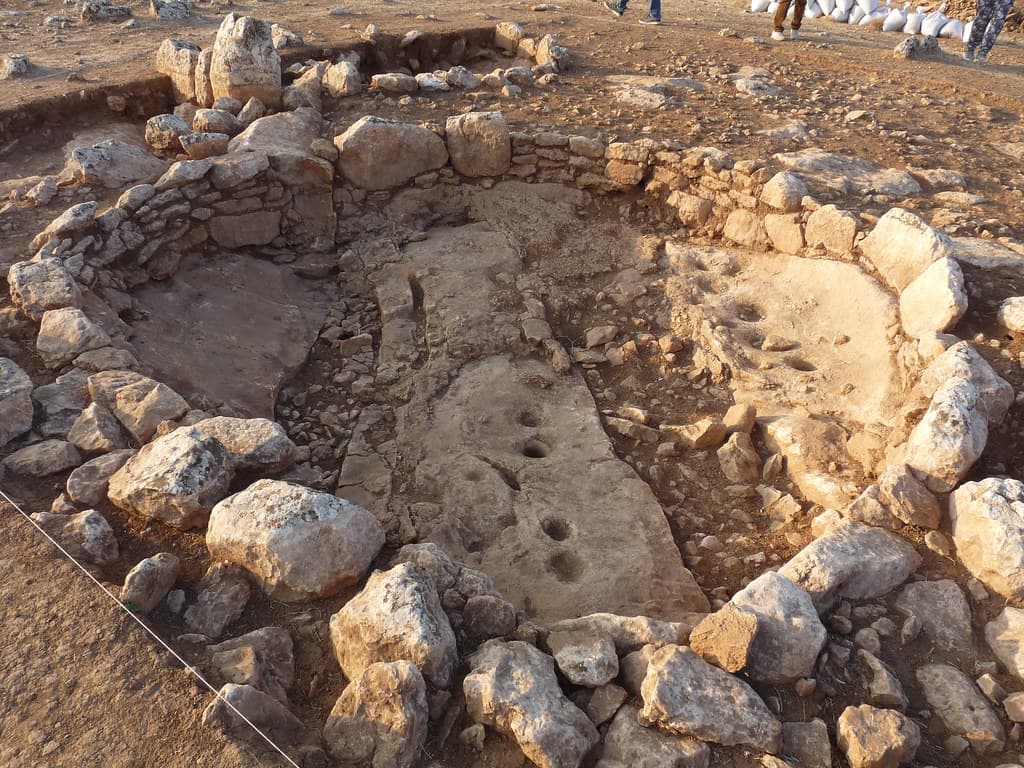
Image of Çakmaktepe. Image source
Visit essentials
A quick read before you go
- Duration
- 1–2 hours at the site; plan a full day for a Taş Tepeler circuit including Göbekli Tepe,…
- Access
- Located approximately 20 km southwest of Şanlıurfa city center in the Eyyübiye district, on the…
Overview
Dating to approximately 9600–8800 BCE in the Pre-Pottery Neolithic A phase, Çakmaktepe is the first known permanent settlement in this corner of the Şanlıurfa plateau and predates Göbekli Tepe by a full millennium. Its quieter architecture already contains seeds of what followed: communal buildings too large for one household suggest shared social or ceremonial gatherings. Burned skulls of wild cattle, sheep, gazelles, and equids were placed at wall bases, either as protective offerings or markers of social meaning.
Buildings were deliberately sealed and buried on abandonment, a ceremonial closure treating architecture as living and requiring a proper death. At 670 meters on a limestone plateau, Çakmaktepe anchors the beginning of a landscape that would become the world's first sacred geography.
Why this place is sacred
The spiritual character of Çakmaktepe does not announce itself through monumental sculpture or elaborate iconography. Its offerings are subtler: the scale of buildings too large to be domestic, the deliberateness of burned skulls placed at structural bases, the ceremony of burial for an architectural space that was ready to close.
The intentional burial of buildings — sealing them prior to abandonment rather than leaving them open or reusing them — is one of the most philosophically suggestive gestures in the Neolithic archaeological record. It implies that the community understood built spaces as having a kind of life-cycle: born when construction began, inhabited and filled with social meaning, and requiring a proper ending. This is not an economic logic. It is a cosmological one.
The building, like a person, needs to be laid to rest.
The placement of burned animal skulls at wall bases extends this logic into the animal world. Wild cattle, sheep, gazelles, and equids — all hunted species in this pre-agricultural period — were brought into structural ritual, their skulls marking transitions in the life of a building. Whether this constituted an offering to a force inhabiting the space, a commemorative act, or something with no modern equivalent is unknown.
What is clear is that the boundary between architectural and living space, between building and body, was deeply porous in the worldview of this community.
Çakmaktepe sits within the broader landscape of the Taş Tepeler project — a cluster of sites across the Şanlıurfa plateau where the transition from mobile gathering to permanent, ritual-centered community took place over roughly 1,500 years. Göbekli Tepe represents the culmination of that transition. Çakmaktepe represents its very beginning.
A Pre-Pottery Neolithic A settlement serving as both a permanent residential community and a space for communal ritual gathering; the large communal buildings suggest functions beyond the domestic.
Occupied during the PPNA phase (c. 9600–8800 BCE), Çakmaktepe is the chronologically earliest known settlement in the Taş Tepeler cluster. Its community existed approximately 1,000 years before the builders of Göbekli Tepe. The site remained unknown to archaeology until discovered in 2021 and is currently in the early stages of systematic excavation.
Experience and orientation
Çakmaktepe is in the early stages of archaeological excavation and visitor development. Arriving here requires some effort and intentionality — this is not a site with polished infrastructure or a comprehensive interpretive program. What it offers is rarity: access to a place that was unknown to the world three years ago, in a landscape whose significance is still being worked out by active excavation.
The site sits on an Eocene limestone plateau at 670 meters, in the Eyyübiye district southwest of Şanlıurfa. The terrain is arid and exposed; on clear days, the sight lines across the plateau suggest something of the landscape logic that made this region the locus of early sedentism. The communal buildings, some up to 16 meters in diameter, are the primary archaeological feature.
Even in partial excavation, the circular outlines of these structures communicate the scale of gathering they were designed to accommodate.
Slow movement rewards. Attention to the animal skull evidence — even described rather than seen in situ — changes how you read the structural foundations. A wall base that held a burned skull of an aurochs is not a neutral architectural element; it is a threshold marked by something that was once alive.
The same logic applies to the building outlines themselves: a structure that was ritually sealed and buried before abandonment is a boundary between a space that was living and one that was deliberately ended.
The recommended approach for most visitors is to incorporate Çakmaktepe into a multi-site Taş Tepeler circuit, spending the primary interpretive time at Göbekli Tepe and Karahantepe, where infrastructure and signage are more developed, and treating Çakmaktepe as the chronological anchor of the sequence — the place where the journey began.
Access through Taş Tepeler circuit tours or independently by car from Şanlıurfa. Check current access with the Taş Tepeler project (goturkiye.com/tastepeler or tastepelertravels.com) before visiting, as the site's public access arrangements are still developing.
Context and lineage
No mythology survives from the PPNA period. Çakmaktepe's community left no written record, no iconographic tradition, no named figures or founding stories. What archaeology recovers is a material testimony to a set of choices: to settle on a limestone plateau, to invest in communal buildings far larger than any single household needed, to mark the foundations of those buildings with burned animal remains, and to give those buildings formal burials when their time was done.
These choices collectively constitute a spiritual orientation — one in which built spaces, animal bodies, and human gathering were intertwined in a single social and ritual fabric. The community that made these choices was also, in all likelihood, an ancestor to the builders of Göbekli Tepe: the people who would go on, a millennium later, to carve the world's first monumental religious architecture.
Çakmaktepe is the chronological foundation of the Taş Tepeler cluster — the cultural landscape that produced Göbekli Tepe, Karahantepe, Sayburç, and the other sites of the Şanlıurfa plateau's Neolithic sacred geography. Its PPNA community represents the generation (or generations) that established permanent settlement in this landscape before the impulse toward monumental architecture emerged.
Associate Professor Fatma Şahin
Lead excavator
Traditions and practice
The distinctive ritual practices at Çakmaktepe center on three gestures: the construction of communal buildings too large for domestic use alone (up to 16 meters in diameter), suggesting gathering of a social or ceremonial nature beyond the household; the deliberate placement of burned animal skulls — from wild cattle, sheep, gazelles, and equids — at wall bases, either as foundational offerings or as markers of transition; and the ritual burial of buildings upon abandonment, sealing the interior and closing the structure as one would close a life.
No active religious or spiritual tradition uses the site. Archaeological excavation continues under the Taş Tepeler project umbrella, involving Şanlıurfa Archaeological Museum, Çukurova University, and the University of Tsukuba.
Çakmaktepe requires the visitor to work with absence more than presence. The site is recently discovered and partly excavated; much of its significance must be carried in from prior reading rather than recovered on-site through signage or infrastructure. Before arriving, spend time with the research on PPNA communities — their animal relationships, their building practices, their transitional lives between mobility and settlement.
At the site, pay attention to the circular outlines of the communal buildings and consider their diameter: 16 meters is a space for many bodies gathered in close proximity, a room for a community. Let the animal skull evidence shift how you read the foundations. These are thresholds, not just walls.
If you have time to sit quietly in or near one of the excavated building outlines, let the plateau landscape settle around you — the same exposed limestone terrain that the builders looked out on, the same light that fell on the burning of an animal skull before it was placed in the wall.
Pre-Pottery Neolithic A (PPNA)
HistoricalÇakmaktepe is the oldest known settlement in the Taş Tepeler cluster, documenting the earliest phase of sedentism in the region that would produce humanity's first monumental sacred architecture. Its communal buildings and ritual practices represent the social and ceremonial foundations from which Göbekli Tepe eventually emerged.
Construction of large communal buildings (up to 16 m diameter); ceremonial placement of burned animal skulls at wall bases; ritual building burial upon abandonment (intentional sealing of structures); domestic occupation in smaller circular to oval houses.
Archaeological Heritage / Taş Tepeler Project
ActivePart of the Turkish Ministry of Culture's flagship Taş Tepeler (Stone Mounds) research initiative, which has reframed global understanding of the origins of ritual architecture and sedentism in Neolithic Anatolia.
Annual excavation seasons; international collaboration (Şanlıurfa Archaeological Museum, Çukurova University, University of Tsukuba); public education and heritage tourism development as part of the broader Taş Tepeler circuit.
Perspectives and open questions
Çakmaktepe's significance is partly defined by its position in the Taş Tepeler timeline: it shows what was present before the monumental architecture of Göbekli Tepe, allowing researchers and visitors to ask what the conditions were that made that later explosion of symbolic building possible.
Scholarly perspective
Published scholarly analysis (notably from Anatolian Archaeology and the Taş Tepeler project team) identifies Çakmaktepe as the oldest known settlement in the Şanlıurfa PPNA landscape, dating to approximately 9600–8800 BCE. The large communal buildings, at up to 16 meters diameter, are significantly larger than anything that would be needed for a single household, pointing to organized social gatherings.
The burned animal skull evidence — placed at wall bases — parallels ritual practices at other PPNA and early PPNB sites in the region and suggests a broad Neolithic cultural horizon where animal remains served structural-ritual functions. The ritual building burial practice (intentional sealing upon abandonment) is particularly noted as evidence of an emerging cosmology where architectural spaces carried social and possibly spiritual meaning.
Living and traditional perspectives
No oral tradition survives from the PPNA period. The site is managed under the Turkish Ministry of Culture's Taş Tepeler initiative, which treats the broader cluster as a landscape of global cultural significance.
Alternative interpretations
The intentional burning and burial of buildings has attracted interpretive attention beyond the strictly archaeological. Some researchers and writers have read this practice as evidence of a cyclical cosmological worldview: the building, like a plant or an animal, has a life-cycle, and its ending requires ceremony. The burning before burial would in this reading be analogous to cremation — a transformation rather than simple abandonment.
Open questions
The full extent of the settlement remains to be determined; excavation is in early stages. The precise function of the communal buildings — whether social, ceremonial, or both — is unresolved. The relationship between Çakmaktepe's PPNA community and the later PPNB builders of Göbekli Tepe is not yet established in the archaeological record. Whether the building orientations were astronomically or calendrically significant has not been investigated.
Plan your visit
Access and arrival
Located approximately 20 km southwest of Şanlıurfa city center in the Eyyübiye district, on the Eocene limestone plateau at 670 meters elevation. Car required — no public transport serves the site directly. For access arrangements, contact the official Taş Tepeler project through Go Türkiye (goturkiye.com/tastepeler) or Taş Tepeler Travels (tastepelertravels.com). Mobile phone signal may be unreliable on the plateau; carry downloaded maps. No information was available at time of writing on formal admission arrangements.
Şanlıurfa city (approx. 20 km) offers a full range of accommodation options. The city is a natural base for multi-day Taş Tepeler exploration.
Respectful visit
No religious dress requirements. Practical outdoor clothing essential: the site is exposed at 670 meters with no shade. Sun protection, sturdy footwear for rocky terrain, and water are necessary in warmer months.
Photography is permitted for visitors in non-restricted areas. Respect any photography restrictions communicated by the excavation team, particularly in active trench areas.
Not applicable.
Do not enter active excavation areas. Do not remove any material from the site. Stay on routes indicated by on-site staff or signage.
Active excavation site — follow all team instructions and do not enter restricted zones. The site is developing its visitor infrastructure; conditions on the ground may differ from published information. Hot, exposed terrain in summer; carry water and sun protection.
Location
Map loads as you approach this section.
Pilgrim reflections
A portrait of encounter, not a score
Pilgrims describe what they felt, how present they could become, and whether the place would shape a journey. There are no stars and no ranking of traditions.
No reviewed reflections yet
The first pilgrims can help describe the character of being here.
Share a reflection
Available after an account-backed “Been there.” Every reflection is reviewed before publication.
Nearby sacred places
Explore other sacred places in the region. Proximity does not establish access or travel time; check each place’s guidance.


References
Sources consulted for this page. Source categories describe the publication, not a guarantee that every claim is verified. Traditional accounts and outside interpretations may differ.
- 01Çakmaktepe: An Early Neolithic Settlement Reframing the Origins of Sedentary Life in Southeast Türkiye — Anatolian ArchaeologyacademicScholarly overview of the site's significance and architecture
- 02Cakmaktepe Archaeological Site Guide | Go Türkiye — Go Türkiye (Turkish Ministry of Culture and Tourism)officialOfficial Turkish government tourism information
- 03Çakmaktepe: A window onto the Pre-Pottery Neolithic Period — Het Hunebed NieuwscaféSource contextGood synthesis of recent excavation findings
- 04Çakmaktepe - Taş Tepeler Travels & Tours — Taş Tepeler TravelsguideSpecialized Neolithic Anatolia tour operator information
- 0510 Questions About Çakmaktepe — Stone Mounds AppSource contextGood FAQ-format overview
- 06Gazelle skulls reveal prehistoric rituals at Cakmaktepe, oldest settlement of Tas Tepeler — Türkiye TodaySource contextCovers ritual skull placement findings
- 07Çakmaktepe Ancient Village or Settlement : The Megalithic Portal — The Megalithic PortalSource contextGPS coordinates and brief overview
Share a photo
Help visitors recognize Çakmaktepe. Every submission is reviewed before publication.