Oylum Höyük
Six thousand years of human time compressed into a single mound at the edge of Anatolia
Understand sacred places, explore living traditions, and learn how to engage respectfully with Pilgrim Map.
Access has not been verified. Check current local guidance before planning a visit.
Kilis, Turkey
Read the sources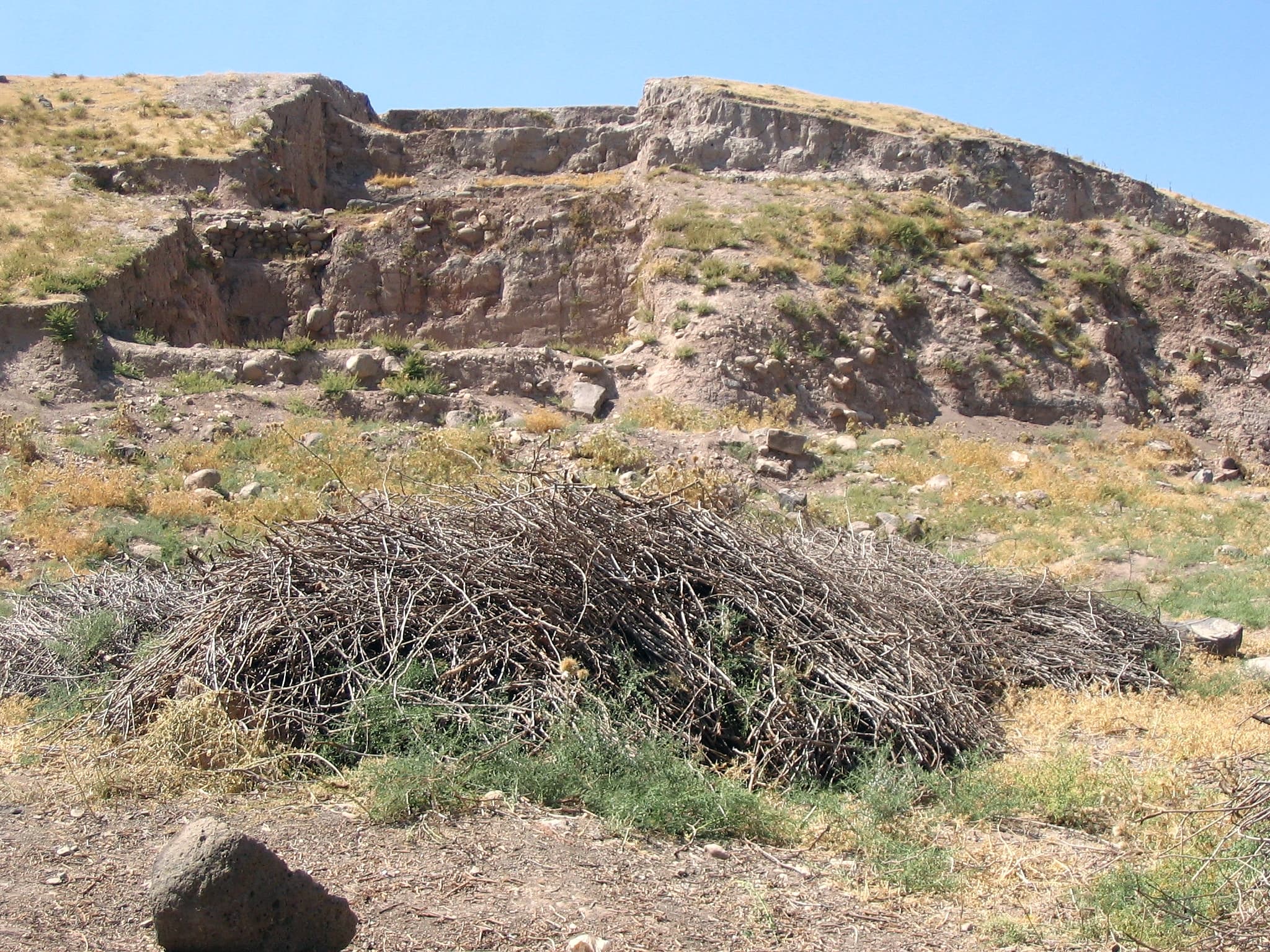
Visit essentials
A quick read before you go
- Duration
- 1–2 hours at the mound; allow an additional 30–45 minutes for the Kilis Museum.
- Access
- Located approximately 7 km east-southeast of Kilis city center, near the village of Oylum.
Overview
Oylum Höyük rises 37 meters above the Kilis plain near the Syrian border, compressing more than six thousand years into earth and stone. Bronze Age palace administrators stored clay seal impressions here; Hittite reach left treaty fragments and divine imagery. A cup from these layers bears the oldest lyre imagery yet found in Anatolia, linking the site to ritual-music traditions that may have traveled across the ancient Near East.
At the junction of the Euphrates Valley and Amik Plain, the mound marks where Anatolian, Syrian, and Mesopotamian currents long converged. Its ancient name remains unconfirmed: Hittite texts mention Ukulzat or Kuilzila as regional administrative centers, but the identification is unproven.
Archaeologists from Nevşehir Hacı Bektaş Veli University continue excavating its layers. Summer visitors may find young scholars carefully exposing what the ground has held for thousands of years.
Why this place is sacred
Some places acquire spiritual weight not through a single founding event but through the sheer accumulation of human presence. Oylum Höyük is such a place. Six thousand years of unbroken habitation have layered meaning into this ground in ways that no single tradition can claim or exhaust.
The people who lived here in the Chalcolithic period, in the Bronze Age, under Hittite hegemony, in the Iron Age, and into Byzantine times each brought their own cosmologies — and each left something of them behind in the earth. The discovery of the oldest known lyre depictions in Anatolia at this site is not merely an archaeological curiosity.
In the ancient Near East, the lyre was an instrument bound to ritual, to divine court ceremonies, to the singing of sacred hymns. The Hurrian Hymns — the oldest notated music in the world — were lyre compositions. Finding lyre imagery here suggests that Oylum Höyük participated in a wider ancient world of sacred sound, one in which music was not entertainment but a form of address to the divine.
The geographic setting reinforces this quality: the mound stands at the boundary between the Anatolian plateau and the Syrian lowlands, between the world of the Hittites and the world of Mesopotamia. Boundaries in the ancient world were understood as sacred spaces — liminal zones where different orders of reality touched.
Bronze Age administrative and likely cultic center within the Syro-Anatolian cultural sphere; probable regional seat of Hittite administrative authority
From Chalcolithic settlement through Bronze Age palace culture and Hittite imperial administration to Iron Age local occupation and eventual Byzantine use; now an active archaeological site and regional heritage asset
Experience and orientation
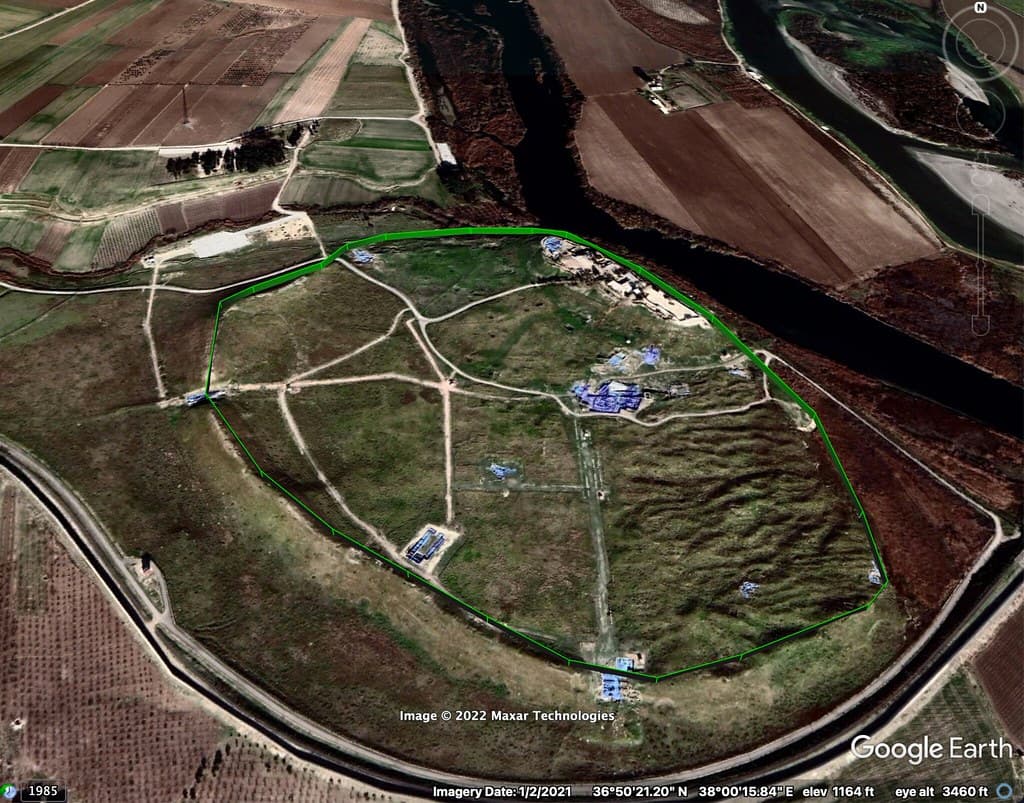
The approach to Oylum Höyük from the village of Oylum is unremarkable at first — a flat agricultural landscape, the familiar architecture of a small Turkish town, a narrow path leading upward. But the mound itself changes this. At 37 meters high and roughly 460 by 370 meters across, it is a substantial physical presence. The climb to the summit is gradual but meaningful: with each meter of altitude, you are ascending not only topographically but through time.
The summit opens onto panoramic views in all directions — south toward the Syrian border (at certain times of year, the political tension of that frontier makes itself felt in the landscape), north toward the Taurus foothills, east toward the plains that once carried Hittite imperial roads. Stand at the top and consider that Chalcolithic families prepared food, Bronze Age scribes pressed cylinder seals into clay, and Hittite administrators drafted correspondence on this same ground.
The sense of temporal vertigo that this can produce — the weight of six thousand years concentrated in a single modest hill — is the site's greatest gift. In summer, when the excavation season is active (usually July through August), the encounter takes on an additional quality: young archaeologists, trowels in hand, working carefully in trenches that reveal walls and floors and pottery from the Bronze Age.
Speaking with them, watching the work, transforms an abstract sense of history into something immediate.
The site is freely accessible year-round. A narrow path leads from the village of Oylum (approximately 7 km east-southeast of Kilis city center) up to the mound. The summit requires about 15 minutes of steady walking from the village edge. Bring water and sun protection — shade is minimal.
Context and lineage
The earliest layers at Oylum Höyük date to the Late Chalcolithic period, around 4000 BCE — before writing, before bronze, before the city-states of Mesopotamia had fully emerged. By the Middle Bronze Age (c. 2000–1600 BCE), the site had become a substantial palatial center with organized storage, ceramic production, and administrative seal use.
Its possible identification with Ukulzat or Kuilzila in Hittite texts would place it as a recognized node in the Hittite imperial network — a city subordinate to greater powers but important enough to be named in royal correspondence and treaty obligations. Burial evidence, state ceremonies, and the use of cylinder seals with divine imagery suggest an organized religious life tied to the Hittite state religion centered on the Storm God and the sun goddess of Arinna.
Bronze Age Syro-Anatolian / Hittite imperial tradition; Iron Age local traditions; Byzantine period occupation; present archaeological and scholarly tradition
Traditions and practice
The archaeological record at Oylum Höyük points to burial rites with grave goods, the use of cylinder seals bearing divine imagery in administrative and ceremonial contexts, and state ceremonies connected to the Hittite imperial cult. In the Hittite religious system, storm god worship and the ratification of treaties before divine witnesses were central ritual acts; as a likely administrative center within the Hittite sphere, the site would have participated in this system.
The discovery of lyre imagery here connects Oylum to ancient traditions of ritual music — the lyre was an instrument of sacred ceremony across the ancient Near East, played at divine courts and in contexts of royal and priestly worship.
Annual archaeological excavation campaigns by the Nevşehir Hacı Bektaş Veli University team; artifacts from the site are displayed at the Kilis Museum in the city center.
Arrive at the site in the early morning before the heat builds. Before climbing, stand at the base of the mound and observe its scale — the full 460-meter breadth of accumulated human habitation. On the ascent, pause at intervals and look back at the plain below: this is the vista that Bronze Age administrators and Hittite-era residents saw every day. At the summit, sit quietly for a few minutes before engaging with the view.
The silence here, broken only by wind and distant agricultural machinery, has its own quality. If the excavation team is present, ask permission before approaching active dig areas — many archaeologists welcome informed visitors and will take a few minutes to explain what they are uncovering. At the Kilis Museum afterward, the seal impressions, pottery, and other finds from the site give the mound's layers a more tangible form.
Bronze Age Syro-Anatolian / Hittite
HistoricalOylum Höyük was an administrative and likely cultic center within the Hittite imperial sphere. Evidence includes a possible Hittite-era treaty fragment, cylinder seals with divine imagery, burial rites with grave goods, and the oldest known lyre depictions in Anatolia — linking the site to ancient ritual musical tradition.
Burial rites with grave goods, state ceremonies, cylinder seal use in administrative and ceremonial contexts, ritual music
Archaeological / Scholarly
ActiveOngoing excavations since 1986 have made Oylum Höyük a key reference site for Bronze Age Anatolia and North Syria. The site is particularly important for understanding Hittite imperial reach and the relationship between Anatolian and Syrian Bronze Age cultures.
Annual excavation campaigns, academic publication, museum curation at Kilis Museum
Perspectives and open questions
Oylum Höyük sits at the intersection of three major ancient civilizations without being fully owned by any one of them — which makes it an unusually open subject for interpretation.
Scholarly perspective
Archaeologists understand Oylum Höyük as a regionally significant Bronze Age administrative center within the Hittite imperial orbit, important for understanding cultural exchange between Anatolia and North Syria. The excavation's most distinctive contribution has been the discovery of the oldest known lyre depictions in Anatolia, and the comparative work linking Oylum with Alalakh that illuminates the Bronze Age Syro-Anatolian cultural zone.
Living and traditional perspectives
No surviving indigenous community maintains continuous religious or cultural connection to the site. The local Turkish and Kurdish communities of Kilis Province are the contemporary stewards of the landscape, but their traditions are rooted in later Islamic and regional history.
Alternative interpretations
The discovery of lyre imagery at this site has prompted speculation about its role in ancient ritual music and possible links to Hurrian musical hymn traditions — the oldest notated music known. Some researchers see Oylum as evidence of a network of sacred musical practice that extended from Mesopotamia through northern Syria and into Anatolia.
Open questions
The ancient name of the settlement remains unconfirmed — the proposed identifications with Ukulzat or Kuilzila in Hittite texts await corroborating evidence. The nature and scale of the monumental palace complex, and whether a formal temple existed at the site, are open questions that ongoing excavations may eventually resolve.
Plan your visit
Access and arrival
Located approximately 7 km east-southeast of Kilis city center, near the village of Oylum. Drive to the village, then walk approximately 200 meters on a narrow path to the mound. No formal entrance gate; the site is freely accessible year-round. Kilis is reachable from Gaziantep (approximately 70 km northeast) by road.
Kilis city offers modest hotels and guesthouses. Larger accommodation options are available in Gaziantep, which serves as a natural base for visiting multiple sites in the region.
Respectful visit
Practical field clothing appropriate for outdoor walking and climbing. Sun protection (hat, sunscreen) is essential in summer.
Generally permitted throughout the open site. During active excavation season (summer), ask site staff before photographing excavation trenches or archaeologists at work.
Not applicable.
Do not enter roped-off or active excavation zones. Do not remove any artifacts, pottery sherds, or soil samples. The removal of archaeological material is illegal under Turkish cultural heritage law.
Do not enter active excavation trenches or disturb any exposed materials. Check current travel advisories for the Kilis region before visiting, given proximity to the Syrian border.
Location
Map loads as you approach this section.
Pilgrim reflections
A portrait of encounter, not a score
Pilgrims describe what they felt, how present they could become, and whether the place would shape a journey. There are no stars and no ranking of traditions.
No reviewed reflections yet
The first pilgrims can help describe the character of being here.
Share a reflection
Available after an account-backed “Been there.” Every reflection is reviewed before publication.
Nearby sacred places
Explore other sacred places in the region. Proximity does not establish access or travel time; check each place’s guidance.


References
Sources consulted for this page. Source categories describe the publication, not a guarantee that every claim is verified. Traditional accounts and outside interpretations may differ.
- 012025 Excavations Begin at Oylum Höyük, a Major Administrative Center of the Hittite PeriodacademicRecent news on ongoing excavations by Anatolian Archaeology
- 02Engin 2022 Oylum Höyük ENG — Atilla EnginacademicAcademic paper by the current excavation director
- 03Oylum Höyük and Alalakh: Bronze Age Centers — Atilla EnginacademicComparative study linking Oylum Höyük with Alalakh
- 04Oylum, Kilis - WikipediaencyclopediaEnglish Wikipedia article covering the site and its excavation history
- 05Excavations At Oylum Höyük In Southeast Anatolia Near Syrian Border - ResumedSource contextSummary article on resumed excavations after Syrian border disruptions
- 06Unveiling history: Oylum Hoyuk excavations reveal secrets of Türkiye's KilisSource contextJournalistic overview of excavation finds
- 07Oylum Hoyuk - All You SHOULD Know Before Going 2026guideVisitor reviews useful for practical information
Share a photo
Help visitors recognize Oylum Höyük. Every submission is reviewed before publication.