Yazılıkaya
Sixty-three gods in procession, carved in stone—a 3,200-year-old image of the cosmos still open to the sky
Understand sacred places, explore living traditions, and learn how to engage respectfully with Pilgrim Map.
Access has not been verified. Check current local guidance before planning a visit.
Çorum, Turkey
Read the sources
Visit essentials
A quick read before you go
- Duration
- 1–1.5 hours for Yazılıkaya alone.
- Access
- Located 2 km northeast of Boğazkale village, Çorum Province, approximately 210 km east of…
Overview
At Yazılıkaya, two limestone ridges form narrow, sky-open clefts called Chamber A and Chamber B. Gateway structures once framed Chamber A, establishing an enclosure understood as where the divine world entered the visible one.
Reliefs carved around 1237-1209 BCE offer the most complete surviving image of the Hittite divine assembly. Chamber A holds 63 deities in converging processions: male gods advance from the left, female gods from the right, meeting at Storm God Teššub and Sun Goddess Hebat. Narrower Chamber B contains 12 warrior figures representing lunar months, a sword-god whose blade emerges from earth, and King Tudhaliya IV embraced from behind by Sharruma, son of Teššub and Hebat.
The sanctuary served the New Year festival and as a memorial chapel for deceased Hittite kings. Research published in 2019 also identified it as a precision instrument for tracking the luni-solar calendar. Rock was not merely backdrop but the carved world itself.
Why this place is sacred
The Hittite understanding of what Yazılıkaya was has been recovered from a combination of visual analysis, textual sources, and recent astronomical research. Chamber A was the gathering point of the entire divine assembly—all 63 deities present simultaneously at the New Year, when the divine order was renewed and the living world was recommitted to cosmic structure.
Chamber B was the realm of what the Hittites called the underworld—not a place of punishment but a different mode of existence, populated by the deceased kings who continued to exercise power and require commemoration. The two chambers together mapped the complete cosmic structure: the living divine world in Chamber A, the world of the dead divine rulers in Chamber B.
Standing in either chamber placed the visitor physically inside that structure—not looking at a representation of the cosmos but occupying it. The rock formations themselves contributed to this. The limestone ridges create chambers that compress and shelter, that admit light from above but not from the sides, that produce a particular quality of enclosed open-air space that is neither fully inside nor fully outside.
The natural world was read as already sacred, already structured for divine purpose; the carvings made that structure explicit.
The additional discovery that the reliefs function as a calendar—that the 30 male deities in the primary frieze track the days of a lunar month, that the 12 warrior figures track the lunar year, that Chamber B's orientation targets the full moon rising at the spring equinox—means that Yazılıkaya was not only an image of the cosmos but an instrument for measuring it. The sacred and the scientific were, for the people who built this place, the same investigation.
Open-air sanctuary functioning as the gathering place of the divine assembly at the New Year (Chamber A), royal mortuary memorial chapel for deceased Hittite kings (Chamber B), and luni-solar calendar device (both chambers).
Sacred use from at least the late 16th century BCE; current reliefs carved in the 13th century BCE under Tudhaliya IV and completed under Suppiluliuma II. Gateway structures were built to formalize the approach to Chamber A. After the collapse of the Hittite Empire c. 1200 BCE, the sanctuary was abandoned and gradually fell into disrepair, the gateway structures collapsing over time. Rediscovered and documented in the 19th century; systematic study intensified in the 20th century.
Astronomical calendar function established by Zangger and Gautschy in a 2019 peer-reviewed study.
Experience and orientation
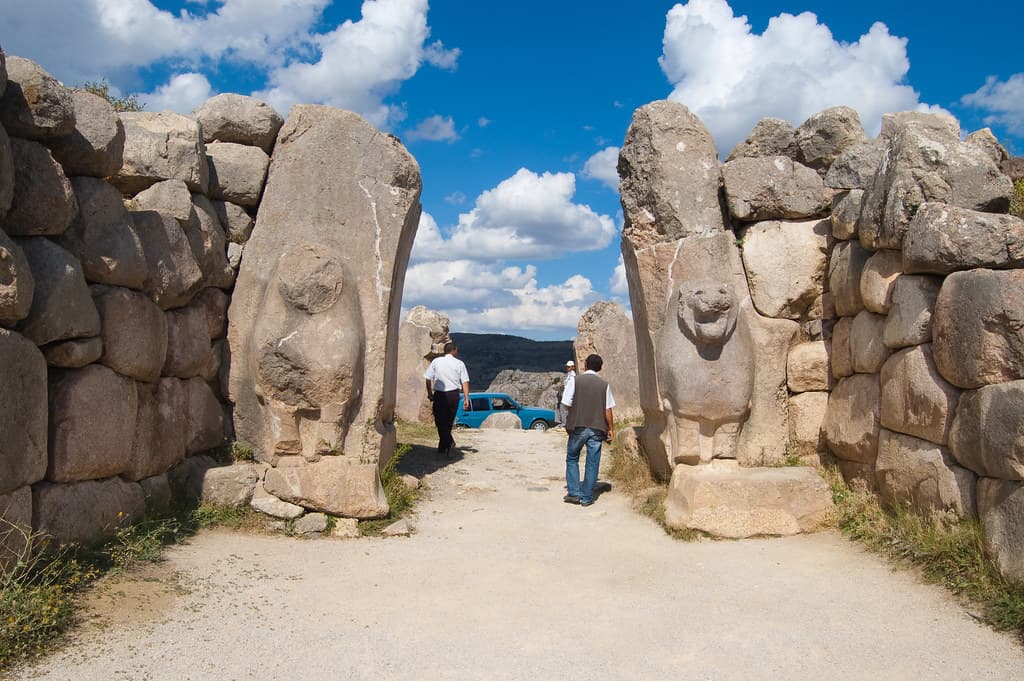
Approach Chamber A through what would once have been an elaborate gateway complex. The entrance narrows as you move forward; the rock walls rise on either side. When you step into the main chamber, resist the impulse to step back for a wide-angle view. The reliefs are carved at approximately human scale and are designed to be encountered close. Begin on the left wall with the male deity procession.
The figures advance with a quality of purposeful movement—each deity distinct, each bearing identifying attributes. Move along the wall following the procession toward the central pairing of Teššub and Hebat. The storm god stands on the backs of two mountain deities; Hebat stands on a lion. Their meeting at the chamber's focal point is the climax of the whole composition, the divine marriage at the center of cosmic order. Notice the frieze of 30 male figures below the main procession.
Recent research has established that these 30 figures represent the 30 days of a lunar month—a calendar embedded in the wall. The stone is tracking time. Move into Chamber B through the narrower passage. The atmosphere changes: the space is tighter, the reliefs fewer but more concentrated in meaning. The 12 warrior figures advancing along one wall represent the 12 months of the lunar year.
The sword-god Nergal, whose blade descends into the earth as if from the underworld, commands the wall. Then find the image of Tudhaliya IV and Sharruma: the king, carved at divine scale, held within the arms of the god. This image of protective embrace—a mortal king held by an immortal god—is among the most intimate things produced by the Bronze Age.
Early morning light enters Chamber B at an angle that illuminates the reliefs differently than afternoon sun; plan accordingly if you can.
The site is 2 km northeast of Boğazkale village and can be walked from the Hattusha circuit or driven to directly. A combined Hattusha–Yazılıkaya visit takes approximately half a day. The Boğazkale Museum in the village provides useful contextual grounding before visiting the sanctuary.
Context and lineage
The site was considered sacred before the Hittites built its formal structures; the natural rock formation may have been recognized as a threshold space long before carving began. The elaborate gateway buildings and the systematic iconographic program of the reliefs were the work of Tudhaliya IV—the 13th-century BCE king who also added the Upper City temples at Hattusha and appears to have had a particular interest in systematizing Hittite religious cosmology.
The iconographic program draws heavily on Hurrian religious tradition, reflecting the deep influence of Hurrian culture on late Hittite religious thought: Teššub and Hebat are Hurrian storm and sun deities, and the divine assembly procession reflects Hurrian divine hierarchy. Suppiluliuma II completed Chamber B as a memorial installation for his father Tudhaliya IV, making the sanctuary simultaneously a cosmic monument and a royal memorial—the two functions understood as continuous with each other.
Pre-Hittite Hattian sacred landscape → Hittite formal sanctuary (16th–13th century BCE) → abandonment c. 1200 BCE → rediscovery and documentation (19th–20th centuries) → UNESCO World Heritage (as part of Hattusha, property 377, 1986)
Tudhaliya IV
Hittite king (c. 1237–1209 BCE) who commissioned the sanctuary's final iconographic program; depicted in Chamber B being embraced by the god Sharruma
Suppiluliuma II
Final Hittite great king; completed Chamber B as a memorial for his father Tudhaliya IV; ruled during the empire's collapse
Eberhard Zangger
Modern researcher who, with Rita Gautschy, established in a 2019 peer-reviewed study that Yazılıkaya functioned as a precision luni-solar calendar
Rita Gautschy
Co-author of the 2019 Journal of Skyscape Archaeology study demonstrating Yazılıkaya's astronomical calendar function
Traditions and practice
Chamber A was the site of the annual New Year celebration, the Hittite equivalent of the Akitu festival known from Mesopotamian tradition: a gathering in which the divine order was renewed, the Storm God's victory over chaos was commemorated, and the king participated in royal procession from Hattusha across 2 km to the sanctuary.
Chamber B served as a royal mortuary chapel where deceased Hittite kings were commemorated and where ritual care was directed toward the continued divine status of dead rulers. Priestly observation of celestial events—particularly the lunar cycle and the spring equinox full moon rise, which aligns with Chamber B's orientation—maintained the luni-solar calendar and determined when intercalary months were needed to keep the religious calendar synchronized with the solar year.
Archaeological conservation work continues to protect the reliefs from weathering. Guided tours are available from Boğazkale village. No religious ceremonies are conducted.
Arrive early. The morning light enters both chambers at angles that shift through the first hours of the day, illuminating details—the curve of a deity's headdress, the texture of a robe hem—that afternoon light flattens. In Chamber A, locate the central pairing of Teššub and Hebat before doing anything else.
Understand that this meeting of the two supreme deities is the cosmological center around which the entire composition is organized; every other figure in the chamber is processionally moving toward or away from this point. Then work outward from the center in both directions, following the processions back toward their origins on either side of the chamber. In Chamber B, give the image of Tudhaliya IV and Sharruma the time it deserves.
This is a king asking—or being shown—what it means to be held by a god. The question is not historical. Sit with it. The sword-god whose blade emerges from the earth on the opposite wall is a figure of the underworld threshold; the two images together define the chamber as a space between the living and the dead. If you are visiting in late March or early April, check the moonrise time before your visit.
Chamber B's orientation was designed so that the full moon near the spring equinox rises into alignment with the chamber's axis. You can experience what the Hittite priests experienced, standing in the same stone chamber, watching the same sky.
Hittite State Religion
HistoricalYazılıkaya was the largest known Hittite open-air sanctuary, functioning as the sacred gathering point of the divine assembly at the New Year and as the royal mortuary chapel. Its 63 carved deities constitute the most complete visual representation of the Hittite divine assembly anywhere.
Annual New Year festival in Chamber A involving royal procession from Hattusha, divine assembly gathering, and reenactment of cosmic order. Royal memorial rites in Chamber B for deceased Hittite kings. Priestly calendar-keeping through observation of celestial events.
Astronomical and Calendrical Practice
HistoricalResearch by Zangger and Gautschy (2019) established that Yazılıkaya functioned as a luni-solar calendar. The 30 male deities in Chamber A track the days of a lunar month; the 12 warrior figures in Chamber B track the lunar year; Chamber B's orientation targets the full moon rising at the spring equinox.
Priestly observation of celestial events to maintain the calendar and determine when intercalary months were needed. The sanctuary served as a reference instrument for synchronizing the religious calendar with astronomical cycles.
Archaeological Heritage
ActiveYazılıkaya contains the most complete and artistically refined examples of Hittite relief carving, dating to the 13th century BCE and spanning both chambers. Over 90 reliefs survive in varying states of preservation. The site is part of the UNESCO Hattusha World Heritage property.
Annual scholarly visits; ongoing conservation of the rock-cut reliefs against weathering; archaeological study; heritage tourism with interpretive panels in multiple languages.
Perspectives and open questions
Yazılıkaya is interpreted across four frameworks that each illuminate a different dimension of the sanctuary's original purpose and continuing significance.
Scholarly perspective
Scholars have understood Yazılıkaya primarily as a monument to Hittite state religion and royal ideology: the most complete surviving representation of the Hittite divine pantheon, executed with artistic sophistication that surpasses other known examples of Hittite relief carving. The identification of Chamber B as a royal mortuary chapel for Tudhaliya IV—supported by the large royal cartouche and the depiction of Tudhaliya embraced by Sharruma—establishes the sanctuary's dual function.
The 2019 study by Zangger and Gautschy in the Journal of Skyscape Archaeology added a third functional layer by demonstrating that the numerical arrangements of figures in both chambers correspond to units of the luni-solar calendar, and that Chamber B's orientation targets the full moon at the spring equinox. This finding has been accepted by many specialists though continues to be debated in detail.
Living and traditional perspectives
No surviving tradition maintains continuity with Hittite religious practice. The site is understood entirely through archaeological and textual (cuneiform) sources. The Hurrian character of the sanctuary's iconography—Teššub, Hebat, and Sharruma are Hurrian deities—reflects the Hurrian cultural influence that deeply shaped late Hittite religious thought; this influence was itself the product of political alliance and conquest rather than indigenous tradition.
Alternative interpretations
Yazılıkaya has attracted significant interest from researchers of ancient cosmology, sacred geometry, and archaeoastronomy. The sanctuary is cited in discussions of Bronze Age sky worship, cosmic orientation of sacred architecture, and the integration of astronomical knowledge into religious practice. Some neo-pagan and reconstructionist Hittite polytheist communities regard the site as spiritually significant.
The image of a king held in the arms of a god—the Tudhaliya–Sharruma relief—has been read by some writers as an image of divine protection that transcends its specific Hittite context.
Open questions
The precise ritual protocols performed in Chamber B—and whether it functioned strictly as a mortuary chapel or had broader ceremonial uses—remains debated. The degree to which the astronomical alignments were conscious design decisions versus emergent properties of a cosmologically oriented architecture is a point of ongoing scholarly discussion. The identity of several unnamed deities in the procession reliefs has not been definitively resolved.
The full range of ceremonies conducted at the site during the New Year festival period is not documented in surviving cuneiform texts.
Plan your visit
Access and arrival
Located 2 km northeast of Boğazkale village, Çorum Province, approximately 210 km east of Ankara. Accessible by car from Boğazkale; can also be walked from the Hattusha circuit entrance (approximately 30–40 minutes on foot). Entrance fee approximately €2 (part of the Hattusha heritage area; may have changed—confirm before visiting). The Boğazkale Museum in the village provides important contextual material. Mobile phone signal is generally available in Boğazkale; may be intermittent at the sanctuary itself.
For organized tours from Ankara, contact the Turkish Tourism Authority or local tour operators in Boğazkale.
Boğazkale village (2 km) has several small hotels and pensions. Hattusas Pension is well regarded among archaeology-focused visitors. Sungurlu (30 km) has additional options.
Respectful visit
No religious requirements. Sturdy footwear for rocky terrain. Bring water and sun protection.
Permitted; flash photography may be restricted near sensitive reliefs. Natural light photography in the morning produces better results.
None appropriate.
Do not touch the rock reliefs. Stay on designated paths within and around the chambers. Do not sit or lean on carved surfaces.
Do not touch the rock reliefs—the oils from hands accelerate weathering. Flash photography may be restricted near sensitive carvings; check with site staff. The rock surfaces are uneven; watch your footing, especially in Chamber B's narrower passage.
Location
Map loads as you approach this section.
Pilgrim reflections
A portrait of encounter, not a score
Pilgrims describe what they felt, how present they could become, and whether the place would shape a journey. There are no stars and no ranking of traditions.
No reviewed reflections yet
The first pilgrims can help describe the character of being here.
Share a reflection
Available after an account-backed “Been there.” Every reflection is reviewed before publication.
Nearby sacred places
Explore other sacred places in the region. Proximity does not establish access or travel time; check each place’s guidance.


References
Sources consulted for this page. Source categories describe the publication, not a guarantee that every claim is verified. Traditional accounts and outside interpretations may differ.
- 01The Symbolic Representation of the Cosmos in the Hittite Rock Sanctuary of Yazılıkaya — The Ancient Near East TodayacademicASOR publication covering latest scholarly interpretation of cosmic symbolism
- 02Celestial Aspects of Hittite Religion: An Investigation of the Rock Sanctuary Yazılıkaya — Eberhard Zangger, Rita GautschyacademicPeer-reviewed 2019 article in Journal of Skyscape Archaeology establishing astronomical calendar function
- 03Hittite Monuments - Yazılıkaya — Hittite MonumentsacademicSpecialized resource on Hittite monuments with detailed iconographic analysis
- 04Five Key Historical Sites of the Hittites — World History EncyclopediaacademicAuthoritative academic overview situating Yazılıkaya within Hittite heritage
- 05A Calendar in Stone: Hittite Yazılıkaya — Eberhard ZanggeracademicDetailed academic study of the calendar and astronomical function
- 06Yazılıkaya - Wikipedia — Wikipedia contributorsencyclopediaComprehensive overview of chambers, reliefs, and scholarly interpretations
- 07Yazılıkaya in the Hittite Empire — World History EduacademicDetailed coverage of religious function and iconography
- 08A Symbolic Image of the Cosmos: The Hittite Rock Sanctuary at Yazılıkaya — Popular ArchaeologyacademicCovers the cosmic symbolism interpretation of the sanctuary
- 09Yazılıkaya: 3200-Year-Old Temple Reflects Hittite Views on Time and the Cosmos — Ancient OriginsSource contextCovers the time-keeping and astronomical interpretation
- 10Yazılıkaya Rock Sanctuary — Turkey — Tracing Origins — Tracing OriginsspiritualSpiritual travel perspective on the site
Share a photo
Help visitors recognize Yazılıkaya. Every submission is reviewed before publication.