Hattusha Lion Gate
Part ofHattusha
Guardian threshold of the city a thousand gods called home
Understand sacred places, explore living traditions, and learn how to engage respectfully with Pilgrim Map.
Access has not been verified. Check current local guidance before planning a visit.
Çorum, Turkey
Read the sources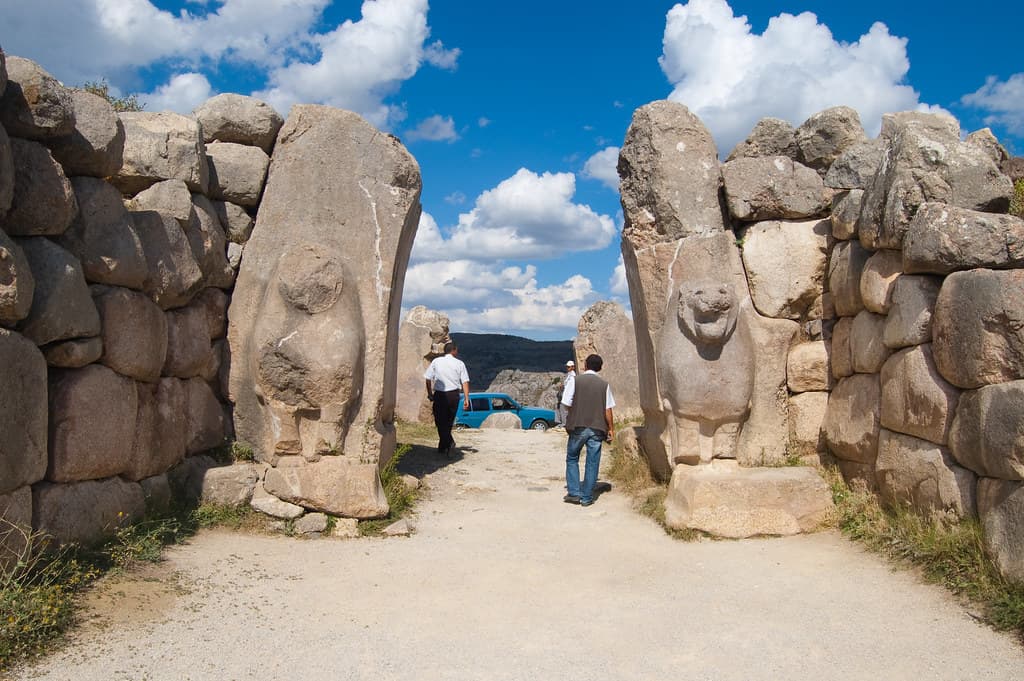
Image of Hattusha Lion Gate. Image source
Visit essentials
A quick read before you go
- Duration
- 3–5 hours for a thorough Hattusa circuit; a full day if including Yazılıkaya (2 km NE) and the…
- Access
- Near Boğazkale village, Çorum Province, approximately 82 km east of Çorum city and 205 km east…
Overview
At Hattusa's Lion Gate, the nearly complete right-hand lion emerges in high relief from its own stone jamb: broad brow, full cheeks, open mouth, and powerful forequarters. The lions were divine sentinels rather than decoration, embodying protection and deterring malevolent forces at the threshold of a city with thirty-one temples that called itself 'the land of a thousand gods.'
Hattusa was the Hittite capital, a Bronze Age rival of Egypt whose kings corresponded with pharaohs as equals and whose roughly 30,000 cuneiform tablets include the world's oldest surviving peace treaty. Its urban form was a sacred landscape: gates as divine thresholds and temples serving an inclusive assembly no single deity owned.
From the fortification circuit's highest point, the Lion Gate looks from the Upper City toward the steppe, making the boundary between protected, ordered interior and outside world visible in stone.
Why this place is sacred
In ancient Near Eastern traditions shared across Mesopotamia, Anatolia, Egypt, and the Levant, city gates were not primarily military features — or rather, they were military features whose military meaning was inseparable from a cosmological one. The gate was the threshold between the ordered human world and the potentially chaotic outside.
To place lion guardians at the gate was to make that threshold divine — to claim that the city's interior was protected not merely by soldiers but by the gods themselves, that the lions embodied the gods' will in permanent material form.
The Hittites understood their capital as 'the land of a thousand gods' — a phrase from their own cuneiform texts that describes Hattusa as the earthly home of the entire divine assembly, not merely a city with a patron deity but a city that hosted the divine world comprehensively. Thirty-one temples have been excavated within the walls.
The Great Temple in the lower city was dedicated to the Storm God Teshup and the Sun Goddess Arinna — the two most powerful deities in the Hittite pantheon — but the city was understood to be continuously inhabited by a vast plurality of divine beings, drawn from Hittite, Hattian, Hurrian, Luwian, and other Anatolian traditions the empire had absorbed.
The Lion Gate stood at the southwestern corner of the Upper City, its position at the highest point of the fortification wall giving it both physical and symbolic elevation. Pilgrims, warriors, diplomats, and kings passed through it. State processions moved through it during festivals. The gate was not a neutral passage but a zone of transition, a place where what you were changed as you crossed it.
The asymmetry created by the loss of the left lion — now in the Ankara Museum — increases the threshold uncanniness rather than diminishing it. The intact right lion gazes at you; the absent left guardian leaves an empty watching on the other side. The space between them is exactly the gap that any genuine threshold requires.
Sacred and defensive threshold of the Hittite capital's Upper City; divine guardian gate within the most extensively sacred urban complex of the Bronze Age.
Constructed in the Hittite New Kingdom, 14th–13th century BC; part of the Upper City expansion associated with the 13th century BC. City abandoned abruptly c. 1200 BC (Bronze Age Collapse). Site gradually buried and forgotten. Rediscovered by European travellers in the 19th century; systematic excavation by German Archaeological Institute from 1906. Left lion head removed to Berlin's Pergamon Museum (prior to repatriation discussions). UNESCO World Heritage Site since 1986. Ongoing German excavations continue.
Experience and orientation
The scale of Hattusa is the first thing that registers, and it does not stop registering. The fortification wall circuit runs approximately 6 kilometres. The city it enclosed covered roughly 1.8 square kilometres — one of the largest Bronze Age cities in the world, larger than contemporary Egyptian Thebes.
A clearly marked visitor route connects the principal monuments: the Lower City with the Great Temple, then up to the Upper City where the Lion Gate, King's Gate, and Sphinx Gate form the southern fortification's monumental sequence.
Drive or walk this circuit; driving allows you to grasp the scale of the walls, which from a car reveal their true ambition — the double casemate wall construction, the towers at intervals, the way the masonry follows the natural ridgeline to command the surrounding plateau in every direction. The Lion Gate is best approached on foot from inside the city, walking toward it along the Upper City terrace.
The internal face of the gateway — the view the departing traveller would have had, looking back at the lions as they left — is rarely discussed but worth attention. You can stand where Hittite kings stood before setting out on campaigns, seeing the guardians from inside the divine protection they embodied. Then pass through the gate and stand outside. Look back.
The two lion positions — one facing you, one now absent — frame the gap through which you have moved. The steppe falls away below, the plateau extends in all directions, the sense of Bronze Age frontier is not forced. It arrives on its own.
The Sphinx Gate at the highest point of the southern wall (a short drive or walk southeast) adds a further dimension: the sphinxes here are the gateway to the most elevated point of the city, and from the gate platform the entire circuit of the walls is visible. The circuit ends best at the King's Gate, where a cast of the original warrior-god relief (the original is in Ankara) greets visitors with the full quality of Hittite monumental sculpture.
Plan the same day for Yazılıkaya (2 km northeast): the outdoor rock sanctuary where 64 deities are carved in relief procession is the sacred heart of the city's theological life, and Hattusa without Yazılıkaya is like a cathedral without its choir.
The visitor circuit is clearly marked and well-signposted from Boğazkale village. Driving the 6 km wall circuit is recommended to grasp scale; then park at each gate for on-foot exploration. Yazılıkaya is 2 km northeast and requires a separate stop. Budget 3–5 hours for a thorough Hattusa visit; a full day if including Yazılıkaya and the Boğazkale Museum.
Context and lineage
The city that became Hattusa was first a Hattian settlement — the Hattians being a pre-Indo-European Anatolian people whose name the Hittites later took. The Hittite king Hattusili I made it his capital in the 17th century BC, an act the Hittite texts present as divinely ordained despite earlier tradition.
An earlier Hittite king is said to have cursed the site, swearing it would never be rebuilt; Hattusili I's rebuilding it was a deliberate act of sacred authority — claiming that his divine mandate superseded even prior divine prohibition. Hittite mythology shaped the theological character of the city: the Storm God Teshup's battle with the serpent Illuyanka, establishing divine order from chaos, provided the theological foundation for lion-guardian gates.
The city was called 'the land of a thousand gods' in the cuneiform archive — a statement less about polytheism per se than about the Hittite political theology of religious inclusion: each people absorbed into the empire brought their gods, and their gods were welcomed into Hattusa's divine assembly rather than suppressed.
Hattian pre-Hittite settlement → Hittite Old Kingdom capital (from c. 1650 BC) → New Kingdom expansion including Lion Gate (14th–13th century BC) → abandonment c. 1200 BC → Phrygian and later settlement on the plain → buried and forgotten → European rediscovery (19th century) → German excavations (from 1906) → UNESCO World Heritage Site (1986) → ongoing excavation.
Traditions and practice
State religious festivals involved processions through the city gates, including the Lion Gate, as formal ritual passages. The New Year festival — one of the most important in the Hittite calendar — involved the symbolic arrival of the divine assembly into the city, with processional ceremonies at the gates marking the boundary between the outside world and the divine interior.
Royal investiture ceremonies almost certainly involved the Lion Gate as a threshold of legitimacy — passing through the divine guardians as part of the ritual claim to kingship. Military campaigns were preceded and followed by religious ceremonies at the temples and city gates, with warriors seeking divine favour for departure and offering thanks on return.
The Yazılıkaya sanctuary (2 km) hosted the New Year assembly and royal mortuary cult, and was reached by procession from the city through the Upper City's gates.
No active religious practices. Archaeological and heritage tourism managed by the Turkish Ministry of Culture and the German Archaeological Institute.
Walk the visitor circuit slowly and in sequence: Lower City and Great Temple first, then up to the Upper City. At the Lion Gate, approach from inside the city — walk toward the gate as a departing traveller would have, seeing the lions from behind before you pass between them. Stand outside the gate and turn back to face it. The intact right lion and the empty left jamb create the threshold most powerfully from outside, looking in.
Take the Sphinx Gate too: from its elevated position the full wall circuit is visible and the spatial logic of the sacred city becomes comprehensible. Reserve Yazılıkaya for after Hattusa — not before, and not as an add-on. The seventy-two carved deities at Yazılıkaya are the divine assembly that the city's thousand-god theology promised, and seeing them after the city gives them their proper context.
Hittite State Religion — Storm God and Sun Goddess
HistoricalHattusa was 'the city of a thousand gods' — the earthly home of the entire Hittite divine assembly, drawn from Hittite, Hattian, Hurrian, Luwian, and other Anatolian traditions. Thirty-one temples have been excavated. The Lion Gate made this theological claim material: the city was divinely protected, its threshold guarded by the gods' own power made stone.
State animal sacrifices; temple festivals for dozens of deities; royal cultic ceremonies; military dedication rituals; New Year divine assembly at Yazılıkaya; royal investiture through sacred gate passage.
Yazılıkaya Rock Sanctuary
HistoricalTwo km northeast of the city, the open-air rock sanctuary with 64 carved divine reliefs was the site of New Year festivals, the royal mortuary cult, and some of Hittite religion's most important state ceremonies. It is the theological heart of Hattusa made visible outside the walls.
New Year divine assembly; royal mortuary rituals; processions of the gods between the rock sanctuary and the city; royal legitimation ceremonies.
Archaeological Heritage — Bronze Age Civilisation
ActiveContinuous excavation since 1906 and a 30,000-tablet cuneiform archive have made Hattusa one of the most thoroughly documented Bronze Age capitals. UNESCO recognition since 1986 reflects its outstanding universal value.
German Archaeological Institute excavations; UNESCO interpretation; international heritage tourism.
Perspectives and open questions
Hattusa invites reading as Bronze Age statecraft made urban form, as the earthly mirror of a divine assembly, as evidence for how a vanished civilisation thought about the relationship between city and cosmos, and as one of the great unsolved mysteries of the ancient world — a capital abandoned overnight, its reasons still unclear.
Scholarly perspective
Hattusa is among the most important Bronze Age archaeological sites in the world. The cuneiform archive of approximately 30,000 tablets has provided foundational evidence for Hittite history, religion, law, and diplomacy — including the Treaty of Kadesh (c. 1259 BC), the world's oldest surviving peace treaty, now displayed at the United Nations. UNESCO's Outstanding Universal Value statement for the site notes its urban organisation, preserved architectural types, the ornamental richness of its gates, and the Yazılıkaya rock art ensemble.
The German Archaeological Institute's more than 115 years of continuous excavation represent one of the longest running archaeological commitments to a single site in history.
Living and traditional perspectives
The Hittites built over a pre-existing Hattian sacred settlement, and the Hattian religious substrate is preserved — incompletely — in Hittite mythology and ritual texts. The Hattian culture was entirely replaced by the Hittite Indo-European speakers and has no living descendants.
Turkish national archaeology engaged with Hattusa in the early Republican period through the Atatürk-era 'Sun Language Theory,' which sought pre-Ottoman Anatolian roots for Turkish national identity — a selective engagement with the site's deep time that has since been superseded by more rigorous scholarship.
Alternative interpretations
Some researchers note that the three main southern gates — Lion Gate (SW), King's Gate (SE), Sphinx Gate (S) — may form a sacred geometric pattern reflecting astronomical or cosmological orientations. The lion-gate guardian tradition connects Hattusa to a vast network of ancient Near Eastern lion-door sacred sites from Egypt's Luxor Temple to Mycenaean Greece's Lion Gate, suggesting shared symbolic vocabulary across Bronze Age cultures.
The Hittite theology of a thousand gods assembled in a single city has drawn attention from scholars of religious pluralism as a Bronze Age model of sacred inclusion.
Open questions
The reason for Hattusa's sudden abandonment around 1200 BC — fire evidence, possible deliberate destruction, and the broader Bronze Age Collapse — remains one of archaeology's most debated unsolved problems. Fire, earthquake, Sea Peoples invasion, internal revolt, climate collapse, and voluntary migration have all been proposed; no consensus exists. The identity of the sphinx heads removed from the Sphinx Gate before formal archaeological protocols and now in the Pergamon Museum in Berlin remains a live repatriation dispute.
The full extent of Hittite ritual practice at the Lion Gate specifically is undocumented — the gate's ceremonial use can be inferred from the city's general ritual life but no text describes what happened here.
Plan your visit
Access and arrival
Near Boğazkale village, Çorum Province, approximately 82 km east of Çorum city and 205 km east of Ankara via the D785. Boğazkale is accessible by private car from Sungurlu (30 km, on the E80 Ankara–Samsun highway). Limited bus services from Sungurlu to Boğazkale. Nearest accommodation in Boğazkale village (several small hotels and pensions) or Sungurlu. Entrance fee applies.
Boğazkale village has several small hotels and family pensions, most within walking distance of the site entrance. Sungurlu (30 km) has larger hotels. Çorum city (82 km) for full range.
Respectful visit
No dress code. Comfortable walking shoes essential for the extensive site.
Permitted throughout the site.
None appropriate.
Do not touch the lion sculptures. Do not climb on ancient walls. Respect excavation area cordons. The left lion head was removed; its absence is a heritage loss, not an invitation to touch the remaining one.
The site covers a large area; comfortable walking shoes are essential. Do not touch the lion sculptures — the surviving right lion has unique conservation value. The wall tops are not accessible for climbing. Entrance fee applies. The Boğazkale village access road can become difficult in ice or heavy snow; check winter conditions if visiting November–March.
Location
Map loads as you approach this section.
Pilgrim reflections
A portrait of encounter, not a score
Pilgrims describe what they felt, how present they could become, and whether the place would shape a journey. There are no stars and no ranking of traditions.
No reviewed reflections yet
The first pilgrims can help describe the character of being here.
Share a reflection
Available after an account-backed “Been there.” Every reflection is reviewed before publication.
Nearby sacred places
Explore other sacred places in the region. Proximity does not establish access or travel time; check each place’s guidance.



References
Sources consulted for this page. Source categories describe the publication, not a guarantee that every claim is verified. Traditional accounts and outside interpretations may differ.
- 01Hattusha: the Hittite Capital — UNESCO World Heritage Centre — UNESCOofficialOfficial UNESCO World Heritage listing since 1986; Outstanding Universal Value statement
- 02Hattusha: the City of a Thousand Gods — Turkish Museums — Turkish Museums / UNESCO TurkeyofficialOfficial Turkish cultural heritage description; 'city of a thousand gods' epithet
- 03Hattusa — Wikipedia — Wikipedia contributorsencyclopediaComprehensive overview of the city, religion, and gates
- 04Lion Gate in Hattusa — Turkish Archaeological News — Turkish Archaeological NewsSource contextDetailed description of Lion Gate architecture and significance
- 05Lion Gate, Hattusa — Wikidata — Wikidata contributorsSource contextCoordinates and structured data for the Lion Gate specifically
- 06Hattusha: UNESCO World Heritage Site Travel Guide — World Heritage SiteguideVisitor guide with UNESCO heritage context
- 07Lions' Gate (Hattusa) — Madain Project — Madain ProjectacademicArchitectural and archaeological detail of the Lion Gate
- 08Hattusha — BiblePlaces.com — BiblePlaces.comSource contextPhoto archive and description from biblical archaeology perspective
Share a photo
Help visitors recognize Hattusha Lion Gate. Every submission is reviewed before publication.