Alacahöyük
Where Hittite sphinxes guard a five-thousand-year threshold of solar devotion
Understand sacred places, explore living traditions, and learn how to engage respectfully with Pilgrim Map.
Access has not been verified. Check current local guidance before planning a visit.
Çorum, Turkey
Read the sources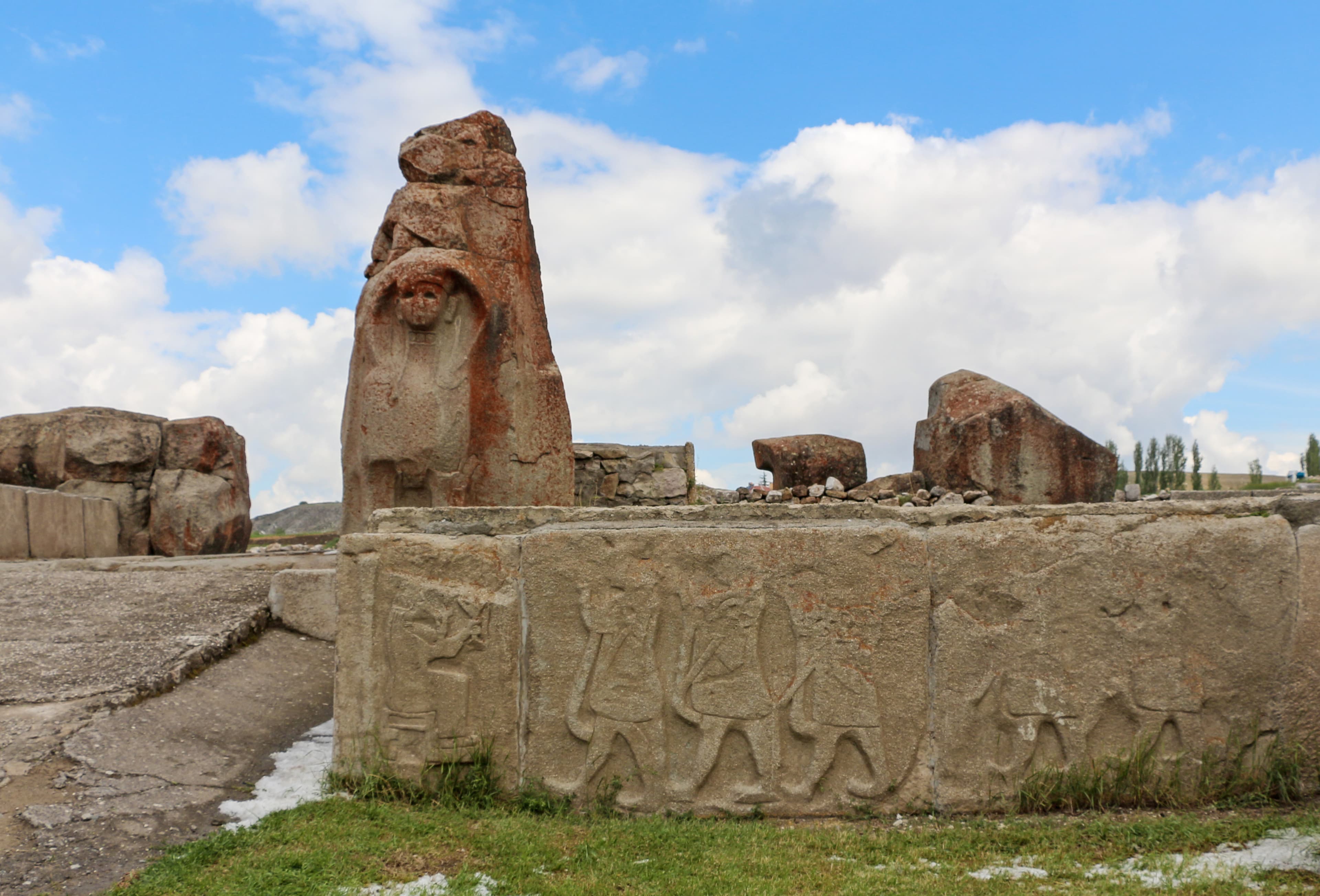
Visit essentials
A quick read before you go
- Duration
- 2–3 hours for a thorough visit covering both the archaeological park and on-site museum.
- Access
- Located 35 km northeast of Çorum city centre in the Alaca district.
Overview
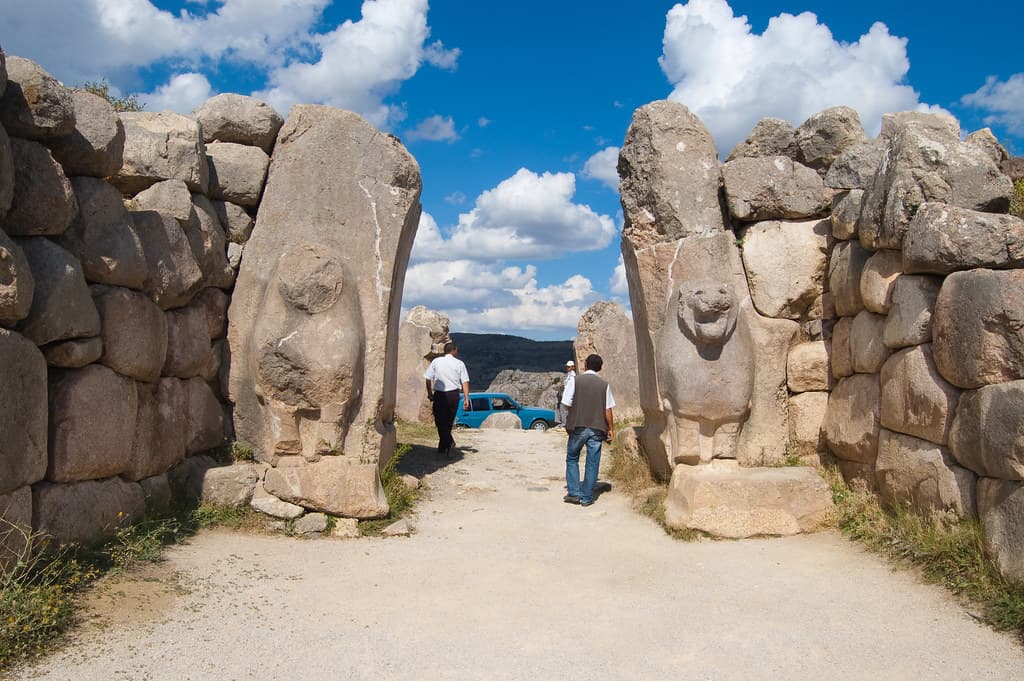
In the hills northeast of Çorum, Alacahöyük is a well-kept archaeological park with a modest museum and an inward-facing Sphinx Gate whose guardians seem to watch those passing through. Occupied from around 4000 BCE, it preserves Royal Tombs from 2500–2000 BCE belonging to the Hattians, Anatolia’s pre-Hittite people, whose religion centred on solar power and divine rulership.
Their bronze sun disks, stag and bull pole standards, and gold and silver vessels are among the most visually arresting objects of any Bronze Age civilization.
The Hittites later magnified the site’s inherited sanctity, possibly identifying it as Arinna, holy city of the Sun Goddess Arinniti. Orthostat reliefs at the Sphinx Gate depict musicians, acrobats, worshippers, and sacrificial animals processing toward the sacred enclosure. Passing between the sphinxes crosses a threshold sacred for longer than most civilizations have existed.
Why this place is sacred
What makes Alacahöyük unusual is not a single founding act of holiness but an accumulation—a place where each successive people encountered the sanctity left by their predecessors and deepened it rather than erasing it. The Hattians buried their rulers here with objects that declare a solar cosmology: the bronze sun disks are not merely decorative but represent the celestial body that governs time, fertility, and royal legitimacy. When the Hittites arrived, they inherited this solar orientation and intensified it.
Their supreme deity, the Sun Goddess of Arinna, may have had her earthly home here—cuneiform texts speak of a city of Arinna possessing a golden sun disk, and the abundance of solar imagery at Alacahöyük fits that description. The Sphinx Gate does not merely mark the entrance to a town; it is a ritual instrument, transforming the act of entering the city into a passage through sacred space.
The orthostats flanking the gate show worshippers approaching the divine presence—and by walking that same path, the modern visitor re-enacts that ancient gesture whether they intend to or not.
Royal burial and solar cult of the Hattian priest-kings; later a Hittite religious center possibly identified as Arinna, sacred city of the Sun Goddess Arinniti.
From Hattian royal funerary complex (2500–2000 BCE) to major Hittite religious and civic center (1650–1180 BCE) with Sphinx Gate and orthostat temple precinct, to Ottoman-era agricultural land, and then to systematic Turkish archaeological excavation beginning in 1935 and continuing today.
Experience and orientation
Approach the Sphinx Gate slowly. The sphinxes are larger than photographs suggest, and the figures carved on the flanking orthostats—musicians playing their instruments, acrobats bent backward, bulls led to sacrifice—carry a liveliness that stone should not possess after 3,300 years. Move between the gate posts and pause: you are standing where the Hittite royal procession passed. The sphinxes do not face outward to warn off intruders; they face inward and slightly downward, watching what enters the sacred precinct.
Behind the gate, the archaeological park extends across the mound with excavated foundations and protective shelters covering the most fragile relief carvings. Walk slowly along the designated paths. The site rewards attentiveness rather than speed—the carved details reveal themselves gradually, and the layout of the Hittite precinct, with its temple platforms and flanking storerooms, begins to read as a planned sacred landscape. The on-site museum is small but concentrated.
The sun disk replicas and animal standards on display—the originals are in Ankara's Museum of Anatolian Civilizations—allow close examination of forms that in the original context were carried in procession or placed in tombs. The area once occupied by the Royal Tombs is now a quiet corner of the park, stripped of its grave goods but not of its weight.
Begin at the museum before entering the archaeological park, so that the relief images you encounter in situ already carry interpretive context. Allocate time to stand still at the Sphinx Gate rather than moving through quickly.
Context and lineage
The Hattians—a pre-Indo-European Anatolian people whose language was unrelated to Hittite—inhabited this site in the third millennium BCE and chose it as a burial ground for their ruling class. The Royal Tombs, excavated from 1935 onward, contained thirteen or more burials of extraordinary richness: bronze sun disks of intricate geometric design, pole standards bearing cast bronze stags and bulls, gold and silver cups and jugs, weapons, and personal ornaments.
These objects were not simply wealth—they were a symbolic vocabulary of divine kingship, asserting that the rulers buried here participated in the solar order that governed the cosmos. When the Hittites occupied the site around 1650 BCE, they inherited a place already dense with sacred history.
Whether they knew it as Arinna—their most sacred city—remains debated, but the cuneiform texts' description of Arinna as possessing a golden sun disk, combined with the solar imagery already concentrated at Alacahöyük, makes the identification plausible. The Hittites built their Sphinx Gate and carved their orthostat reliefs over this Hattian foundation, adding a new layer of sacred architecture to an already ancient holy place.
Hattian (Chalcolithic through Early Bronze Age) → Hittite Empire (Middle and Late Bronze Age) → post-Hittite Iron Age occupation → abandonment → Ottoman agricultural land → Turkish archaeological excavation from 1935
Traditions and practice
The Hattian royal burials involved the placement of bronze sun disks—precise geometric constructions that may represent the solar disk as a cosmological symbol—alongside stag and bull standards, weapons, jewelry, and drinking vessels. These objects were likely not simply gifts to the dead but cultic instruments: the standards were carried in processions during the deceased ruler's lifetime and interred with them at death, connecting the mortal body to the celestial order.
The Hittite state religion at Alacahöyük involved formal processions through the Sphinx Gate, animal sacrifice (depicted in the orthostat reliefs), music and acrobatic performance as part of religious spectacle, and regular temple ceremonies honoring the Sun Goddess. The relief carvings show the complete ritual sequence: worshippers approaching, musicians preceding the procession, animals being led to the altar.
No active religious practices occur at the site. The Turkish Ministry of Culture and Tourism operates it as an archaeological park and museum. Occasional academic conferences and excavation-season public events take place in connection with ongoing excavations.
Walk the approach to the Sphinx Gate from a distance and let the scale resolve slowly—the gate reads differently when approached on foot than in photographs. Pause between the sphinx posts and look at each of the orthostat carvings in sequence, reading them as a unified procession narrative.
Sit at some point in the open area of the park and allow the sun's position to be present—the solar disk imagery throughout the site makes the sun itself a visible participant in the landscape. In the museum, compare the sun disk forms: the geometric precision of these objects, made four and a half thousand years ago, rewards sustained looking.
Hattian Royal Funerary Cult
HistoricalThe Royal Tombs of 2500–2000 BCE represent the most elaborately documented expression of Hattian sacred kingship, in which rulers were interred with objects declaring their participation in the solar order of the cosmos.
Burial with bronze sun disks, stag and bull pole standards, gold and silver vessels, weapons, and personal ornaments; probable graveside animal sacrifice; standards likely carried in procession during the ruler's lifetime and interred at death.
Hittite State Religion – Sun Goddess of Arinna
HistoricalThe Hittite occupation transformed Alacahöyük into a major ceremonial center, possibly identifying it as Arinna, the sacred city of the supreme Sun Goddess Arinniti. The Sphinx Gate and orthostat reliefs document formal state religious processions.
Royal processions through the Sphinx Gate; animal sacrifice and libation at temple altars; music and acrobatic performance as part of public religious spectacle.
Archaeological Heritage
ActiveSystematic excavation since 1935 has made Alacahöyük one of the most carefully documented Bronze Age sites in Turkey and a cornerstone of Hittite and pre-Hittite studies.
Ongoing excavations; museum display on-site and in Ankara; heritage tourism; academic conferences.
Perspectives and open questions
Alacahöyük occupies an unusual position in Near Eastern studies: physically modest, archaeologically foundational, and mythologically charged by a disputed identification that scholars continue to revisit.
Scholarly perspective
Alacahöyük is firmly established as the premier site for Hattian royal material culture in Anatolia. The Royal Tombs represent the apex of Early Bronze Age craftsmanship in the region and provide the primary material evidence for Hattian religious ideology. The identification of the site with Arinna—the sacred city of the Hittite Sun Goddess—is a working hypothesis supported by circumstantial evidence (solar imagery, geographic position, name associations in cuneiform texts) but not confirmed by a direct textual identification.
The site's importance to Hittite state religion is not in doubt regardless of the Arinna question.
Living and traditional perspectives
No living indigenous community maintains a direct religious connection to Alacahöyük. In Turkish national cultural identity, Hittite heritage is incorporated as a founding layer of Anatolian civilization; the sun disk from Alacahöyük has become an unofficial symbol of this identity and appears on the emblem of the Turkish Historical Society.
Alternative interpretations
The density of solar disk imagery at Alacahöyük invites placement within broader traditions of sky-worship and solar religion across Eurasia. Some alternative researchers connect the site to pan-Eurasian Bronze Age sun-cult networks; the circular sun disk forms have been compared to petroglyphs and symbolic objects from as far as Scandinavia and Central Asia.
Open questions
The identity of the individuals buried in the Royal Tombs—whether they were kings, priest-kings, or a different category of sacred ruler—remains unknown. The precise religious function of the bull and stag standards (were they funerary only, or used in living cult?) is debated. The relationship between the Hattian solar theology present at Alacahöyük and the later Hittite Sun Goddess theology is incompletely mapped.
Plan your visit
Access and arrival
Located 35 km northeast of Çorum city centre in the Alaca district. By car: follow the D795 highway northeast from Çorum toward Alaca, then follow signs. By public transport: buses from Çorum to Alaca town (35 km), then taxi or minibus to Alacahöyük village (15 km). Museum and site open daily approximately 08:30–17:00; box office closes 16:30. A combined ticket covers both the archaeological park and on-site museum.
Çorum city (35 km) offers the widest range of accommodation. Alaca town (15 km from the site) has limited guesthouses. Boğazkale village near Hattusha has small hotels and pensions oriented to archaeological tourists and can serve as a base for both Hattusha and Alacahöyük.
Respectful visit
No dress requirements. Sturdy footwear is recommended for the uneven terrain of the archaeological park.
Photography is permitted throughout the open-air site and museum. Flash photography may be restricted inside museum display cases; observe posted signs.
Not applicable at this secular heritage site.
Do not touch the relief carvings, sphinx surfaces, or any exposed stone. Stay on marked paths. Active excavation areas are fenced off and must not be entered.
Do not touch the relief carvings or sphinx surfaces, which are vulnerable to oils and wear. Active excavation zones are fenced and should not be entered. The site's open terrain can be hot in summer; bring water.
Location
Map loads as you approach this section.
Pilgrim reflections
A portrait of encounter, not a score
Pilgrims describe what they felt, how present they could become, and whether the place would shape a journey. There are no stars and no ranking of traditions.
No reviewed reflections yet
The first pilgrims can help describe the character of being here.
Share a reflection
Available after an account-backed “Been there.” Every reflection is reviewed before publication.
Nearby sacred places
Explore other sacred places in the region. Proximity does not establish access or travel time; check each place’s guidance.



References
Sources consulted for this page. Source categories describe the publication, not a guarantee that every claim is verified. Traditional accounts and outside interpretations may differ.
- 01Overview of Alacahöyük Hittite Settlement - World History Encyclopedia — World History EncyclopediaencyclopediaAcademic-level reference for settlement overview
- 02Hattian Royal Tombs at Alacahöyük - World History Encyclopedia — World History EncyclopediaacademicDetailed coverage of the royal tombs and their contents
- 03Alaca Höyük (archaeological site) - EBSCO Research Starters — EBSCOacademicAnthropological reference covering archaeological context
- 04Alacahöyük - Turkish Archaeological News — Turkish Archaeological NewsofficialCurrent archaeological news and site status
- 05Alacahöyük - Hittite Monuments — Hittite MonumentsacademicSpecialist site covering Hittite monumental architecture
- 06Alaca Höyük - Wikipedia — Wikipedia contributorsencyclopediaComprehensive overview of site history and excavations
- 07Alacahöyük: Sacred Gateway to the Hittite World - MuseoPics — MuseoPicsguideDetailed coverage of sacred architecture and spiritual significance
- 08Alacahöyük: A Journey into Ancient Anatolia's Spiritual Heart — Local Explore ToursguideVisitor-oriented coverage of spiritual and sacred aspects
Share a photo
Help visitors recognize Alacahöyük. Every submission is reviewed before publication.