Kerkenes Dağ
The largest Iron Age walled city on the Anatolian plateau, built in a century and destroyed in a night
Understand sacred places, explore living traditions, and learn how to engage respectfully with Pilgrim Map.
Access has not been verified. Check current local guidance before planning a visit.
Yozgat, Turkey
Read the sources
Visit essentials
A quick read before you go
- Duration
- A full circuit of the walls takes 3–4 hours.
- Access
- Located south of Sorgun in Yozgat Province, approximately 200 km east of Ankara.
Overview
There are sites whose sacredness accumulates through continuous use, layer by layer across generations. Kerkenes Dağ achieved a different kind of intensity: it was built within a single lifetime, densely inhabited, and then destroyed in a single catastrophic event — a fire so complete that carbonized timber and ash sealed the city's contents for two and a half millennia.
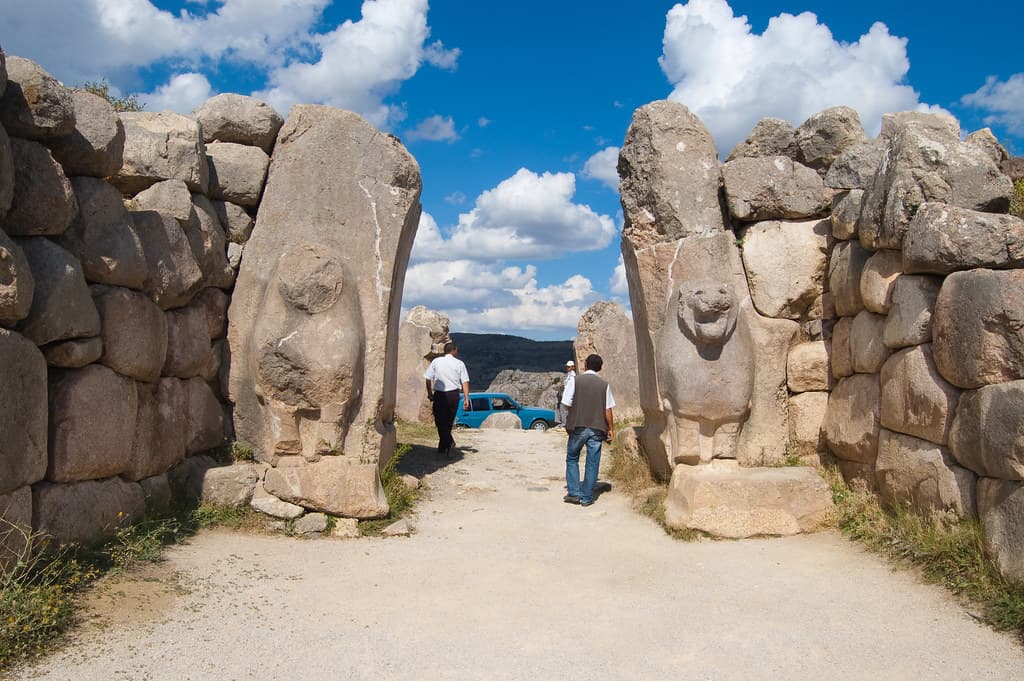
Seven kilometers of stone walls, punctuated by seven gates, enclose a summit plateau of 2.5 square kilometers: the largest Iron Age walled city on the Anatolian plateau, yet almost unknown compared to the great ruins of the Aegean coast. At the Cappadocia Gate, archaeologists found a Phrygian cult stele set on a built stepped platform — evidence that even a city of uncertain ethnic identity organized its gates around sacred liminal zones.
The identity of the founders remains genuinely contested: Medes, Phrygians, a local Anatolian polity, or some combination that 6th-century BCE politics dissolved before it could be named. What is certain is that someone built this enormous city with enormous energy, and someone else — Croesus of Lydia, in the account drawn from Herodotus — took it away from them forever.
Why this place is sacred
Kerkenes exercises its pull through scale and solitude rather than through accumulated religious practice. Standing inside seven kilometers of walls on a mountain summit, surrounded by the silence of a completely uninhabited plateau, the mind performs the calculation that all ruined cities invite — the ratio of ancient density to present emptiness — and here the calculation yields an unusual result.
The walls are so long that you cannot see their full extent from any single point; the enclosure is so large that the interior contains its own topography of ridges and valleys. The Kale (citadel) on its prominent ridge dominates the interior. And the fire — the catastrophic single event that ended the city in approximately 540 BCE — left in its ruins a completeness that slower decay does not.
Charred wood and ash, sealed by collapse, preserved organic materials across twenty-five centuries. There is a quality to sites destroyed all at once, in contrast to those gradually abandoned: the former feel interrupted, the latter feel complete. Kerkenes feels interrupted — a city still mid-sentence when the flames arrived.
Urban-political capital of an unidentified Iron Age polity; included civic, palatial, and religious functions within its walls; gates served as sacred liminal zones as well as practical entry points
Founded ca. 650–600 BCE; violently destroyed by fire ca. 540 BCE, likely by Croesus of Lydia; never reoccupied; gradually covered by vegetation and soil; rediscovered and excavated 1993–2012 by Middle East Technical University; now an open archaeological landscape
Experience and orientation
Most visitors who reach Kerkenes arrive expecting a conventional archaeological site and are not prepared for what the scale of the walls actually does to the experience. You approach along a minor road from Sorgun, and the first indication of the site is the mountain itself — an unusually prominent isolated summit rising above the surrounding plateau.
The walls become visible as a pattern of dark stone against the slope, and only when you are walking alongside them does the length begin to register: seven kilometers is a significant walk even without the terrain. The Cappadocia Gate is the best-excavated entrance and the logical starting point.
The stepped cult platform excavated here — a Phrygian stele base placed precisely at the gate threshold — gives an immediate sense of how sacred and civic functions were integrated into the city's structure. Gates, in ancient Anatolian urban design, were not simply functional apertures but charged liminal zones where the outside world crossed into organized space, and where the gods were asked to protect the transition. From the gate, proceed toward the Kale along the ridge.
The views from the citadel — across Yozgat province, with the enclosing walls visible as a ring on the slopes below — are exceptional and offer the best way to comprehend the site as a whole. Allow time simply to stand and let the scale and the silence register together.
Begin at the Cappadocia Gate; proceed to the Kale for panoramic orientation; then walk the walls as far as time allows. Private transport is essential — the site is not accessible by public transport and the road conditions can be difficult in wet weather.
Context and lineage
The founding mythology of Kerkenes has not been recovered from the archaeological record. Herodotus records that Croesus of Lydia, in his disastrous campaign to test the Oracle's prophecy that crossing the Halys River would destroy a great empire, attacked a city called Pteria in the territory of the Cappadocians — destroying it, enslaving its population, and defeating the forces of Cyaxares the Mede who came to its defense. Geographically, Kerkenes is the strongest candidate for Pteria.
If the identification is correct, then Kerkenes entered world history as the pivot point of the campaign that destroyed Croesus's kingdom, fulfilled the oracle's warning, and contributed to Cyrus the Great's conquest of the Lydian Empire.
Founded ca. 650–600 BCE; mixed Phrygian and non-Phrygian cultural character; destroyed ca. 540 BCE; never reoccupied; METU excavation project 1993–2012
Traditions and practice
The Cappadocia Gate excavations uncovered a semi-aniconic stele of classic Phrygian type, set on a built stepped monument — direct evidence that Phrygian cult objects and rituals were present in the city's gates. Old Phrygian inscriptions found at the site confirm Phrygian cultural presence alongside what appears to be a non-Phrygian architectural tradition. The gate zone likely hosted protective rites, libations, and stele veneration as part of the city's civic and religious life.
No active religious practices. Archaeological fieldwork was active 1993–2012 and may resume. The site is freely accessible but receives very few visitors.
Walk the perimeter of the walls as far as your time and energy allow — not to cover distance for its own sake, but because the walls' full length is the primary experience this site offers and cannot be grasped without walking it. At the Cappadocia Gate, stand in the threshold and consider the logic of ancient gates as sacred liminal zones: the space between outside and inside, between wilderness and city, between the human world and divine protection.
On the Kale, face outward across the plateau and allow the scale of the enclosed space below to settle into comprehension. The city this wall enclosed was real, fully inhabited, and ended in a single night.
Phrygian Cybele Cult
HistoricalThe Cappadocia Gate stele provides direct evidence that Phrygian cult practices were brought eastward into this city. The presence of Old Phrygian inscriptions alongside the stele confirms Phrygian cultural penetration of what may have been a non-Phrygian urban foundation.
Gate stele veneration; likely associated protective rites and possibly festivals in the Matar Kubileya tradition
Archaeological and Heritage Scholarship
ActiveKerkenes represents a unique Iron Age urban phenomenon: the largest walled city on the Anatolian plateau, preserved by fire, excavated through advanced geophysical methods that reveal city-scale planning without full excavation.
Geophysical survey; selective excavation; architectural study; geospatial documentation
Perspectives and open questions
Kerkenes is read primarily through the lens of archaeology and historical geopolitics; its religious dimension is present but secondary to its significance as a political and urban phenomenon.
Scholarly perspective
Kerkenes is accepted as the largest Iron Age walled city on the Anatolian plateau, founded ca. 600 BCE and destroyed by fire ca. 540 BCE. The Pteria identification (from Herodotus) is plausible but not definitively proven. The founding population shows mixed Phrygian and non-Phrygian cultural traits, suggesting an ethnically or politically complex founding context. The 1993–2012 excavation project (METU) produced extensive geophysical and archaeological data; full interior building plans remain largely unknown. The fire destruction preserved exceptional organic materials.
Living and traditional perspectives
No surviving indigenous tradition associated with the site.
Alternative interpretations
The Median origin hypothesis — that Kerkenes was established as a Median royal capital or administrative center in the early 6th century BCE — would place it within the context of the great geopolitical contest between the Medes, Lydians, and eventually Persians. If correct, this would make Kerkenes a western outpost of the Iranian world, a city that stood at the intersection of Anatolian and Iranian civilizations before that intersection became the Persian Empire.
Open questions
The founding population's identity is genuinely unresolved. The complete plans of interior buildings are known only through geophysical survey — ground-truthing of those plans remains incomplete. Whether the city was Pteria is probable but not certain. What happened to the survivors of the destruction is entirely unknown.
Plan your visit
Access and arrival
Located south of Sorgun in Yozgat Province, approximately 200 km east of Ankara. Accessible by car via minor roads from Sorgun. No public transport to the site. The nearest towns with accommodation are Sorgun or Yozgat city.
Sorgun town (nearest) offers basic accommodation. Yozgat city provides more options. Most visitors approach as a long day trip from Ankara or as part of a broader central Anatolian itinerary combining Hattusha and Kerkenes.
Respectful visit
No restrictions. Sturdy footwear essential for the rocky mountain terrain. Layering recommended for the exposed summit.
Permitted throughout the site.
None traditional or expected.
Do not remove any material from the site — even loose surface artifacts carry archaeological context. Stay clear of any active excavation areas if work is ongoing.
The site is remote and at altitude — bring sufficient water, weather-appropriate clothing (the summit is exposed and can be cold even in summer), and navigation tools. Stay clear of any active excavation areas.
Location
Map loads as you approach this section.
Pilgrim reflections
A portrait of encounter, not a score
Pilgrims describe what they felt, how present they could become, and whether the place would shape a journey. There are no stars and no ranking of traditions.
No reviewed reflections yet
The first pilgrims can help describe the character of being here.
Share a reflection
Available after an account-backed “Been there.” Every reflection is reviewed before publication.
Nearby sacred places
Explore other sacred places in the region. Proximity does not establish access or travel time; check each place’s guidance.



References
Sources consulted for this page. Source categories describe the publication, not a guarantee that every claim is verified. Traditional accounts and outside interpretations may differ.
- 01The Kerkenes Project — Middle East Technical University — Geoffrey Summers, Françoise SummersacademicOfficial project website from the excavating institution
- 02Kerkenes: 20 years of research and exploration — British Institute at Ankara — Geoffrey SummersacademicRetrospective academic summary of the 1993–2012 excavation project
- 03The Kale at Kerkenes Dağ: An Iron Age Capital in Central Anatolia — Geoffrey SummersacademicDetailed study of the citadel structure
- 04The Identification of the Iron Age City on Kerkenes Dag in Central Anatolia — Geoffrey SummersacademicKey paper on the Pteria identification
- 05Phrygian Expansion to the East: Evidence of Cult from Kerkenes Dağ — Geoffrey SummersacademicKey paper on religious evidence including the Cappadocia Gate stele
- 06Kerkenes — Phrygian Monuments — Phrygian Monuments ProjectacademicSpecialist resource placing Kerkenes in Phrygian cult context
- 07Kerkenes — Wikipedia — Wikipedia contributorsencyclopediaSolid overview of the site and its identification
- 08Ancient Pteria (Kerkenes Dag) in Turkey — Ancient Near East resourceacademicOverview connecting the site to Herodotus and Croesus
Share a photo
Help visitors recognize Kerkenes Dağ. Every submission is reviewed before publication.