Uaxactun
Siaan K'aan, Born in Heaven — the oldest known Maya solar observatory, where day-keepers still meet the equinox sun
Understand sacred places, explore living traditions, and learn how to engage respectfully with Pilgrim Map.
Access has not been verified. Check current local guidance before planning a visit.
Flores, Petén, Guatemala
Read the sources
Visit essentials
A quick read before you go
- Duration
- A half-day visit, plus travel from Tikal or Flores; equinox events span pre-dawn to morning.
- Access
- About 19–23 km north of Tikal via an unpaved road, reached from Flores or Tikal, often by guided…
Overview
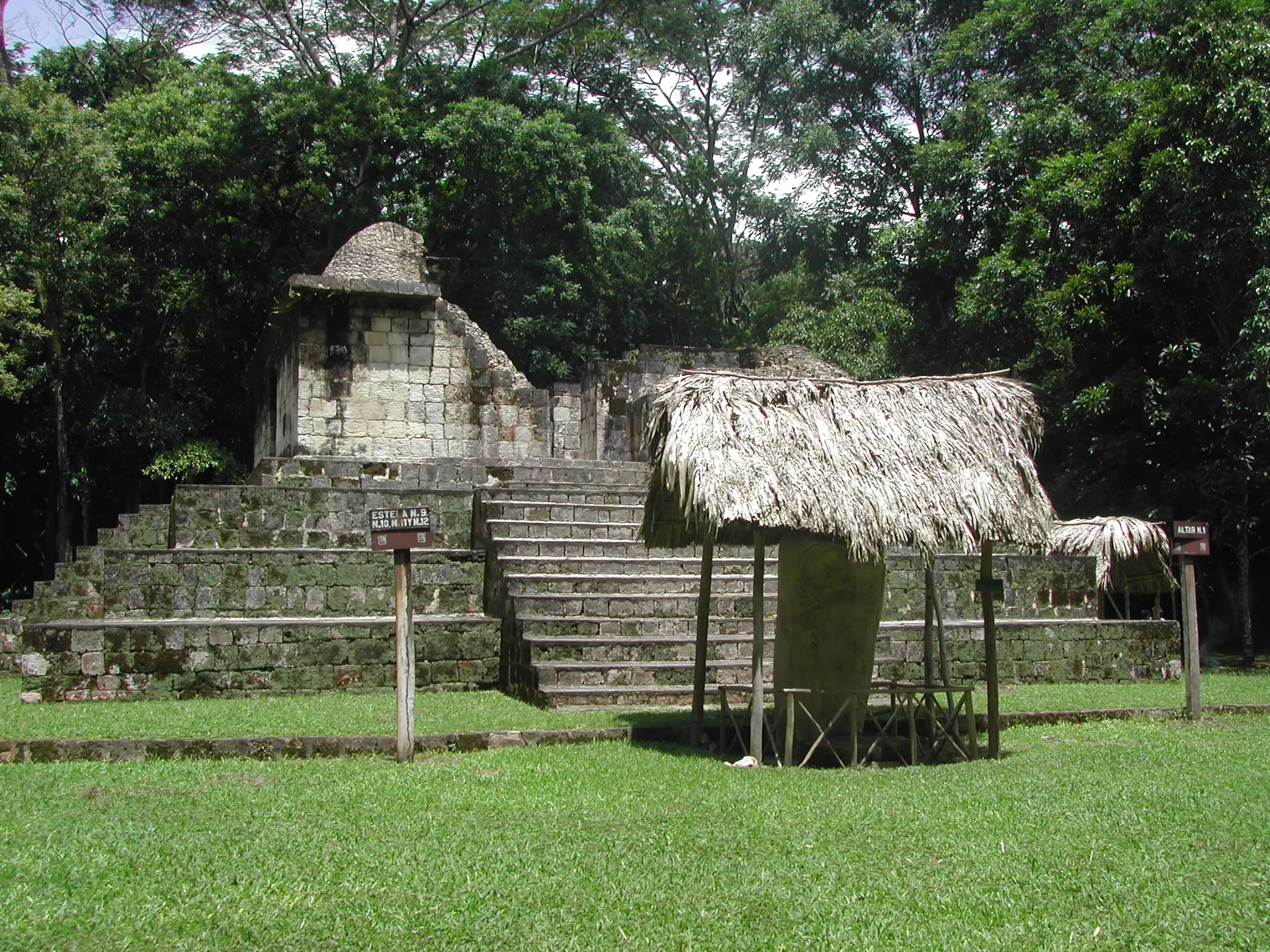
At Uaxactún, archaeologists first understood that the Maya built to catch the sun. Group E—a low western pyramid facing three eastern temples—was the first such complex identified and remains the oldest known Maya solar observatory. From the pyramid, the equinox sun rises behind the central temple and solstice suns behind the flanking temples. Its resonant geometry became a template across the Maya lowlands.
The ancient name Siaan K'aan means 'Born in Heaven,' binding the place to celestial origin. Settled in the Middle Preclassic and occupied for well over a millennium, Uaxactún entered Tikal's orbit after Siyaj K'ak's intervention in 378, when both centers came to dominate the Petén. Pyramid E-VII-sub survives with great stucco faces of jaguar and serpent deities masking its sides.
Continuity makes the site rare. Aldea Uaxactún stands beside the ruins and stewards the forest through a community concession. At the spring equinox, day-keepers—the tatas and nanas—lead pre-dawn chanting, fire, and drumming in Group E with seekers from around the world. The ancient observatory and living calendar still meet at the same sunrise.
Why this place is sacred
Uaxactún's thinness lies in continuity. Its Group E was built to frame the sun on the year's turning points, and the geometry still holds: at the equinox the sun rises precisely behind the central eastern temple. That ancient act of skywatching has not ended. Maya day-keepers gather at the same pyramid to honor the same sunrise, with chanting, fire and drumming, so that millennia of timekeeping fold into a single morning.
Set deep in protected biosphere forest, beside a small living community, it is a place where astronomy, ritual and landscape remain bound together.
A Preclassic and Classic Maya center built around the E-Group solar observatory, used to mark the equinoxes and solstices and to anchor the Maya day-count and ritual calendar.
Settled in the Middle Preclassic and occupied into the Early Postclassic, Uaxactún was absorbed into the Tikal-Uaxactún polity after 378. Today it stands within the Maya Biosphere Reserve beside the living community of Aldea Uaxactún, recognized as a UNWTO Best Tourism Village, where day-keepers continue equinox and solstice ceremonies.
Experience and orientation
Uaxactún feels far from anywhere. The road north from Tikal turns to dirt, and the forest closes in; the site is quiet, with few visitors most of the year. At its heart stands Group E — the western observation pyramid and the three eastern temples — looking exactly as it must have when Maya astronomers first stood here. Nearby, the pyramid E-VII-sub preserves its great stucco masks of jaguar and serpent, a rare survival of Late Formative art.
The forest is alive with howler monkeys, birds and the textures of the biosphere reserve. At the spring equinox the site transforms: day-keepers lead ceremonies in Group E with chant, fire, dance and drumming, and the sun rises precisely behind the central temple as the geometry intends. To stand there in the dark before dawn, waiting for that alignment, is to feel the join between ancient observation and living devotion.
Reached via an unpaved road beyond Tikal, with entry typically under the Tikal National Park ticket. The visit centers on Group E and the E-VII-sub pyramid, beside the village of Aldea Uaxactún. Equinox events run from before dawn into the morning.
Context and lineage
Uaxactún has Middle Preclassic origins, with the E-VII-sub pyramid built in the Late Formative, and was occupied into the Early Postclassic. Its ancient name, Siaan K'aan — 'Born in Heaven' — links it to celestial origin. After the 378 intervention of Siyaj K'ak', it was politically absorbed under the Tikal-Uaxactún entity that would dominate the Petén. The E-Group's solar geometry became a template for timekeeping and ritual replicated across the Maya world.
Preclassic and Classic Maya astronomy and religion, continued today through Maya day-keepers sustaining equinox and solstice ceremonies at Group E.
Siyaj K'ak'
Teotihuacan-linked figure of the 378–379 intervention
Carnegie Institution archaeologists
Early excavators and mappers
The tatas and nanas (day-keepers)
Living Maya ceremonial leaders
OMYC community of Aldea Uaxactún
Forest stewards
Šprajc and colleagues
Astronomical researchers
Traditions and practice
Ancient practice at Uaxactún centered on solar observation from the E-Group pyramid to mark the equinoxes and solstices, alongside the jaguar and serpent stucco-mask iconography of E-VII-sub and the dedication of carved stelae.
The community holds a Spring Equinox Festival with ceremonies in Group E — pre-dawn and post-dawn chanting, fire, dance and drumming led by tatas and nanas, joined by spiritualists from around the world. The festival also promotes Maya tradition and forest conservation.
If you can, time a visit to the spring equinox and arrive in darkness to watch the sun rise behind the central temple; otherwise, stand at the western pyramid and read the alignment for yourself, imagining the year's turning marked on the eastern horizon. Move slowly through the forest and let its quiet register.
Preclassic and Classic Maya astronomy and religion
HistoricalUaxactún holds the first-identified E-Group, the oldest known Maya solar observatory, and the stucco-mask pyramid E-VII-sub.
Solar observation from the E-Group pyramid to mark equinoxes and solstices, jaguar and serpent stucco-mask iconography, and stela dedication.
Contemporary Maya spirituality
ActiveThe community of Aldea Uaxactún holds a Spring Equinox Festival with Maya ceremonies in Group E.
Pre-dawn and post-dawn ceremonies of chanting, fire, dance and drumming led by tatas and nanas, joined by spiritualists from around the world.
Perspectives and open questions
Uaxactún is understood as the place where Maya astronomy was first decoded, as living day-keeper ground, and as a magnet for global equinox gatherings.
Scholarly perspective
Uaxactún is where the Maya 'E-Group' solar observatory was first defined. Its Group E and the Late Formative stucco-masked pyramid E-VII-sub are landmarks of Maya astronomy and Preclassic art, and the site was absorbed into the Tikal-Uaxactún polity after 378.
Living and traditional perspectives
Maya day-keepers — tatas and nanas — continue equinox and solstice ceremonies at Group E, sustaining ancient skywatching traditions, while the community stewards the surrounding forest.
Alternative interpretations
The 'Born in Heaven' name and the precise solar alignments draw spiritualists from around the world to the equinox gatherings.
Open questions
The earliest construction dates of E-VII-sub — sometimes pushed back as far as around 2000 BC, though the most secure occupation is Middle Preclassic onward — and the precise ritual calendar tied to the observatory remain subjects of study.
Plan your visit
Access and arrival
About 19–23 km north of Tikal via an unpaved road, reached from Flores or Tikal, often by guided tour or sturdy vehicle. Entry is typically under the Tikal National Park ticket. Basic lodging and food are available in Aldea Uaxactún.
Basic lodging and food in the village of Aldea Uaxactún.
Respectful visit
Light jungle clothing, sturdy shoes and insect repellent; modest dress when attending ceremonies.
Generally permitted for the monuments; ask before photographing day-keepers or ceremonies.
Take part in offerings only as invited by the day-keepers; do not disturb ceremonial fires or items.
Stay on trails, respect the community concession and biosphere-reserve rules, and do not disturb wildlife or remove anything.
Attend ceremonies as a respectful observer, not a participant, unless invited by the day-keepers; do not disturb ceremonial fires or items, and ask before photographing them. Respect the community concession and biosphere-reserve rules, stay on trails, and remove nothing.
Current practical details
Address
Uaxactun, Guatemala
Hours, fees, and access can change — verify on the official source before you travel. Practical details last checked Jun 2026.
Location
Map loads as you approach this section.
Pilgrim reflections
A portrait of encounter, not a score
Pilgrims describe what they felt, how present they could become, and whether the place would shape a journey. There are no stars and no ranking of traditions.
No reviewed reflections yet
The first pilgrims can help describe the character of being here.
Share a reflection
Available after an account-backed “Been there.” Every reflection is reviewed before publication.
Nearby sacred places
Explore other sacred places in the region. Proximity does not establish access or travel time; check each place’s guidance.



References
Sources consulted for this page. Source categories describe the publication, not a guarantee that every claim is verified. Traditional accounts and outside interpretations may differ.
- 01Uaxactun — Wikipedia — Wikipedia contributorsacademicConfirms ~19 km north of Tikal, Middle Preclassic to Postclassic occupation, the first-identified E-Group, 378 AD conquest involving Siyaj K'ak', E-VII-sub stucco masks.
- 02Uaxactún | Ruins, Maya, & Pre-Columbian Art — Britannica — Encyclopaedia BritannicaacademicAuthoritative overview of the site and its role in Maya archaeology.
- 03The Astronomical E-Complex at Uaxactun — Maya Ruins of Uaxactun — mayaruins.comSource contextDetails how Group E marks equinox sunrise behind Temple II and solstice sunrises over Temples I and III; oldest such observatory identified.
- 04Astronomical aspects of Group E-type complexes and implications for ancient Maya architecture and urban planning — PLOS ONE — Šprajc et al.academicPeer-reviewed analysis of E-Group astronomical function and urban planning across the Maya lowlands.
- 05Siyaj Kʼakʼ — Wikipedia — Wikipedia contributorsacademicDocuments the 378–379 AD installation of new rulers at Tikal, Uaxactun and Copán; Tikal-Uaxactun dominance of the Petén thereafter.
- 06Uaxactún, Guatemala — UNWTO Best Tourism Villages — UN Tourism (UNWTO)officialRecognizes Uaxactún as a Best Tourism Village; community within the Maya Biosphere Reserve.
- 07Uaxactun — WCS Guatemala (Wildlife Conservation Society) — Wildlife Conservation SocietyofficialDocuments the OMYC community forest concession (~83,558 ha), FSC-certified stewardship preserving wildlife including jaguar.
- 08Uaxactun Archaeological Site, Guatemala — Trans-Americas Journey — Trans-Americas JourneySource contextVisitor detail: access via dirt road beyond Tikal, equinox ceremonies at Group E, 'Born in Heaven' meaning.
Photo gallery
3 curated photos
Share a photo
Help visitors recognize Uaxactun. Every submission is reviewed before publication.