Tikal
Maya temples rising above the rainforest, where rulers staged the cosmos and the sun still turns
Understand sacred places, explore living traditions, and learn how to engage respectfully with Pilgrim Map.
Access has not been verified. Check current local guidance before planning a visit.
Flores, Petén, Guatemala
Read the sources
Visit essentials
A quick read before you go
- Duration
- Half to a full day; four to six hours minimum to see the main temples and plazas.
- Access
- In the Petén, about 64 km from Flores, reached by road from Flores or El Remate, often by guided…
Overview
Tikal is a city built to stage the cosmos. For more than six centuries its rulers raised limestone pyramids meant to be sacred mountains, laid out plazas as a ground-plan of the heavens, and timed their ritual to the movement of the sun. Then the city emptied.
What the rainforest reclaimed, archaeologists slowly returned: temple summits that pierce a green ocean of canopy, the tomb of Jasaw Chan K'awiil I deep within Temple I, the Lost World complex where dawn light still strikes the alignments laid down to mark the turning year.
The Maya knew it as Yax Mutal. Settled in the Preclassic and dominant through the Classic period, roughly the fourth to ninth centuries, Tikal absorbed an outside force in 378, when figures linked to distant Teotihuacan arrived and reshaped its dynasty and its imagery.
It is not a dead site. Q'eqchi' and Itza' Maya regard Tikal as a place of origin, ancestral ground where the dead dwell, and spiritual guides still conduct fire and offering ceremonies among the ruins. To arrive at dawn — when howler monkeys begin their roar and the temples surface from mist — is to feel the city as the Maya may have intended it: a threshold between the forest, the underworld, and the sky.
Why this place is sacred
Tikal was conceived as a stage for the cosmos. Its temple-pyramids were sacred mountains; its plazas, causeways and twin-pyramid complexes ordered the city as a model of the world. Rulers mediated between people, gods and ancestors, and the sun's annual passage was woven into the architecture. The Lost World E-Group still tracks the equinoxes and solstices, and the dawn chorus of the surrounding rainforest gives the ruins a charged, threshold quality.
For living Q'eqchi' and Itza' Maya, the place remains a point of origin and a site of active ritual — thinness here is both ancient and present.
A royal capital and ceremonial center where Classic Maya rulers staged cosmic and political ritual — burials within temples, stela dedication, the ballgame, and solar observation — laying out the city as a sacred landscape.
Settled in the Preclassic, Tikal rose to dominance in the Classic period before being abandoned amid the wider Maya collapse. Reclaimed by jungle and gradually excavated, it became a national park and UNESCO World Heritage Site in 1979, and remains ancestral sacred ground where contemporary Maya conduct ceremonies.
Experience and orientation
Most visitors remember the scale first — temples that rise above an unbroken rainforest, so that from one summit you look across the canopy to the combs of others breaking through like islands. At dawn the forest is loud: howler monkeys roar, toucans and parrots call, coatis cross the trails, and occasionally jaguar tracks are found near water. Clear sunrises are not guaranteed; mist holds most mornings, and the view that does emerge feels earned.
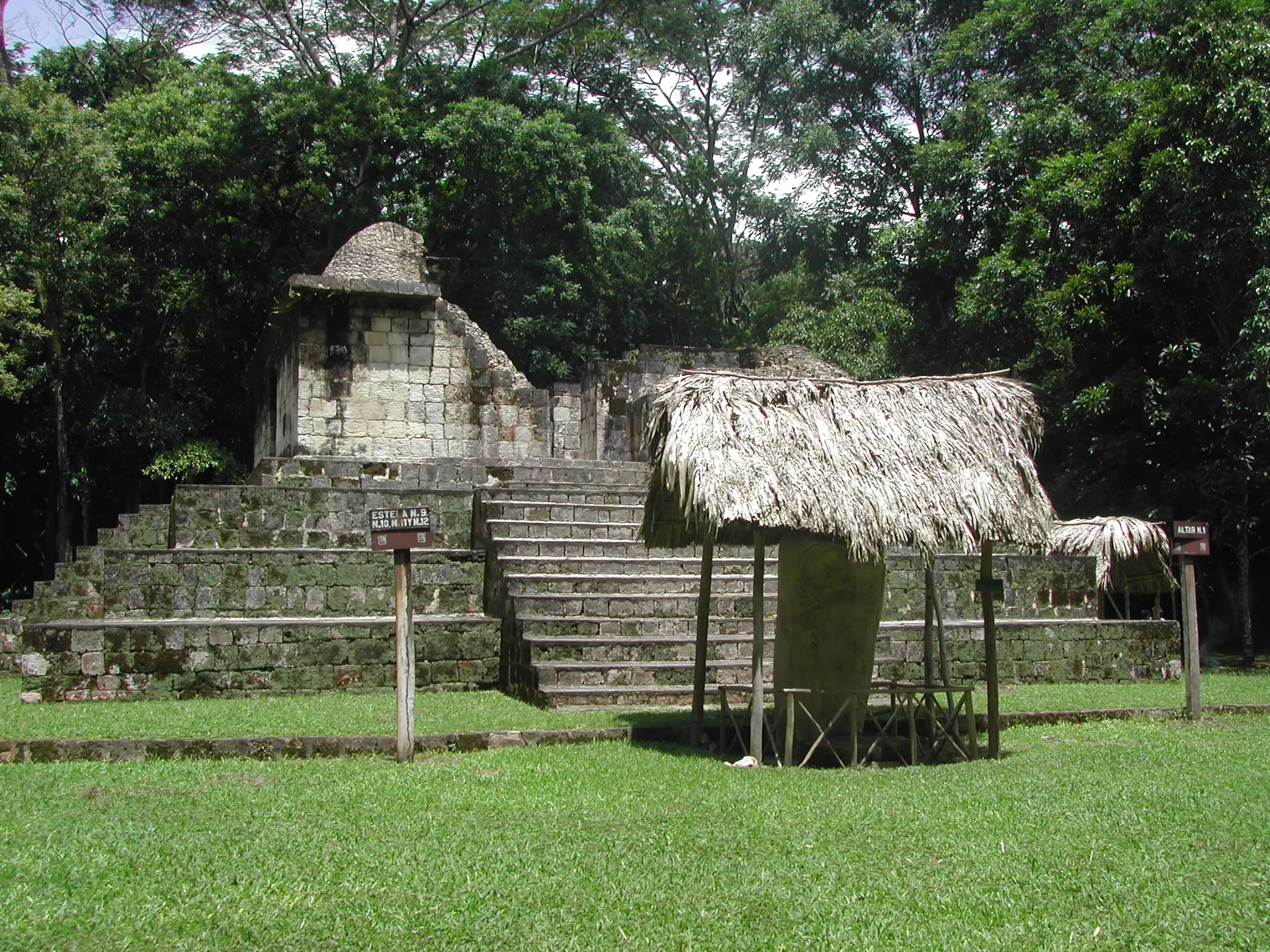
The city rewards slow movement. The Great Plaza sets Temple I and Temple II facing each other across the heart of old Tikal. Temple IV, the tallest structure, gives the widest view over the forest. The Lost World complex, with its observation pyramid and three eastern temples, was built to catch the equinox and solstice sunrises.
If you encounter a Maya ceremony among the ruins, keep your distance and let it be — the site is living as well as ancient.
From the entrance and visitor area, trails lead to the Great Plaza (Temples I and II), then onward to Temple IV and the Lost World (Mundo Perdido) complex. Allow four to six hours minimum; sunrise tours depart very early from Flores or El Remate to reach Temple IV before dawn.
Context and lineage
Tikal was settled in the Preclassic, in the first millennium BC, and rose to dominance through the Classic period, with major construction between the fourth and eighth centuries AD. A pivotal episode came in 378, the so-called entrada, when Siyaj K'ak', linked to the central-Mexican power of Teotihuacan, arrived and the Teotihuacan-connected ruler Yax Nuun Ahiin I was installed the following year. The event reshaped the city's politics and royal iconography for generations.
For modern Q'eqchi' and Itza' Maya, Tikal is held to be a place of origin where the ancestors dwell.
Classic Maya religion and royal ritual, reshaped by Teotihuacan-influenced practice after 378, and continued today as contemporary Q'eqchi' and Itza' Maya spirituality.
Yax Nuun Ahiin I
Ruler installed 379 AD
Siyaj K'ak'
Teotihuacan-linked figure of the 378 entrada
Jasaw Chan K'awiil I
Classic-period ruler
Yik'in Chan K'awiil
Classic-period ruler
Contemporary Maya spiritual guides
Living ritual practitioners
Traditions and practice
Classic Maya ritual at Tikal centered on royal entombment within the temple-pyramids, the dedication of carved stelae, the ballgame, and solar observation at the Lost World E-Group. Twin-pyramid complexes were raised to mark the close of twenty-year k'atun periods in the Long Count calendar.
Maya spiritual guides conduct fire and offering ceremonies at the site, which remains active for Maya ritual. Most visitors come to walk the plazas and climb the permitted temples, often on a dawn tour timed to the awakening forest.
Arrive early and walk slowly. Climb to a permitted summit and simply sit while the forest wakes; let the scale and the dawn chorus do their work. At the Lost World complex, consider how the alignments were built to catch the sun on the year's turning points. Carry water and patience — the mist may not lift.
Classic Maya religion and royal ritual
HistoricalTikal, or Yax Mutal, was a dominant Classic Maya capital whose pyramids functioned as sacred mountains and whose rulers staged cosmic and political ritual.
Royal burials within temples, such as Jasaw Chan K'awiil I within Temple I, stela dedication, the ballgame, and solar observation at the Lost World E-Group.
Teotihuacan-influenced ritual
HistoricalThe 378 AD arrival of Siyaj K'ak' and the installation of Teotihuacan-linked rulers reshaped Tikal's politics and iconography.
Central-Mexican imagery and regalia in royal monuments, and alliance ritual binding Tikal to a distant power.
Contemporary Maya spirituality
ActiveModern Q'eqchi' and Itza' Maya regard Tikal as a place of origin and sacred ancestral ground.
Maya fire and offering ceremonies performed at the site by spiritual guides.
Perspectives and open questions
Tikal is read at once as a documented Classic Maya capital, as living Maya ancestral ground, and as a popular icon of ancient astronomy.
Scholarly perspective
Tikal was one of the most powerful Classic Maya capitals. Its dynastic history, the 378 Teotihuacan entrada, its monumental temples and astronomically aligned complexes are extensively documented, and it was inscribed as a UNESCO World Heritage Site in 1979 under mixed cultural and natural criteria.
Living and traditional perspectives
Q'eqchi' and Itza' Maya regard Tikal as a sacred place of origin and ancestral ground, and continue to conduct ceremonies there.
Alternative interpretations
Popular accounts emphasize Tikal's astronomy and the pyramid-as-mountain cosmology, dwelling on the equinox and solstice sightlines of the Lost World complex.
Open questions
The full causes of the Classic Maya collapse and Tikal's eventual abandonment, and the precise nature of its relationship with Teotihuacan, remain debated.
Plan your visit
Access and arrival
In the Petén, about 64 km from Flores, reached by road from Flores or El Remate, often by guided tour or shuttle. Ticketed park entry; sunrise access requires a special permit or tour. Exact current fees and any changes to sunrise-tour access are not confirmed — check with the park authority before travel.
Respectful visit
Light, breathable clothing, sturdy shoes, a hat and insect repellent; bring layers for the cool, damp pre-dawn starts.
Permitted for the monuments and landscape; do not photograph Maya ceremonies or participants without their consent.
Leave offerings only as directed by Maya spiritual guides.
Stay on the trails, climb only where permitted, do not feed or disturb wildlife, and carry out all trash under national-park and Maya Biosphere Reserve rules.
If a Maya ceremony is underway, observe respectfully from a distance and do not photograph participants without consent. Leave offerings only as directed by Maya spiritual guides. Stay on trails, climb only where permitted, and follow national-park and biosphere-reserve rules.
Current practical details
Address
Tikal, Guatemala
Phone
Hours
Hours, fees, and access can change — verify on the official source before you travel. Practical details last checked Jun 2026.
Location
Map loads as you approach this section.
Pilgrim reflections
A portrait of encounter, not a score
Pilgrims describe what they felt, how present they could become, and whether the place would shape a journey. There are no stars and no ranking of traditions.
No reviewed reflections yet
The first pilgrims can help describe the character of being here.
Share a reflection
Available after an account-backed “Been there.” Every reflection is reviewed before publication.
Watch deeper
Films, episodes, and recorded talks for visitors who want more context before or after a visit. Speculative and alternative-history entries are labelled as perspectives, not as sources for established claims.
Streaming episode
Alternative-history media
Ancient Apocalypse: Legacy of the Sages
Graham Hancock's Giza/Sphinx-focused episode in Ancient Apocalypse season 1.
Perspective note: Highly contested by mainstream archaeology; included as a perspective, not as evidence.
Open on NetflixVideo resource
Alternative-history media
The Revelation of the Pyramids (La Revelation des Pyramides)
Influential 2010 French documentary on pyramid geometry, alignments, and ancient-site pattern claims.
Perspective note: Controversial and not a source for established archaeological claims.
Open on JustWatch MegalithomaniaUK / YouTube
Alternative-history media
Revelations Beneath Khafre's Pyramid FULL UPDATE
Gaia panel discussion connected to Ancient Civilizations and claims beneath Khafre's Pyramid.
Perspective note: Very speculative; pair with mainstream context before treating any claim as factual.
Open on MegalithomaniaUK / YouTubeNearby sacred places
Explore other sacred places in the region. Proximity does not establish access or travel time; check each place’s guidance.



References
Sources consulted for this page. Source categories describe the publication, not a guarantee that every claim is verified. Traditional accounts and outside interpretations may differ.
- 01Tikal National Park — UNESCO World Heritage Centre — UNESCOofficialConfirms 1979 inscription under both cultural and natural criteria, pyramid-as-mountain cosmology, setting in Maya Biosphere Reserve.
- 02Tikal — Wikipedia — Wikipedia contributorsacademicConfirms dynasty history, 378 AD Teotihuacan 'entrada' (Siyaj K'ak'), Jasaw Chan K'awiil's tomb in Temple I, scale and location in Petén.
- 03Tikal | Guatemala, Park, Maya Ruins, & Temples — Britannica — Encyclopaedia BritannicaacademicOverview of Tikal's history, temples, and national-park status.
- 04Mundo Perdido, Tikal — Wikipedia — Wikipedia contributorsacademicDocuments the Lost World E-Group: Pyramid 5C-54 observation point and three eastern temples marking equinox and solstice sunrises.
- 05Yax Nuun Ahiin I — Wikipedia — Wikipedia contributorsacademicTeotihuacan-linked ruler installed AD 379; son of Spearthrower Owl; depicted in central-Mexican attire.
- 06Tikal: Guatemala's Cultural and Natural Heritage Site in the Heart of the Maya Forest — FLAAR Mesoamerica — FLAAR MesoamericaacademicContext on Tikal's biodiversity and archaeological significance within the Maya forest.
- 07Tikal Ruins Guide | The Maya City That Touched the Sky — Lost Ruins of the Americas — Lost Ruins of the AmericasSource contextNotes modern Q'eqchi' and Itza' Maya regard Tikal as a place of origin and ancestral sacred ground; twin pyramids and equinox alignments.
Photo gallery
3 curated photos
Share a photo
Help visitors recognize Tikal. Every submission is reviewed before publication.