Yaxchilan Archaeological Zone
Where blood offerings opened doorways to the gods, carved in stone above the river's bend
Understand sacred places, explore living traditions, and learn how to engage respectfully with Pilgrim Map.
Access has not been verified. Check current local guidance before planning a visit.
Ocosingo, Chiapas, Mexico
Read the sources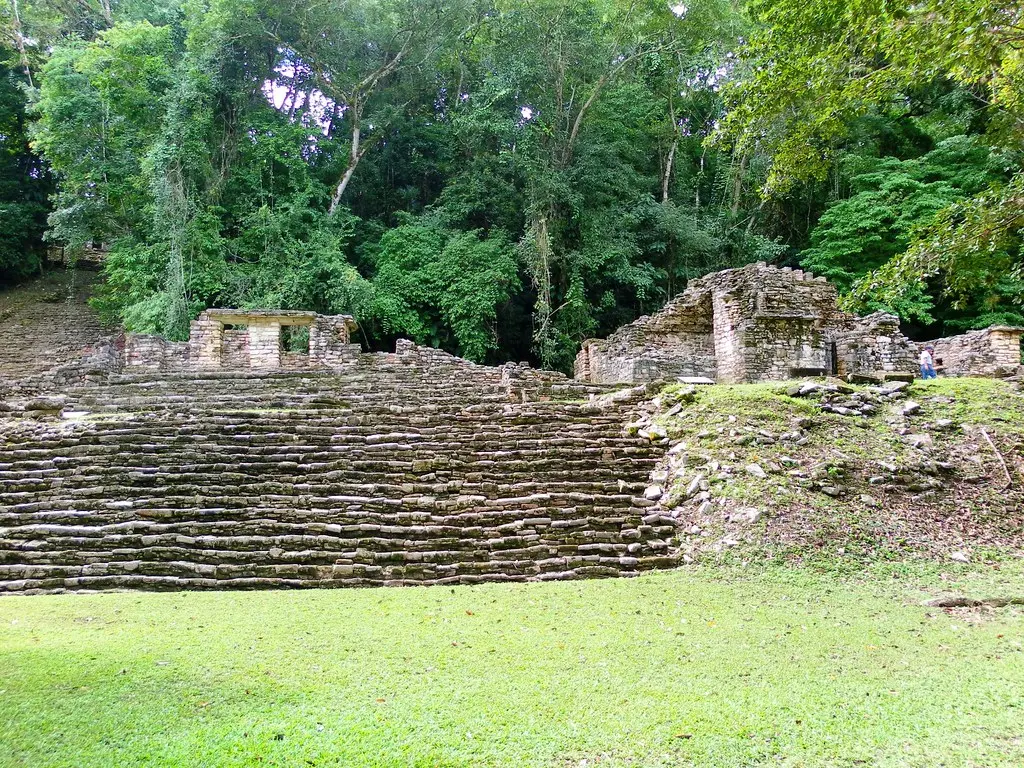
Image of Yaxchilan Archaeological Zone. Image source
Visit essentials
A quick read before you go
- Duration
- Full day from Palenque (5-6 AM departure, return approximately 7 PM).
- Etiquette
- Respect Yaxchilan as both archaeological treasure and living sacred site for Lacandon Maya.
Overview
Pa' Chan, 'Cleft Sky' or 'Broken Sky,' was Yaxchilan's ancient name, expressing the opening of passages between worlds through blood and devotion. For five centuries, from 350 to 850 CE, this river-bend city cultivated sacred passage.
The Usumacinta River curves around three sides as natural moat and trade highway, connecting the site to allies and rivals across the Maya world. Today, as in antiquity, arrival requires an hour-long boat journey from Frontera Corozal, not an obstacle but an initiation: a water passage preceding the temple encounter.
Yaxchilan preserves over 120 structures, numerous carved stelae, and a dynasty traced from 320 CE through more than twenty rulers. Its distinctive doorway lintels document rituals legitimizing power. Famous scenes show Lady K'ab'al Xook, principal wife of Shield Jaguar II, pulling a thorned rope through her pierced tongue while a Vision Serpent rises from a blood-filled bowl with an ancestor's face in its jaws.
Maya artists presented not symbols but participants' ritual experience: portals opening through pain and blood, divine beings emerging from the Otherworld, and gods and ancestors made present through offering. Sculptors signed their work as preservers of sacred truth.
Shield Jaguar II ruled sixty years, from 681 until his death in his nineties in 742 CE. His son Bird Jaguar IV continued the building program and commissioned temples visited today. Rivalry with Piedras Negras and warfare with Palenque formed the political context, while Yaxchilan's religious vision centered contact between realms.
The Lacandon Maya, the region's last practitioners of ancient traditions, still arrive by the same river route, offer to the same gods their ancestors served, and sustain continuity beyond archaeology. Where scholars see documentation, they recognize living presence.
Why this place is sacred
The threshold at Yaxchilan is not metaphorical. The lintels that make this site unique document a technology of transcendence—specific ritual actions that Maya practitioners believed opened actual passages to the Otherworld. To stand beneath Structure 23's doorways is to occupy space deliberately engineered for breakthrough.
Lady K'ab'al Xook kneels in carved stone, rope bristling with thorns pulled through her tongue, blood dripping into the offering bowl. From this sacrifice rises the Vision Serpent, its open jaws bearing the face of an ancestor warrior. This is not mythology but journalism—skilled artists recording what ritual participants experienced when blood and pain punctured the membrane between realms.
The Maya understanding was precise. Royal blood carried special potency; its offering created obligation in the divine realm. When rulers shed their blood, gods responded. The Vision Serpent that appears in these carvings gave visual form to what witnesses saw: the moment when sacrifice succeeded, when the sky split open—Pa' Chan—and beings from beyond passed through.
This technology required specific conditions. The temples' placement in the river bend created sacred geography; the darkness of inner chambers focused attention; the pain of perforation altered consciousness; the blood itself bridged worlds. Every element worked together toward a single purpose: making the invisible visible, the distant present, the divine accessible.
The Lacandon Maya who still pilgrimage to Yaxchilan understand what tourists may miss. These stones are not memorials to dead practice but instruments that retain their function. The gods the lintels depict—Chaak, K'awiil, the feathered serpent—remain present for those who approach with proper intention. The rituals depicted continue in modified form among those who preserved tradition through five centuries of colonization.
The jungle that surrounds Yaxchilan participates in its thin quality. Howler monkeys call through morning mist; toucans flash between ceiba trees; the river's constant presence sounds beneath all else. This is not merely atmosphere but context—the living world that Maya cosmology understood as permeable, responsive to proper approach, capable of yielding its secrets to those willing to pay the required price.
Yaxchilan served as a dynastic capital where rulers demonstrated their divine connections through documented blood sacrifice. The city's temples functioned as stages for rituals that opened passages between the mortal and Otherworld realms.
Founded around 350 CE, Yaxchilan reached its height under Shield Jaguar II (ruled 681-742 CE) and Bird Jaguar IV. Abandoned by 850 CE, it was reclaimed by jungle until modern archaeological attention. Lacandon Maya maintained pilgrimage traditions throughout, and continue today.
Experience and orientation
The journey begins in darkness. Tours from Palenque depart before dawn, the two-and-a-half-hour drive to Frontera Corozal completed as the sun rises over Chiapas. At the river, boats wait—long lanchas that carry visitors down the Usumacinta toward Guatemala, whose shore you will see but not touch.
The river journey is essential, not incidental. For an hour, the same water that carried Maya traders and warriors carries you between walls of green. Howler monkeys announce your passage; kingfishers dive from overhanging branches; the modern world recedes behind each bend. When Yaxchilan's landing appears, you have traveled not just distance but consciousness.
Enter through the Labyrinth—a passage through Structure 19's dark interior that deposits you in the main plaza. The transition from jungle density to open space, from darkness to light, replicates ancient procession. You emerge where Maya citizens emerged, facing the temples that ordered their understanding of reality.
Structure 33, built by Bird Jaguar IV, demands climbing. The steps are steep, the humidity relentless, but the reward justifies effort: standing where kings stood, surveying the plazas where their power was displayed. The decorative program here includes ballgame imagery, female figures holding K'awiil scepters, and thirteen carved risers documenting royal ritual.
But Structure 23 holds the treasures. The famous lintels—24, 25, and 26—remain in place above doorways. (The British Museum holds casts; these are originals.) Stand beneath them. Study Lady K'ab'al Xook's documented ecstasy. Notice the Vision Serpent's emergence, the ancestor's face it bears, the precise rendering of thorned rope and blood drops. These are perhaps the most detailed accounts of Maya religious experience ever carved.
Allow time simply to be present. Sit in the plaza. Listen to the jungle sounds that would have accompanied ancient ceremony. Notice how the buildings frame sky and forest, creating defined sacred space within undefined wilderness. The howler monkeys' calls may not differ from those that accompanied Shield Jaguar's rituals thirteen centuries ago.
The return journey, upriver against the current, allows final contemplation. The temples recede into green; the modern world approaches. But something of Yaxchilan's quality travels with those who have genuinely attended.
Accessible only by boat from Frontera Corozal (190 km from Palenque, 2.5 hours by road). Boats require minimum 6 passengers and cost approximately MX$1,300 divided among travelers. Most visitors spend about 2 hours at the site.
Context and lineage
Around 320 CE, a ruler established what would become a dynasty lasting five centuries. The location's advantages were clear: the Usumacinta's bend created natural defense on three sides while the river itself provided trade access to the wider Maya world. The city they called Pa' Chan—Cleft Sky—would become synonymous with the art of opening passages between realms.
The dynasty grew through warfare and alliance. Yaxchilan dominated smaller sites like Bonampak, rivaled Piedras Negras for regional supremacy, and in 654 went to war with mighty Palenque. These political struggles provided the context for religious display: rulers justified their power through demonstrated divine connection, documenting their sacrifices in permanent stone.
Shield Jaguar II transformed the city. Enthroned in October 681, he would rule for over sixty years, dying in his nineties in 742. His building program created the structures visitors see today; his commissioned lintels became the supreme expression of Maya artistic achievement. His principal wife, Lady K'ab'al Xook, features in the most famous carvings—her blood sacrifices documented with a precision that allows reconstruction of ancient ritual.
Bird Jaguar IV continued his father's vision, though their relationship may have been complex. His structures emphasize his own achievements, his own divine connections, as if asserting legitimacy against doubt. The rivalry between father and son, if rivalry it was, produced architectural abundance.
By 850 CE, Yaxchilan fell silent. The causes mirror those affecting the wider Maya collapse: drought, warfare, ecological degradation, social disruption. But while the city emptied, its significance persisted. The Lacandon Maya, preserving traditions other groups abandoned, continued pilgrimage to Yaxchilan, maintaining relationship with the gods whose stone faces watch from temple walls.
The dynasty founded around 320 CE produced at least twenty rulers documented through inscriptions. The Lacandon Maya maintain spiritual connection to Yaxchilan through continuing pilgrimage, representing a living lineage of devotion if not political succession.
Shield Jaguar II (Itzamnaaj B'alam II)
King (ruled 681-742 CE)
Lady K'ab'al Xook
Principal wife of Shield Jaguar II
Bird Jaguar IV
King, son of Shield Jaguar II
Traditions and practice
Royal blood sacrifice formed the core practice: rulers and their wives pierced tongues, earlobes, or genitals with thorned ropes or obsidian blades, collecting blood in offering bowls. This sacrifice summoned the Vision Serpent, opening communication with ancestors and gods. Enthronement ceremonies, ballgames, and warfare captive sacrifice extended the ritual program.
Lacandon Maya continue making pilgrimages to Yaxchilan, performing offerings to the gods their ancestors served. For most visitors, the site functions as protected archaeological zone. The carved lintels that document ancient practice remain in place, allowing contemplation of rituals no longer publicly performed.
Approach Yaxchilan as pilgrimage, not tourism. Let the river journey create transition. Spend time with the lintels of Structure 23, studying the documented sacrifices in detail. Allow the jungle sounds and temple silence to create contemplative space. Honor the Lacandon tradition by approaching with reverence rather than mere curiosity.
Maya Civilization / Blood Sacrifice Tradition
HistoricalYaxchilan's lintels document the most detailed visual record of Maya blood sacrifice, revealing practices that opened communication between human and divine realms. This tradition legitimized royal power through demonstrated spiritual capacity.
Tongue and body piercing with thorned ropes and obsidian blades, blood collection in offering bowls, summoning of Vision Serpent, ancestor communication, and captive sacrifice following warfare.
Lacandon Maya
ActiveThe Lacandon preserved ancient Maya traditions through centuries of colonization, maintaining pilgrimage to sites like Yaxchilan and relationship with gods other groups abandoned.
Pilgrimage to ancient sites, offerings to Maya gods, ritual at temple locations.
Perspectives and open questions
Yaxchilan can be understood through archaeological documentation, Maya cosmological belief, the continuing practice of Lacandon pilgrimage, or as masterpiece of ancient American art.
Scholarly perspective
Art historians recognize Yaxchilan's lintels as supreme achievements of Maya sculpture, their detail allowing reconstruction of ritual practice. Epigraphers have decoded the inscriptions documenting dynastic history. Archaeologists study the site's political relationships within the broader Maya world.
Living and traditional perspectives
For Lacandon Maya, Yaxchilan remains a place where gods are present and accessible. Their continuing pilgrimage maintains relationship with powers their ancestors served, understanding the stone temples as functional instruments rather than historical artifacts.
Alternative interpretations
Some visitors experience Yaxchilan's energy as palpable—the accumulated power of centuries of ritual practice somehow persisting in the stones. While not subject to scientific verification, such experiences participate in the site's ongoing significance.
Open questions
The specific circumstances of Yaxchilan's abandonment remain debated. The full extent of the city beyond excavated areas is not yet mapped. The meaning of some carved symbols continues to be interpreted.
Plan your visit
Access and arrival
No facilities at site. Limited options in Frontera Corozal. Full services in Palenque town.
Respectful visit
Practical jungle attire: long sleeves and pants protect against insects and vegetation. Sturdy shoes essential for climbing. Light colors attract fewer mosquitoes. Sun protection for river journey and open plazas.
Photography permitted throughout. Respect any Lacandon practitioners you may encounter; ask permission before photographing people. The famous lintels benefit from careful observation before attempting documentation.
Visitors may offer quiet reverence and attention. Material offerings are the province of Lacandon practitioners. Entrance fees support site preservation.
Do not touch carved surfaces. Stay on established paths. The site closes at 3:30 PM—respect closing times as boat schedules are fixed.
The site is remote; bring all necessary water, food, and sun protection. The jungle environment includes biting insects—repellent essential. Some climbing required for full exploration. Return boat schedules are fixed; do not miss your departure.
Current practical details
Address
Ocosingo Municipality, 29935 Chis., Mexico
Hours
Hours, fees, and access can change — verify on the official source before you travel. Practical details last checked Jun 2026.
Location
Map loads as you approach this section.
Pilgrim reflections
A portrait of encounter, not a score
Pilgrims describe what they felt, how present they could become, and whether the place would shape a journey. There are no stars and no ranking of traditions.
No reviewed reflections yet
The first pilgrims can help describe the character of being here.
Share a reflection
Available after an account-backed “Been there.” Every reflection is reviewed before publication.
Nearby sacred places
Explore other sacred places in the region. Proximity does not establish access or travel time; check each place’s guidance.


References
Sources consulted for this page. Source categories describe the publication, not a guarantee that every claim is verified. Traditional accounts and outside interpretations may differ.
- 01Yaxchilan - WikipediaSource context
- 02Maya: The Yaxchilan Lintels - SmarthistorySource context
- 03Yaxchilan Lintels 24 and 25 - SmarthistorySource context
- 04Yaxchilan - The Mayan Ruins WebsiteSource context
- 05Yaxchilan Ruins Guide - Lost Ruins of the AmericasSource context
- 06Yaxchilan Ruins - Chiapas - Loco GringoSource context
Photo gallery
3 curated photos
Share a photo
Help visitors recognize Yaxchilan Archaeological Zone. Every submission is reviewed before publication.