El Ceibal
Jungle bluffs above the Pasión River that hold the earliest known Maya ceremonial complex
Understand sacred places, explore living traditions, and learn how to engage respectfully with Pilgrim Map.
Access has not been verified. Check current local guidance before planning a visit.
Sayaxché, Petén, Guatemala
Read the sources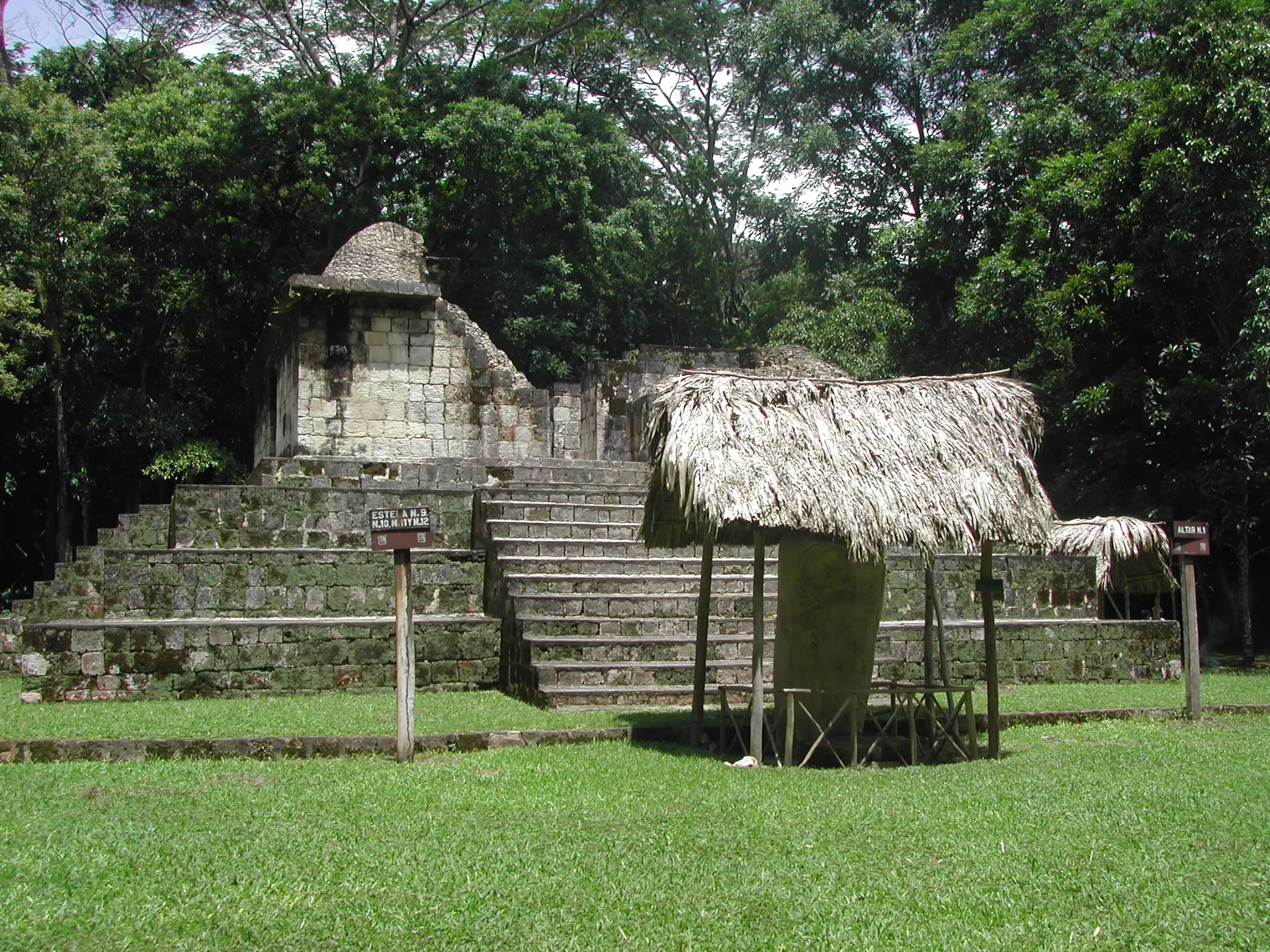
Image of El Ceibal. Image source · CC-BY-SA-3.0
Visit essentials
A quick read before you go
- Duration
- 2 to 3 hours on site, plus boat or road travel from Sayaxché.
- Access
- About 16 km east of Sayaxché, Petén; usually reached by boat up the Pasión River or by rough…
Overview
Ceibal, also written Seibal, lies on jungle bluffs about one hundred metres above the Pasión River, sixteen kilometres east of Sayaxché. Around 1000–950 BC, its people built the earliest known formal Maya ceremonial complex: a solar-aligned E-Group. Greenstone-celt and obsidian caches on its axis and in cruciform patterns marked the world-centre and four cardinal directions; green itself signified the centre.
Research by Takeshi Inomata, Daniela Triadan, and colleagues shows lowland Maya public ritual emerging through interregional interaction rather than one-way Olmec influence.
After its principal Late Preclassic occupation and a long decline, Ceibal flourished again around AD 830–890. Its lords used hybrid Maya and central Mexican symbolism across seventeen stelae and the rare circular Structure C-79 before the city was abandoned. Reached most reliably by boat, the ruins remain among ceiba trees and howler monkeys.
Why this place is sacred
Ceibal's quiet is part of its meaning. This is not a crowded monument but a forest site reached by river, where the founding of a ceremonial plaza around 1000 BC marks one of the formative moments of lowland Maya civilization. To stand in its restored plaza is to stand where public ritual first bound a Maya community together and where, beneath the surface, caches of greenstone and obsidian were arranged to make the world's center and its four directions visible.
The river approach, the towering ceiba trees, and the calls of howler monkeys lend the arrival the quality of reaching a hidden source. The thinness here is one of deep origins: a felt sense of being at the beginning of a cosmological order that would shape a civilization for millennia.
Experience and orientation
Most visitors reach Ceibal by boat up the Pasión River from Sayaxché, an approach through jungle that sets the tone for the visit. The site is remote and atmospheric, shaded by towering ceiba trees and alive with howler monkeys. The restored A-3 temple and the rare circular platform, Structure C-79, are the principal standing features, and the Terminal Classic stelae reward attention, especially read with a guide.
There is no formal participatory ritual at Ceibal and no documented site-specific contemporary Maya ceremony; the experience is one of quiet walking among monuments in a forest that has reclaimed much of the city. Move attentively, watch and listen to the wildlife, and let the river approach and the deep history settle.
Allow 2 to 3 hours on site, plus boat or road travel from Sayaxché. Wear lightweight covering clothing, sturdy footwear, and insect repellent. Stay on trails, and do not climb or remove anything from the monuments.
Context and lineage
Ceibal's story is told through archaeology rather than myth: the founding of its ceremonial plaza around 1000 BC marks one of the formative moments of lowland Maya civilization. The greenstone and obsidian caches laid along the E-Group axis and in cruciform patterns express, from the very start, a cosmology of a world-center and four directions. There is no documented site-specific origin legend; the broader region remains within living Maya cultural territory, though no contemporary ritual at Ceibal itself is recorded.
Preclassic and Classic Maya religion, with a distinctive Terminal Classic hybrid Maya and central Mexican (Putún) ritual phase.
Ancestral lowland Maya builders
Founders
Putún (Chontal) Maya-influenced elites
Terminal Classic rulers
Takeshi Inomata and Daniela Triadan
Archaeologists
Conservators and the Petén heritage authority
Custodians
Traditions and practice
Ancient caching of greenstone celts and obsidian along cosmic axes, plaza ceremonies, and Terminal Classic stela dedication, including Stela 10 / Wat'ul Chatel.
No documented site-specific contemporary Maya ceremony at Ceibal; broader Maya spiritual practice continues across the region.
Walk the restored plaza and the circular platform attentively, and read the stelae with a guide to grasp how public ritual and cosmology developed here. Let the river approach and forest setting frame a contemplative visit.
Preclassic Maya religion
HistoricalThe site holds the earliest known formal Maya ceremonial complex (E-Group), shaping understanding of how lowland Maya civilization and public ritual emerged.
Greenstone celt and obsidian caches placed along the E-Group axis and in cruciform arrangements to mark the cosmic center and four directions; plaza-based public ceremonies.
Classic and Terminal Classic Maya religion
HistoricalCeibal flourished again in the Terminal Classic under lords adopting hybrid Maya and central Mexican symbolism, documented on a remarkable stela series.
Stela dedication and royal display (e.g., Stela 10 / Wat'ul Chatel), and ceremony at Structure A-3 and the circular platform C-79.
Perspectives and open questions
Ceibal is central to Maya-origins research, set within living Maya cultural territory, and noted in popular accounts for its rare circular temple.
Scholarly perspective
Scholars regard Ceibal as pivotal for Maya origins: its early E-Group ceremonial complex shows lowland Maya civilization arose through interregional interaction rather than one-way Olmec influence, and its caches reveal the development of public ritual and cosmology.
Living and traditional perspectives
The broader region remains within living Maya cultural territory, though no site-specific contemporary ritual at Ceibal is documented.
Alternative interpretations
Popular accounts emphasize the rare circular temple as evidence of central Mexican (Ehecatl, the wind god) influence in the Terminal Classic.
Open questions
The causes of the Preclassic-to-Classic hiatus and the exact nature of Putún Maya influence in the Terminal Classic remain debated. Reported coordinates vary slightly between sources.
Plan your visit
Access and arrival
About 16 km east of Sayaxché, Petén; usually reached by boat up the Pasión River or by rough road, ideally with a local guide. Current opening hours and fees were not confirmed; check locally before visiting.
Respectful visit
Lightweight, covering clothing for the jungle; sturdy footwear and insect repellent.
Permitted for the monuments and landscape.
None are expected; do not leave items at the monuments.
Stay on trails; do not climb or remove anything from the monuments; respect the conservation of fragile carvings.
Do not leave items at the monuments, and do not climb or remove anything from them. Respect the conservation of fragile carvings.
Current practical details
Address
Seibal, Guatemala
Hours, fees, and access can change — verify on the official source before you travel. Practical details last checked Jun 2026.
Location
Map loads as you approach this section.
Pilgrim reflections
A portrait of encounter, not a score
Pilgrims describe what they felt, how present they could become, and whether the place would shape a journey. There are no stars and no ranking of traditions.
No reviewed reflections yet
The first pilgrims can help describe the character of being here.
Share a reflection
Available after an account-backed “Been there.” Every reflection is reviewed before publication.
Nearby sacred places
Explore other sacred places in the region. Proximity does not establish access or travel time; check each place’s guidance.



References
Sources consulted for this page. Source categories describe the publication, not a guarantee that every claim is verified. Traditional accounts and outside interpretations may differ.
- 01Seibal — Wikipedia — Wikipedia contributorsacademicConfirms location 16 km east of Sayaxché on bluffs above the Pasión River, occupation history, Terminal Classic recovery, restored structures A-3 and C-79.
- 02Early Ceremonial Constructions at Ceibal, Guatemala, and the Origins of Lowland Maya Civilization — Science — Inomata, Triadan et al.academicDocuments earliest known formal Maya ceremonial complex (E-Group) c. 1000–950 BC predating La Venta's major occupation; interregional-interaction model for Maya origins.
- 03Polished greenstone celt caches from Ceibal: the development of Maya public rituals — Antiquity (Cambridge) — Inomata, Triadan et al.academicGreenstone celt and obsidian caches arranged on E-Group axis and cruciform patterns marking center and four cardinal directions of Maya cosmos; green associated with world-center.
- 04The Origins of Maya Civilization: New Insights from Ceibal — Peabody Museum (Harvard) — Peabody Museum / InomataacademicSummarizes Ceibal's role in understanding lowland Maya origins and Preclassic ceremonial architecture.
- 05Seibal — The Mayan Ruins Website — themayanruinswebsite.comSource contextVisitor information including river access via Sayaxché and restored monuments.
- 06Seibal — Infogalactic — InfogalacticacademicDetails Stela 10 / Wat'ul Chatel, Putún (Chontal) Maya influence, 17 stelae AD 849–889 with hybrid Maya–central Mexican iconography (Ehecatl mask).
Share a photo
Help visitors recognize El Ceibal. Every submission is reviewed before publication.