Byōdō-ji
A vow that healing belong to all — and a well that began it
Understand sacred places, explore living traditions, and learn how to engage respectfully with Pilgrim Map.
Access has not been verified. Check current local guidance before planning a visit.
Anan, Tokushima Prefecture, Japan
Read the sources
Station 22 of 88
Shikoku 88 Temple PilgrimageVisit essentials
A quick read before you go
- Duration
- 30-60 minutes for a typical visit.
- Access
- Address: 177 Aratano-chō Akiyama, Anan, Tokushima 779-1510.
Overview
Byōdō-ji means Equality Temple, and the equality is concrete: a vow that all people's mental and physical illnesses be healed without distinction. Kūkai is said to have made this vow here in 814, after digging a well in search of holy water and finding water as white as milk well up. He purified himself with it, performed a 100-day goma fire ritual, and carved the wooden Yakushi Nyorai now enshrined as principal icon.
The mountain name Hakusuizan — White Water Mountain — and the temple name Byōdō-ji together state the foundation: pure water, freely given, healing without distinction. The well still stands within the precinct. Pilgrims drink, fill bottles, and carry water home for ill family members. After the long descent from Tairyū-ji's mountain monastic atmosphere, Byōdō-ji often reads as a return to the human scale of the henro. The temple is unusually pilgrim-friendly.
Walking pilgrims find free wifi, free parking, accommodation, and tents permitted with prior permission. Ajikan meditation classes — visualisation of the Sanskrit syllable A as a teaching device for Shingon practice — run weekday mornings. The temple maintains an unusually robust online presence, including live-streamed services and a virtual pilgrimage program for those who cannot travel. Byōdō-ji often functions as the after-Tairyū-ji descent temple — a place where the henro shifts from austerity (T20-21) to communal warmth.
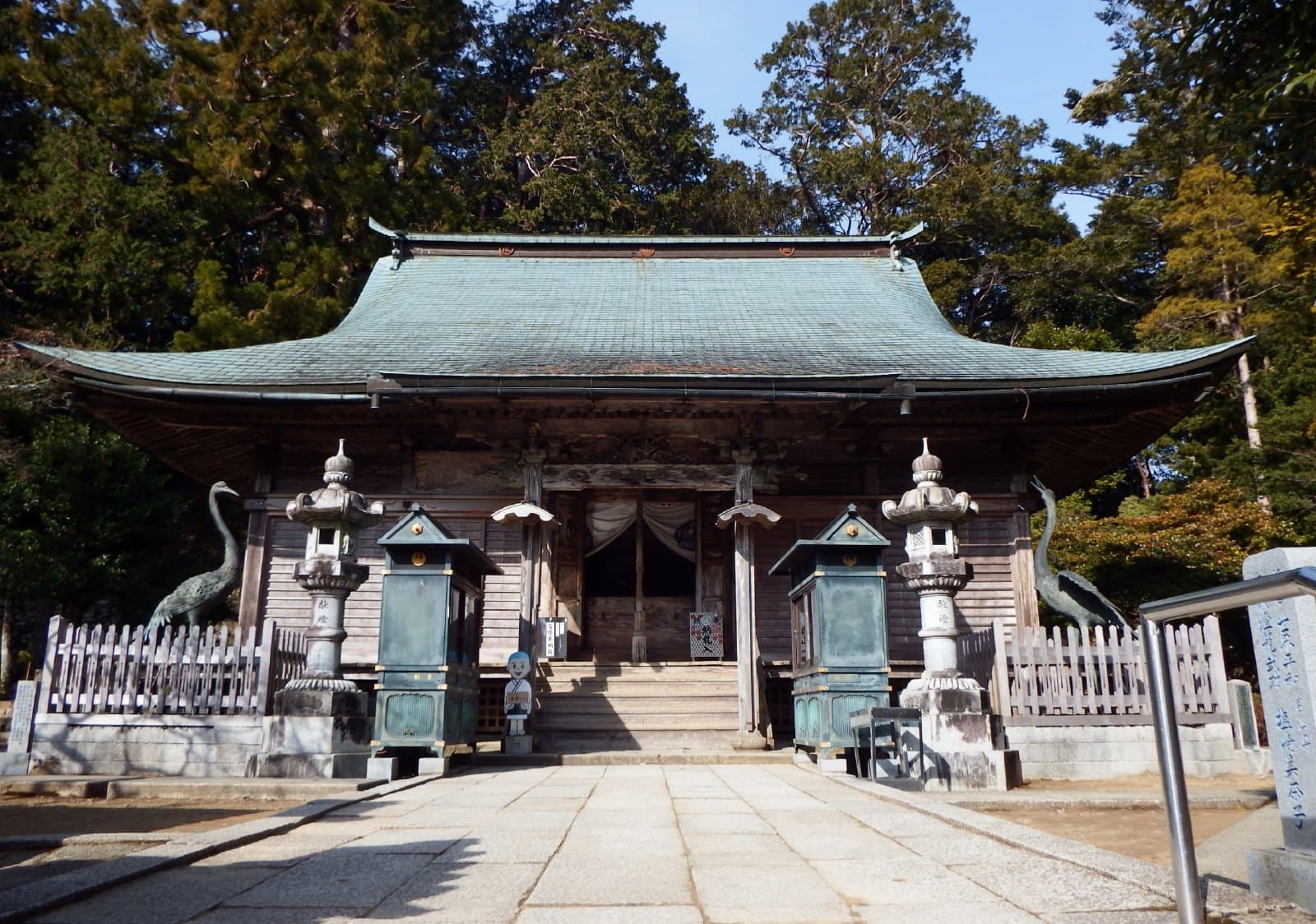
The Hondō's elevated position above steep stone steps gives a view back across the Anan plain. The well is below; the vow above; the pilgrim between.
Why this place is sacred
Most temple foundation stories are layered through centuries. Byōdō-ji's is unusually compact. In 814, Kūkai is said to have made his vow that all suffering be healed equally; he dug a well; milk-white water came up; he performed a 100-day goma fire ritual; he carved the Yakushi statue. Vow, water, image: one act. The well still exists. Pilgrims drink. The Yakushi statue, after centuries of preservation, remains the principal icon. The continuity is rare.
The thinness here lies in this unity. The mountain's hydrology and the temple's central rite are the same thing. The amrita (kanro) — sweet dew, dharma-rain — that Shingon iconography invokes is not a metaphor at Byōdō-ji; it is a literal spring. The temple is therefore a dharma-spring in the most direct sense. Buddhist nourishment as physical liquid. Pilgrims do not need to choose between symbolic and concrete reading; the two collapse.
The vow Kūkai is said to have made — heal equally — is also unusually direct. It does not specify Buddhists, or pilgrims, or the worthy. It specifies all. The temple's continuing online presence and virtual pilgrimage program quietly extend this vow to those who cannot reach Anan in person.
Founded in 814 CE by Kūkai. The original purpose was the literal expression of Kūkai's vow that all suffering be healed equally — a public-good ethic linked to the Yakushi (Medicine Buddha) tradition. The well, dug at the moment of the vow, is the temple's hydrological centre.
Across centuries, the temple has remained a working Yakushi site. The Hondō's elevated position above the steep stone steps was preserved through successive rebuildings. The temple's modern character — exceptionally pilgrim-friendly, with free wifi, accommodation, and a robust online presence — extends rather than departs from its founding vow. Today Byōdō-ji is a Kōyasan Shingon temple offering daily services, ajikan meditation classes weekdays, accommodation, and live-streamed services for those participating remotely.
Experience and orientation
Byōdō-ji opens off a quiet road in Aratano, with a free parking lot and the gate ahead. Pilgrims arriving from Tairyū-ji often arrive tired, the long descent from the mountain monastery still in their legs. The temple meets that tiredness practically. Free wifi at the gate. Tents permitted on grounds with prior permission. Walking pilgrims are welcomed with a warmth not always typical of mountain-monastic neighbours. Past the gate, the precinct rises.
Steep stone steps lead up to the Hondō; the climb is short but firm. The Daishidō sits to one side. The founding well — the original 814 spring — is on the precinct, with a small canopy and a place to fill containers. Pilgrims complete the formal worship at both halls — bow, hand-purification, offerings, the Heart Sutra, the Kōbō Daishi mantra — then often drink at the well or fill a small bottle for an ill family member.
The hondō's elevated position gives a view back over the Anan plain, especially memorable in late afternoon when the light angles low across the rice fields. Ajikan meditation classes run weekday mornings (10:00-13:00); guests may join.
Bow at the gate. Purify hands and mouth at the stone basin. Climb the stone steps to the Hondō. Offer first to Yakushi Nyorai at the Hondō, then at the Daishidō to Kōbō Daishi. Drop your osamefuda, light incense, chant or read the Heart Sutra and the Kōbō Daishi mantra. Visit the founding well — drink, fill a small bottle, or simply stand. Receive your nōkyōchō stamp at the temple office.
If joining ajikan meditation, arrive in time for the weekday morning class. If staying overnight, check accommodation arrangements with the office in advance.
Context and lineage
Tradition holds that in 814, Kūkai vowed at this site that all people's mental and physical illnesses be healed equally. Searching for holy water with which to seal the vow, he dug a well; water as white as milk welled up. He purified himself with it, performed a 100-day goma fire ritual, and carved the wooden Yakushi Nyorai now enshrined as the temple's principal icon.
The mountain was named Hakusuizan — White Water Mountain — for the milky water; the temple was named Byōdō-ji — Equality Temple — for the vow. The well still stands within the precinct, and water is drawn from it daily.
Kōyasan Shingon. Byōdō-ji is the 22nd of the Shikoku 88 in standard order, in the southern part of Anan. The temple's modern character — strong online presence, virtual pilgrimage program, ajikan classes — extends the founding vow into contemporary practice.
Kūkai (Kōbō Daishi)
Founder, well-digger, vow-maker, principal-image carver
Traditions and practice
Daily goma fire rituals on schedule. Yakushi healing services. Annual commemoration of the founding 100-day goma rite. Ajikan meditation classes — visualisation of the Sanskrit syllable A as a teaching device for Shingon practice — run weekday mornings (10:00-13:00).
Pilgrim worship at the Hondō and Daishidō. Visit to the founding well, where many pilgrims drink and fill containers for ill family members. Participation in ajikan classes when scheduled. Reception of nōkyōchō stamp. Online streaming and virtual pilgrimage for those who cannot travel — a contemporary extension of the founding vow.
If you arrive on a weekday, consider joining the ajikan meditation class — it is one of the most accessible opportunities to experience formal Shingon meditation as a lay visitor on the henro. Drink at the founding well. If you have someone unwell at home, fill a small bottle and carry it. Read the Heart Sutra at each hall; if you know the Kōbō Daishi mantra ('Namu Daishi Henjō Kongō'), include it.
Shingon Buddhism (Kōyasan branch)
ActiveThe temple's name (Byōdō = equality) reflects Kūkai's vow that all people's mental and physical illnesses be healed equally — a statement of bodhisattva intent that links the Yakushi (Medicine Buddha) tradition to a public-good ethic. The vow is unusually explicit and unusually inclusive.
Daily services; goma fire rituals; ajikan meditation classes weekdays 10:00-13:00 (no weekends); online prayer streaming and virtual pilgrimage offerings. The founding well remains a working sacred element of daily practice.
Perspectives and open questions
Byōdō-ji's founding story is unusually compact, and different readings emphasise different layers of the vow-water-image unity.
Scholarly perspective
The milk-white water motif fits a wider Buddhist iconography — the milky ocean of compassion, amrita as sweet dew — and historians read it as a symbolic translation of the founding vow into local hydrology. The 100-day goma narrative parallels Kūkai's other founding stories. Whether the original water was literally milk-white is unverifiable; the motif's function is theological.
Living and traditional perspectives
Local Anan devotion to the well as a healing source remains active. People from the surrounding villages visit specifically for the water, often without engaging the broader pilgrimage. The well is treated as a living source — water taken home, water carried to the bedside of an ill family member.
Alternative interpretations
In Shingon esoteric reading, the well water represents amrita (kanro), the dharma-rain that ends the suffering of all sentient beings. The temple is therefore literally a dharma-spring: Buddhist nourishment as physical liquid, the bodhisattva vow encoded in hydrology.
Open questions
Mineral analyses of the well — and what gave the original water its milky character — have not been published in widely accessible form. The 100-day goma narrative has no archaeological correlate. The temple's online presence (byodoji.online) includes its own primary documentation and should be checked for current programs.
Plan your visit
Access and arrival
Address: 177 Aratano-chō Akiyama, Anan, Tokushima 779-1510. About 2 km / 30-min walk from Aratano Station on the JR Mugi Line. Free parking (~30 spaces); free wifi. Hours: 08:30-17:00 (free admission). Phone: 0884-36-3522 (verify).
The temple offers accommodation for pilgrims (advance reservation recommended); tents permitted on grounds with prior permission. Anan city has business hotels for those arriving by car.
Respectful visit
Modest casual; pilgrim attire welcomed. Remove shoes for halls and shukubo.
Outdoor and grounds photography permitted; respect altar prohibitions inside halls.
Coin, three sticks of incense, one candle, an osamefuda dropped in the wooden box at each hall. Many pilgrims also leave a small written prayer slip near the well for an ill family member.
Quiet hours after 21:00 in the shukubo. No smoking in the precinct. Ask permission before pitching a tent. The well is for drinking and prayer only.
Ajikan classes are weekday-only; do not assume weekend availability.
Current practical details
Address
Akiyama-177 Aratanochō, Anan, Tokushima 779-1510, Japan
Phone
Hours
Hours, fees, and access can change — verify on the official source before you travel. Practical details last checked Jun 2026.
Location
Map loads as you approach this section.
Pilgrim reflections
A portrait of encounter, not a score
Pilgrims describe what they felt, how present they could become, and whether the place would shape a journey. There are no stars and no ranking of traditions.
No reviewed reflections yet
The first pilgrims can help describe the character of being here.
Share a reflection
Available after an account-backed “Been there.” Every reflection is reviewed before publication.
Watch deeper
Films, episodes, and recorded talks for visitors who want more context before or after a visit. Speculative and alternative-history entries are labelled as perspectives, not as sources for established claims.
Nearby sacred places
Explore other sacred places in the region. Proximity does not establish access or travel time; check each place’s guidance.


References
Sources consulted for this page. Source categories describe the publication, not a guarantee that every claim is verified. Traditional accounts and outside interpretations may differ.
- 01Byōdōji Online | Prayer, Live Streaming & Virtual Pilgrimage — Byōdō-ji TempleofficialTemple's own website with hours, services, and online pilgrimage.
- 02Byodoji – Anan, Tokushima Prefecture, Shikoku — Henro.orgguideWalking-pilgrim friendly amenities, well legend.
- 03Byōdō-ji (Anan, Tokushima) — Wikipedia contributorsencyclopediaFoundation, sect, principal image.
- 04Byodo-ji Temple — Japan HoppersguideHours, free wifi, parking.
- 05Byodoji Temple — Japan ExperienceguideFoundation legend and well water.
- 06Byodo-ji Temple, the 22nd temple of the Shikoku Pilgrimage — Shikoku Pilgrimage NewsguideGoma 100-day ritual narrative.
Pilgrim glossary
- Bodhisattva
- An enlightened being who postpones full nirvana to help others toward awakening.
- Sutra
- A canonical Buddhist scripture, often chanted as part of practice.
- Mantra
- A sound, word, or phrase repeated as part of meditation or ritual.
- Dharma
- The teachings of the Buddha; also the universal law underlying them.
- Shingon
- An esoteric Japanese Buddhist school emphasizing ritual, mantra, and mandala practice.
Share a photo
Help visitors recognize Byōdō-ji. Every submission is reviewed before publication.