Tlos
Bronze Age city, hero's tomb, Ottoman fortress — Tlos holds more layers of time than almost any site in Lycia
Understand sacred places, explore living traditions, and learn how to engage respectfully with Pilgrim Map.
Access has not been verified. Check current local guidance before planning a visit.
Muğla, Turkey
Read the sources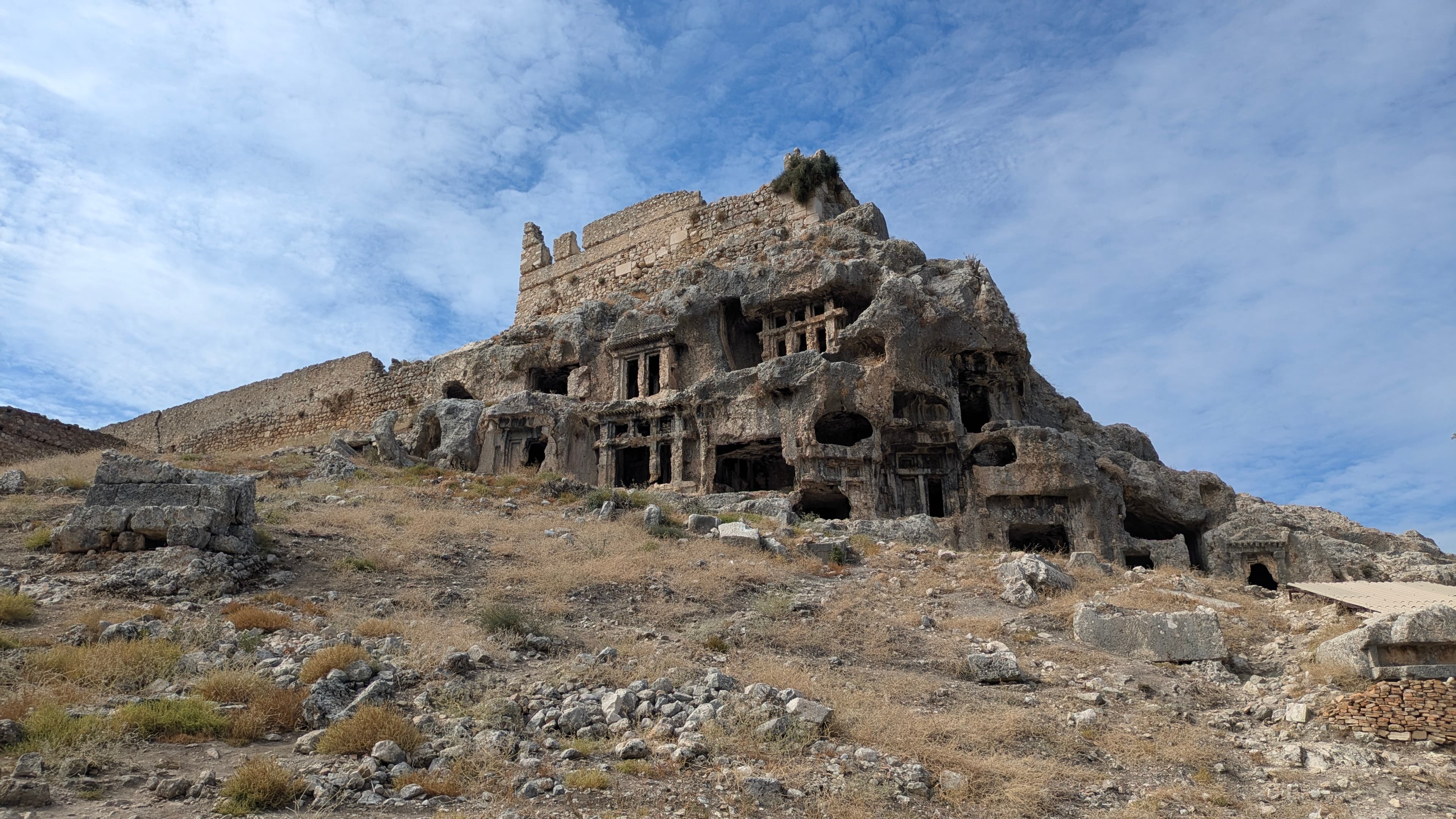
Image of Tlos. Image source
Visit essentials
A quick read before you go
- Duration
- Two to three hours for the full site including the acropolis climb.
- Access
- Located 42 km east of Fethiye on the road toward Saklıkent, near Yaka village, Seydikemer…
Overview
Tlos enters Hittite texts as 'Dalawa,' the earliest written record of any Lycian city and the beginning of this coast's literate history. In Lycian it was 'Tlawa.' The name changed remarkably little across millennia of occupation, reflecting an unusual continuity of place.
Tlos made Bellerophon—the Pegasus-riding slayer of the Chimera who tried to fly to Olympus and was cast down—its founding myth. Three civic demes bore the names of Lycian mythological heroes: Bellerophon, Iobates, who sent him on his impossible tasks, and Sarpedon, the Lycian prince who fought at Troy. Myth thus shaped the city's constitutional structure, not only its temples.
The 4th-century BC Tomb of Bellerophon is carved into the acropolis rock face and shows the hero mounted on Pegasus. After twenty-five centuries in open air, its worn but legible relief still carries the horse's upward tension and the hero's forward attitude of flight.
Above the Lycian and Roman city, the Ottoman commander Kanli Ali Agha built a fortress in the nineteenth century. It is the topmost and most recently occupied layer. From within its walls, the acropolis view encompasses the entire Xanthos valley: river, fields, mountains, and sky.
Why this place is sacred
Bellerophon's story has an arc that resists comfortable interpretation. He is granted Pegasus, destroys the Chimera, performs heroic deeds — and then, in hubris, attempts to fly to Olympus itself. The gods throw him from the horse. He falls to earth, wandering blind and alone. In the Iliad, he 'roamed the Aleian plain, avoiding the paths of men, gnawing at his own heart.'
The city of Tlos did not choose a triumphant hero for its founding myth; it chose a figure whose story ends in catastrophic overreach and lonely suffering.
This is a striking mythological choice. It suggests that Tlos understood the sacred life not as the guarantee of divine favour but as the site of human striving that acknowledges its own limits. The three demes named for Lycian heroes — Bellerophon, Iobates, Sarpedon — created a civic identity out of mythology's most ambivalent figures. Iobates sent Bellerophon on missions meant to destroy him. Sarpedon died at Troy. The heroic tradition Tlos claimed was mortal, flawed, and beautiful.
The Bronze Age cave sites nearby — Girmeler and Tavabaşı — suggest that the landscape around Tlos was considered sacred long before the city existed. The caves have not been fully studied, but their proximity to the city and their apparent ritual use predating the Lycian period hint at a very long tradition of treating this valley as a place of encounter with what lies beyond ordinary human experience.
The Ottoman fortress at the summit is not merely an intrusion into the ancient landscape; it is another layer of the same process — human beings returning to this rock because it commands the valley, because height here means something.
Civic and religious centre of one of the oldest and most important Lycian cities; the Bellerophon hero cult gave the city a mythological identity embedded in its political constitution.
Bronze Age occupation (attested c. 3300–1200 BC) → Lycian city-state with Bellerophon hero cult → part of the Lycian League federation → Hellenistic and Roman development (theatre, stadium, baths) → Byzantine Christianisation → Ottoman fortress occupation (Kanli Ali Agha, 19th century) → modern archaeological excavations (2005–present)
Experience and orientation
The road from Fethiye toward Saklıkent Gorge passes the turnoff for Tlos, and the site appears as a rocky outcrop rising from the flat valley floor, its Ottoman fortress walls visible on the summit from several kilometres away. There is nothing ambiguous about the rock: it is a natural citadel, steep-sided, commanding the approaches.
The path from the entrance area passes the Roman baths — substantial ruins, their brick courses still partly intact — and begins climbing toward the theatre. The theatre is well-preserved in its lower section, its seating hewn from the hillside in the Lycian fashion, looking out over the valley toward the mountains.
The stadium, set on a terrace above the theatre, is unusually large for a city of this scale — nearly 200 metres long, seating around 2,500 — and its purpose and context are still being studied.
The Tomb of Bellerophon is carved into the vertical rock face of the acropolis cliff. It is approached from below by a path that puts you directly in front of the carved relief, at close range. The hero on Pegasus occupies the left side of the composition; the horse's wings are spread in the upward position. After twenty-five centuries of open-air exposure the relief is worn, but the forms are legible. Give it time.
The eyes and the composition gradually come clear.
The acropolis climb to the Ottoman fortress is the most physically demanding part of the visit, but it is the most rewarding. From within the fortress walls, the entire Xanthos valley spreads below — the river visible as a line of green through the patchwork of fields, the mountains enclosing everything on three sides, the sea not visible but implied in the direction the valley opens.
This is what it felt like to hold the valley: total visual command in every direction.
Enter from the car park near the Roman baths. Walk uphill through the baths to the theatre and stadium, then continue to the Tomb of Bellerophon in the cliff face. The acropolis and Ottoman fortress require a further climb — allow 30–40 minutes for the ascent and descent. The Bellerophon tomb requires no climbing but is reached by a path branching left from the main route.
Context and lineage
The city appears in Hittite records as 'Dalawa', making it one of the earliest attested Lycian sites in any written source. Lycian inscriptions called it 'Tlawa'. The mythological origin story centres on Bellerophon, the hero associated with Lycia through the Iliad and the broader Greek mythological tradition. Three of the city's civic demes — administrative subdivisions — carried the names of Lycian mythological heroes: Bellerophon, his adversary-turned-father-in-law Iobates, and Sarpedon.
This embedding of mythology into the city's constitutional structure is unusual even among the Lycian cities.
Alexander the Great arrived at Tlos in 333 BC, the same year he swept through most of Lycia. Roman development produced the theatre, baths, and the oversized stadium. In the Byzantine period a church was built within the city. The Ottoman commander Kanli Ali Agha — whose name means 'Bloody Ali Agha', suggesting a violent reputation — built the fortress that crowns the acropolis in the 19th century and used it as a base into the 1800s.
Excavations directed by Prof. Dr. Taner Korkut of Akdeniz University began in 2005 and have significantly extended the understanding of the Bronze Age and early Lycian periods.
Bronze Age occupation (c. 3300 BC) → Hittite suzerainty ('Dalawa') → Lycian city-state with Bellerophon hero cult → Lycian League federation → Achaemenid Persian, then Macedonian rule → Hellenistic → Roman → Byzantine → Ottoman fortress occupation → modern excavations (2005–present)
Traditions and practice
Hero cults in the ancient Greek world involved regular veneration at a hero's tomb — libations, offerings, sometimes sacrifices — on the understanding that the dead hero retained power over the place and could be called on for protection and intercession. At Tlos, the Tomb of Bellerophon was the focal point of such a cult.
The hero's mythological connection to Lycia — his long sojourn in the land, his marriage to a Lycian princess, his founding of the city in some traditions — made him the city's most powerful ancestral protector.
The embedding of Bellerophon's name in a civic deme meant that the hero was not merely venerated religiously but was constitutionally part of the city's identity. Citizens who belonged to the Bellerophon deme carried the hero's name in their civic designation.
Lycian funerary practice throughout the site involved rock-cut tombs, sarcophagi, and pillar tombs, many of which bear inscriptions specifying who was permitted to be buried and the legal penalties for violation — a practice that invested the tombs with ongoing legal as well as religious authority.
Archaeological excavations are active. The site is open for heritage tourism. No religious practices take place at the ruins.
Begin with the Roman baths to establish scale, then move uphill to the theatre. Sit in the theatre seating and look out over the valley: this was the direction the audience faced, and the landscape was always part of the performance.
At the Tomb of Bellerophon, stand close enough to read the carved relief clearly, then step back to see the tomb in its architectural context — the facade with its porch columns, the entrance, the relief composition as a whole. The hero is in motion; the horse is in flight. Hold both scales in mind: the small, worn carving and the story it carries.
The acropolis climb requires effort but provides the key orienting experience of the site. From the Ottoman walls, you see why this rock was occupied continuously for four thousand years. The valley is completely legible from here: every approach, every road, the river's course, the fields. Whatever changed above — Lycian, Roman, Byzantine, Ottoman — the view remained the same.
Lycian Religion / Bellerophon Hero Cult
HistoricalTlos was uniquely identified with the mythological hero Bellerophon across its entire civic life — from the carved Tomb of Bellerophon (c. 350–320 BC) to the constitutional embedding of his name in a civic deme. Three of the city's demes were named for Lycian mythological heroes.
Hero cult veneration at the Tomb of Bellerophon; libations and offerings; funerary rites at the rock-cut tombs and sarcophagi throughout the site.
Byzantine Christianity
HistoricalAn early Byzantine church was constructed within Tlos, indicating the Christianisation of the city in Late Antiquity and its continued occupation as a functioning community.
Christian liturgy; community life within the Byzantine period city.
Archaeological / Scholarly
ActiveOngoing excavations since 2005 have revealed Bronze Age occupation layers, a stadium of unusual scale, Roman structures including a theatre seating approximately 2,500, and evidence of the pre-Lycian sacred landscape. The excavations are significantly revising the understanding of Tlos as one of the oldest occupied sites in Lycia.
Annual interdisciplinary excavations directed by Prof. Dr. Taner Korkut of Akdeniz University; publication of stratigraphic and archaeological reports.
Perspectives and open questions
Tlos is understood through archaeology, Lycian mythological tradition, and the unusual continuity of a site occupied from the Bronze Age through the Ottoman period — each layer distinct but all inhabiting the same commanding rock.
Scholarly perspective
Tlos is one of the oldest continuously occupied sites in Lycia, with Bronze Age occupation confirmed through pottery and tools from c. 3300–1200 BC. Its mention in Hittite records as 'Dalawa' makes it one of the earliest attested Lycian cities in any written source. The Bellerophon association was not ornamental but was embedded in the city's civic deme structure.
Excavations since 2005 are significantly extending knowledge of the pre-Lycian occupation layers and the early Bronze Age use of the surrounding landscape. The stadium remains unusually large relative to the city's known size and population — its full significance is still under investigation.
Living and traditional perspectives
Tlos held a privileged position among Lycian cities as the home of Bellerophon, the quintessential Lycian hero — the mortal who came closer than any other to the divine realm and paid the ultimate price for the attempt. The Bellerophon tomb was the focal point of ongoing ancestor veneration and hero cult; the embedding of the hero's name in the civic constitution made the myth not merely decorative but structurally present in the city's self-understanding.
Alternative interpretations
Some modern visitors associate the Pegasus imagery with broader ancient Near Eastern traditions of winged horse deities and astral mythology — specifically with the Mesopotamian traditions of divine horses and celestial travel. While no direct iconographic continuity has been demonstrated, the geographical proximity of Lycia to the Near East and the evidence of significant cultural exchange across the Bronze Age make such comparisons worth holding open.
Open questions
The Bronze Age occupation levels are only beginning to be understood. The Girmeler and Tavabaşı cave sites near Tlos appear to preserve evidence of ritual use predating the city, but they have not been fully excavated or published. The stadium's unusual size — larger than what might be expected for a city of Tlos's population — invites questions about its role in the broader Lycian ceremonial calendar that have not been answered.
The full extent of the hero cult's practice at the Bellerophon tomb is unknown.
Plan your visit
Access and arrival
Located 42 km east of Fethiye on the road toward Saklıkent, near Yaka village, Seydikemer district, Muğla Province. Signposted from the main D400 highway. Accessible by private car; some organised tours from Fethiye include Tlos. Entrance fee applies. Turkey Museum Pass accepted.
Fethiye (42 km) is the practical base, with the widest range of accommodation on this part of the Lycian coast. Smaller guesthouses are available in the Saklıkent/Yaka area. Ölüdeniz (30 km) offers resort-style options.
Respectful visit
Sturdy walking shoes with ankle support are required for the acropolis climb. No dress code requirements otherwise.
Permitted throughout. The Tomb of Bellerophon is best photographed in morning or late afternoon light when the relief is most legible in raking light. The acropolis view photographs well throughout the day.
None expected or practiced.
Do not climb on tomb facades or carved surfaces. Respect any roped-off excavation areas. No removal of any material from the site.
The acropolis climb involves steep sections without guardrails. Sturdy footwear is essential. The site can become very hot in summer; visit early in the morning or late in the afternoon. Carry water — there are no facilities once past the entrance area.
Location
Map loads as you approach this section.
Pilgrim reflections
A portrait of encounter, not a score
Pilgrims describe what they felt, how present they could become, and whether the place would shape a journey. There are no stars and no ranking of traditions.
No reviewed reflections yet
The first pilgrims can help describe the character of being here.
Share a reflection
Available after an account-backed “Been there.” Every reflection is reviewed before publication.
Nearby sacred places
Explore other sacred places in the region. Proximity does not establish access or travel time; check each place’s guidance.


References
Sources consulted for this page. Source categories describe the publication, not a guarantee that every claim is verified. Traditional accounts and outside interpretations may differ.
- 01Tlos | Turkish Archaeological News — Turkish Archaeological NewsacademicAggregates peer-reviewed excavation reports; documents 2005-onward excavations
- 02Tlos - Wikipedia — Wikipedia contributorsencyclopediaComprehensive; cites archaeological sources
- 03The Ancient Lycian City of Tlos - Established Over 4,000 Years Ago! — The ArchaeologistacademicGood synthesis of archaeological timeline
- 04Ancient Lycian City of Tlos — Lycian MonumentsguideSpecialist Lycian heritage site; detailed monument descriptions
- 05Tlos — Atlas ObscuraguideGood narrative overview
- 06Tlos Ancient City: Information & Facts to Know — LetooniaguidePractical visitor information
- 07Ancient Lycian Tombs and Sacred Sites near AHÂMA Resort, Turkish Riviera — The AficionadosspiritualDiscusses sacred landscape of Lycian tombs including Tlos
Share a photo
Help visitors recognize Tlos. Every submission is reviewed before publication.