Pinara
Hundreds of tombs in the cliff face — Pinara holds the Lycian dead in suspended flight above the valley
Understand sacred places, explore living traditions, and learn how to engage respectfully with Pilgrim Map.
Access has not been verified. Check current local guidance before planning a visit.
Muğla, Turkey
Read the sources
Visit essentials
A quick read before you go
- Duration
- A minimum of two hours; three to four hours for those who want to cover the full site and take…
- Access
- Near Minare village, Seydikemer district, Muğla Province.
Overview
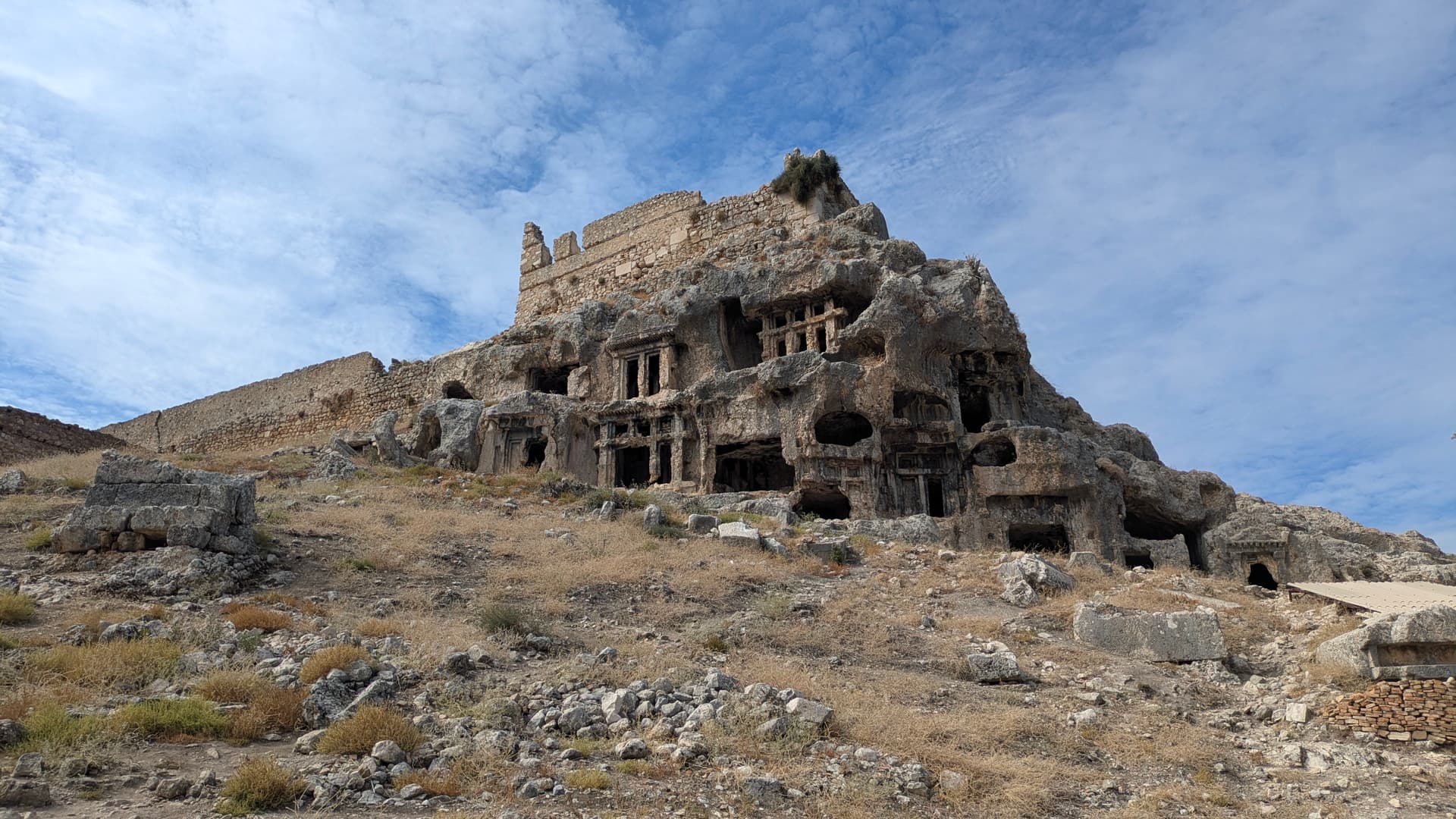
Pinara's upper acropolis is a massive cylindrical rock, a nearly vertical drum rising from the mountain. Lycian stonemasons cut hundreds of tombs into it and surrounding cliffs. Seen from below, their cellular openings resemble a living wall of chambers meant to be visible from the valley. Height was deliberate: Lycian funerary belief held that winged creatures carried the dead upward, so tombs placed as high as possible—sometimes beyond ordinary reach—prepared that passage.
Aphrodite was worshipped here, with a temple somewhere in the city though its exact location remains unconfirmed. Funerary monumentalism beside the cult of love and beauty suggests a worldview holding death and beauty close together.
Almost none of the city has been excavated. Its theatre, agora, and Royal Tomb with carved reliefs remain visible on the surface; everything else waits. Pinara is encountered more than understood.
Why this place is sacred
For Lycians, the placement of tombs was not merely practical but cosmological. The dead needed to be positioned for ascent. Rock faces and cliff sides were preferred over flat ground precisely because height aided the upward passage. The extraordinary programme of tomb-cutting at Pinara — hundreds of chambers carved into vertical surfaces at varying heights, many inaccessible without flight — makes this cosmology physically visible.
Standing in the valley below the honeycomb cliff, looking up at the rows of dark rectangular openings set into pale stone, the cumulative effect is difficult to describe without recourse to feeling. The cliff is not dramatic in a theatrical sense; it is persistent, and the tombs are persistent, and together they establish that the living world here was always understood as temporary and the dead world as permanent.
The city below the cliff — theatre, houses, agora — is rubble returning to earth. The tombs above remain.
Aphrodite's presence at Pinara introduced a counterforce to the funerary dominant. The goddess whose domain was desire, beauty, and generative power held a temple in a city whose most prominent monument was the preparation of the dead for flight. Whether this was experienced as tension or as completion — death and beauty as two aspects of the same process — the site does not say. That question is part of what the place holds open.
Major city of the Lycian League serving as a political, religious, and funerary centre; the honeycomb cliff tombs served the city's ancestral veneration and funerary beliefs; the Temple of Aphrodite provided a centre for the cult of beauty and love.
Founded in the 5th century BC by colonists from Xanthos; developed through Hellenistic and Roman periods as one of the six principal Lycian cities (holding three federal votes); declined in the Byzantine period; rediscovered by Charles Fellows in 1839; remains largely unexcavated.
Experience and orientation
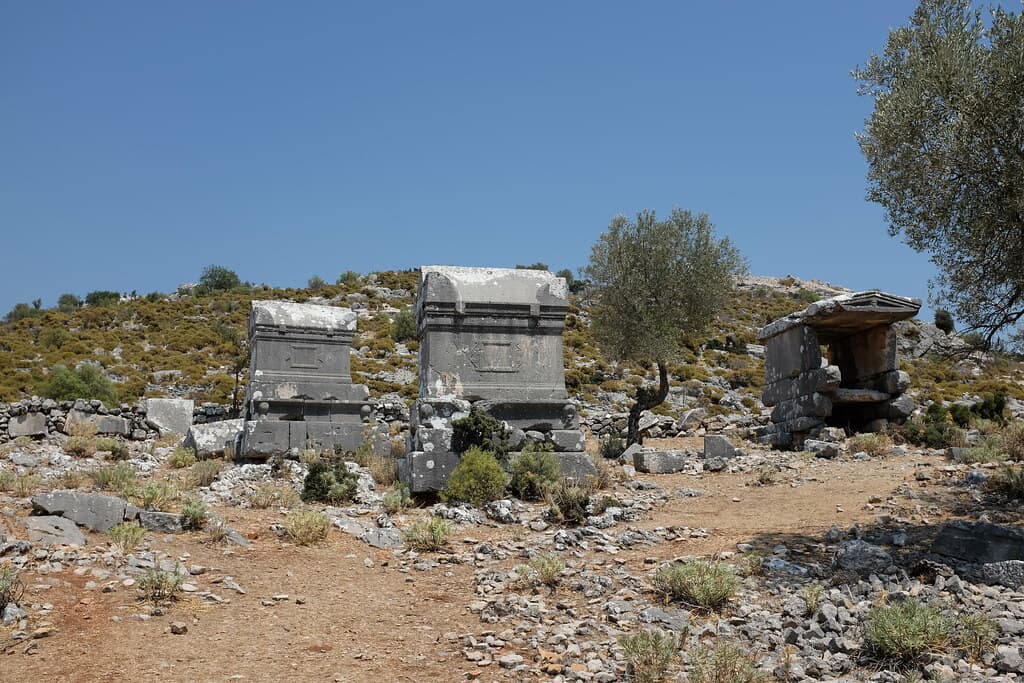
The approach from Minare village follows a two-kilometre road that ends at an entrance gate with a caretaker and a small fee. Beyond the gate, the path begins to climb. The vegetation is Mediterranean maquis — dense, aromatic, low — and through it the remains of the city emerge piecemeal rather than all at once. The theatre appears to the right, its seating hewn partly from the hillside, its stage building partly collapsed.
It is well-proportioned and sits within its landscape rather than against it.
The Royal Tomb, one of the most fully worked examples of Lycian funerary art at the site, displays carved relief panels that include scenes of city life — walls, gates, figures in procession. It gives a sense of what a living Lycian city looked like from outside its walls: a bounded, purposeful place. The tomb commemorates that life by depicting it.
This is a specific kind of funerary statement: not merely marking death but insisting on the value of what was left behind.
To see the honeycomb cliff tombs fully, you need to find a position in the valley that allows you to look back up at the upper acropolis rock. The cylindrical mass of the rock dominates the skyline, and on its faces and on the surrounding cliff walls, the rectangular openings of the tombs are visible in rows and clusters. There is no prepared viewing point; you find your own.
The light in the late afternoon is best for reading the cliff face — the shadows deepen the openings and the stone takes on warmth.
The site rewards those who move through it without an itinerary, following the terrain rather than a map. Most visitors spend two hours; the site can absorb three or four without repetition.
Begin at the theatre and Royal Tomb near the entrance, then climb toward the agora and upper city. Allow time to find a valley vantage for the honeycomb cliff face. Sturdy shoes with ankle support are essential — the path involves loose stone and uneven ground. No facilities on site; bring water.
Context and lineage
Pinara was established in the 5th century BC by settlers from Xanthos — the dominant Lycian city of the Xanthos valley — who moved south onto the flanks of Mount Babadağ. The city's name is believed to derive from a Lycian word for 'round hill', which describes the massive cylindrical rock forming the upper acropolis.
In the Lycian League, Pinara held three votes in the federal assembly, placing it among the most significant cities of the federation alongside Xanthos, Patara, Myra, Tlos, and Olympos.
The city surrendered to Alexander the Great in 334 BC without resistance. Hellenistic and then Roman rulers added new buildings — the odeon, additional temple phases — but the Lycian identity of the city, expressed most powerfully in its funerary landscape, persisted through all of these phases. By the Byzantine period, the city had declined significantly; a small Christian community may have persisted for some time, but the city was eventually abandoned.
Charles Fellows, the British antiquarian, rediscovered Pinara in 1839 and brought its tombs and inscriptions to wider scholarly attention.
Lycian (founded 5th century BC from Xanthos colonists) → Hellenistic development → Roman period → Byzantine decline → abandonment → rediscovery (1839) → modern archaeological survey and limited excavation
Traditions and practice
The rock-cut tombs were the primary site of ongoing religious life at Pinara. They were not merely burial places but points of contact between the living and the ancestral dead. Lycian practice involved maintaining the tombs, making periodic offerings, and ensuring that the dead were positioned correctly for the upward passage that Lycian cosmology described.
The height of the honeycomb tombs in the cliff face — many accessible only by rope or unreachable entirely — may have been intended precisely to mirror the upward motion of the soul after death.
The Temple of Aphrodite served a different function: the living community's relationship with beauty, fertility, and generative power. Though no detailed record of Pinara's Aphrodite cult practices has survived, the standard repertoire of Greek temple ritual would have applied: animal sacrifice, votive dedications, festival celebrations.
No active religious ceremonies take place at Pinara. The site receives a small number of visitors annually — mostly travellers who have deliberately sought it out rather than passing through — and functions as an archaeological heritage site under Turkish state protection.
Move through the site without a fixed sequence. Begin with the theatre and Royal Tomb to establish scale and artistic register. Then walk into the upper city, where the agora and lesser-known tomb clusters are. Allow yourself to get somewhat lost — the site is large enough that unplanned directions lead to unexpected encounters with tomb facades and architectural fragments.
When you have a sense of the ground-level remains, find a position in the valley where you can see the upper acropolis and its surrounding cliff face from below. Sit. The full effect of the honeycomb tombs requires stillness and time: the pattern of openings in the rock takes a few minutes to resolve from visual noise into meaning. Count what you can see. The density accumulates into something that is not merely archaeological observation.
If visiting in April or May, the wildflowers in the maquis below the cliff are part of the experience — a living seasonal fullness against the permanence of the cut stone above.
Lycian Religion / Aphrodite Cult
HistoricalPinara was considered sacred to Aphrodite, and a temple dedicated to her stood within the city. The city's funerary landscape and the Aphrodite cult together reflect a Lycian worldview that held beauty and death in close proximity.
Temple rites to Aphrodite; ancestor veneration through the elaborate rock-cut tomb programme; funerary offerings.
Lycian Funerary Culture
HistoricalPinara's hundreds of cliff-face tombs constitute one of the densest and most ambitious programmes of rock-cut funerary architecture in the ancient world. The placement of tombs at inaccessible heights reflected the belief that winged beings would carry the dead upward after death.
Periodic maintenance and offering at tomb sites; Lycian funerary inscriptions specifying who was permitted to be buried in each tomb and the penalties for violation.
Archaeological / Scholarly
ActiveSite surveys and limited excavations have confirmed the city plan and key monuments. The site remains one of the least-excavated major cities of Lycia.
Archaeological survey; documentation of tomb inscriptions and reliefs; limited excavation seasons.
Perspectives and open questions
Pinara is understood primarily through the lens of Lycian funerary culture, with the temple of Aphrodite adding a counterpoint of divine beauty to the city's overwhelming funerary character.
Scholarly perspective
Pinara was one of the six principal cities of the Lycian League, holding three votes in the federal assembly proportional to its size. Its most remarkable feature — the hundreds of tombs cut into the vertical faces of the upper acropolis rock and surrounding cliffs in honeycomb patterns — represents one of the most ambitious programmes of rock-cut funerary architecture in the ancient world. The scholarly consensus holds that Lycian tomb placement at height was intentional and cosmologically motivated.
The site remains largely unexcavated, meaning most of the city plan and its stratigraphic history are unknown.
Living and traditional perspectives
Lycian funerary belief, as reconstructed from tomb inscriptions, reliefs, and comparative study of related Anatolian traditions, held that the dead were carried upward by winged beings — possibly related to the winged figures depicted on many Lycian tomb facades. Tomb placement at great height, on cliff faces that required the ability to fly to reach, expressed this belief architecturally.
At Pinara, where hundreds of tombs occupy positions ranging from easily accessible to entirely unreachable, this belief was given its most concentrated physical form anywhere in Lycia.
Alternative interpretations
Some visitors interpret the honeycomb pattern of the cliff tombs as a form of deliberate visual composition — a sacred geometry of apertures intended to be read from below. No scholarly evidence supports this as a Lycian intentional design; the pattern is more likely a function of quarrying logic and the desire to maximise the number of tombs in a given cliff face. The interpretive impulse is understandable but should be held loosely.
Open questions
The majority of the city plan remains unexcavated. The precise dating of the honeycomb cliff tombs — their construction sequence, the workforce that produced them, the period of their primary use — is not established. The location of the Temple of Aphrodite has not been confirmed archaeologically. The relationship between Pinara and Xanthos in the Lycian period — whether colonial subordination or political partnership — is incompletely understood.
Plan your visit
Access and arrival
Near Minare village, Seydikemer district, Muğla Province. Approximately 45 km from Fethiye via the D400 highway and then local roads toward Minare. A 2 km stabilised road leads from Minare to the site entrance. No public transport serves the site — private car or taxi is required. Entrance fee payable at the gate. Turkey Museum Pass may be accepted.
No accommodation in Minare village. Fethiye (45 km) has a wide range of options from budget guesthouses to boutique hotels and is the practical base for day trips to Pinara. Ölüdeniz and Hisarönü (30 km) offer a range of mid-range and resort accommodation.
Respectful visit
Sturdy walking shoes with ankle support are essential due to rough terrain. No dress code requirements beyond practical comfort.
Permitted throughout the site. The honeycomb cliff face photographs best in late afternoon light when the shadows deepen the tomb openings. Avoid using flash near carved relief surfaces.
No offerings expected or practiced.
Do not climb on tomb facades or carved relief surfaces — the stone is fragile and the carvings are irreplaceable. The site is a protected archaeological zone; no removal of any material.
The terrain is rough and some areas near the cliff base are unstable. Do not attempt to climb tomb facades — the stone is friable and the heritage is irreplaceable. The site receives minimal maintenance; the path markings are basic. Visit with a fully charged phone for navigation.
Location
Map loads as you approach this section.
Pilgrim reflections
A portrait of encounter, not a score
Pilgrims describe what they felt, how present they could become, and whether the place would shape a journey. There are no stars and no ranking of traditions.
No reviewed reflections yet
The first pilgrims can help describe the character of being here.
Share a reflection
Available after an account-backed “Been there.” Every reflection is reviewed before publication.
Nearby sacred places
Explore other sacred places in the region. Proximity does not establish access or travel time; check each place’s guidance.


References
Sources consulted for this page. Source categories describe the publication, not a guarantee that every claim is verified. Traditional accounts and outside interpretations may differ.
- 01Pinara: A Lycian City and Roman Settlement in Turkey — Ancient History SitesacademicDetailed archaeological overview
- 02Pinara - Wikipedia — Wikipedia contributorsencyclopediaSolid overview with academic citations
- 03Pınara Ancient City: The Mysterious Treasure of Lycia — Fethiye TimesguideRegional journalism with good descriptive content
- 04Pinara: A Virtually Unexplored Ancient Lycian City — Nomadic NikoguideFirst-hand visitor account with practical information
- 05GPS coordinates of Pinara, Turkey — latitude.toSource contextCoordinate source: 36.4893N, 29.2584E
- 06Pinara: Explore an Ancient Lycian Settlement Near Fethiye — Arkadaslik YachtingguideGood overview of key monuments
- 07Pinara Ancient City — TourTurkaguideVisitor information including access details
Share a photo
Help visitors recognize Pinara. Every submission is reviewed before publication.