Sidyma
A Lycian necropolis without fences, where 100 tomb monuments grow among olive groves and farmhouses
Understand sacred places, explore living traditions, and learn how to engage respectfully with Pilgrim Map.
Access has not been verified. Check current local guidance before planning a visit.
Muğla, Turkey
Read the sources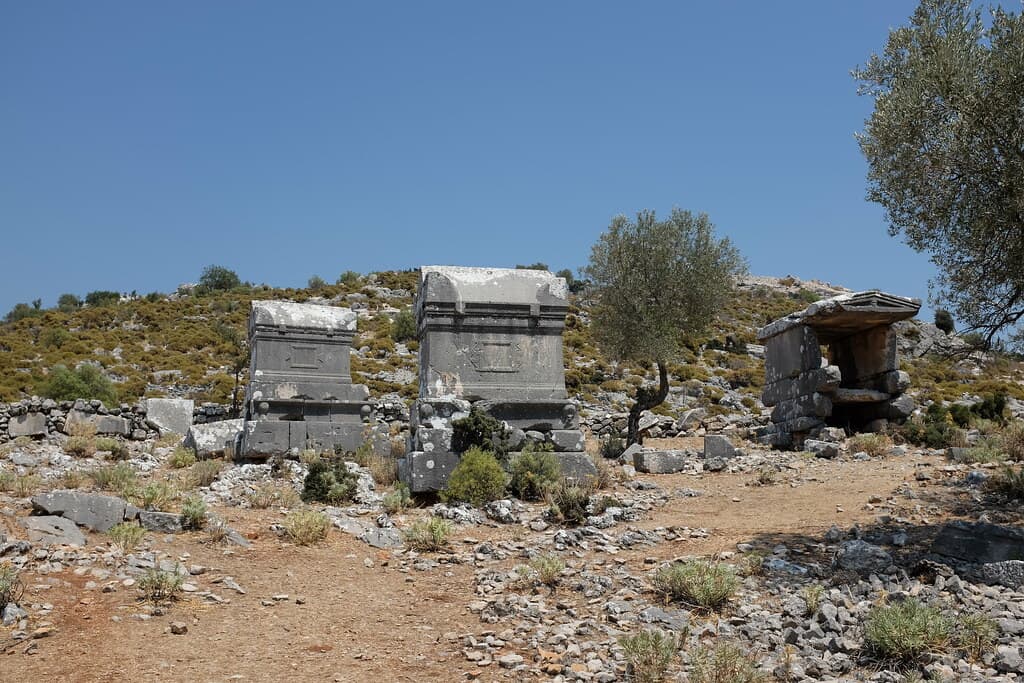
Image of Sidyma. Image source
Visit essentials
A quick read before you go
- Duration
- 2–3 hours for thorough exploration of the necropolis and plateau monuments.
- Access
- Dodurga village, Seydikemer district, Muğla province.
Overview
Sidyma has no fence, ticket booth, or managed distance from the present. The Lycian city shares its plateau in the Muğla hills with today's village of Dodurga: sarcophagi stand in olive groves, house tombs lean against terrace walls, and the tall-walled Sebasteion imperial-cult temple rises among village buildings without separating its ashlar masonry from household life.
Never formally excavated, the site remains raw, uninterpreted, and uncommercial—an institutional gap that is also an experiential gift. Its extensive necropolis, civic center with theatre, agora, and Sebasteion, and hilltop acropolis survive together. More than 100 tomb structures encode sacred genealogies in Lycian script, trace funerary form from fifth-century BCE pillar tombs to Roman-period sarcophagi, and form one of southwestern Turkey's densest ancestral-monument assemblages.
The Lycian Way passes directly through the village, making Sidyma an increasingly known and atmospheric waypoint for the walking-pilgrimage community.
Why this place is sacred
Lycian funerary religion held that the dead required elevated, visible burial positions to facilitate their passage to the afterlife, carried by winged supernatural creatures. This theology produced, across all Lycian cities, necropolises of tombs placed on cliff faces, hilltops, and visible plateaus — the honored dead always in sight, always watching over the living city. At Sidyma, the particular quality of this sacred arrangement is that it has never been institutionally resolved.
No excavation has reorganized the tombs into a managed heritage landscape. No fence separates the sarcophagi from the farmland. The winged-creature theology that put the tombs in visible positions is still, in a concrete spatial sense, functioning — the tombs are visible from the houses, the houses are built against the tomb walls, and the daily life of Dodurga unfolds in the same space as the sacred genealogical record of the Lycian elite.
The 5th-century BCE pillar tombs — the oldest type — are the most formally sacred: their elevated platforms, carved facades, and inscribed chambers were designed to house the honored dead in a form approximating divine residence. The later house tombs imitating wooden domestic architecture express a different theology: the dead inhabit a version of the home they occupied in life, preserved in stone.
Both types appear at Sidyma, often within meters of each other, creating an implicit conversation between different Lycian understandings of what the dead require.
Major Lycian city and necropolis center; member of the Lycian League from 169 BCE; attested in the Delian League by 425 BCE, suggesting earlier political organization.
From Lycian religious and political center through Roman integration (Sebasteion built for Imperial cult) and Byzantine period (structures evident but poorly documented) to partial abandonment and eventual reoccupation as the Turkish village of Dodurga. The site's continued habitation has both threatened the monuments through domestic construction and paradoxically preserved the non-institutional character of the landscape.
Experience and orientation
Arrive in Dodurga without expectations about a managed site and the experience becomes coherent quickly. The first tomb monuments appear at the village edge — sarcophagi on podia, sometimes three or four visible simultaneously from a single position, their carved surfaces weathered but legible. Walk toward the Sebasteion, whose tall ashlar walls are unmissable against the village skyline.
Approach it as a building that happens to be among houses rather than as an exhibit — which is exactly what it is.
The necropolis area fans out across the plateau and into the cliff faces above. In spring, the tomb zone among the olive groves has a quality that photographs can suggest but cannot fully convey: angled morning light on carved limestone, the silence of the olive grove, the occasional sound of the village, and the cumulative weight of 100 funerary monuments each encoding a specific person or family's claim to sacred permanence.
The Lycian Way enters Dodurga from the south and exits to the north, connecting Sidyma to the wider network of Lycian sacred sites accessible on foot. Hikers often stay in the village pensions and explore the ruins on a rest day from the trail — an integration of pilgrimage movement and archaeological contemplation that would not have been unfamiliar to ancient Lycian travelers moving between league cities.
Sidyma is accessed via Dodurga village in the Seydikemer district of Muğla province. There is no entrance fee, no ticket booth, and no on-site interpretation. The ruins are distributed through active farmland and village streets. The acropolis is accessible via a rough path from the upper village. A full exploration of the plateau and necropolis area takes 2–3 hours.
Context and lineage
The city's earliest recorded history places it within the Delian League tribute system by 425 BCE — a political alignment with Athens that predates Lycian League formation. By 169 BCE, Sidyma was one of the 23 founding cities of the Lycian League, that unusually democratic federation whose model of weighted voting and collective governance later influenced Roman provincial administration and, through it, modern political thought.
The tomb monuments that constitute Sidyma's most impressive physical legacy were built over a span of roughly seven centuries, from the 5th-century BCE pillar tombs of the earliest Lycian elite to the Roman-period sarcophagi of the Imperial era.
Each generation of the city's leading families invested in funerary architecture as the primary form of sacred expression — the wealth of an elite Lycian family was most publicly declared in the quality and visibility of its tomb, not in the size of its domestic residence.
Iron Age origins → Delian League membership (425 BCE) → Lycian League founding member (169 BCE) → Roman integration, Sebasteion construction → Byzantine period structures → partial abandonment → reoccupied as village of Dodurga → on Lycian Way hiking trail (established 1999)
Unnamed Lycian elite families
Commissioners of the elaborate inscribed tomb monuments — their names survive in Lycian-language inscriptions encoding the sacred genealogies of Sidyma's founding and prominent families
Opramoas of Rhodiapolis
Famous Lycian benefactor of the 2nd century CE whose inscriptions across the league cities are among the longest surviving Greek texts from Lycia; regional connections to the Sidyma area
Traditions and practice
Lycian funerary rites at the time of interment; periodic commemorative visits to tomb facades; recitation of inscribed Lycian genealogies maintaining the sacred bond between the living and the honored dead. The Sebasteion hosted Imperial cult ceremonies — sacrifices, games, and public celebrations honoring the Roman emperor as divine — which were simultaneously religious obligations and political expressions of loyalty.
No formal religious practices. The Lycian Way hiking community passes through regularly. Local village life coexists with the ruins as it has for centuries.
Walk the necropolis zone in the morning, when the light comes in low from the east and the tomb facades are most legible. Begin with the pillar tombs — the oldest type, their elevated platforms now at varying degrees of intact — and work forward in time through the house tombs to the Roman sarcophagi.
Notice how the funerary vocabulary changes: the earliest tombs assert divine proximity through elevation and formal architectural pretension; the later house tombs settle into a different claim, that the dead continue domestic existence in recognizable form.
Approach the Sebasteion in the same spirit as you would a village building that happens to be 2,000 years old — which is precisely what it is. Walk around it completely. Note the scale: the near-perfect rectangle of tall ashlar walls was designed to enclose sacred space visibly, to say that something important happened here. What happened here was the civic performance of loyalty to an empire through the transformation of its emperor into a divine being.
If you are staying in the village overnight as a Lycian Way hiker, return to the necropolis at dusk. The quality of the light on carved limestone at sunset, without other visitors, without electronic ambient noise, with only the village sounds below, is the experience that makes Sidyma distinctive among all Lycian sites.
Lycian Funerary and Ancestor Cult
HistoricalSidyma's most striking feature is its necropolis of approximately 100 tomb structures, ranging from 5th-century BCE pillar and house tombs to Roman sarcophagi. The Lycian belief that the dead were transported to the afterlife by winged creatures led to the placement of tombs in elevated and visually prominent positions, constituting a sacred landscape of ancestral honor.
Funerary rites; commemoration of elite dead; inscribed genealogical records in Lycian language
Roman Imperial Cult (Sebasteion)
HistoricalThe Sebasteion, a temple to the Imperial Cult with tall ashlar walls forming a near-perfect rectangle, is one of the most substantial buildings still standing on the plateau. It represents Sidyma's integration into Roman political-religious structures during the early Imperial period.
Sacrificial rites, games, and ceremonies honoring the Roman emperor as divine
Lycian League Civic Religion
HistoricalSidyma was one of the 23 founding cities of the Lycian League in 169 BCE and was previously attested in the Delian League in 425 BCE. Civic temples and public monuments expressed a shared Lycian religious and political identity.
Civic assemblies, temple dedications, communal religious festivals; participation in League-wide ceremonies at the federal sanctuary of Letoon
Archaeological and Heritage
ActiveSidyma has never been formally excavated, making it rare among significant Lycian cities. The site's integration into the living village of Dodurga creates an unusually authentic encounter with the ancient landscape.
Informal heritage visits; Lycian Way trekking through the site; specialist epigraphic and surface-survey research
Perspectives and open questions
Sidyma's scholarly situation is unusual: it is a significant Lycian city whose surface monuments are well-documented through epigraphy and survey, but whose subsurface archaeology — which would answer most of the important questions about its religious and political life — has never been investigated.
Scholarly perspective
Sidyma is known primarily through surface survey and the Lycian epigraphy of its tomb inscriptions, which have been studied since the 19th-century European expeditions to Lycia. The site's membership in both the Delian League (425 BCE) and the Lycian League (169 BCE) is documented. The absence of excavation means that the site's occupation phases, the full complement of its sacred buildings, and the chronology of its tomb monuments cannot be definitively established.
Specialist Lycian monument scholarship has catalogued the visible structures, but the site lacks the stratigraphic depth of excavated Lycian cities.
Living and traditional perspectives
Lycian funerary tradition held that the elevated placement of tomb monuments was essential for the soul's departure, and that the genealogical inscriptions maintained the ongoing sacred presence of the dead within the living community. At Sidyma, the unusually direct integration of this sacred landscape with contemporary village life means the traditional theology of ancestral presence has a concrete, observable expression.
Alternative interpretations
Sidyma is cited among those interested in sacred landscape as an example of a place where the ancestral sacred persists through landscape continuity rather than institutional religion. The unexcavated state, the village integration, and the density of named ancestral monuments create conditions for what some describe as direct contact with the memorial consciousness of a specific ancient community.
Open questions
Because the site has never been excavated, almost everything about its subsurface archaeology is unknown: the full extent of its sacred buildings, the dating and iconographic programs of most tomb monuments, the character of any pre-Hellenistic religious structures, and the nature of Byzantine-period occupation all remain undocumented.
Plan your visit
Access and arrival
Dodurga village, Seydikemer district, Muğla province. Accessible by car via minor roads from Seydikemer (c. 25 km) or Fethiye (c. 35 km) — a GPS or offline map is useful as road signage is limited. On the Lycian Way trail, approximately 9 km on foot from Gey. Free access with no ticket booth. No facilities whatsoever — bring water, food, and any supplies needed. Mobile phone signal can be unreliable in the village; check coverage before arrival.
No dedicated contact or keyholder arrangement exists — the site is freely accessible farmland and village streets.
Village pensions in Dodurga are available for Lycian Way hikers and occasional heritage visitors; advance booking is advisable as capacity is limited. Fethiye (c. 35 km) provides the full range of accommodation options for those making a day trip.
Respectful visit
Comfortable walking shoes for uneven agricultural terrain. No dress code applies.
Permitted throughout the ancient monument zone. Do not photograph village residents without permission. Be aware that your presence in what are essentially people's gardens and farmland requires a different posture than in a ticket-controlled archaeological site.
None.
Do not disturb tomb structures or attempt to enter tomb chambers. Do not remove any artifact or stone fragment. Respect cultivated fields, orchards, and all private property adjacent to or surrounding ancient monuments. The site has no staff; all responsibility rests with visitors.
The ruins are distributed through active farmland and private property. Respect the boundaries of cultivated fields and orchards, the privacy of village residents, and the structural integrity of tomb monuments that have no institutional protection. Do not climb on or enter tomb chambers. No facilities of any kind are available on-site.
Location
Map loads as you approach this section.
Pilgrim reflections
A portrait of encounter, not a score
Pilgrims describe what they felt, how present they could become, and whether the place would shape a journey. There are no stars and no ranking of traditions.
No reviewed reflections yet
The first pilgrims can help describe the character of being here.
Share a reflection
Available after an account-backed “Been there.” Every reflection is reviewed before publication.
Nearby sacred places
Explore other sacred places in the region. Proximity does not establish access or travel time; check each place’s guidance.


References
Sources consulted for this page. Source categories describe the publication, not a guarantee that every claim is verified. Traditional accounts and outside interpretations may differ.
- 01Ancient Lycian City of Sidyma — Lycian MonumentsacademicSpecialist Lycian archaeology site with detailed monument descriptions
- 02Sidyma Antik Kenti — Kültür Portalı — Turkish Ministry of Culture and TourismofficialOfficial Turkish cultural authority listing
- 03Sidyma — Wikipedia — Wikipedia contributorsencyclopediaGeneral overview; limited detail due to lack of excavation
- 04Sidyma Antique City: Explore an Unexcavated Lycian Site Near Fethiye — Arkadaslik YachtingguideDetailed site description and visitor observations
- 05Sidyma Ancient City — Visit My Turkey — Visit My TurkeyguideVisitor overview and practical tips
- 06Settled life in ancient city draws attention — Hürriyet Daily NewsSource contextCoverage of living village integrated with ancient ruins
- 07Sidyma Ancient City | Villa Plus Turkey — Villa Plus TurkeyguideHistorical summary and visitor tips
Share a photo
Help visitors recognize Sidyma. Every submission is reviewed before publication.