Necropolis of Xanthos
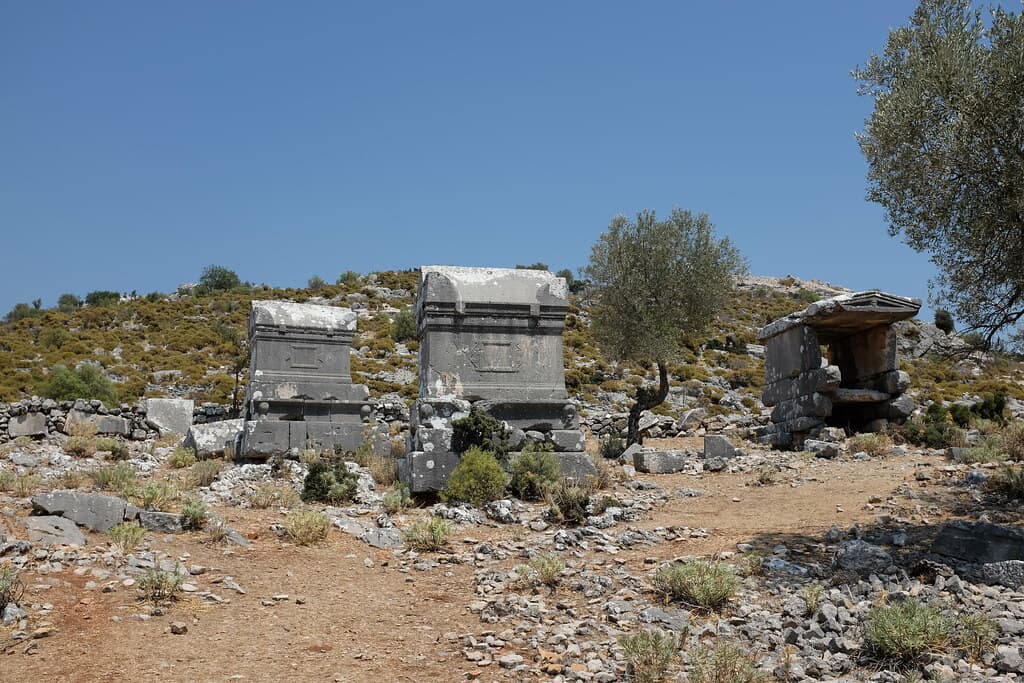
The pillar tombs of Lycia's capital: where the honored dead rose toward the sky above the Eşen River valley
Understand sacred places, explore living traditions, and learn how to engage respectfully with Pilgrim Map.
Access has not been verified. Check current local guidance before planning a visit.
Antalya, Turkey
Read the sources
Visit essentials
A quick read before you go
- Duration
- 2–3 hours for Xanthos alone; 3–4 hours for a combined visit with Letoon (5 km south).
- Access
- Located near modern Kınık, Antalya Province, 63 km southeast of Fethiye on the D400 coastal…
Overview
Xanthos's pillar tombs—stone plinths carrying burial chambers or sarcophagi high above ground—are unique in the ancient world; no other culture built them. By elevating honored ancestors between mortal earth and the divine realm above, the Lycians expressed a distinct theology of the afterlife at their greatest city.
Xanthos occupies a defensible hill above the Eşen River, the ancient Xanthos River, framed by the Taurus Mountains. Twice its citizens chose mass self-destruction rather than surrender: before Harpagus's Persian army in the 6th century BCE and Brutus's Roman forces in 42 BCE. The men fought to death while women, children, and possessions were burned. These collective sacrifices gave Xanthos a mythic quality extraordinary to the Greek and Roman world, still carried in the site's silence.
The necropolis did not permanently separate Lycian dead from the living. Visible across the valley, its tombs bear Lycian and Greek inscriptions and reliefs of sirens and mythological figures, remaining in conversation with the city below. Sirens served as psychopomps carrying souls between worlds; the pillar was the bridge.
Why this place is sacred
Lycian funerary theology began from a different premise than Greek or Roman practice. The earth was not the proper destination for the honored dead — that would be too final, too enclosed. The sky, or the threshold between earth and sky, was where the ancestors properly belonged: elevated, visible, present in the landscape of the living rather than absent beneath it.
The pillar tomb is the material expression of this theology. A solid stone plinth of hewn blocks, rising from two to eleven meters, supports a burial chamber or sarcophagus at its summit. The dead are literally overhead. Their position in the necropolis — on a hilltop, in sight of the valley, the river, and the Taurus range — made them participants in the ongoing life of the city.
Inscriptions named them, recorded their civic offices, and threatened legal penalties against those who violated the tombs. The dead had rights. They were not gone.
The sirens carved on the tomb reliefs complete the theology. In Lycian tradition, these winged female figures were not the dangerous creatures of the Odyssey. They were carriers — beings who moved between the mortal and divine realms, transporting the souls of the dead upward. The tomb reliefs depicted this transit. To pass the tomb was to see, in stone, the moment of transformation that awaited every human life.
The nearby sanctuary of Leto at Letoon (4 km south) anchored the living city's relationship with the divine. Xanthos was the political capital; Letoon was the religious heart. The two sites together — city of the living and cult of the divine — framed the necropolis between them: the honored dead at the threshold, occupying the space that separated, and connected, human and sacred worlds.
The city's two episodes of collective self-destruction add a layer of sacred intensity that no architectural theology alone can produce. Xanthos chose annihilation over submission twice, and survived twice — repopulated by neighboring communities. The site holds the memory of those decisions in its stones.
Elite funerary monument and civic/religious statement expressing Lycian belief in the elevated dead as threshold beings between mortal and divine realms.
The Xanthos necropolis was in active use from at least the 6th century BCE through the Roman period, with tomb types evolving from early pillar tombs through classical period sarcophagi and Hellenistic-period house tombs. After Romanization, traditional Lycian funerary practice faded, though the site retained civic significance. Modern recognition came through Charles Fellows's 1838 rediscovery, French excavation beginning in the 1950s, and UNESCO inscription in 1988.
Experience and orientation
The approach to Xanthos from modern Kınık is unremarkable — a road through flat agricultural land — until the hill announces itself and the ruins begin to appear along its sides. The site entrance is at the base of the theater, which occupies a natural slope and originally faced away from the valley.
Climbing through the theater and into the upper city, the density of the ruins becomes clear: agora, stoa foundations, Roman-period forum, the remains of a Byzantine church, and between all of these, rising from the ground and from purpose-built bases, the pillar tombs.
The most prominent group stands between the agora and theater. The Lycian pillar tomb — a stone-block plinth roughly three meters high, topped by a 3.6-meter sarcophagus with carved lid and relief decoration — is not dramatic in size but extraordinary in presence. Its placement in the civic center, among the colonnades and political buildings, makes explicit what the Lycians believed: that the honored dead belonged in the city's public life, not excluded from it.
Walk to the edge of the hilltop and look down at the Eşen River valley, the poplar trees along the water, the Taurus Mountains in every direction. This is the view the pillar tombs commanded. This is what the Lycians ensured their honored dead would overlook for eternity. The scale of that gesture — an architecture of permanence in a landscape of seasonal change — is felt most clearly from here.
The site is largely unshaded. Summer heat is severe and the absence of shade makes midday visits uncomfortable and potentially dangerous. Spring and autumn mornings offer the site at its most contemplative, before tour groups from the coast arrive mid-morning.
The site is roughly linear from the theater entrance upward to the acropolis and eastward along the hilltop. Plan for at least two hours for the necropolis and main civic area; the full site including the acropolis walls, Byzantine church, and all visible tomb groups rewards three hours. A combined visit with Letoon (5 km south, shared entrance ticket) is strongly recommended.
Context and lineage
Xanthos's earliest name, Arna, points to a pre-Greek Anatolian foundation. By the 6th century BCE it had emerged as the dominant city in Lycia — the capital of a loose confederation of city-states that would eventually formalize as the Lycian League.
The city's relationship with its own mythology was characteristically Lycian: the region was said to have sheltered Leto when she was pregnant with Apollo and Artemis, and the Letoon sanctuary (4 km south) perpetuated this origin story in its three temples to the divine family. The Xanthos River — 'the blonde one,' a name connected to Apollo's golden light — flows below the city. The name and the god converge in the city's geography.
The first of the city's celebrated self-destructions came in 546 BCE when the Persian general Harpagus arrived with an army. According to Herodotus, the Xanthians collected their women, children, slaves, and property inside the citadel, set it afire, and then the men went out and died fighting. The Persians took a nearly empty city. The second self-destruction came in 42 BCE when Brutus's Roman forces besieged the city after the assassination of Julius Caesar. Again, mass suicide and collective burning.
Again, a Roman general faced with a city that had refused conquest by disappearing into its own flames.
These events gave Xanthos a quality of sacred defiance that ancient writers found extraordinary and modern visitors still feel in the quality of the hilltop silence.
Xanthos stands in the Lycian cultural tradition — an indigenous Anatolian civilization that maintained a distinct language, funerary practice, and religious system while absorbing Greek and Persian influences. The Lycian League's system of representative government was later cited by the American Founding Fathers as a historical precedent for federalism. After Roman absorption in 43 BCE, Xanthos continued as a provincial city through the Byzantine period, when a church was built within the ancient civic area.
Harpagus
Persian general who besieged Xanthos c. 546 BCE; his arrival precipitated the city's first mass self-destruction
Brutus
Roman general whose 42 BCE siege provoked the city's second collective self-destruction; noted the event as extraordinary in his own account
Strabo
Ancient Greek geographer who described Xanthos as the largest city in Lycia and recorded its history
Charles Fellows
British archaeologist who rediscovered Xanthos in 1838 and removed major sculptures — including portions of the Nereid Monument and the Harpy Tomb — to the British Museum, where they remain
Traditions and practice
Lycian funerary practice at Xanthos involved the construction and formal consecration of the tomb, the placement of the dead in the chamber or sarcophagus, and ongoing commemorative observances at the heroon — a hero shrine built over or beside an especially significant tomb. Inscriptions on many Xanthos tombs record legal penalties against those who violated the burial chambers, suggesting ongoing social obligation to protect the dead.
Festival worship at the Letoon sanctuary 4 km south was the religious counterpart to the funerary practices of the necropolis: the living city's relationship with Leto, Apollo, and Artemis maintained the divine connection that gave the elevated tombs their meaning.
No active religious ceremonies take place at Xanthos. The Lycian Way, one of Turkey's great long-distance trekking routes, passes near the site, bringing a modern form of purposeful journey to the ancient landscape. French archaeological teams have excavated the site since the 1950s; ongoing research continues to refine the chronology and typology of the necropolis.
Walk directly to the pillar tombs between the agora and theater before moving to any other part of the site. Stand at the base of the Lycian pillar tomb and put your hand against the stone plinth — not to touch the relief carvings, but to feel the scale of the stone blocks and the weight of what they were asked to hold for 2,500 years. Look up at the sarcophagus resting on the plinth's summit.
Then look across the valley. The sarcophagus and the mountains occupy the same horizontal frame. This is intentional. This is the theology.
From the agora's edge, trace the relationship between the civic buildings and the tombs. In Lycian urbanism, the honored dead were not moved to the margins — they stood in the city's public space. Walk slowly through the agora with this in mind: the people who gathered here to conduct public business did so in the company of their most significant ancestors. The dead were a civic presence.
If you have time after the main site, cross the valley to Letoon. The 4-km distance between the city of the living and the sanctuary of the divine is the same gap that the pillar tombs were built to bridge. Standing at the Letoon temples and looking back toward the Xanthos hill, you understand the sacred landscape as the Lycians organized it: polis, necropolis, sanctuary, each in its proper place.
Lycian Funerary Religion
HistoricalThe necropolis of Xanthos is the apex of Lycian funerary theology expressed in architecture. The pillar tombs, sarcophagi, and rock-cut house tombs represent five centuries of investment in a specific belief about the afterlife — that the honored dead belonged between earth and sky, present in the city's public landscape.
Construction of monumental pillar tombs and rock-cut house tombs; sarcophagi elevated on stone pillars; funerary reliefs depicting sirens and mythological figures; annual commemorative ceremonies at heroa; formal legal inscriptions protecting tomb chambers
Hellenic / Syncretic Religion
HistoricalXanthos served as the political capital of the Lycian League and maintained formal cultic ties to the Letoon sanctuary. A Roman-period sacred enclosure linked to an inscription of the twelve Lycian gods reflects the city's ongoing effort to maintain its religious distinctiveness within an increasingly Hellenized and then Romanized world.
Temple worship; festival cycles centered on the Letoon sanctuary; dedications to Leto, Apollo, and Artemis; civic participation in pan-Lycian religious events
Archaeological / Heritage
ActiveXanthos-Letoon was inscribed as a UNESCO World Heritage Site in 1988. French archaeological teams have excavated the site continuously since the 1950s. The site is central to the ongoing reconstruction of the Lycian language and civilization.
International archaeological excavation; conservation of the tomb facades and civic structures; UNESCO heritage management; public heritage access and interpretation
Perspectives and open questions
Xanthos accumulates interpretive frameworks. Archaeological study has refined the chronology and identified the political significance. Lycian funerary tradition encoded a specific theology in the pillar tomb's form. And the city's two self-destructions give the site a mythic dimension that neither archaeological nor traditional religious language fully captures.
Scholarly perspective
Xanthos was the political and religious capital of ancient Lycia, demonstrating an exceptional and self-contained blend of Lycian, Greek, and Persian cultural influences. The pillar tombs are unique in the ancient world — no other culture developed comparable monumental funerary architecture. The Lycian language and its inscriptions, particularly those at Xanthos, have been central to reconstructing the linguistic history of the Anatolian branch of the Indo-European family.
UNESCO inscription in 1988 recognized the site's outstanding universal value for funerary art, civic architecture, and epigraphy. French excavations since the 1950s have produced the most comprehensive understanding of Lycian civilization available from any single site.
Living and traditional perspectives
Lycian funerary tradition placed the dead in elevated positions as a theological statement about the afterlife: the honored ancestors occupied the space between mortal and divine realms, neither fully one nor the other, but present in the landscape of the living as enduring civic and spiritual presences. The siren reliefs on the tombs depicted the psychopomps carrying souls upward. The inscriptions that named and protected the occupants assumed an ongoing relationship between the living city and its honored dead.
Xanthos's two collective self-destructions entered Lycian cultural memory as acts of supreme communal honor — a people that chose its own ending rather than accept subjection.
Alternative interpretations
The consistent upward orientation of the pillar tombs — bodies elevated toward the sky, sirens shown in ascending flight — has prompted speculation about solar or celestial significance connected to Apollo worship, whose solar attributes are well established. The Xanthos River's name, meaning 'the blonde one,' has been connected to Apollo's golden quality. Whether the tomb alignments encode specific astronomical intent has not been formally studied.
Open questions
The full extent of the Xanthos necropolis has not been excavated; additional tombs and tomb groups may remain beneath the surface. The specific iconographic programs on many pillar tomb reliefs — what particular mythological scenes mean in relation to the individuals they commemorate — are debated. Many Lycian inscriptions remain only partially interpreted. The relationship between the heroa (hero shrines at significant tombs) and the annual festival calendar at Letoon is not fully understood.
Plan your visit
Access and arrival
Located near modern Kınık, Antalya Province, 63 km southeast of Fethiye on the D400 coastal highway. Regular dolmuş (minibus) connections from Fethiye to Kınık run throughout the day; the site is a short walk or taxi ride from the Kınık minibus stop. Open daily: 08:00–19:00 (April–October), 08:30–17:30 (winter). Entrance fee approximately 129 TL (2025); free with Museum Pass Türkiye. Cash only.
Mobile phone signal is generally available in the Kınık area and at the site entrance; signal may be unreliable deeper in the ruins. No emergency services on site; the nearest hospital is in Fethiye (63 km). For current access and fee information, check the Turkish Ministry of Culture and Tourism website.
Fethiye (63 km) offers the widest range of accommodation. Smaller options are available in Kınık village and along the coast between Fethiye and Kaş. No accommodation at the site itself.
Respectful visit
No religious dress requirements. Sunhat, sunscreen, and substantial water are necessary rather than optional in warm months.
Photography is permitted throughout the site. The pillar tombs photograph most effectively in early morning or late afternoon light, when the angled sun catches the carved relief details.
Not applicable. Xanthos is an archaeological heritage area with no active cultic use.
Do not climb on or touch the tomb structures; the stone reliefs are irreplaceable and UNESCO-protected. Bring water — there is no café or water source on site. Cash only for entry (approximately 129 TL as of 2025); Museum Pass Türkiye accepted. The site is largely unshaded; plan accordingly.
The site is almost entirely unshaded. Bring substantial water. Summer midday temperatures on the exposed hilltop are dangerous. The terrain is uneven. Do not climb on tomb structures, which carry UNESCO protection. Cash only for the entrance fee; the Museum Pass Türkiye is accepted.
Location
Map loads as you approach this section.
Pilgrim reflections
A portrait of encounter, not a score
Pilgrims describe what they felt, how present they could become, and whether the place would shape a journey. There are no stars and no ranking of traditions.
No reviewed reflections yet
The first pilgrims can help describe the character of being here.
Share a reflection
Available after an account-backed “Been there.” Every reflection is reviewed before publication.
Nearby sacred places
Explore other sacred places in the region. Proximity does not establish access or travel time; check each place’s guidance.


References
Sources consulted for this page. Source categories describe the publication, not a guarantee that every claim is verified. Traditional accounts and outside interpretations may differ.
- 01Xanthos-Letoon - UNESCO World Heritage Centre — UNESCOofficialUNESCO World Heritage inscription 1988, official description
- 02Xanthus | Ancient City, Ruins, Lycia | Britannica — Encyclopaedia BritannicaencyclopediaAuthoritative encyclopedia entry
- 03Ancient Lycian City of Xanthos — Lycian MonumentsacademicSpecialist Lycian archaeology resource
- 04Xanthos | Turkish Archaeological News — Turkish Archaeological NewsacademicCurrent archaeological news and excavation updates
- 05Xanthos - Wikipedia — Wikipedia contributorsencyclopediaComprehensive overview of the city and its necropolis
- 06Xanthos: Lycian Polis and Archaeological Site in Turkey — Ancient History SitesacademicArchaeological overview of the site
- 07Xanthos: A Detailed Look at an Ancient Lycian City — Nomadic NikoguideDetailed visitor guide with site description
- 08A Journey to Xanthos: Lycia's Defiant Capital — Arkadaslik YachtingguideGood contextual overview of the site's mythology and history
Share a photo
Help visitors recognize Necropolis of Xanthos. Every submission is reviewed before publication.