Xanthos
Capital of ancient Lycia and a civilization that carved its dead into the sky — twice destroyed rather than surrendered
Understand sacred places, explore living traditions, and learn how to engage respectfully with Pilgrim Map.
Access has not been verified. Check current local guidance before planning a visit.
Antalya, Turkey
Read the sources
Visit essentials
A quick read before you go
- Duration
- 2–3 hours for a thorough exploration of the main site; allow an additional 1.5–2 hours to walk…
- Access
- Located near Kınık village, Antalya Province.
Overview
The Lycians called their city Arñna. They built it on a commanding hill above the Eşen River valley in what is now Antalya Province, and from roughly the 8th century BCE they made it the capital of their civilization — a culture that was Anatolian in its roots, absorbing Greek, Persian, and Roman influences in succession without losing its distinctive character.
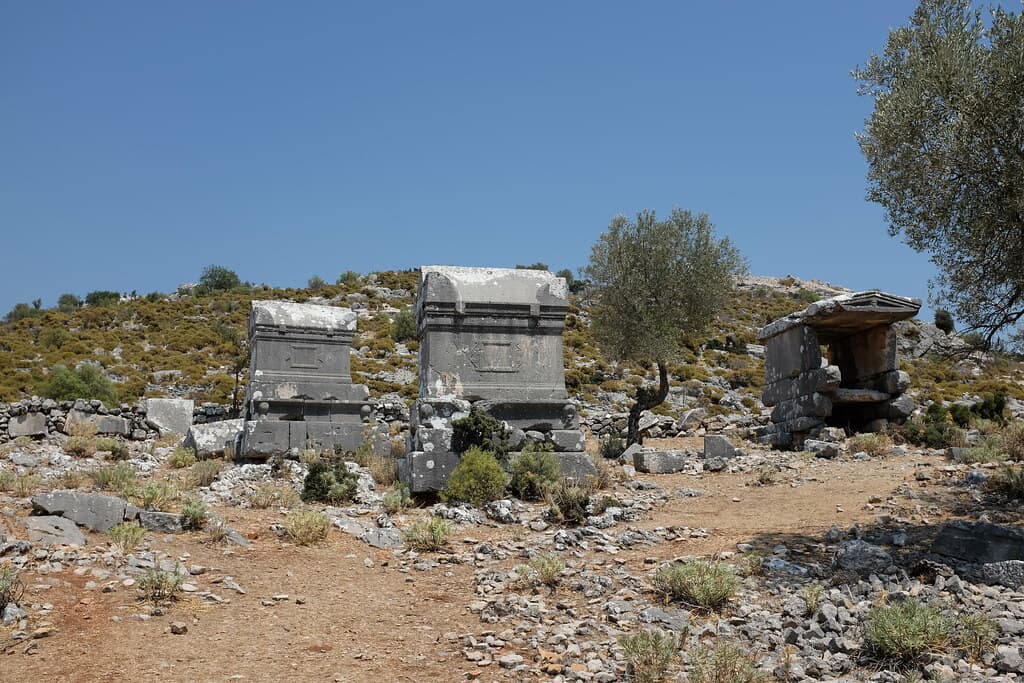
That character expressed itself above all in how the Lycians treated their dead. Where other cultures built tombs underground or in rock faces, the Lycians raised their honored dead on pillars — stone columns topped with funerary chambers, sculpted on all four sides, facing the sky. Seventeen such pillar tombs survive at Xanthos, the finest examples of a funerary architecture found nowhere else with the same sophistication. The Harpy Tomb (c.
480–470 BCE, now in the British Museum) and the Nereid Monument (c. 390 BCE, also in the British Museum) represent the apex of this tradition. What remains in situ are the columns and bases — the sculptures were removed by Charles Fellows in 1838 — but the placement speaks clearly enough.
Xanthos is also defined by what happened here twice. Around 540 BCE, the Median general Harpagus arrived with the Persian army. The Xanthians, facing certain defeat, gathered their women, children, slaves, and possessions inside the city and set fire to it, killing their own people before fighting to the last man against the Persians. In 42 BCE, Brutus's Roman forces besieged the city. The Xanthians again chose self-immolation. Only 150 people survived.
Brutus, moved by grief, reportedly declared the day a day of mourning. These events — recorded by Herodotus and Appian — gave Xanthos a mythological weight in antiquity that it retains today.
The site is bound to the Letoon sanctuary 4 kilometers to the south by a sacred road. Xanthos was the political capital; Letoon was the religious center. The two cannot be understood apart from each other, and the UNESCO World Heritage inscription in 1988 recognized this by inscribing them jointly.
Why this place is sacred
The Lycian obsession with funerary monumentality was not merely decorative. The pillar tomb is a theological statement: the dead are elevated above the plane of the living, visible from a distance, their stories carved facing outward. This is not burial — it is proclamation. The person inside the tomb continues to inhabit the civic space. Their presence is architectural, legible, permanent.
At Xanthos, this theology reached its peak. The Harpy Tomb's sculpted panels showed supernatural figures carrying the souls of the dead to the afterlife — harpies, or more likely sirens, bearing miniature figures in their arms across the threshold of the divine. The Nereid Monument imitated the Erechtheion and other Athenian buildings while remaining irreducibly Lycian in its purpose: not a temple to a god but a monument to a dynast, Arbinas, whose memory was given the architecture of divinity.
The twice-enacted mass suicide deepens this. A culture that was willing to burn its own city and kill its own people rather than be taken alive was a culture for which dignity, memory, and cultural identity were worth more than physical continuity. This is not romanticism — it is a specific and terrifying commitment. The ruins at Xanthos carry this knowledge.
Whatever the pillar tombs originally communicated, they now communicate it in a place that paid the full price of what it believed.
The connection to Letoon, four kilometers south along the sacred road, extends the theological picture: Xanthos was the political body; Letoon was the divine sanction. Power was legitimate only when declared before Leto and her twins at the federal sanctuary. The two sites together form one sacred statement.
Political capital and administrative center of Lycia from at least the 8th century BCE; primary city of the Lycian League and locus of the most elaborate Lycian funerary cult.
Lycian capital (8th century BCE) → Persian conquest (c. 540 BCE, city burned and rebuilt) → Lycian dynastic period (5th–4th centuries BCE, period of greatest funerary monument construction) → Hellenization (Alexander's campaign and aftermath) → Roman period → Byzantine occupation → Abandonment → Rediscovery by Charles Fellows (1838) → Excavation by French School at Athens (since 1950) → UNESCO World Heritage Site (1988) → Active ongoing excavation
Experience and orientation
The road to Xanthos rises from Kınık village through agricultural land before climbing to the archaeological site. The approach on foot from the dolmuş junction (2 km uphill) is worth doing in favorable weather — the elevation and the view of the Eşen River valley below explain why this position was chosen.
Enter through the main gate and orient yourself on the acropolis. The Lycian pillar tombs are scattered across the site rather than concentrated in a single area; they are most visible from a distance, their columns rising from the ground among the surviving walls and foundations. Walk toward the nearest group slowly. The columns are worn; the original sculpted panels that covered their funerary chambers are largely absent, removed in the 19th century.
What remains is the structure of the statement: the dead, raised above the living, permanently present in the city's topography.
The Harpy Tomb base is one of the first visible monuments. Stand beside it and look up. The replicas set in place after the originals were removed to London give a partial sense of the original effect — supernatural figures bearing souls, carved to face in four directions, visible from the city below. The originals are in the British Museum; what is here is the column and the question of what was taken.
The Xanthian Obelisk/Stele stands near the theater: a pillar bearing the longest known Lycian inscription, recording the deeds of a dynast in Lycian, Milyan, and Greek. It is partly damaged, but the ambition of the record is still legible — a civilization that wanted its words on stone, in multiple languages, where they would last.
The theater, agora, and Byzantine basilica fill the lower portions of the site. The theater is well-preserved — Hellenistic in origin, Roman in its current form. This is where the civic and religious life of the city's later periods was conducted, layered over the Lycian foundations below.
Leave time for the walk south to Letoon. The 4-kilometer track between the two sites (now also part of the Lycian Way) traces the ancient sacred road. Arriving at Letoon on foot from Xanthos, or departing from Letoon back to Xanthos, is the closest available approximation of how this pairing was originally experienced.
Approach via Kınık and the uphill route to the exposed acropolis; carry water and sun protection. The climb and Eşen Valley view orient the city's commanding position before the monuments come into focus.
Context and lineage
The Lycians traced their origins to Sarpedon, a son of Zeus who led Lycian forces to Troy in Homer's Iliad — a mythological lineage that placed the city's founders in the company of heroes. The historical city was established during or before the 8th century BCE, in the Xanthos River valley in what was already a region of Anatolian settlement.
Its name in Lycian, Arñna, predates Greek contact; the Greek name Xanthos (meaning 'blond' or 'yellow,' perhaps a reference to the river's appearance) was applied later.
The city rose to primacy within Lycia through its political and military capacity, becoming the seat of the Lycian League's administration and the capital from which the region's foreign relations were conducted. Its connection to the Letoon sanctuary to the south made this political primacy inseparable from religious authority — declarations made at Xanthos were sanctified by the divine presence at Letoon.
Two catastrophic events shaped the city's historical identity. Around 540 BCE, the Persian general Harpagus arrived with Cyrus the Great's forces. The Xanthians, outnumbered, gathered their non-combatants inside the city, set fire to the buildings, and fought until all were killed. Herodotus records that 80 families who were away from the city at the time repopulated it afterward. In 42 BCE, Brutus besieged the city during Rome's civil wars.
Again the Xanthians chose mass suicide over surrender — only 150 survived. Brutus reportedly wept and declared a public mourning.
French excavations led by the École française d'Athènes have been ongoing since 1950 and resumed an active phase in 2025.
Lycian (from 8th century BCE) → Persian imperial period (from c. 540 BCE) → Lycian dynastic period (5th–4th century BCE) → Hellenistic (from 334 BCE, after Alexander's campaign) → Roman (after 42 BCE rebuilding) → Byzantine → Abandoned → Rediscovered 1838 → UNESCO World Heritage 1988
Harpagus
Median general who conquered Xanthos for the Persian Empire c. 540 BCE. The Xanthians burned their city and fought to the last rather than surrender, an act recorded by Herodotus as one of the most remarkable in Greek historical memory.
Arbinas (Erbbina)
Xanthian dynast c. 390 BCE, buried in the Nereid Monument — one of the greatest Lycian funerary monuments, now in the British Museum. His reign marked the apex of Lycian dynastic funerary architecture.
Charles Fellows
British archaeologist who rediscovered Xanthos in 1838 and subsequently oversaw the removal of the Harpy Tomb reliefs, the Nereid Monument, and other significant sculpture to the British Museum — a transfer still debated as a cultural heritage question.
Brutus
Roman general who destroyed Xanthos in 42 BCE. The Xanthians again chose mass suicide over surrender; only 150 survived. Brutus was reportedly so moved by grief that he declared a day of public mourning.
Traditions and practice
Lycian funerary rites centered on the pillar tombs and rock-cut sarcophagi that define the city's architectural profile. The dead were placed in the funerary chambers atop columns, their stories carved in relief, their names inscribed — the full apparatus of a funerary cult organized around ensuring the memory and spiritual continuity of the deceased.
Religious ceremonies at the site were conducted in concert with the Letoon federal sanctuary four kilometers south, linked by a sacred road; civic religious observance was tied to the Lycian League assembly, which met here. The Xanthian Obelisk, bearing the longest known Lycian inscription, records dynastic deeds as a form of permanent sacred address.
Active French-Turkish archaeological excavations (resumed 2025). UNESCO-managed heritage site open to visitors. The Lycian Way long-distance hiking route passes near the site; guided tours operate from Fethiye and Kaş.
Give the pillar tombs the time they require. Don't photograph and move on — stand beside each one and look up. Consider that the original sculptural panels now in the British Museum faced outward from the funerary chambers: the dead were given a visual field. Their stories were carved for an audience. You are that audience now, however accidentally.
Walk the perimeter of the site before visiting the central monuments. The views over the Eşen River valley from the acropolis edges show you the site's position in the landscape — the deliberate elevation, the visibility from the plain below. The Lycians chose this hill for the same reasons all ancient hilltop settlements were chosen, but the pillar tombs add another layer: visibility was not just defensive but commemorative.
Find the Xanthian Obelisk near the theater. The inscription is damaged but the ambition of the text — three languages, one dynastic record — is still apparent. Read the theater's proportions. Sit in the seats and look across the valley.
When you leave, consider walking the 4 km south to Letoon rather than driving. The two sites share a UNESCO inscription and, anciently, a sacred road. The walk is part of the Lycian Way.
Lycian
HistoricalXanthos (Lycian: Arñna) was the political capital and greatest city of Lycia from the 8th century BCE. The Lycians maintained a distinctive Anatolian culture — with its own language, funerary theology, and political structure — that absorbed Greek, Persian, and Roman influences without losing its core identity. The city housed the administrative seat of the Lycian League and was paired with the federal sanctuary at Letoon. Xanthos's rulers commissioned the most ambitious Lycian funerary monuments, making the city the primary expression of Lycian civilization's defining cultural practice.
Grand funerary cult expressed in pillar tombs and sculptured sarcophagi; civic religious rites linked to the Letoon federal sanctuary via the sacred road; dynastic record-keeping through monumental inscriptions including the Xanthian Obelisk (longest known Lycian text).
Hellenistic/Roman
HistoricalAfter Hellenization from the 4th century BCE, Xanthos evolved into a prosperous Hellenistic and Roman city. The agora, propylon, and theater represent this later urban life. Funerary culture evolved through Hellenistic and Roman periods while retaining Lycian elements.
Greco-Roman civic religion; imperial cult; theatrical and civic cultural life centered on the agora and theater.
Archaeological/Scholarly
ActiveXanthos is one of the most important archaeological sites in Turkey for Lycian civilization. The French School at Athens has conducted excavations since 1950; inscriptions found here were essential for deciphering the Lycian language. UNESCO World Heritage inscription in 1988. Active excavation phase resumed 2025.
Annual French-led excavations; heritage conservation; open-air museum management under Turkey's Ministry of Culture and Tourism.
Perspectives and open questions
Xanthos is approached through Lycian archaeology, ancient history, and the ongoing question of cultural heritage stewardship — particularly regarding the sculptures removed to the British Museum in the 19th century.
Scholarly perspective
UNESCO recognized Xanthos-Letoon in 1988 under Criteria I, II, and III, noting that the sites demonstrate 'strikingly the continuity and unique combination of the Anatolian, Greek, Roman and Byzantine civilizations.' Xanthos is the foremost site for Lycian language and culture: inscriptions found here were essential for deciphering Lycian, a language with no other known close relatives. The French School at Athens has conducted excavations since 1950; the most recent phase resumed in 2025.
Scholarly consensus holds that Xanthos was one of the most sophisticated urban centers of Iron Age Anatolia and that the Lycian funerary tradition it exemplifies has no parallel in the ancient Mediterranean world.
Living and traditional perspectives
The Lycian identity as a distinct cultural and linguistic tradition ended through Hellenization in the Hellenistic period, though elements persisted into the Roman era. Modern Turkey positions Xanthos as a foundational element of Anatolian civilizational heritage. The Lycian Way hiking route, established in 1999, was designed in part to create a form of contemplative engagement with this heritage.
Alternative interpretations
Xanthos features in alternative traditions interested in Anatolian pre-Olympian religion as a sacred center connected through its link to Leto and the Letoon sanctuary to the pre-Greek Anatolian Great Goddess. The repeated acts of mass self-sacrifice are occasionally interpreted in spiritual frameworks focused on collective will, death as transformation, and the sacralization of resistance.
Open questions
The fate of the relief sculptures removed to the British Museum is an ongoing cultural heritage debate — Turkey has sought their return. The identity of the occupants of most Xanthian tombs is unknown. The full extent of Byzantine occupation at the site is incompletely excavated. Recent (2025) excavation findings have not yet been published.
Plan your visit
Access and arrival
Located near Kınık village, Antalya Province. GPS: approximately 36.3561°N, 29.3186°E. From Fethiye (approximately 60 km): take a dolmuş towards Kalkan; alight at the Kınık junction, then walk approximately 2 km uphill to the site entrance. Entry fee approximately ₺200 (2025). Site open approximately 08:30–18:30 summer, 08:30–17:00 winter. Active excavations may close certain zones. Mobile signal is generally available at the site. Parking available for those arriving by car.
No accommodations at the site. Fethiye (60 km northwest) and Kaş (55 km east) are the primary bases, both with full accommodation ranges. Kalkan (30 km east) offers boutique hotels close to the site. Lycian Way campsites exist in the valley between Xanthos and Letoon — consult Lycian Way trail guides for current camping options.
Respectful visit
No specific requirements; sun protection (hat, sunscreen) is strongly recommended for the exposed hilltop.
Permitted throughout the site. Active excavation zones may be restricted — look for markers.
Not applicable.
Climbing on tomb pillars and cliff structures is prohibited for safety and preservation reasons. Do not remove any material from the site. Stay on marked paths, particularly near active excavation areas.
Stay on marked paths. The hilltop is exposed to direct sun from midmorning; bring water and sun protection. Do not remove stones or fragments.
Location
Map loads as you approach this section.
Pilgrim reflections
A portrait of encounter, not a score
Pilgrims describe what they felt, how present they could become, and whether the place would shape a journey. There are no stars and no ranking of traditions.
No reviewed reflections yet
The first pilgrims can help describe the character of being here.
Share a reflection
Available after an account-backed “Been there.” Every reflection is reviewed before publication.
Nearby sacred places
Explore other sacred places in the region. Proximity does not establish access or travel time; check each place’s guidance.


References
Sources consulted for this page. Source categories describe the publication, not a guarantee that every claim is verified. Traditional accounts and outside interpretations may differ.
- 01Xanthos - Wikipedia — Wikipedia contributorsencyclopediaComprehensive encyclopedic overview
- 02Xanthos-Letoon - UNESCO World Heritage Centre — UNESCO World Heritage CentreofficialOfficial UNESCO World Heritage inscription, 1988
- 03Xanthus | Ancient City, Ruins, Lycia | Britannica — Encyclopaedia BritannicaencyclopediaAuthoritative encyclopedia entry
- 04Ancient Lycian City of Xanthos — Lycian MonumentsacademicSpecialist site for Lycian archaeological documentation
- 05Nereid Monument | British Museum — British MuseumofficialOfficial British Museum documentation of the Nereid Monument from Xanthos
- 06Harpy Tomb - Wikipedia — Wikipedia contributorsencyclopediaDocumentation of Xanthos's Harpy Tomb
- 07Religion and cultural conservatism in Lycia: Xanthos and the Letoon — Academia.eduacademicAcademic study on Lycian religious practices at Xanthos and Letoon
- 08World heritage in Turkey: Xanthos-Letoon, ancient sister sites on the historical Lycian Way — Daily SabahSource contextGood cultural overview of both sites
- 09Xanthos & Letoon — UNESCO Ancient Cities on the Lycian Way (2026) — Lycian WayguidePractical guide connecting Xanthos and Letoon to the Lycian Way trail
- 10Xanthos: A Detailed Look at an Ancient Lycian City — Nomadic NikoguideDetailed visitor-focused account with site descriptions
Share a photo
Help visitors recognize Xanthos. Every submission is reviewed before publication.