Termessos
The mountain city Alexander could not take — Solymian, unconquered, and still watching from the peaks
Understand sacred places, explore living traditions, and learn how to engage respectfully with Pilgrim Map.
Access has not been verified. Check current local guidance before planning a visit.
Antalya, Turkey
Read the sources
Visit essentials
A quick read before you go
- Duration
- Three to four hours for a thorough visit to the theater, temples, agora, necropolis, odeon, and…
- Access
- Located 30 km northwest of Antalya city centre on the road toward Korkuteli.
Overview
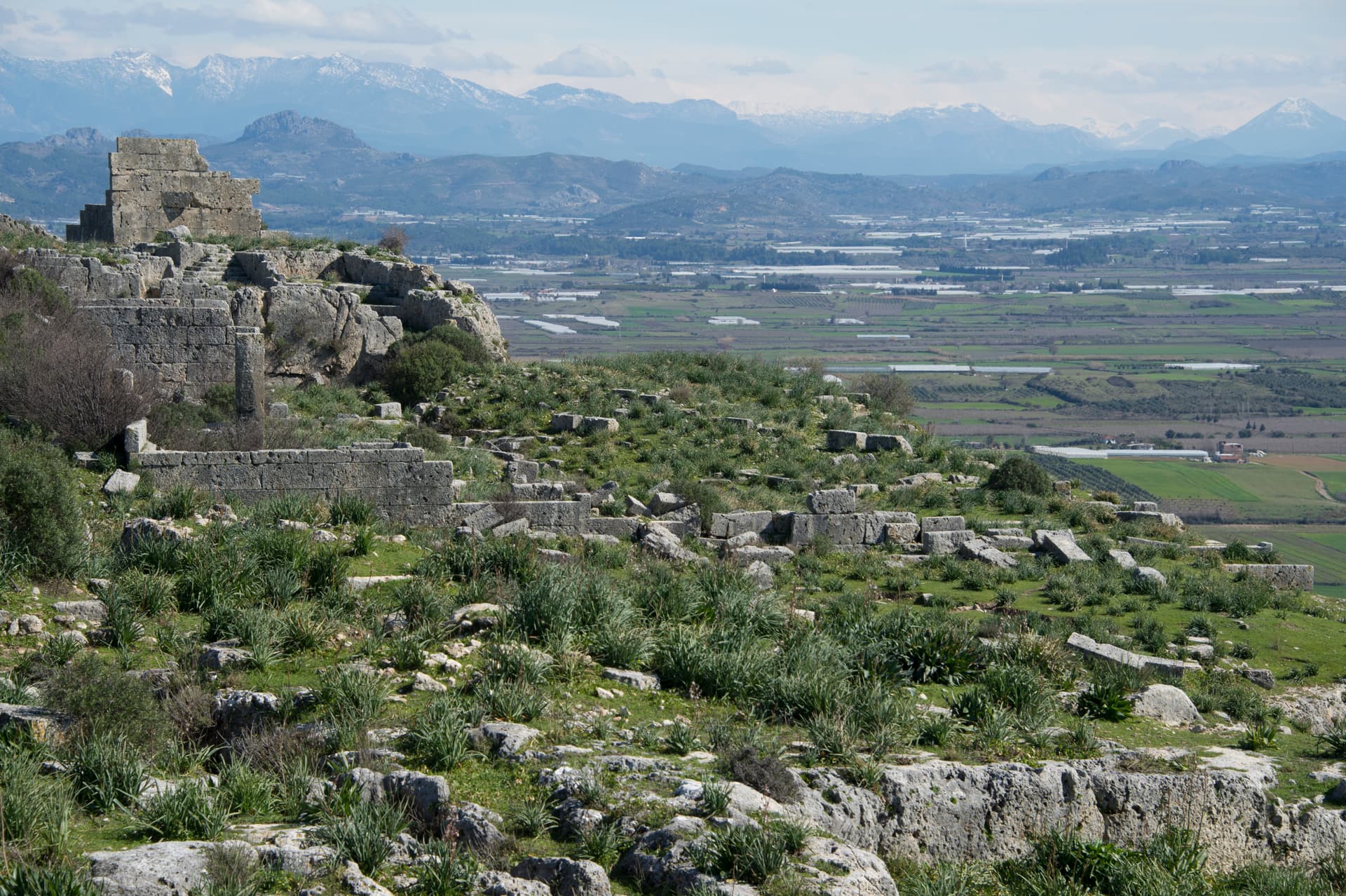
Termessos lies within Güllük Dağı Termessos National Park, reached through rising pine forest and limestone before its ruins appear inside a natural fortress of cliffs and ridges that made conventional siege futile.
According to Homer's Iliad, the Solymian builders were an ancient Anatolian people in conflict with Bellerophon before nearby Greek cities existed. Their deity Solymeus, an Anatolian sky and storm god, was later syncretized with Zeus as Zeus Solymeus. Deity and city shared a name; mountain and god were one.
In 333 BCE, Alexander the Great assessed Termessos's walls and terrain and marched on, one of his campaign's rare strategic withdrawals. The Solymians understood the city's unconquerability as sacred distinction and divine protection.
Ruins include a Hellenistic theater overlooking the entire Pamphylian plain, temples of Zeus Solymeus and Artemis, a five-hundred-metre funerary road with elaborately carved sarcophagi, and a largely unexcavated odeon and gymnasium. Formal archaeology began only in 2025, leaving much seen but not yet studied.
Why this place is sacred
The sacred identity of Termessos is inseparable from its topography in a way that goes beyond the usual rhetoric of mountain sanctuaries. The Solymians did not simply build on a mountain and associate it with a sky-god as a convenient metaphor. Their deity — Solymeus — carried the same name as the mountain (Solymos, now Güllük Dağı), creating an identity between place and divine power that was total. To enter the city was to enter the god's body.
To stand on its walls and look down at the plain was to occupy the position the deity occupied in relation to the human world below.
The Zeus Solymeus cult that emerged from this earlier Anatolian theology syncretized local tradition with Greek religious language without replacing the fundamental Anatolian substrate. Sacrificial and festival activity at the two main temples — Zeus Solymeus and Artemis — maintained the city's sacred centre through the Hellenistic and Roman periods while the mountain setting continued to communicate a message that no Greek inscription could fully encode.
The unconquerability of Termessos extended this sacred quality into history. The city's successful resistance to Alexander was not understood simply as military success but as divine protection made visible. No conqueror broke this city's walls. The mountain held. That the ruins are still largely unexcavated — that formal archaeology arrived only in 2025 — adds a further dimension of intactness: Termessos has been seen for centuries but not yet opened. There is something still held within it.
Sacred mountain citadel of the Solymian people, whose deity Solymeus was the personification of the mountain itself. The site served simultaneously as military stronghold, civic centre, and temple complex for one of Anatolia's oldest identified peoples.
Solymian mountain veneration and Zeus Solymeus cult (pre-classical through classical period) → Greek polytheism overlay retaining Solymian theological core (Hellenistic) → Roman religious influence maintaining the Zeus Solymeus and Artemis traditions → eventual abandonment and preservation within what became a national park → first formal archaeological excavation beginning 2025
Experience and orientation
Begin with the national park itself. The drive from the Antalya junction through Güllük Dağı rewards attention — the mountain's character announces itself before you arrive at the ruins. Park at the trailhead and enter the forest on foot.
The path climbs steadily through pine and cedar, and the physical work of ascent over the last section is not accidental: arriving at the Hellenistic theater slightly breathless, stepping through the upper entrance and seeing the stage open to a view across the Pamphylian plain that extends to the Mediterranean horizon, the body registers the arrival in a way that a flat approach cannot produce.
The theater is the site's most arresting structure: a Hellenistic cavea cut into the mountain ridge, its seats intact across many courses, facing a view that no set designer could improve. Spend time here. The acoustics are functional — a dropped stone at the orchestra position is audible from the upper row.
The view from the upper seats encompasses not just the plain but the ridgeline of Güllük Dağı rising above and behind the stage, reminding you that the city is within the mountain rather than on top of it.
From the theater, move along the ridge to the temples of Zeus Solymeus and Artemis. Neither is fully standing, but the platform dimensions and remaining column drums communicate their original scale. The Zeus temple's position — commanding the highest accessible point of the main precinct — places it in its proper theological context: the deity on the summit, the worshippers below.
The necropolis, along the five-hundred-metre funerary road leading south from the civic zone, is among Turkey's most striking burial landscapes. Sarcophagi of varying degrees of elaboration line both sides of the road, many overturned by tree roots and time, their lids displaced. The tomb of Alcetas — Alexander's general who fled here and died here after his patron's death — bears carved reliefs of a horseman that remain legible after two millennia. It has never been formally excavated.
Leave the necropolis as the last section of your visit. The walk back through the forest in the afternoon light, having spent time among structures that have not been cleaned, labelled, or opened by modern archaeology, produces a retrospective sense of the city's scale and strangeness.
The site requires a minimum of three to four hours. Bring water — there are no facilities of any kind within the ruins. The terrain is uneven and includes loose stone. Go slowly; the ruins are everywhere, including underfoot.
Context and lineage
The Solymians are among the most ancient named peoples in Anatolia. Homer's Iliad, in the story of Bellerophon, places them as an already-established warrior people fighting the hero dispatched against them by the Lycian king Iobates. The hero kills many but does not destroy them. Strabo later identified their mountain — Solymos, now Güllük Dağı — and their city as the place from which their deity took its name.
This gives the site a mythological genealogy predating classical antiquity by an unknowable span.
As a classical city, Termessos flourished from the 3rd century BCE onward, building the theater, temples, agora, gymnasium, odeon, and the extensive necropolis that still extends along the ridge. The city minted its own coinage, maintained its independence within the Hellenistic world, and entered the Roman orbit without being subdued.
In 333 BCE, during Alexander's campaign through Anatolia, the general approached Termessos, surveyed its approaches, and withdrew — an episode preserved in Arrian's Anabasis and treated in antiquity as evidence of the city's sacred invincibility.
The Solymian general Alcetas, one of Alexander's officers who fled to Termessos after the wars of succession, was killed there under disputed circumstances. His tomb in the necropolis was created by the city's residents after local aristocrats handed his body to his enemies; the people, apparently sympathetic, later buried him with honour and carved his image in the rock.
Pre-classical Solymian settlement (attested through Homer and mythological geography) → classical Solymian city flourishing from 3rd century BCE → Hellenistic period maintaining independence from Macedonian and Seleucid control → Roman period with maintained cultural identity → gradual decline and abandonment (date uncertain) → Ottoman-era rediscovery by travelers → national park designation preserving the site → first formal excavation 2025 under Antalya Bilim University
Homer
Referenced the Solymi in the Iliad, Book VI, placing them in the mythological geography of the Aegean world centuries before any Greek presence in the region
Alexander the Great
Attempted siege of Termessos in 333 BCE; withdrew without taking the city — one of the very few such withdrawals in his entire campaign
Alcetas
Successor-war general who took refuge at Termessos; killed and buried there; his carved tomb on the necropolis road remains one of the site's most legible monuments
Strabo
Geographer who described Termessos's Solymian identity, its mountains, and its traditions in his Geography, providing one of the primary ancient textual sources for the site
Traditions and practice
The cult of Zeus Solymeus was the city's defining religious practice — the Anatolian sky-god Solymeus, who shared his name with the mountain and the people, honoured through sacrifice and festival at his temple on the ridge. The syncretism with the Greek Zeus gave the cult a familiar vocabulary without dissolving its distinctively local theological content. The temple of Artemis provided a second major sacred precinct.
Funerary practice at Termessos was elaborate and publicly expressed: the long necropolis road was the city's statement about death, lined with sarcophagi whose carved surfaces depicted athletic scenes, hunts, mythological episodes, and portraits of the deceased.
Conservation work within Güllük Dağı Termessos National Park maintains the site. The first formal archaeological excavation campaign, announced in 2025 under Antalya Bilim University, focuses initially on the necropolis and the theater. The site attracts visitors primarily from Antalya, both independently and on guided tours.
Ascend to the theater before anything else — let the view establish the context of everything else you see. Sit in the upper rows and spend time looking at the plain. The horizon where it meets the sky on clear days is fifty kilometres away.
Allow your eyes to adjust from the distance to the ruins immediately around you: the detail of the carved seats, the wear on the orchestra stone, the way the mountain's own rock forms the backstage wall.
At the necropolis, move slowly. The sarcophagi are not in ordered rows — they have been displaced, overturned, and repositioned by centuries of root growth and weather. Some have their carved lids nearby; some have lost them entirely. Look for the tomb of Alcetas on the path's east side. The horseman relief carved into the rock-cut chamber face has survived with unusual clarity.
Whether or not you know his story, the care given to the carving communicates that someone grieved here with intention.
The temples of Zeus Solymeus and Artemis require some navigation. Both are further from the theater than they first appear on site maps. The Zeus temple's platform, once found, gives the best sense of the city's highest-elevation civic zone — and of the intention embedded in placing the sky deity at the summit.
Solymian Religion / Zeus Solymeus Cult
HistoricalThe city's founding religious identity: Solymeus, the Anatolian sky-storm deity, was the mountain, the city, and the people's divine patron. The syncretism with Zeus preserved this identity within Greek religious language without replacing its Anatolian theological core.
Temple worship, sacrifices, and public festivals at the temple of Zeus Solymeus; funerary rites along the necropolis road reflecting beliefs about the afterlife
Greek Polytheism / Roman Religion
HistoricalTermessos maintained multiple sacred precincts for Artemis and other Olympian deities alongside the Zeus Solymeus cult, reflecting its participation in the broader Greco-Roman religious world while retaining a distinctively Solymian theological core.
Temple rituals, sacrificial ceremonies, and public festivals at the Artemis temple and other precincts; funerary monument construction in the necropolis
Archaeological Heritage
ActiveTermessos is among Turkey's most significant unexcavated ancient sites. The first formal excavation campaign (2025, Antalya Bilim University) opens a new chapter in understanding both the site and Solymian culture more broadly. The national park designation has preserved the site and its natural setting together.
First excavation campaigns in progress; national park conservation; guided tourism from Antalya
Perspectives and open questions
Termessos can be approached as a monument to Solymian religious identity, as a test case for the limits of Macedonian expansion, as an unexcavated reservoir of Anatolian antiquity, or as a living landscape where mountain, sky, and stone continue to occupy the same positions the ancients described.
Scholarly perspective
Termessos is considered one of Turkey's best-preserved ancient sites, notable for the completeness of its civic and funerary architecture and for the near-total absence of formal excavation. The first excavation campaign, announced for 2025 under Antalya Bilim University and focusing initially on the necropolis, is expected to produce significant new findings — the site has been observed and surveyed but not opened.
The Zeus Solymeus cult is understood as a classic example of Anatolian-Greek theological syncretism in which the Anatolian substrate (Solymeus = mountain god) retains its essential identity while adopting Greek nomenclature. The Alcetas episode is one of the most precisely dated and documented events in the site's history, preserved in multiple ancient sources.
Living and traditional perspectives
The Solymians, as a people, cannot be spoken for by any living community. Their theology is reconstructed from temple dedications, coin imagery, and the ancient literary references preserved by Homer, Strabo, and Arrian. What those sources communicate is a people who understood their mountain as sacred, their god as the mountain's personification, and their city's invincibility as evidence of divine protection.
The tomb of Alcetas — built by the city's ordinary residents after aristocrats had handed him over — suggests a community capable of honouring even its enemies' enemies when it judged the cause worthy.
Alternative interpretations
The identification of Güllük Dağı with Solymeus — mountain as deity, deity as mountain — has attracted attention from those exploring pre-Greek Anatolian religious traditions in which landscape features (peaks, springs, caves) were not metaphors for divine power but its literal expression. At Termessos, that identification is not inferential. It is stated in the city's name, its deity's name, and its mountain's name. The three were one thing.
Open questions
The interior of the Zeus Solymeus and Artemis temples has never been formally excavated. The tomb of Alcetas, though identified and observed, has not been opened. The reason for Termessos's eventual abandonment — the city appears in Byzantine records but at some point fell silent — is not established. Whether the population migrated, died of plague, or was absorbed into surrounding settlements is unknown. The first excavation campaigns may begin to answer some of these questions.
Plan your visit
Access and arrival
Located 30 km northwest of Antalya city centre on the road toward Korkuteli. Follow signs for Güllük Dağı Termessos National Park. No public transport reaches the site; private vehicle or organised tour is essential. National park entry fee (nominal); separate ruins entry fee at the site gate. Open daily 08:00–17:00. Mobile phone signal is unreliable within the national park and absent at the ruins; ensure someone knows your planned return time.
No accommodation within the national park or near the ruins. Antalya (30 km) provides full tourist infrastructure and is the natural base. Early morning departure from Antalya is recommended to have the ruins in morning light and before the heat builds.
Respectful visit
No religious dress code. Sturdy hiking boots are essential — the terrain throughout the ruins involves loose limestone, uneven surfaces, and in wet weather, slippery stone. Light layers for the descent, which can be cooler than expected.
Permitted freely throughout the site and national park. The theater, necropolis, and tomb of Alcetas are the most photographed areas.
Not applicable. This is an archaeological site without active religious practice.
Do not move, sit on, or climb structures. Do not remove any material — pottery sherds, tile fragments, carved stone — from the site. Carry out all waste. Stay on established paths through the ruins to avoid disturbing the archaeological surface layer that underlies the entire site and has not yet been studied.
No water, food, or shade facilities exist within the ruins. The national park section immediately below the ruins has basic facilities; bring supplies for the entire visit. The rocky terrain has produced ankle injuries in visitors wearing inadequate footwear. Some sections of the necropolis road involve unstable stone; proceed with care.
Location
Map loads as you approach this section.
Pilgrim reflections
A portrait of encounter, not a score
Pilgrims describe what they felt, how present they could become, and whether the place would shape a journey. There are no stars and no ranking of traditions.
No reviewed reflections yet
The first pilgrims can help describe the character of being here.
Share a reflection
Available after an account-backed “Been there.” Every reflection is reviewed before publication.
Nearby sacred places
Explore other sacred places in the region. Proximity does not establish access or travel time; check each place’s guidance.



References
Sources consulted for this page. Source categories describe the publication, not a guarantee that every claim is verified. Traditional accounts and outside interpretations may differ.
- 01Termessos — Wikipedia — Wikipedia contributorsencyclopediaDetailed article with founding mythology, Alexander the Great episode, and architectural overview
- 02Archaeological Excavations Begin for the First Time in the Ancient City of Termessos — AncientistguideFirst formal excavations beginning 2025 under Antalya Bilim University
- 03Güllükdağı Termessos National Park — Lonely Planet — Lonely PlanetguideAuthoritative travel guide entry
- 04Termessos: City Where History And Mythology Marked People's Daily Lives — Ancient PagesguideCovers Solymian mythology and Zeus Solymeus cult
- 05Termessos Ancient City — Complete Guide to Turkey's Majestic Ruins — termessosancientcity.comguideVisitor guide with site overview
- 06The Ancient City of Termessos — HeritageDailguideArchitectural and historical overview
- 07Guide to the Ancient City of Termessos in Antalya: History and Tips — Antalya Tourist InformationguidePractical visitor information
- 08Termessos: The city Alexander the Great failed to conquer — Daily SabahguideOverview of the city's defenses and legendary status
Share a photo
Help visitors recognize Termessos. Every submission is reviewed before publication.