Phaselis
A Rhodian colonial city where Alexander placed roses on Apollo's altar and Achilles' lance stood in the acropolis temple
Understand sacred places, explore living traditions, and learn how to engage respectfully with Pilgrim Map.
Access has not been verified. Check current local guidance before planning a visit.
Antalya, Turkey
Read the sources
Visit essentials
A quick read before you go
- Duration
- Half day to full day.
- Access
- Located 16 km south of Kemer on the D400 highway and approximately 57 km from Antalya city…
Overview
According to founding tradition, the Rhodian colonist Lacias bought this Lycian coast from a local shepherd with salted fish—a mercantile beginning suited to a city built around three natural harbors, a headland, and the approaches to Pamphylia. Phaselis became an eastern Mediterranean trade node: Rhodian by origin, Lycian by geography, then Persian, Athenian, Roman, and Byzantine.
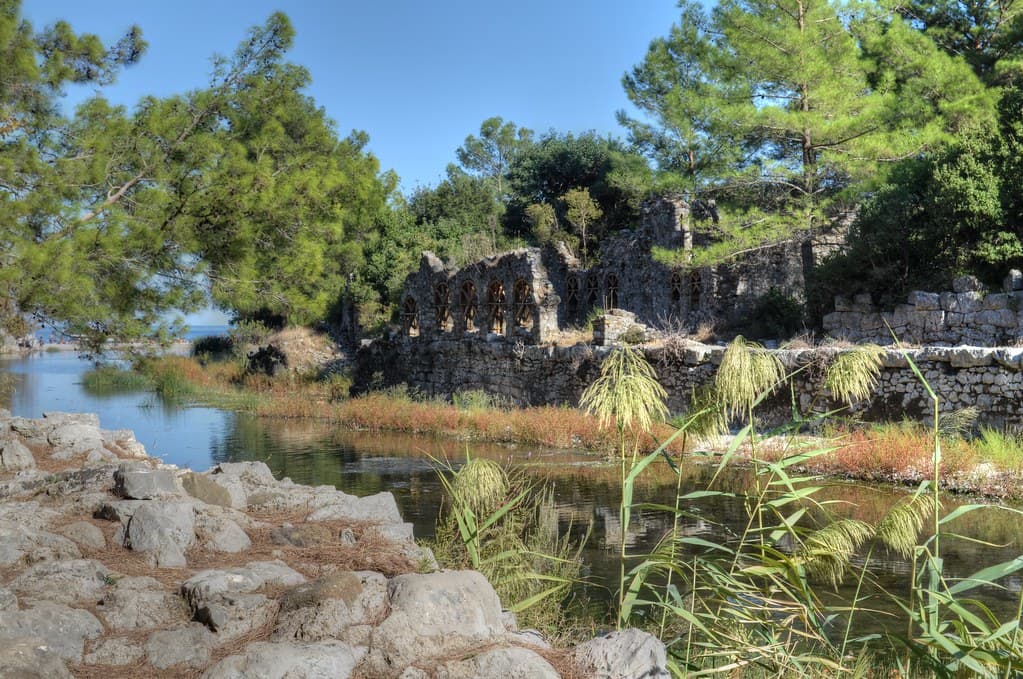
In 333–334 BC, Alexander the Great wintered here with his army. Citizens offered him a golden crown; he placed a rose garland on Apollo's statue, while his officers reportedly read letters in the theatre amid pine trees and harbor sound. That image still captures Phaselis, where extraordinary history rests lightly in an exceptional coastal setting.
Why this place is sacred
The sacred geography of Phaselis was organized along a single axis. The colonnaded main street — the Via Triumphalis in Roman designation — ran from the city's inland gate to the South Harbor, with the civic and religious architecture arrayed along its length. To walk this street was to move in a direction: from land toward sea, from the city's defensive threshold toward the open water.
The acropolis rose at the north end, and it was there that Athena Polias stood — protector of the polis, chief deity, her votive inscription recently confirmed by excavation. Her temple held what ancient sources describe as the lance of Achilles.
This is a claim that archaeology cannot verify and that history cannot dismiss: the display of a heroic relic in a civic temple was a common form of sacred legitimacy in the Greek world, and its presence at Phaselis would have given the city's identity a mythological depth reaching back to the Trojan War.
Whether the lance was genuine, a tradition-honored object, or a constructed claim, its presence in the temple transformed the act of civic sacrifice there into an encounter with the heroic age. Below the acropolis, a circular 3rd-century BC temple to Hermes and Hestia stood near the harbor.
The joint dedication was not accidental: Hermes was the god of commerce and travel — the natural patron of a trading city — and Hestia was the goddess of the civic hearth, the principle of continuity and belonging. Their temple together described the city's dual identity: outward-looking in trade, inward-bound in civic cohesion.
The three natural harbors that framed the city added a geographic thinness — the promontory between the North and South harbors created a sacred axis between land and water that defined every civic approach and departure.
Rhodian Greek colonial city; commercial trading port; civic religious center with temples to Athena Polias, Hermes, and Hestia.
From Rhodian colonial foundation (c. 691 BC) through Persian occupation, Athenian democratic period, Alexander the Great's military use, Roman provincial flourishing under Hadrian, Byzantine occupation, and gradual abandonment in the 13th century AD; today managed as a national park archaeological site with active excavation.
Experience and orientation
The approach to Phaselis is through pine forest — Olympos-Beydağları Coastal National Park surrounds the site, and the transition from highway to ruins passes through kilometers of Taurus pines that prepare the body for a different pace before you arrive. The main entrance leads to the colonnaded street. Walk it slowly, from its inland end toward the sea.
The street is long enough that you lose sight of the harbor until you are well along it, then the water appears ahead and the geometry of the choice — to build the city's main axis as a processional approach to the sea — resolves into something you can feel as much as understand. The Temple of Athena Polias is on the acropolis to the north. The acropolis climb is short but steep.
From the top, the three harbors of Phaselis become visible simultaneously: North Harbor ahead and left, South Harbor to the south, the Canal Harbor between them. The promontory on which you stand was the entire civic and sacred territory of a city that held this position for nearly two thousand years.
The small circular temple foundation near the harbor area, where Hermes and Hestia were jointly honored, is worth a slow look — its circular plan within a rectangular temenos is unusual, and the joint dedication still legible in the remaining architectural evidence. After the acropolis, walk to the North Harbor. The harbor is intact enough that you can walk the ancient quay. The water is clear.
Swimming is permitted in the North Harbor, and the experience of entering the same body of water that Rhodian, Persian, Athenian, and Alexandrine ships crossed is one that no amount of historical reading can replicate. Stay for the late afternoon. The pine forest changes color as the light lowers. The ruins, already warm-toned, become amber. The harbour view from the theatre seats at dusk is consistently described by visitors as the most peaceful moment in the Antalya region.
The site entrance is off the D400 highway, 16 km south of Kemer. Parking available. Entry fee at the gate. The main ruins are spread across a promontory approximately 1.5 km long; comfortable walking shoes are necessary. A full circuit of the main monuments takes 2–3 hours without swimming.
Context and lineage
The founding tradition attributes the establishment of Phaselis to Lacias, a colonist from Lindos on the island of Rhodes, who purchased the site from a Pisidian shepherd for a load of dried fish, around 691 or 690 BC. The story is almost certainly apocryphal in its details but reliable in its implications: the city was Rhodian in origin, mercantile in orientation, and built on negotiation rather than conquest.
It became one of the most commercially significant cities on the Lycian-Pamphylian coast, managing diplomatic relationships across a remarkable range of political powers. In 469 BC, Cimon of Athens defeated the Persian garrison and incorporated the city into the Athenian sphere. Alexander the Great arrived in 333–334 BC as the city voluntarily offered him a golden crown — a deliberate welcome rather than a conquest — and used Phaselis as a winter base and strategic staging point for his campaigns.
In 131 AD, Emperor Hadrian visited and the city honored him with statues, new buildings, and a renamed agora, the Tetragonal Agora, in his honor. The city continued through Byzantine occupation before its final abandonment in the 13th century AD.
Rhodian Greek colonial (c. 691 BC); Persian occupation (5th century BC); Athenian incorporation (469 BC); Lycian League member; Alexander's Macedonian military use (333–334 BC); Roman provincial city; Hadrianic building program (131 AD); Byzantine; abandoned 13th century AD.
Lacias of Lindos
Rhodian colonist credited with founding Phaselis c. 691 BC, according to the founding tradition
Cimon of Athens
Athenian general who conquered Phaselis from Persian control in 469 BC
Alexander the Great
Macedonian king who wintered at Phaselis in 333–334 BC; received a golden crown from the citizens; placed a rose garland on the statue of Apollo
Emperor Hadrian
Roman emperor who visited in 131 AD and was honored with new buildings, statues, and a renamed agora
Achilles
Mythological hero; his lance was reportedly displayed as a sacred relic in the Temple of Athena Polias — its presence giving the temple sacred legitimacy reaching to the Trojan War era
Traditions and practice
Phaselis maintained several distinct religious traditions simultaneously. The Cult of Athena Polias — Athena as protector of the polis — was the city's primary religious identity, centered on the acropolis temple and expressed through votive offerings, civic sacrifice, and the custody of what were claimed to be Achilles' remains or his lance. The joint temple to Hermes and Hestia expressed the city's commercial and civic identity in religious form.
When Alexander arrived in 333–334 BC, the welcome ceremony — the golden crown given by the citizens and Alexander's personal offering of a rose garland to Apollo — was both diplomatic and religious, a ritual encounter between the conquering hero and the city's divine protectors. Hadrian's visit in 131 AD produced an imperial cult response: statues, monuments, and a renamed agora incorporated the emperor into the city's sacred geography.
No active religious ceremonies. The site is managed as a national park archaeological monument with annual excavation campaigns by Turkish universities. Visitors swim in the North Harbor, which is adjacent to the ancient quay. Guided tours from Kemer and Antalya are available.
Walk the main street at least twice — once in each direction. The experience changes depending on whether you are moving toward the sea or away from it. Climb to the acropolis before the midday heat. Stand at the top and orient yourself within the three-harbor geography: understand the city as a place designed to live simultaneously inland and at sea.
Visit the circular Hermes-Hestia temple foundation and consider the joint dedication — what it means to honor commerce and hearth in the same structure. Swim in the North Harbor in the afternoon, which is when the light enters the water at its most transparent angle. Stay until the evening light changes the color of the stone. The theatre on the northwest acropolis slopes at dusk is a particularly quiet point.
Cult of Athena Polias
HistoricalAthena Polias — protector of the polis — was the chief deity of Phaselis, confirmed by a votive inscription from the acropolis. Her temple reportedly housed the lance of Achilles as a sacred relic, giving the civic cult a mythological depth reaching back to the Trojan War.
Votive offerings, civic sacrifice, custody and display of the lance of Achilles as a legitimizing relic.
Cult of Hermes and Hestia
HistoricalA circular 3rd-century BC temple near the acropolis was jointly dedicated to Hermes — god of commerce and travel — and Hestia — goddess of the civic hearth and continuity. The joint dedication expressed the city's dual identity as a trading port and a bounded community.
Civic and commercial religious rites; maintenance of the sacred hearth.
Alexander the Great Veneration
HistoricalIn 333–334 BC, Alexander the Great wintered at Phaselis, received a golden crown from the citizens, and placed a garland of roses on the statue of Apollo. The event gave Phaselis a special place in the memory of Hellenistic civilization and marked the city's transition from Persian-aligned to Macedonian-aligned within a single ceremony.
Royal reception and crown-offering by citizens; Alexander's personal votive offering to Apollo; military encampment and strategic planning.
Imperial Cult of Hadrian
HistoricalHadrian's visit in 131 AD prompted the city to honor him with statues, monuments, and a renamed agora — the Tetragonal Agora. The response expressed the Roman imperial cult at its height, integrating the living emperor into the city's sacred geography.
Imperial reception, statue dedication, monument construction, agora renaming.
Archaeological and Scholarly Heritage
ActivePhaselis is one of the most systematically excavated sites in the Lycia-Pamphylia region, with ongoing annual campaigns by Turkish universities continuing to reveal new architectural phases, inscriptions, and evidence of the city's complex colonial and imperial history.
Annual archaeological excavations, architectural documentation, heritage site management, national park conservation.
Perspectives and open questions
Phaselis carries more overlapping historical identities than most sites its size, and each layer — Rhodian, Persian, Athenian, Alexandrine, Roman, Byzantine — offers a distinct interpretive framework. No single reading is sufficient.
Scholarly perspective
Phaselis was a prosperous Greek colonial city that served as a key node in eastern Mediterranean trade networks from its founding in the late 7th century BC through its Roman imperial peak. Recent excavations have continued to refine the chronology and architectural history, with ongoing work at the acropolis revealing new inscriptions and phases. The confirmation of Athena Polias as the city's chief deity by a votive inscription is a significant recent finding.
The city's repeated changes of political allegiance — Rhodian, Persian, Athenian, Macedonian, Roman — reflect the standard diplomatic pragmatism of a commercially oriented coastal polis rather than weakness or instability.
Living and traditional perspectives
The Rhodian founding myth and the custody of Achilles' lance reflect a deep concern with sacred legitimacy. The city's hospitality to Alexander was itself a ritual act: the golden crown offered by the citizens and the rose garland placed by Alexander on Apollo's statue were not merely diplomatic gestures but religious offerings establishing a reciprocal relationship between the conqueror and the city's divine protectors.
The founding story — land purchased with fish — has a quality of sacred founding charter: the transaction was modest but the result was sacred territory.
Alternative interpretations
The three natural harbors forming a geographic frame around the promontory, combined with the acropolis-to-sea sacred axis of the colonnaded street, have attracted attention from those interested in ancient sacred geography.
The deliberate alignment of a city between mountain and sea, with the civic and religious axis running perpendicular to the coast rather than parallel to it, suggests a spatial theology of transition — between the inland world and the open Mediterranean — that the colonnaded street makes visible in stone.
Open questions
The origin and fate of the lance of Achilles displayed in the Temple of Athena is unknown. Whether it was a specific object, a tradition passed down from the city's founding, or a later legitimizing claim cannot be established from the surviving evidence. The full extent of the Archaic period occupation (7th–6th century BC) — the first two centuries of the city's life — has not been excavated.
Plan your visit
Access and arrival
Located 16 km south of Kemer on the D400 highway and approximately 57 km from Antalya city center. Accessible by car with parking at the site, or by dolmuş from Kemer (approximately 15 minutes) or Antalya (approximately 1 hour). Entry fee required at the Turkish Ministry of Culture site. Mobile signal is generally available at the site, though not reliable within the pine forest approach. Toilets and basic refreshment available near the entrance.
No accommodation at the site. Kemer (16 km north) has a full range of accommodation from budget to luxury. Tekirova (approximately 5 km north) has smaller, quieter options. Antalya (57 km) is the nearest city. For those combining Phaselis with Olympos and Chimaera, tree-house accommodation in Çıralı (near Olympos) offers an alternative base.
Respectful visit
No specific requirements for the ruins. Swimwear acceptable near the beach and North Harbor but not within the monument zone. Sun protection essential.
Permitted throughout the site.
Not applicable to contemporary visit. The ancient votive tradition at Athena's temple is documented but has no modern continuation.
Do not remove artifacts. Do not climb on fragile architectural elements including column drums, wall courses, and mosaic fragments. Standard national park rules apply. Entry fee required.
The site is within Olympos-Beydağları Coastal National Park; standard national park rules apply. Do not climb on fragile architectural elements. Swimwear is appropriate near the beach and North Harbor but not within the monument zone. The beach can be crowded in July and August; the ruins themselves remain quieter.
Location
Map loads as you approach this section.
Pilgrim reflections
A portrait of encounter, not a score
Pilgrims describe what they felt, how present they could become, and whether the place would shape a journey. There are no stars and no ranking of traditions.
No reviewed reflections yet
The first pilgrims can help describe the character of being here.
Share a reflection
Available after an account-backed “Been there.” Every reflection is reviewed before publication.
Nearby sacred places
Explore other sacred places in the region. Proximity does not establish access or travel time; check each place’s guidance.


References
Sources consulted for this page. Source categories describe the publication, not a guarantee that every claim is verified. Traditional accounts and outside interpretations may differ.
- 01Phaselis – Wikipedia — Wikipedia contributorsencyclopediaComprehensive article with coordinates, history, temples, Alexander connection
- 02Phaselis – Turkish Archaeological NewsacademicScholarly compilation of archaeological research and recent excavation news
- 03Antalya Phaselis Archaeological Site – Turkish MuseumsofficialOfficial government registry
- 04A New Athena Polias Votive Inscription from the Phaselis Acropolis – ResearchGateacademicAcademic article confirming Athena Polias as chief deity of Phaselis
- 05Phaselis Ancient City / Turkey – ArticHaeologyacademicGood architectural overview and historical chronology
- 06Phaselis Guide – Coastal Ruins Of An Ancient City – Turkey's For LifeguidePractical visitor guide with firsthand description
- 07Explore the Rich History of Phaselis Ancient City – Akka HotelsguideGood summary of Alexander the Great connection and temple descriptions
Share a photo
Help visitors recognize Phaselis. Every submission is reviewed before publication.