Ariassus
A hillside Pisidian city above the Anatolian plain, where Artemis and Zeus once held civic life together
Understand sacred places, explore living traditions, and learn how to engage respectfully with Pilgrim Map.
Access has not been verified. Check current local guidance before planning a visit.
Antalya, Turkey
Read the sources
Visit essentials
A quick read before you go
- Duration
- 2–3 hours for a thorough exploration of the fortifications, civic centre, and necropolis.
- Access
- Located near Dağbeli village, Döşemealtı district, approximately 50–51 km north of central…
Overview
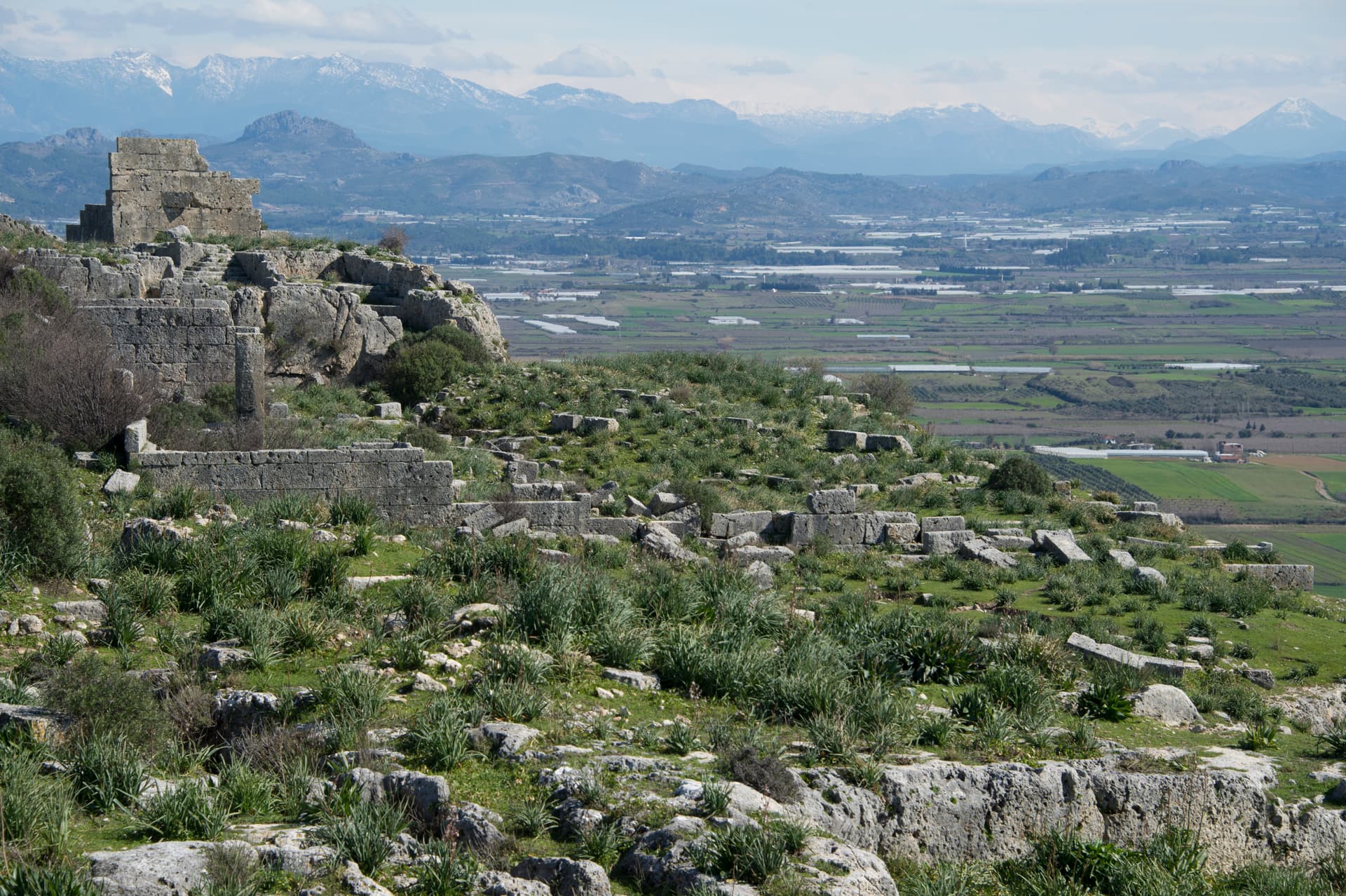
About fifty kilometres north of Antalya’s resort coast, the Burdur road crosses limestone foothills below Ariassus on a steep slope above Dağbeli. Its durable walls, civic spaces for deliberation and worship, and tombs blending Greek and Indigenous Anatolian forms reveal a community navigating between empires. Pisidian origins likely predate its Hellenistic flourishing; Artemidorus recorded the pre-Greek name Aarassos around 100 BC. By the age of Alexander’s successors, the city held a council bouleuterion, ceremonial prytaneion, hillside-fed nymphaeum, and small temple.
Local coins paired Artemis with a quiver and Zeus with a humped bull, distinguishing Pisidian civic religion from a straightforward Hellenic transplant. Rarely visited beside Anatolia’s major sites, Ariassus retains hillside silence, panoramic views, and unhurried exploration.
Why this place is sacred
Ariassus did not become famous. It minted its own coins, venerated its own divine patrons, buried its dead with care and local tradition, and then receded from history as the great imperial centres pulled population and attention downhill to the coast. What remains is precisely what did not get quarried for later construction: walls still standing to their upper courses, the ghost of a triumphal arch framing sky, tomb facades carved into the rock above the necropolis slope.
The sacred topology of a Pisidian city was civic as much as it was devotional — the gods were present in the public square, in the coins exchanged at market, in the rites performed at the prytaneion's eternal fire. Artemis and Zeus were not remote figures but patrons of the community's survival and continuity. The temple, though small, was at the centre of things.
What makes Ariassus feel like a thin place today is not any surviving energy but an absence: the absence of crowds, of interpretation boards at every turn, of the noise of managed tourism. The hillside asks you to read it for yourself.
The necropolis, where the blending of Greek chamber tombs and indigenous Anatolian burial forms is most clearly visible, is where this quality is strongest — a landscape of thresholds where two cultures negotiated what it meant to pass from life.
Pisidian and later Greco-Roman city; civic, religious, commercial, and funerary functions. The bouleuterion (council chamber), prytaneion (civic hearth building), temple, and necropolis formed the religious and administrative core.
Founded in the Hellenistic period by Pisidian communities, Ariassus came under Roman Imperial rule and reached its architectural peak in the 1st–3rd centuries AD (the triumphal arch, baths, gymnasium date to this period). The city gradually declined in late antiquity and was abandoned. No Byzantine reoccupation is documented.
It has been known to scholars since at least the 19th century but has not been the subject of systematic full-scale excavation — making it unusually intact and unrestored compared to more famous Anatolian sites.
Experience and orientation
The approach to Ariassus involves a short but steep climb from the village road below, and the terrain throughout the site is rough — uneven stone, sudden drops where walls have collapsed, open shafts of old cisterns. This physical engagement with the landscape is not incidental but integral to the experience: Ariassus was built for a community that lived at altitude, and approaching it on foot restores something of that original relationship between city and mountain.
The Hellenistic fortification walls are among the most immediately legible structures. Built with the careful polygonal masonry characteristic of Pisidian defensive architecture, they trace the contours of the hill in a way that makes the city's logic visible from outside: this was a place that expected to defend itself.
Moving inside the walls, the civic complex opens up — the bouleuterion and prytaneion foundations, the nymphaeum with its carved water channel, the small Hellenistic temple whose stylobate (the stepped base) remains in place.
The Roman triumphal arch is the site's most dramatic single element: standing columns and partial entablature above the main approach, framing a view down the hillside that would have greeted every visitor arriving from the plain. It speaks of a city that understood its own grandeur. The thermal baths and gymnasium, now reduced to foundations, hint at the scale of daily life during the Roman period.
The necropolis, spread across the slopes below the civic centre, is the most contemplative section. Rock-cut chambers, sarcophagi, and carved tomb facades represent two or three centuries of death and memory. Walk slowly here.
Park at the village of Dağbeli and follow the signposted path toward the site (approximately 600 metres). Begin with the fortification walls to orient yourself to the city's layout before moving to the civic centre and then the necropolis. Allow time to pause at the triumphal arch and look across the plain below.
Context and lineage
Ariassus was established by Pisidian communities on a strategic hilltop in the Hellenistic period, probably in the 3rd century BC. The Pisidians were a non-Greek Anatolian people who occupied the highland zones of southwestern Turkey and maintained cultural independence even as Hellenistic kingdoms and then Rome absorbed their political autonomy. The city's name — recorded by Artemidorus of Ephesus around 100 BC as Aarassos — preserves traces of a pre-Greek linguistic heritage.
It was incorporated into the Roman province of Galatia and later Lycia-Pamphylia, and the triumphal arch and bath complex attest to its prosperity under Imperial Rome.
Ariassus belongs to the broader family of Pisidian urban centres including Termessos, Sagalassos, and Kremna — mountain cities that adapted Hellenistic urbanism to indigenous highland traditions. The Pisidian region was never fully absorbed into the Hellenistic or Roman cultural mainstream, and the blending of Greek urban forms with indigenous funerary and religious practices is one of the defining characteristics of these sites.
Traditions and practice
Civic religious life at Ariassus centred on the principal deities represented in the city's coinage: Artemis (shown with quiver, suggesting her role as a hunter-goddess and protector of the wild spaces the city bordered) and Zeus (shown with a humped bull, a detail with Near Eastern resonances suggesting a local variant of the god). Ceremonies at the bouleuterion and prytaneion would have included sacrifices and offerings at the civic hearth.
Funerary rites in the necropolis combined Greek chamber tomb forms with indigenous Anatolian traditions — a negotiation between imported cultural forms and local ancestral practice visible in the tomb architecture itself.
Ariassus is uninhabited ruins. There are no active religious or ceremonial practices at the site.
The necropolis slope is the place to slow down and spend time. Walk between the tomb facades and read them as architecture — the choices made about proportion, carving, and orientation tell you something about what this community believed about death and memory. At the triumphal arch, stand in the axis of the original approach and look both directions: back across the plain below (the world the city faced), and forward into the city (the world the arch announced).
At the temple's stylobate, sit and consider the scale: this was a community small enough to be called a minor Pisidian city, yet it built a formal sacred space for its gods. On the walls, look for the joints between stones and observe the quality of fit — no mortar, only precision.
Hellenistic and Roman Polytheism
HistoricalAriassus worshipped Artemis and Zeus as principal civic deities, reflected in coinage. A small temple within the civic complex served as the formal sacred space. The prytaneion's eternal fire linked the gods to daily civic life.
Civic cult rituals, public sacrifices, offerings at sanctuaries, festivals tied to the principal deities. Funerary rites in the necropolis blended Hellenistic and indigenous Anatolian burial traditions.
Perspectives and open questions
Ariassus is understood primarily through the lens of Pisidian and Roman provincial archaeology, with its necropolis receiving the most detailed scholarly attention as a case study in funerary syncretism.
Scholarly perspective
Ariassus was a mid-sized Pisidian city that flourished under Hellenistic and Roman rule. Its coins attest to a standard regional pantheon (Artemis, Zeus) with local distinctives, particularly the humped bull associated with Zeus. The Roman-period necropolis has been studied in detail (Anatolian Studies / Cambridge) as a case study in the blending of Greek chamber tomb and indigenous Anatolian funerary traditions.
The full extent of the city's sacred topography — how many temples and sanctuaries existed — remains incompletely mapped due to the absence of systematic full excavation.
Living and traditional perspectives
No living descendant community. The Pisidian people were absorbed into Anatolian, then Byzantine populations over the Roman period. Their language is known primarily through inscriptions and is now extinct.
Alternative interpretations
No significant alternative or esoteric traditions documented for this site.
Open questions
The pre-Hellenistic Pisidian phase of the site is poorly documented — what existed here before the formal city walls were built is not known. The precise identities of deities worshipped at the small temple beyond what the coins imply remain unconfirmed. The fate of the city's population and the reasons for its eventual abandonment are not established.
Plan your visit
Access and arrival
Located near Dağbeli village, Döşemealtı district, approximately 50–51 km north of central Antalya on the D650 road toward Burdur. A signposted turn-off leads approximately 600 m to the site. Approximate coordinates: 37.1503°N, 30.5167°E. No formal entrance fee reported; the site is open-air.
Accommodation available in central Antalya (50–51 km south); Döşemealtı district has limited guesthouses.
Respectful visit
Sturdy footwear with ankle support is essential for the steep, rocky terrain. Sun protection and adequate water are necessary, particularly in summer.
Freely permitted throughout the open-air site.
Not applicable; the site has no active religious dimension.
Do not remove any artefacts or fragments from the site. Do not climb on unstable wall sections. Avoid entering cistern or chamber openings.
The terrain is genuinely rough and steep in places. Do not climb unstable masonry. Be aware of open cistern shafts in grassy areas. Summer temperatures are extreme — carry water and start early.
Location
Map loads as you approach this section.
Pilgrim reflections
A portrait of encounter, not a score
Pilgrims describe what they felt, how present they could become, and whether the place would shape a journey. There are no stars and no ranking of traditions.
No reviewed reflections yet
The first pilgrims can help describe the character of being here.
Share a reflection
Available after an account-backed “Been there.” Every reflection is reviewed before publication.
Nearby sacred places
Explore other sacred places in the region. Proximity does not establish access or travel time; check each place’s guidance.


References
Sources consulted for this page. Source categories describe the publication, not a guarantee that every claim is verified. Traditional accounts and outside interpretations may differ.
- 01The Roman-Period Necropolis of Ariassos, Pisidia — Anatolian Studies / Cambridge CoreacademicPeer-reviewed study of burial customs and tomb architecture at the site
- 02Cult in Pisidia: Religious Practice in Southwestern Asia Minor (Studies in Eastern Mediterranean Archaeology 10) — P. TalloenacademicScholarly monograph on religious practice across Pisidia including Ariassus
- 03Ariassus – Wikipedia — Wikipedia contributorsencyclopediaOverview of history, founding, and architectural remains
- 04Travel: Ancient Antalya – World Archaeology — World ArchaeologySource contextPlaces Ariassus in wider context of Anatolian archaeological sites
- 05Ariassus Ancient City – Döşemealtı, Antalya — Unlock AntalyaguidePractical visitor guide; describes key structures
- 06Ariassus Ancient City – ArticHaeology — ArticHaeologySource contextDescriptive overview including triumphal arch and necropolis
- 07Ariassos Ancient City Antalya – Her Antalya — Her AntalyaguideRegional tourism blog with historical context
- 08ARIASSOS ANCIENT SITE – Slow Travel Guide — Slow Travel GuideguideVisitor-oriented description of ruins and access
Share a photo
Help visitors recognize Ariassus. Every submission is reviewed before publication.