Tanjō-ji (Okayama)
Birthplace of Hōnen Shōnin and home of the 25 Bodhisattvas Procession enacting Amida's descent
Understand sacred places, explore living traditions, and learn how to engage respectfully with Pilgrim Map.
Access has not been verified. Check current local guidance before planning a visit.
Kumenan, Okayama Prefecture, Japan
Read the sources
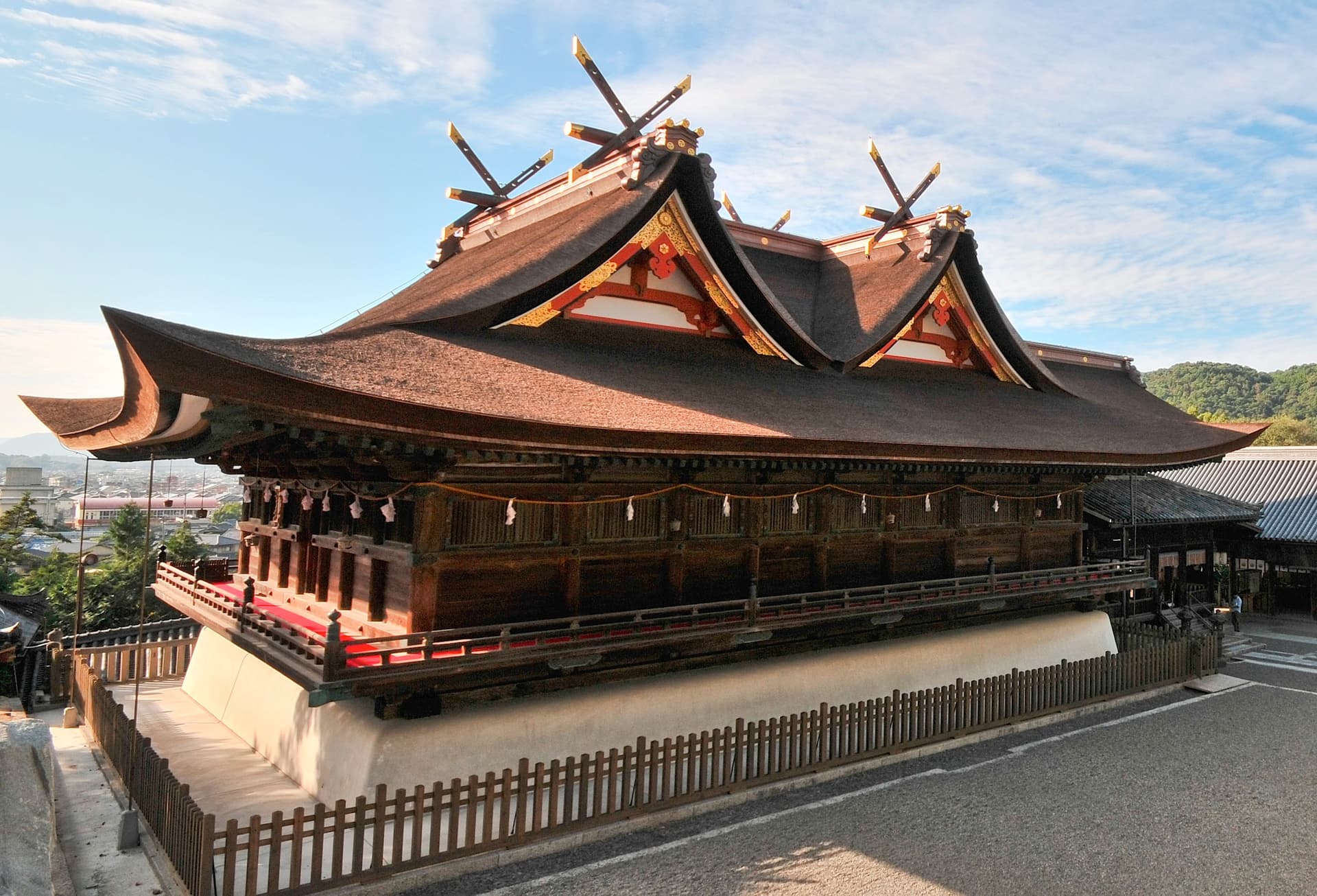
Image of Tanjō-ji (Okayama). Image source · CC-BY-SA-3.0
Visit essentials
A quick read before you go
- Duration
- 60–90 minutes; longer if attending the procession or walking the surrounding rice terraces.
- Access
- JR Tsuyama Line to Tanjōji Station (named after the temple); the precinct is approximately a…
Overview
Tanjō-ji rises from the terraced rice landscape of Kumenan, north of Tsuyama, on the spot where Hōnen Shōnin was born in 1133. The temple's name — literally 'Birth Temple' — encodes its primary identity: this is not a teaching site or a relic shrine but the ground itself where the founder of Pure Land Buddhism in Japan first opened his eyes.
Kumagai Naozane, a samurai who became Hōnen's disciple after killing the young Heike warrior Atsumori, transformed the family home into a memorial temple in 1193. The well used at the infant Hōnen's first ablutions, the graves of his parents, and a statue of him at age fifteen as he departed for Mt. Hiei all remain on the precinct.
The present buildings reflect the Genroku-era rebuild of 1695 after fires consumed earlier structures. The Sanmon (gate) and Mikage-dō (main hall) are National Important Cultural Properties — exemplary late-seventeenth-century temple architecture. An 870-year-old ginkgo by the birth-well turns brilliant gold in late November and has become one of the temple's signature seasonal sights, while terraced rice paddies surrounding the precinct (Bessho Tanada, a National Important Cultural Landscape) are particularly lovely at planting and harvest.
The temple anchors the Hōnen Shōnin 25 Reijō circuit at station #1 and appears as a Special (bangai) entry on the Chūgoku 33 Kannon route, where many pilgrims include it as a Pure Land counterpoint to the Kannon stations.
The annual Niju-go Bosatsu Oneri Kuyō — a procession of twenty-five participants in golden robes and bodhisattva masks enacting Amida's descent to receive the dying — is one of Japan's three great Buddhist processions and draws pilgrims and spectators from across the country.
Why this place is sacred
Pure Land devotional logic treats the place where a 'jōdo no kaisō' — the founder of the Pure Land school — was born as itself a Pure Land threshold. Tanjō-ji's atmosphere is neither remote nor ascetic; it is rooted in the warmth of family memory and the public continuity of nembutsu practice. The 870-year-old ginkgo, the well of first ablutions, and the parents' graves anchor the precinct in a particular human story.
The annual 25 Bodhisattvas Procession briefly turns architectural space into participatory raigō painting, with humans wearing masks of the bodhisattvas who, in tradition, accompany Amida to receive the dying.
Established in 1193 by Kumagai Naozane as a memorial temple at the site of Hōnen's birth, Tanjō-ji was conceived from its founding as a Pure Land pilgrimage destination — a place where nembutsu could be chanted in proximity to the founder's natal ground.
After repeated fires through the medieval period, the present Mikage-dō was rebuilt in 1695 (Genroku 8) as part of a broader Pure Land restoration cycle. The Hōnen Shōnin 25 Reijō pilgrimage formalised Tanjō-ji's primacy as station #1, and the temple's role as a Special (bangai) site on the Chūgoku 33 Kannon route emerged with the establishment of that circuit in 1981/1982.
The 25 Bodhisattvas Procession continues as an annual high point, drawing both Pure Land pilgrims and broader Japanese Buddhist visitors.
Experience and orientation
Walk from JR Tanjōji Station — named after the temple — for ten minutes to reach the Sanmon. Pause at the gate, then enter the precinct facing the Mikage-dō. Inside, an image of the youthful Hōnen, statues of Amida, and the temple's ritual furnishings frame the central act of pilgrim worship: chanting Namu Amida Butsu and bowing toward the ground where the founder was born.
Walk to the well of first ablutions, then to the parents' graves on the slope behind the main hall. The 870-year-old ginkgo stands near the well; in late November it turns gold and drops leaves into a layer that visitors describe as walking on coins. The terraced rice paddies that surround the precinct shift through the agricultural year — flooded silver in late May at planting, gold in September at harvest.
For pilgrims who arrive in late April, the 25 Bodhisattvas Procession enacts Amida's descent in a way that pulls observers and participants together into the same ritual frame; spectators report being moved to tears even when they hold no Pure Land affiliation.
Begin at the Sanmon, then enter the Mikage-dō. Walk to the birth-well, the ginkgo, and the parents' graves. Allow time at the treasure hall (hōmotsu-kan) if open. Sixty to ninety minutes for an ordinary pilgrim visit; longer for procession days.
Context and lineage
Hōnen Shōnin was born here on the seventh day of the fourth month of Chōshō 2 (1133) to the local samurai Uruma no Tokikuni and his wife. After his father's murder and his deathbed instruction not to seek revenge, the young Hōnen entered the priesthood, eventually formulating the senju nembutsu doctrine that founded Jōdo-shū.
Kumagai Naozane, a warrior who became Hōnen's disciple after killing the young Heike warrior Atsumori in the Genpei War, transformed Hōnen's family home into a memorial temple in 1193.
Jōdo-shū (Pure Land Buddhism). The temple's affiliation is direct — Tanjō-ji is a major Jōdo-shū pilgrimage site under the school whose founder was born here. Earlier lineage threads run through the Tendai-derived training Hōnen received at Mt. Hiei before formulating the senju nembutsu doctrine.
Traditions and practice
The 25 Bodhisattvas Procession (Niju-go Bosatsu Oneri Kuyō) enacts Amida's descent to receive the dying. Twenty-five participants in masks and golden robes walk a processional path between the main hall and a temporary altar; the rite is held annually, typically in spring around Hōnen's birth-anniversary. Daily nembutsu liturgy includes recitation of the Amida Sutra and chanting of the nembutsu in a sustained pattern.
Modern pilgrim hospitality, goshuin issuance, Pure Land religious instruction, and treasure-hall exhibits run year-round. The temple is a pilgrim base for both the Hōnen Shōnin 25 Reijō and the Chūgoku 33 Kannon Special (bangai) circuit.
Light incense at the Mikage-dō and chant nembutsu — even a few repetitions of Namu Amida Butsu honour the form of practice the temple anchors. Walk to the birth-well, the parents' graves, and the ginkgo. Receive the goshuin. If visiting in late April, plan around the 25 Bodhisattvas Procession.
Jōdo-shū (Pure Land Buddhism)
ActiveTanjō-ji is the birthplace of Hōnen Shōnin, founder of Jōdo-shū. The temple commemorates Hōnen's nativity and parents and is a foundational pilgrimage site for nembutsu practitioners. Daily life on the precinct is structured around nembutsu liturgy and the Pure Land devotional calendar.
Hōnen Shōnin 25 Reijō
ActiveTanjō-ji is station #1 of the 25 Sacred Sites of Hōnen Shōnin pilgrimage circuit, which traces sites associated with Hōnen's life from birth at Tanjō-ji through training at Mt. Hiei to founding teachings and exile sites. As the opening station, the temple sets the rhythm and devotional frame for the whole circuit.
Chūgoku 33 Kannon Pilgrimage
ActiveTanjō-ji is listed as a Special (bangai) temple on the modern Chūgoku 33 Kannon route. Many pilgrims include it as a culminating Pure Land counterpoint to the thirty-three Kannon stations, weaving Pure Land and esoteric Kannon devotion into a single broader practice.
Perspectives and open questions
Tanjō-ji invites overlapping readings: as a Pure Land birth-temple at the heart of Jōdo-shū devotion, as a Genroku architectural witness, and as a multi-pilgrimage station on both the Hōnen 25 and Chūgoku 33 Kannon routes. Each frame describes the same place from a different angle.
Scholarly perspective
Tanjō-ji is well documented as Hōnen's birthplace and a Kenkyū-era foundation. Its architecture (Sanmon, Mikage-dō) reflects the 1695 Genroku rebuild after fires; both structures are National Important Cultural Properties and serve as primary case studies in late-seventeenth-century Japanese Pure Land temple architecture. The 25 Bodhisattvas Procession is regularly studied as a participatory raigō form.
Living and traditional perspectives
In Pure Land devotion, Hōnen is regarded as the saviour-teacher who made nembutsu accessible to all beings; his birthplace is therefore a 'Pure Land seed-ground' where compassionate teaching first entered the world. Pilgrims often describe the visit as a 'returning to source' — encountering the human Hōnen behind the doctrine.
Alternative interpretations
The 25 Bodhisattvas Procession is read by some scholars as a participatory raigō painting. Where painted raigō scrolls depict Amida descending with attendant bodhisattvas to receive the dying, the procession turns visual iconography into embodied ritual: humans, briefly, become the bodhisattvas welcoming Amida. Even non-Pure Land pilgrims report deep emotional resonance.
Open questions
The exact spot of Hōnen's birth-room within the 1193 footprint is unverified; original early-Kamakura buildings have been lost to repeated fires. The continuity of practice on the site is well documented even where specific building locations are not.
Plan your visit
Access and arrival
JR Tsuyama Line to Tanjōji Station (named after the temple); the precinct is approximately a 10-minute walk from the station. By car, on-site parking is available.
Limited accommodation in Kumenan; Tsuyama City (~30 minutes by train) and Okayama City (~90 minutes) offer wider options. Pilgrim-oriented stays are limited; most walking pilgrims base in Tsuyama for the central Okayama leg.
Respectful visit
Modest, covered clothing with comfortable shoes. The terrace paths can be muddy after rain.
Outer precinct generally permitted; respect signs in halls and during the procession.
Saisen, incense, candles. Pilgrims often offer nembutsu chanting at the main hall.
Quiet during processional services | No flash or close-range photography during ritual | Treasure hall has admission fee; respect handling rules
The procession is solemn — observers should remain quiet during the ritual sequence. Some sub-buildings may have restricted access; respect any closed gates. Photography is welcome in the outer precinct but should be paused during ongoing services.
Current practical details
Address
808 Satogata, Kumenan, Kume District, Okayama 709-3602, Japan
Phone
Hours
Hours, fees, and access can change — verify on the official source before you travel. Practical details last checked Jun 2026.
Location
Map loads as you approach this section.
Pilgrim reflections
A portrait of encounter, not a score
Pilgrims describe what they felt, how present they could become, and whether the place would shape a journey. There are no stars and no ranking of traditions.
No reviewed reflections yet
The first pilgrims can help describe the character of being here.
Share a reflection
Available after an account-backed “Been there.” Every reflection is reviewed before publication.
Nearby sacred places
Explore other sacred places in the region. Proximity does not establish access or travel time; check each place’s guidance.



References
Sources consulted for this page. Source categories describe the publication, not a guarantee that every claim is verified. Traditional accounts and outside interpretations may differ.
- 01誕生寺 official site — Tanjō-ji templeofficialOfficial temple site
- 02誕生寺 | 久米南町 — Kumenan TownofficialLocal government tourism page
- 03Tanjoji temple — Okayama Prefecture Official Tourism GuideofficialFounding history in English
- 04第1番 誕生寺 - Hōnen Shōnin 25 Reijō — Hōnen Shōnin Niju-go Reijō CouncilofficialTanjō-ji is #1 of the Hōnen 25 Sacred Sites pilgrimage
- 05誕生寺 (岡山県久米南町) - Wikipedia — Wikipedia (Japanese)academicFounding 1193 by Kumagai Naozane, Mikage-dō rebuild 1695, Sanmon and Mikage-dō ICP
- 06Day 65 — Tanjō-ji, Our Last Temple — Tali Landsman blogspiritualPilgrim's first-person experience
Pilgrim glossary
- Kannon
- The bodhisattva of compassion, central to many East Asian pilgrimage routes.
- Bodhisattva
- An enlightened being who postpones full nirvana to help others toward awakening.
- Sutra
- A canonical Buddhist scripture, often chanted as part of practice.
- Tendai
- A Japanese Buddhist school based on the Lotus Sutra, foundational to many later traditions.
- Pure Land
- A Buddhist tradition focused on rebirth in Amida Buddha's western paradise through devotional practice.
Share a photo
Help visitors recognize Tanjō-ji (Okayama). Every submission is reviewed before publication.