Hase-dera
A 9.18-metre Kannon, a Jizō grove, and a hillside above the Kamakura sea
Understand sacred places, explore living traditions, and learn how to engage respectfully with Pilgrim Map.
Access has not been verified. Check current local guidance before planning a visit.
Sakurai, Kanagawa Prefecture, Japan
Read the sources
Image of Hase-dera Shingon Buddhist Temple, Sakurai. Image source · CC-BY-SA-4.0
Station 4 of 33
Bandō Sanjūsankasho PilgrimageVisit essentials
A quick read before you go
- Duration
- 60–90 minutes for a contemplative visit including the Kannon-dō, Benten-kutsu cave, Jizō grove,…
- Access
- About a 5-minute walk from Hase Station on the Enoden line (the third station from Kamakura).
Overview
Hase-dera sits on a wooded hill above Yuigahama Bay, a five-minute walk from Hase Station on the Enoden line. By tradition the temple was founded in 736 CE to enshrine an Eleven-Headed Kannon image carved in 721 by the priest Tokudō from a single great camphor tree.
According to the temple's most evocative legend, Tokudō carved two identical statues from the same tree: one was kept at Hase-dera in Nara, the other set adrift on the sea with the prayer that it would come to rest where it was karmically needed. After fifteen years adrift, the second Kannon washed ashore at Nagai Beach on the Miura Peninsula on the night of 18 June 736, sending out rays of light.
It was brought to Kamakura, and a temple was built on this hillside to enshrine it.
The principal Kannon — 9.18 metres of gilded camphor wood — stands inside the dim Kannon-dō at the top of the precinct. Eleven faces rise above the central head, each representing a phase of bodhisattva insight; the gilding catches what light enters the hall. For Bandō pilgrims, this is the visual climax of the Kamakura cluster: after the moss of Sugimoto-dera, the cliff of Ganden-ji, and the azaleas of An'yō-in, the great Kannon stands at full height.
The rest of the precinct is itself a layered devotional landscape. A Benten-kutsu cave at the lower terrace preserves rock-carved images of Benzaiten and her sixteen attendants. Thousands of small Jizō statues, placed by parents in memory of unborn children, fill the upper grounds — making Hase-dera one of Japan's most concentrated mizuko-kuyō sites. From the hilltop terrace, Yuigahama beach and the open sea are visible in clear weather.
In mid-June, more than 2,500 hydrangea plants bloom along the hillside path, and timed-entry tickets are often required at peak.
Why this place is sacred
What gives Hase-dera its quality of thinness is the way several distinct devotional registers — each strong on its own — coexist in walking distance of each other. The Kannon-dō is the visual and devotional center: a 9.18-metre gilded Eleven-Headed Kannon whose true scale registers only when a visitor stands close enough to see how high the statue rises into the hall's roof beams.
A short walk away, the Jizō grove holds thousands of small statues, each placed by a parent who has lost a pregnancy, an infant, or a young child. Mizuko-kuyō — the memorial practice for these losses — finds at Hase-dera one of its largest concentrations in Japan. Visitors who pause here often find that the grove is the temple's emotional center; the Kannon-dō above is what makes the grief addressable.
Further down the slope, the Benten-kutsu cave runs into the rock, lit only by the candles visitors place along the walls. Carvings of Benzaiten and her attendants emerge from the stone in low relief. Above the cave, the hilltop terrace opens onto a view of Yuigahama beach and the wider Sagami Bay — sea horizon in the same precinct as the Kannon.
In mid-June the 2,500-plant hydrangea path turns the hillside saturated colour, and the temple becomes one of Kanagawa's most-visited destinations. In other seasons the precinct is much quieter, and the layering of cave, grove, hall, and sea view becomes more legible.
By temple tradition, Hase-dera was founded in 736 CE to enshrine the Eleven-Headed Kannon image that washed ashore at Nagai Beach after drifting on the sea from Nara. The hillside above Yuigahama was selected for the new temple, and the principal devotion has been to the Eleven-Headed Kannon ever since.
Originally a Tendai temple, Hase-dera shifted in the medieval period and now operates as an independent single-temple Buzan-ha lineage with Pure Land affinities; sources sometimes label it 'Jōdo-shū' for convenience. The precinct's distinctive features — the Jizō grove for mizuko-kuyō, the Benten-kutsu cave, and the hydrangea path — have developed across many centuries; the mizuko-kuyō tradition in its present popular form is largely a 20th-century development, although the underlying Jizō devotion is much older.
Experience and orientation
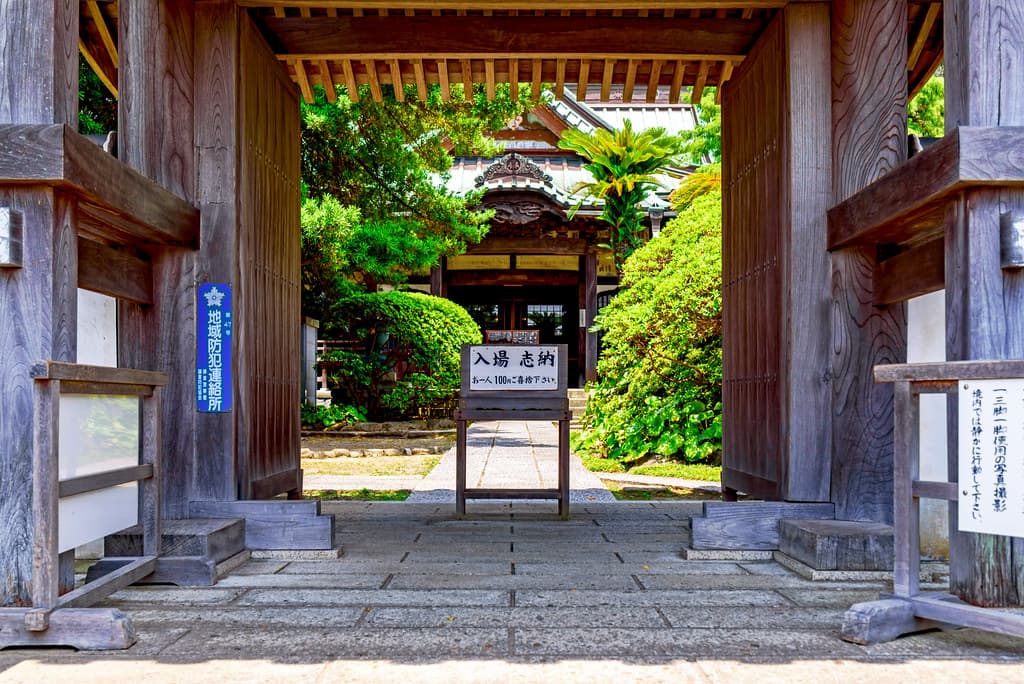
From Hase Station — three stops from Kamakura on the Enoden — the temple is a five-minute walk inland. The entrance gate opens onto a lower garden with seasonal plantings (plum in February, cherries in early April), a small pond, and the Benten-kutsu cave. The Benten-kutsu is easy to miss; visitors have to duck slightly to enter the rock passage, which leads into a candle-lit interior with rock-carved Benzaiten and her sixteen attendants in low relief along the walls.
A stepped path rises to the upper terrace. On the way up, the Jizō grove appears: thousands of small stone Jizō figures arranged in tiers, some weather-worn, some recent, many wearing red knitted bibs or caps left by parents. Mizuko-kuyō — the memorial practice for miscarried, stillborn, or aborted children — has its most concentrated public expression here. The atmosphere is quiet; many visitors who have come for the Kannon find that they linger longer than expected at the grove.
The Kannon-dō stands at the top of the upper terrace. Inside the dim hall, the 9.18-metre Eleven-Headed Kannon rises overhead, gilded and catching what light enters from the open doorway. The eleven faces above the central head each represent a phase of bodhisattva insight. From the terrace beside the hall, the view extends across Yuigahama beach to the open sea.
In mid-June the 2,500-plant hydrangea path along the upper hillside turns saturated blue, and the temple often issues timed-entry tickets to manage crowds; the path is at its most luminous in the rainy-season grey light.
Walk five minutes from Hase Station inland to the temple gate. Pay admission at the entrance. Visit the Benten-kutsu cave first (lower garden), then climb to the upper terrace via the stepped path; pause at the Jizō grove on the way; enter the Kannon-dō at the top; finish at the hilltop terrace with the sea view. The temple museum, near the Kannon-dō, requires an additional fee. Bandō pilgrims should bring their nōkyō-chō to the office for the Bandō #4 stamp.
Context and lineage
In 721 CE, the priest Tokudō discovered a vast camphor tree and carved two identical statues of the Eleven-Headed Kannon. One was enshrined at Hase-dera in Nara; the other was set adrift on the sea with the prayer that it would come to rest where it was karmically needed. On the night of 18 June 736 CE, after fifteen years adrift, the second Kannon washed ashore at Nagai Beach on the Miura Peninsula, sending out rays of light.
Local people brought it to Kamakura, and a temple was built on this hillside above Yuigahama to enshrine it.
This founding legend is treated as devotional rather than historically verified. Modern art-historical analysis suggests the surviving principal Kannon image was carved later than the legend implies — possibly in the late Heian or Kamakura period — but the legend remains the temple's central narrative and the source of its date of 18 June, which is observed locally as auspicious for prayers at Hase-dera.
The temple's institutional history shows a clear move from medieval Tendai affiliation to a Jōdo-shū-related independent lineage in modern times. The Benten-kutsu cave and the Jizō grove developed across many centuries; the present concentration of small Jizō for mizuko-kuyō reflects in particular a 20th-century intensification of the practice.
Hase-dera operates today as an independent single-temple Buzan-ha lineage with Jōdo-shū-related Pure Land affinities. Its medieval institutional roots are Tendai. The Kannon devotion at the heart of the temple predates and survives these institutional realignments, anchored in the founding legend of the sea-borne Eleven-Headed Kannon.
Tokudō (656–735)
Traditional carver of the principal Kannon
Nara-period priest who, by tradition, carved the two camphor-wood Eleven-Headed Kannon images — one for Nara's Hase-dera, one set adrift to find its destined home in Kamakura.
Local Kamakura patrons
Traditional founders
The 8th-century community that, by temple tradition, recovered the floating Kannon at Nagai Beach and built the hillside temple to enshrine it.
Saichō (767–822)
Lineage founder of original affiliation
Founder of the Tendai school in Japan; Hase-dera's original sectarian affiliation is traditionally Tendai before the later move to a Jōdo-shū-related lineage.
Hōnen (1133–1212)
Later lineage founder
Founder of the Jōdo-shū (Pure Land) school, with which Hase-dera's modern independent Buzan-ha lineage has affinities.
Modern conservators and resident clergy
Contemporary stewards
The continuing community responsible for maintaining the Kannon-dō, the Jizō grove, the Benten-kutsu cave, and the hydrangea path, and for receiving Bandō pilgrims.
Traditions and practice
The Kannon-dō hosts daily devotions before the principal Eleven-Headed Kannon. The Benten-kutsu cave is the focus of regular Benten-do services for Benzaiten, the goddess of music, water, and worldly blessings. Setsubun bean-throwing ritual is observed in early February. During the rainy season, the temple offers hydrangea-tea (ajisai-cha) as a seasonal devotional gesture.
The mizuko-kuyō at the Jizō grove is a continuous lay practice, with parents placing small Jizō statues, leaving knitted bibs or caps, and offering prayers for the welfare of unborn or lost children.
Bandō pilgrims arrive year-round for the Bandō #4 goshuin, often combined with the Kamakura 33 (#4) stamp. The autumn nighttime light-up of the hilltop maples (late October to mid-December) and the winter plum-blossom illumination (February, after 17:00) extend the temple's hours into the evening. The hydrangea bloom in mid-June through early July is the temple's busiest season, often requiring timed-entry tickets. Daily lay visits combine prayer, photography, and the standard temple-precinct rhythms.
Allow at least an hour. Begin in the lower garden with the Benten-kutsu cave; the cave is small and easy to miss but worth the brief crouch through the entrance. Climb to the upper terrace, pausing at the Jizō grove. Inside the Kannon-dō, move slowly enough to register the statue's true scale — the eleven faces above the central head are easy to overlook. Finish at the hilltop terrace for the sea view.
Bandō pilgrims should bring their nōkyō-chō to the office for the Bandō #4 stamp; the office can also issue the Kamakura 33 stamp.
Buddhism
ActiveHase-dera (Kamakura) is one of the most beloved Kannon temples in eastern Japan, the fourth station of the Bandō Sanjūsankasho, and home to the Jūichimen Kannon (Eleven-Headed Kannon) sometimes called the largest wooden statue in Japan — 9.18 metres of gilded camphor wood, with eleven heads representing successive phases of bodhisattva insight. By tradition the temple was founded in 736 to enshrine a Kannon image carved in 721 by the priest Tokudō. The statue is the karmic 'twin' of the principal image of Hase-dera in Nara: both were carved from the same camphor tree, with Nara's image kept in place and Kamakura's set adrift on the sea to find its destined home. The temple also contains a Benzaiten cave, thousands of small Jizō statues for mizuko-kuyō memorial, and a hilltop terrace overlooking Yuigahama beach.
Perspectives and open questions
Hase-dera is a temple where founding legend, art history, and contemporary lay devotion each tell a different story about the same hillside. Holding all three in mind opens the precinct's layered character.
Scholarly perspective
The 736 CE founding date is traditional. The principal Eleven-Headed Kannon statue's exact dating is debated; while temple tradition attributes it to Tokudō in 721, art-historical analysis suggests a later Heian- or Kamakura-period carving. The temple's institutional history shows a clear move from Tendai affiliation in the medieval period to a Jōdo-shū-related independent Buzan-ha lineage in modern times. The mizuko-kuyō practice at the Jizō grove, in its present popular form, is largely a 20th-century intensification of older Jizō devotion.
Living and traditional perspectives
In the temple's own narrative, the Kannon's arrival on the sea — sending out rays of light at Nagai Beach in 736 — is a karmic event: the bodhisattva's compassion finding the place that needed it. The eleven heads on the great statue articulate the Kannon's many ways of perceiving and responding to suffering. Devotees pray here for safe childbirth, recovery from illness, and the well-being of departed loved ones, especially through the Jizō grove for mizuko-kuyō.
Alternative interpretations
Folk Buddhism associates the Benten-kutsu cave with worldly blessings — wealth, music, eloquence — through Benzaiten and her attendant deities. Some lay practitioners hold that the 18th of the month, the date of the statue's miraculous arrival, is especially auspicious for prayers at Hase-dera. The mizuko-kuyō tradition has become, for many parents who have suffered pregnancy loss, a publicly recognized site of mourning that ordinary funeral practice does not provide.
Open questions
{"Exact carving date and original location of the principal Kannon image","Precise medieval-period course of the temple's transition from Tendai to Jōdo-shū-related affiliation","Identity of the original community that received the floating statue at Nagai Beach"}
Plan your visit
Access and arrival
About a 5-minute walk from Hase Station on the Enoden line (the third station from Kamakura). Hours: 08:00–17:00 (Jul–Mar, last entry 16:30); 08:00–17:30 (Apr–Jun, last entry 17:00). Admission 400 JPY adults, 200 JPY children (ages 6–11); additional fee for the temple museum. Mobile phone signal is reliable on all major Japanese carriers in the Hase neighborhood.
The Hase neighborhood has a small selection of inns and boutique hotels, including options that allow walking access to both Hase-dera and the Great Buddha. Many Bandō pilgrims base themselves in central Kamakura and visit Hase as a half-day on foot.
Respectful visit
Modest, walking-comfortable clothing. Pilgrim coat (hakui) and staff appropriate for those on the Bandō circuit. Closed-toe shoes recommended for the stepped paths.
Permitted in the precincts and gardens; generally not permitted inside the Kannon-dō (follow posted signs); avoid photographing individual mourners at the Jizō grove.
Incense, candles, monetary saisen, transcribed sutra (nōkyō) for the pilgrimage office, small Jizō statues for mizuko-kuyō.
Quiet, respectful behavior at the Jizō grove and Kannon-dō | Stay on marked paths in the hydrangea garden during peak bloom | Timed-entry ticket may be required at the height of hydrangea season | No photography inside the Kannon-dō; no photography of individual mourners at the Jizō grove
The Jizō grove deserves quiet, respectful behavior; many visitors there are mourning, and individual mourners should not be photographed. Photography inside the Kannon-dō is generally not permitted — follow posted signs. During hydrangea season, plan visits early or arrive ready to use timed-entry tickets; the hillside path can become very crowded.
Current practical details
Address
3-chōme-11-2 Hase, Kamakura, Kanagawa 248-0016, Japan
Phone
Hours
Hours, fees, and access can change — verify on the official source before you travel. Practical details last checked Jun 2026.
Location
Map loads as you approach this section.
Pilgrim reflections
A portrait of encounter, not a score
Pilgrims describe what they felt, how present they could become, and whether the place would shape a journey. There are no stars and no ranking of traditions.
No reviewed reflections yet
The first pilgrims can help describe the character of being here.
Share a reflection
Available after an account-backed “Been there.” Every reflection is reviewed before publication.
Nearby sacred places
Explore other sacred places in the region. Proximity does not establish access or travel time; check each place’s guidance.

References
Sources consulted for this page. Source categories describe the publication, not a guarantee that every claim is verified. Traditional accounts and outside interpretations may differ.
- 01Hase-dera (Kamakura) — Wikipedia contributorsacademicFounding traditions, twin-statue legend, statue dimensions (9.18 m), camphor-wood gilded construction, Tendai-to-Jōdo-shū lineage history.
- 02INTRODUCTION | KAMAKURA HASEDERA — Hasedera (official temple website)officialOfficial temple introduction — confirms Eleven-Headed Kannon honzon, traditional 736 founding, 11 heads representing phases of enlightenment.
- 03ADMISSION & ACCESS | KAMAKURA HASEDERA — Hasedera (official temple website)officialHours: Jul–Mar 08:00–17:00 (last entry 16:30); Apr–Jun 08:00–17:30 (last entry 17:00). Admission 400 JPY adult, 200 JPY child. Additional museum fee.
- 04ANNUAL EVENTS | KAMAKURA HASEDERA — Hasedera (official temple website)officialAnnual event calendar including Setsubun, hydrangea season, Benten-do services, autumn light-up, plum-blossom illumination.
- 05Hase Kannon Temple (Hasedera) — Japan Guideguide2,500+ hydrangea plants, hilltop view, Benten-kutsu cave, jizō statues for mizuko-kuyō.
- 06Hasedera Temple Kamakura — Japan's Tallest Wooden Kannon & Views — Kamakura GuideguideDetailed visitor information; Bandō #4; jizō and Benzaiten cave detail.
- 07Kamakura Hasedera Temple: Plum Blossoms and Illuminations — MATCHAguideWinter plum-blossom illumination details.
- 08Kamakura Hasedera Autumn Light-up — Time Out TokyoguideAutumn nighttime illumination of the hilltop maples.
Photo gallery
3 curated photos
Pilgrim glossary
- Kannon
- The bodhisattva of compassion, central to many East Asian pilgrimage routes.
- Bodhisattva
- An enlightened being who postpones full nirvana to help others toward awakening.
- Tendai
- A Japanese Buddhist school based on the Lotus Sutra, foundational to many later traditions.
- Pure Land
- A Buddhist tradition focused on rebirth in Amida Buddha's western paradise through devotional practice.
Share a photo
Help visitors recognize Hase-dera. Every submission is reviewed before publication.