Stratonikeia
The only ancient city where sacred roads ran simultaneously to Hecate's crossroads shrine and Zeus's golden-sword sanctuary
Understand sacred places, explore living traditions, and learn how to engage respectfully with Pilgrim Map.
Access has not been verified. Check current local guidance before planning a visit.
Muğla, Turkey
Read the sources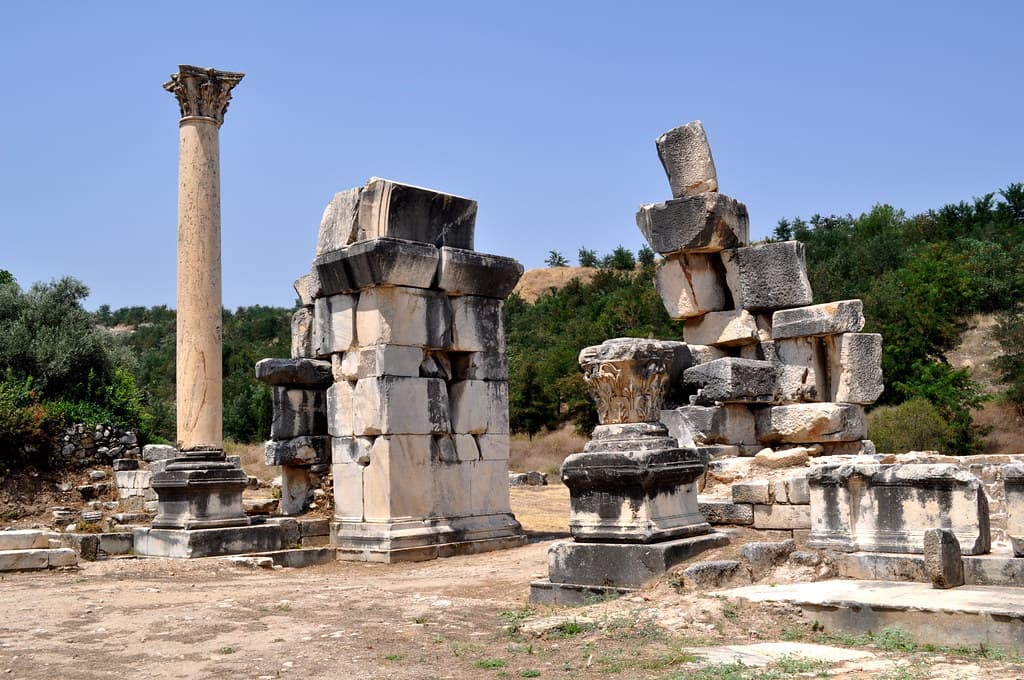
Image of Stratonikeia. Image source
Visit essentials
A quick read before you go
- Duration
- 2–3 hours for a thorough visit to the main city.
- Access
- Located at Eskihisar village, 7 km west of Yatağan district center, Muğla Province.
Overview
Stratonikeia was deliberately linked by sacred roads and reciprocal processions to two divine landscapes. From Lagina, eight kilometers north, a choir of young girls annually carried Hecate's sacred key to the Underworld in the kleidagōgia. From Panamara to the south, the statue of Zeus Chrysaoreus—Zeus of the Golden Sword—was carried to the city. The goddess of crossroads, magic, and the threshold between living and dead thus met the god of celestial authority and golden armament.
Its Hittite name Atriya, Classical name Khrysaoris after the Chrysaorian League, and Hellenistic name given by Antiochus I for Stratonike mark cultural strata still visible on site. Modern Eskihisar, built among the ruins, extends this unbroken sequence from 1500 BCE to the present.
Why this place is sacred
Stratonikeia's dual sacred connection was structural: no other classical city is documented as the ceremonial center for two separate major deity cults with outside sanctuaries. Lagina was the Mediterranean's most prominent Hecate sanctuary, while Panamara's Zeus Chrysaoreus cult was the Chrysaorian League's religious center; their processions made the city their connecting node.
They were not obvious companions. Hecate governed thresholds, crossroads, magic, the moon, and the underworld—the liminal and dangerous boundary—while Zeus Chrysaoreus embodied celestial authority and the golden sword, Olympian power made terrestrial. Ancient residents understood this arrangement more fully than we can. The city remains a geographic, cultural, and theological crossroads legible through Hittite, Carian, Greek, Roman, Byzantine, and Ottoman layers.
Civic hub of the Chrysaorian League; ceremonial intersection of the Hecate cult at Lagina and the Zeus cult at Panamara; later, seat of Carian political and religious administration.
Hittite settlement Atriya (c. 1500 BCE) → Classical Carian city Khrysaoris/Idrias (member of the Chrysaorian League) → Hellenistic refounding as Stratonikeia by Antiochus I (3rd century BCE) → Roman civic and gladiatorial culture → Byzantine period → Ottoman occupation (village of Eskihisar) → modern village within active excavation site → UNESCO Tentative List (2015).
Experience and orientation
Unlike heritage sites that fence contemporary life from a designated past, Stratonikeia and modern Eskihisar remain interwoven: a column enters a courtyard wall, ancient masonry supports a modern house, the bouleuterion rises beyond a garden, and the theatre shares the houses' light. This temporal compression is both disorienting and illuminating.
From the northern gate, note around twelve gladiatorial burial sites belonging to fighters who trained, competed, and sometimes retired in one of the Roman world's most significant gladiatorial centers. Continue through the 105 x 267 meter gymnasium—the largest identified in the ancient world—to the largest known ancient council chamber, the bouleuterion, and the theatre. During July–September, Pamukkale University archaeologists are typically visible at work, making the visit a live encounter with archaeological method.
Enter from the northern road and read the site broadly before focusing on individual structures. The scale of the gymnasium is best appreciated by walking its full perimeter. The overlay of ancient and modern architecture is a deliberate aspect of the site's character — attend to it rather than treating it as interference.
Context and lineage
The city's Hittite name, Atriya, places its origins in the Late Bronze Age cultural world of western Anatolia — the same world that produced the Trojan War, the Luwian inscriptions, and the early Carian cities of the Aegean hinterland. Its Classical-period name, Khrysaoris or Idrias, connected it to the Chrysaorian League — the federation of Carian cities bound by the cult of Zeus of the Golden Sword.
When the Seleucid commander Antiochus I established or refounded the Hellenistic city in the 3rd century BCE, he named it Stratonikeia after Stratonike — variously identified as his stepmother and later wife — in a naming practice that fused personal dynastic history with civic foundation myth.
Hittite Atriya (c. 1500 BCE) → Carian city Khrysaoris/Idrias (member of the Chrysaorian League) → Hellenistic Stratonikeia (3rd century BCE, Antiochus I) → Roman civic and gladiatorial center → Byzantine period → Ottoman village Eskihisar → modern inhabited village within excavation zone → UNESCO Tentative List (2015).
Traditions and practice
The kleidagōgia — key-carrying ceremony — was among the most distinctive rituals of the ancient world: a choir of young girls walked the sacred road from Lagina to Stratonikeia, carrying a sacred key representing Hecate's authority over the gates of the Underworld. The annual Genethlia festival honored Hecate's birthday (the 30th of each month in the lunar calendar was sacred to Hecate; the annual festival was a larger observance).
The Zeus statue was carried in reciprocal procession from the Panamara sanctuary to the city. These dual processions made Stratonikeia a city organized around sacred movement — a place that defined its divine connections through repeated ritual journeying rather than through a single stationary sacred center. The Chrysaorian League assemblies held here combined political governance with religious ceremony, as was standard for Carian league gatherings.
No active religious practice at the ancient site. Annual excavation season (July–September) by Pamukkale University's team under Bilal Söğüt is typically visible to visitors. The site is freely accessible with a straightforward walk through Eskihisar village.
Attend to evidence of multiple periods coexisting. At the entrance, the little-promoted gladiator graves humanize people who fought, bled, died or retired here, gaining social identity and sometimes respected burial. Pace the gymnasium's full 105 x 267 meter footprint to grasp the investment and ambition behind the ancient world's largest known example. In the bouleuterion, where the Chrysaorian League made political and religious decisions, consider the acoustics of deliberation.
During summer excavations, observe archaeologists and their method from a respectful distance.
Carian / Chrysaorian Religious League
HistoricalStratonikeia was a member and assembly point of the Chrysaorian League, a Carian federation whose divine center was Zeus Chrysaoreus. The League's assemblies at Stratonikeia combined political and religious functions, making the city a theocratic-civic hub.
Chrysaorian League assemblies; procession of Zeus statue from Panamara; sacrifices at the Zeus sanctuary.
Hecate Cult (via Lagina)
HistoricalStratonikeia was ritually linked to the Sanctuary of Hecate at Lagina by a sacred road along which the annual kleidagōgia procession traveled. This made Stratonikeia the unique polis ceremonially connected to two major divine sanctuaries simultaneously.
Kleidagōgia procession (key-carrying ceremony from Lagina); Genethlia festival of Hecate; sacred procession road maintenance.
Gladiatorial Culture
HistoricalStratonikeia was one of the most important gladiatorial cities in Asia Minor, with around twelve gladiator graves near the city entrance. Gladiators trained, competed, and retired here, constituting a recognized social community.
Gladiatorial combat in the theatre; gladiator schools; civic integration of gladiators as a recognized social group.
Archaeological Heritage
ActiveContinuous occupation from 1500 BCE to the present; on UNESCO Tentative List since 2015; ongoing excavation under Pamukkale University.
Annual excavation campaigns; conservation of multi-period structures; integration of ancient site with modern Eskihisar village.
Perspectives and open questions
Stratonikeia is interpreted differently by scholars (who emphasize its architectural scale and political significance), by those attentive to Carian religious identity (who see its dual sacred connections as evidence of a sophisticated religious geography), and by esoteric readers (who interpret the co-presence of Hecate and Zeus as a theology of complementary divine principles).
Scholarly perspective
Stratonikeia is recognized as one of the most important Hellenistic city-states in Caria, with unbroken occupation from the Bronze Age to the present. On the UNESCO Tentative List since 2015. The gymnasium is the largest known in the ancient world. Ongoing excavations under Bilal Söğüt continue to reveal new structures, with each season adding to the understanding of this complex multi-period site.
The gladiatorial tradition here — with its concentration of graves near the city entrance — is one of the most significant documented gladiatorial communities in Asia Minor.
Living and traditional perspectives
The multiple name changes — Atriya, Khrysaoris, Idrias, Stratonikeia — reflect successive cultural overlays on an ancient landscape that maintained its own identity beneath each. The Chrysaorian League's Zeus cult likely preserved pre-Greek Carian religious identity within a Hellenistic surface, just as the Hecate epithet at nearby Lagina preserved a Carian divine identity within the Greek goddess name.
Alternative interpretations
The co-presence of Hecate (moon, crossroads, the threshold between worlds) and Zeus Chrysaoreus (celestial authority, golden sword, masculine Olympian power) in Stratonikeia's ceremonial life has attracted esoteric interpretation as a site where divine feminine and masculine principles were deliberately held in balance — a city organized around the energetic encounter of two complementary divine modes.
Open questions
The full extent of the Chrysaorian League's religious practices at Stratonikeia remains incompletely documented. The gladiatorial tradition and its possible connection to religious spectacle is an under-researched area. The pre-Hellenistic site plan — what Atriya/Khrysaoris looked like before the Hellenistic city reorganization — is largely unknown.
Plan your visit
Access and arrival
Located at Eskihisar village, 7 km west of Yatağan district center, Muğla Province. Accessible by car from Muğla (approx. 45 km) or Milas. Dolmuş (shared taxi) services run between Yatağan and Eskihisar.
Yatağan (7 km) has basic accommodation. Muğla (45 km) and Milas (40 km) have a wider range. Stratonikeia is comfortably visited as a day trip from either city.
Respectful visit
Comfortable practical clothing; the site involves walking on uneven ground across a substantial area. Respectful dress in the village.
Permitted throughout the site and village, though as in any living community, photograph people with their consent.
Not applicable for this archaeological site.
Respect fenced excavation zones absolutely. Do not remove any artifacts, pottery, or masonry. Do not enter private domestic properties without invitation.
Respect all fenced excavation zones. The modern village is inhabited — treat it as such. Do not remove any artifacts.
Location
Map loads as you approach this section.
Pilgrim reflections
A portrait of encounter, not a score
Pilgrims describe what they felt, how present they could become, and whether the place would shape a journey. There are no stars and no ranking of traditions.
No reviewed reflections yet
The first pilgrims can help describe the character of being here.
Share a reflection
Available after an account-backed “Been there.” Every reflection is reviewed before publication.
Nearby sacred places
Explore other sacred places in the region. Proximity does not establish access or travel time; check each place’s guidance.

References
Sources consulted for this page. Source categories describe the publication, not a guarantee that every claim is verified. Traditional accounts and outside interpretations may differ.
- 01Ancient City of Stratonikeia - UNESCO World Heritage Centre — UNESCOofficialOfficial UNESCO tentative list submission with full site description
- 02Stratonikeia - a walk through a time tunnel of ancient civilisations — Turkish Archaeological NewsacademicDetailed archaeological and historical analysis
- 03Stratonicea (Caria) - Wikipedia — Wikipedia contributorsencyclopediaComprehensive historical overview
- 04Walk in history in Türkiye's ancient cities of Lagina, Stratonikeia — Daily SabahguideContemporary overview of both Lagina and Stratonikeia
- 05Stratonikeia: Where Ancient Greek and Turkish History Meet — Memphis ToursguideHistorical and visitor overview
- 06The City of Gladiators and Eternal Love: Stratonikeia — Turkish Airlines BlogguideOverview including gladiator tradition
- 07Ancient City of Stratonikeia: City of Eternal Loves and Retired Gladiators — Voyage TurkeyguideGladiator graves and social history
- 08Stratonikeia | All About Turkey — All About TurkeyguideReligious and structural overview
Share a photo
Help visitors recognize Stratonikeia. Every submission is reviewed before publication.