Temple of Hecate at Lagina
The world's foremost sanctuary of Hecate, where the goddess of crossroads and keys was never secondary to any other divine power
Understand sacred places, explore living traditions, and learn how to engage respectfully with Pilgrim Map.
Access has not been verified. Check current local guidance before planning a visit.
Muğla, Turkey
Read the sources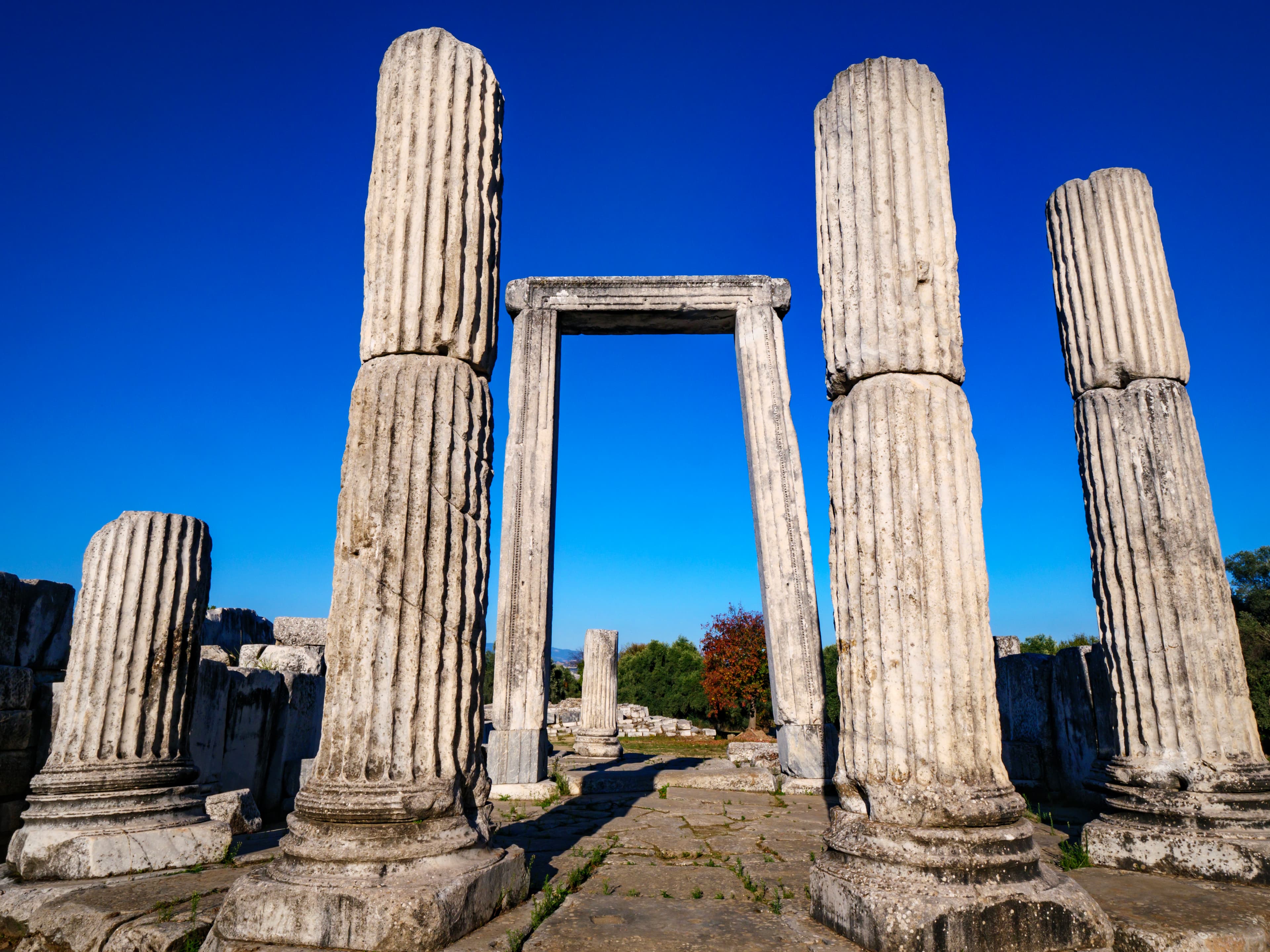
Corinthian columns of the Hecate sanctuary at Lagina. Image source · CC BY-SA 4.0
Visit essentials
A quick read before you go
- Duration
- 1–2 hours for the sanctuary precinct.
- Access
- Located near Turgut village, approximately 9 km from the Yatağan-Milas highway (turn at the…
Overview
Ancient sanctuaries often gave Hecate an altar or niche beside another deity. Lagina was entirely hers: maintained across centuries, served by eunuch priests tending a sacred oak grove inside the temenos, and unmatched in the ancient Mediterranean for the scale and specificity of its Hecate worship.
The 3rd-century BCE temple, possibly built over Bronze Age sacred ground, had a Corinthian peristyle with eight columns on each short side and eleven on each long side. Its Gigantomachy frieze and Hecate-specific imagery now reside in the Istanbul Archaeological Museum. Emperor Augustus's financial support signalled the sanctuary's pan-Mediterranean importance. An eight-kilometre sacred road linked Lagina to Stratonikeia.
Along it, the annual kleidagōgia procession carried young girls bearing Hecate's sacred key—the key to the Underworld—in one of the ancient world's most ritually specific documented processions.
That key, symbol of Hecate's authority over thresholds and gates, remains the offering contemporary pilgrims most commonly bring from Europe, North America, and Australia. CNN documented the pilgrimage; site archaeologists report garlic, pomegranates, keys, and wheat left by votaries. These offerings replicate ancient practice without institutional continuity across two thousand years, a rare spontaneous return of devotion to a specific site.
Why this place is sacred
Hecate did not originate in the Greek Olympian tradition, though she was absorbed into it. The most persuasive scholarly case for her origins points to Caria — the region of southwestern Anatolia where Lagina lies — making Lagina not merely the most important sanctuary of Hecate but potentially the site of her earliest continuous worship.
In Carian religion, before the Greek names arrived, there was a goddess who held authority over thresholds, over the passage between states of being, over the dark moon and the crossroads where three roads met. The Greeks gave her a name and a mythology. The Carians had known her by a different name for an indeterminate prior span. The kleidagōgia — the key-carrying procession — was not merely a ritual but an enacted theology.
Hecate holds keys: not locks of ordinary importance but the gates between the living world and the dead, between the known world and what lies beyond it. Every year, the procession walked the eight-kilometer sacred road from Lagina to Stratonikeia carrying her key in public, enacting the divine attribute in human movement through the landscape. The road itself became sacred through this repetition — consecrated by the annual passage of the goddess's symbol.
The sacred grove of oak trees maintained within the temenos by the eunuch priesthood added another dimension: a living enclosure of the divine, a piece of forest held perpetually in sacred custody. Trees in the ancient world were not merely botanical; an oak grove in a sanctuary was the goddess's body made arboreal, her presence rendered perennial and immediate in the living timber.
What the contemporary pilgrim brings to Lagina — keys, garlic, pomegranates, the specific offerings of ancient practice recovered through text and transmitted through contemporary devotional communities — is something that should not be possible given the two-thousand-year gap in institutional practice. That it happens anyway, spontaneously, from multiple continents, is a datum about the depth of this site's sacred charge that no academic framework fully accounts for.
Principal sanctuary of Hecate — the world's largest and most complete temple and precinct dedicated to her; ritual hub for the annual kleidagōgia procession to Stratonikeia; center of the Hecate festival cycle for the Carian region.
Pre-Greek Carian goddess worship on this site (Bronze Age, possibly earlier) → 3rd century BCE Corinthian peristyle temple construction → Hellenistic and Roman-period sacred grove and procession traditions → Emperor Augustus as financial patron → Roman period continuation → late antique abandonment → first Turkish-led archaeological excavation (Osman Hamdi Bey, 1891) → ongoing excavation and restoration → column re-erection (2020) → contemporary Hecate pilgrimage traditions documented from at least the early 2000s.
Experience and orientation
The road to Lagina passes through the Muğla hinterland toward Turgut village, the landscape becoming progressively more rural as the thermal power plant at Yatağan recedes behind you. The site is reached via a turn at the power plant junction and a further nine kilometers of road through agricultural land. The relative distance from major tourist routes is not incidental to the site's character: Lagina's isolation is part of what makes it feel distinct from heavily trafficked ancient sites.
The temenos — the sacred enclosure — is entered through a gateway. The first view of the re-erected Corinthian columns is immediate. They are high and spare, the capitals well-preserved, the effect one of vertical clarity against the sky. Move into the precinct slowly. The site rewards a pace slower than ordinary sightseeing, because the atmosphere — which visitors consistently describe as unusually still, unusually weighted with a quality they struggle to name — is not available to rapid movement.
The area where the sacred oak grove stood is now open ground within the temenos; stand in it and look back at the colonnade. The pool basin that held sacred water is identifiable. The propylon gateway through which the kleidagōgia procession entered the precinct is partially standing. The library building — Lagina had a library within its sanctuary — has foundations visible. Walk the temenos wall's interior perimeter.
At certain points you will see, in the stone or at the base of columns, the traces of contemporary offerings: garlic cloves dried to papery husks, small keys, fragments of pomegranate rind. These are not tourist detritus; they are acts of devotion from people who traveled specifically to make them here. They mark Lagina as genuinely active in a way that most ancient sites are not.
If you visit on or near a dark moon night, the atmosphere changes in ways that are consistent with everything the ancient tradition associated with Hecate: the intensification of threshold-consciousness, the sense of the boundary between states of being becoming permeable.
Approach through the propylon when possible, as the procession would have entered. Move counterclockwise around the colonnade interior. The oak grove area is at the center; spend time there before examining the structural remains. If other visitors are present who appear to be engaged in active devotion, give them space.
Context and lineage
The Carian origins of Hecate — the scholarly consensus that she was an indigenous Anatolian goddess absorbed into the Greek pantheon rather than a Greek goddess exported to Anatolia — place Lagina at the authentic center of her tradition. The pre-Greek cult at this site is attested by the Bronze Age material beneath the Hellenistic temple's foundations.
The specific deity venerated here in Carian times, before she carried the Greek name Hecate, remains nameless in surviving records, which is itself a form of preservation: the name was changed but the site was kept, the continuity expressed spatially rather than nominally. The 3rd century BCE temple was built as the Seleucid kings' power reached Caria and the region's cities entered a period of architectural ambition.
The sacred oak grove, the pool, the library, and the accommodation buildings that made up the full precinct represent a religious complex of considerable sophistication — a sanctuary designed not merely for a single act of worship but for extended devotional residence.
Bronze Age Carian goddess cult (pre-Greek, unrecorded name) → 3rd century BCE Hellenistic Corinthian temple construction → Roman period expansion (Augustus as patron) → late antique abandonment → 1891 Osman Hamdi Bey excavation → 20th century scholarly archaeology → 2020 column re-erection → active contemporary pilgrimage tradition.
Traditions and practice
The kleidagōgia was the annual ceremony through which Lagina declared its relationship to the wider world. A choir of young girls — selected, trained, and ceremonially prepared — walked the sacred road from the sanctuary to the city of Stratonikeia, carrying Hecate's sacred key.
The key represented her mythological authority as keeper of the gates of the Underworld: in Greek religious cosmology, Hecate stands at the threshold between the living world and the realm of the dead, holding the keys to the passage between them. The procession enacted this role in human terms, moving Hecate's symbol through the landscape.
The Genethlia festival, held on the 30th of each lunar month (which was sacred to Hecate across all of Greek religion), was the regular monthly observance. The annual Festival of the Key was a larger, multi-day event. Animal sacrifice, ritual purification (khernips) before entering the precinct, and oracle consultation if an oracle function existed here were part of the ritual calendar.
The eunuch priesthood's maintenance of the sacred oak grove was a continuous liturgical act — the tending of living trees as a form of divine presence.
Contemporary pilgrims from Hellenic polytheist, Wicca, and witchcraft traditions travel to Lagina from Europe, North America, and Australia to make offerings and pray at the ruins. CNN documented this pilgrimage in detail. Offerings seen at the site include garlic (an ancient Hecate offering mentioned in historical sources), pomegranates, small keys, apples, wheat, and occasionally fish — all drawn from documented ancient practice.
Ceremonial gatherings happen on Hecate's sacred dates: the dark moon, the 13th of the month in some traditions, the equinoxes, and the annual Hecate's Night (November 16 by some contemporary reckoning). Archaeologists ask that offerings not be placed on fragile stone surfaces; offerings left at the perimeter of the precinct or carried away are preferred.
Arrive at or shortly after the site opens, before other visitors arrive. Walk to the center of the temenos and stand still for five minutes — longer than you think you need — before doing anything else. Let the quality of the space establish itself. The site's numinous atmosphere, noted by visitors across a wide range of backgrounds, is most accessible in conditions of relative quiet and stillness.
Then walk slowly to the colonnade and read the architectural details: the proportions of the Corinthian capitals, the way the drums are fitted, the height of the full column against the sky.
The frieze that once ran around the temple — its Gigantomachy scenes, its Hecate-specific imagery — is in the Istanbul Archaeological Museum; if you are traveling through Istanbul, plan to see it before or after your visit to Lagina, as it makes the stripped temple far more imaginatively vivid. In the grove area, stand facing the temple and consider Hecate's triple nature: sky, earth, underworld; maiden, mother, crone; light, threshold, dark.
The standing columns correspond to one of these axes — vertical, connecting earth to sky. Bring something to the site if you feel moved to — a key, a garlic clove, a small pomegranate. Leave it at the ground level of the precinct wall, not on any stone surface. If you visit near the dark moon, come in the late afternoon and stay as long as the site permits.
The transition from light to dusk at Lagina is, according to many pilgrims, the most powerful time to be here.
Hecate Cult (Ancient)
HistoricalLagina housed the largest and most important sanctuary of Hecate in the ancient world — not an altar in a larger complex but an entire precinct dedicated to her alone. The Carian origins of Hecate make Lagina potentially the site of her oldest continuous worship.
Kleidagōgia (annual key-carrying procession to Stratonikeia); Genethlia monthly festival on the 30th; annual Festival of the Key (multi-day); animal sacrifice; ritual purification before entering; maintenance of sacred oak grove by eunuch priests.
Contemporary Hecate Pilgrimage
ActiveLagina has become the most significant pilgrimage site globally for contemporary practitioners of Hecate devotion, Hellenic polytheism, and witchcraft traditions. The pilgrimage has been documented by CNN and in multiple spiritual community publications. Offerings replicating ancient practice appear regularly at the site.
Individual and group pilgrimage; offerings of garlic, pomegranates, keys, apples, wheat, and sometimes fish; prayer and meditation at the ruins; ceremonial gatherings on Hecate's sacred dates (dark moon, 13th of month, equinoxes, Hecate's Night).
Archaeological Heritage
ActiveThe 1891 Osman Hamdi Bey excavation was a landmark in Turkish and Mediterranean archaeological history. Ongoing excavation and restoration — including the 2020 column re-erection — continues to reveal the precinct's full extent.
Annual excavation campaigns; architectural restoration; scholarly publication; conservation of the frieze reliefs now in Istanbul.
Perspectives and open questions
Lagina is interpreted across a wider range of frameworks than almost any other site in Turkey: archaeologists recognize it as a masterwork of Hellenistic religious architecture and a landmark in Turkish archaeological history; scholars of religion see it as the clearest evidence for Hecate's Carian/Anatolian origins; contemporary practitioners regard it as their most sacred living site.
Scholarly perspective
Lagina is recognized as the largest and most important sanctuary of Hecate in the ancient world, the only site where she was the principal deity of a major complex. The 1891 excavation by Osman Hamdi Bey was a landmark in Turkish archaeological history — the first scientifically conducted excavation led by a Turkish team. The temple frieze, now in Istanbul, is a masterwork of Hellenistic sculpture.
Scholarly debate continues over Hecate's origins; the preponderance of recent scholarship supports a Carian/Anatolian origin with Lagina as the likely epicenter. The precise function of any oracle at the site, and the full iconographic program of the frieze, remain subjects of active research.
Living and traditional perspectives
Hecate's Carian/Anatolian origin — now widely accepted in the scholarly literature — makes Lagina her authentic homeland and the site of her oldest continuous worship. The pre-Greek layer of the Hecate cult here represents one of the rare survivals of genuine Anatolian goddess tradition beneath the Greek mythological surface. The contemporary pilgrimage to Lagina is understood by practitioners as a return to the source, a reconnection with the goddess at the site of her oldest known veneration.
Alternative interpretations
Contemporary Hecate practitioners regard Lagina as the most sacred place on earth for their devotional tradition. The site is experienced as a portal or nexus point between the worlds — sky, earth, and underworld corresponding to Hecate's triple domain. Lunar rituals on dark moon nights are described by contemporary pilgrims as producing an unusually direct sense of the goddess's presence.
The spontaneous return of devotion to a site after two thousand years is interpreted within the tradition as evidence of the site's enduring sacred charge rather than as cultural construction.
Open questions
Whether a Bronze Age cult structure preceded the 3rd century BCE Corinthian temple is an open archaeological question. The full iconographic program of the temple frieze — its Hecate-specific scenes in particular — has not been completely decoded. The nature of any oracle function at Lagina is undocumented in surviving texts. The meaning of 'Lagina' as a place name, whether Carian or Greek, is not established.
Plan your visit
Access and arrival
Located near Turgut village, approximately 9 km from the Yatağan-Milas highway (turn at the Yatağan Thermal Power Plant junction), 12 km from Yatağan town center, 8 km from Stratonikeia. Car access is the only practical option; no public transport serves the site.
Yatağan (12 km) has basic accommodation. Muğla (50 km) has a wider range. Lagina is most commonly visited as a day trip from Muğla or Milas; overnight visitors wishing to be present at dusk or dawn should base themselves in Yatağan.
Respectful visit
No formal requirements. Comfortable footwear for uneven ground. Attire that is physically comfortable for a potentially extended or meditative visit.
Permitted. Be considerate of other visitors who may be engaged in personal devotional practice; photograph them only with their consent.
Traditional offerings associated with Hecate (garlic, pomegranates, keys) are part of the site's living devotional history. Archaeologists ask that offerings not be placed on or against any stone surface. Offerings left at the ground level of the perimeter, or carried away by the pilgrim after use, are preferable to placing them on fragile structural elements.
Do not touch or climb the columns. Respect fenced excavation zones. Do not remove any artifacts, stones, or plant material from the sacred grove area.
Offerings should not be placed on any stone or architectural surface, however ancient the practice; the fragility of the ruins is the archaeologists' primary concern. Do not touch or attempt to climb the columns. Respect any active excavation zones.
Location
Map loads as you approach this section.
Pilgrim reflections
A portrait of encounter, not a score
Pilgrims describe what they felt, how present they could become, and whether the place would shape a journey. There are no stars and no ranking of traditions.
No reviewed reflections yet
The first pilgrims can help describe the character of being here.
Share a reflection
Available after an account-backed “Been there.” Every reflection is reviewed before publication.
Nearby sacred places
Explore other sacred places in the region. Proximity does not establish access or travel time; check each place’s guidance.


References
Sources consulted for this page. Source categories describe the publication, not a guarantee that every claim is verified. Traditional accounts and outside interpretations may differ.
- 01The 3,000-year-old Lagina Hecate Temple in Lagina Hecate Sanctuary is being resurrected — Anatolian ArchaeologyacademicArchaeological update on restoration
- 02Lagina | Turkish Archaeological News — Turkish Archaeological NewsacademicExcavation and site details
- 03Excavation team at Türkiye's 3,000-year-old Lagina Hekate Sacred Site uncovers major ancient relics — Anadolu AgencyofficialOfficial news on recent discoveries
- 04Lagina - Wikipedia — Wikipedia contributorsencyclopediaComprehensive historical overview
- 05Why modern witches are making pilgrimages to an ancient temple in Turkey — CNN TravelguideContemporary pilgrimage practices documented
- 06Archeologists re-erect structures at Sanctuary of Hecate in southwest Turkey — Daily Sabahofficial2020 column re-erection details
- 07Temple of Hecate at Lagina and ancient practices — The Wild HuntspiritualFocus on contemporary pagan practices and ancient rituals
- 08Restoring the Hekate Temple: Reviving Ancient Rituals at the Lagina Sanctuary — Greek City Timesguide2024 restoration update
- 09Sanctuary of Hecate in Lagina — Turkey Tour OrganizerguideLocation and visitor guide
- 10Sanctuary of Hecate in Lagina — Pagan PlacesspiritualContemporary spiritual significance documented
Share a photo
Help visitors recognize Temple of Hecate at Lagina. Every submission is reviewed before publication.