Euromos
Sixteen Corinthian columns among ancient olives, built to a god whose name the Greeks never fully translated
Understand sacred places, explore living traditions, and learn how to engage respectfully with Pilgrim Map.
Access has not been verified. Check current local guidance before planning a visit.
Muğla, Turkey
Read the sources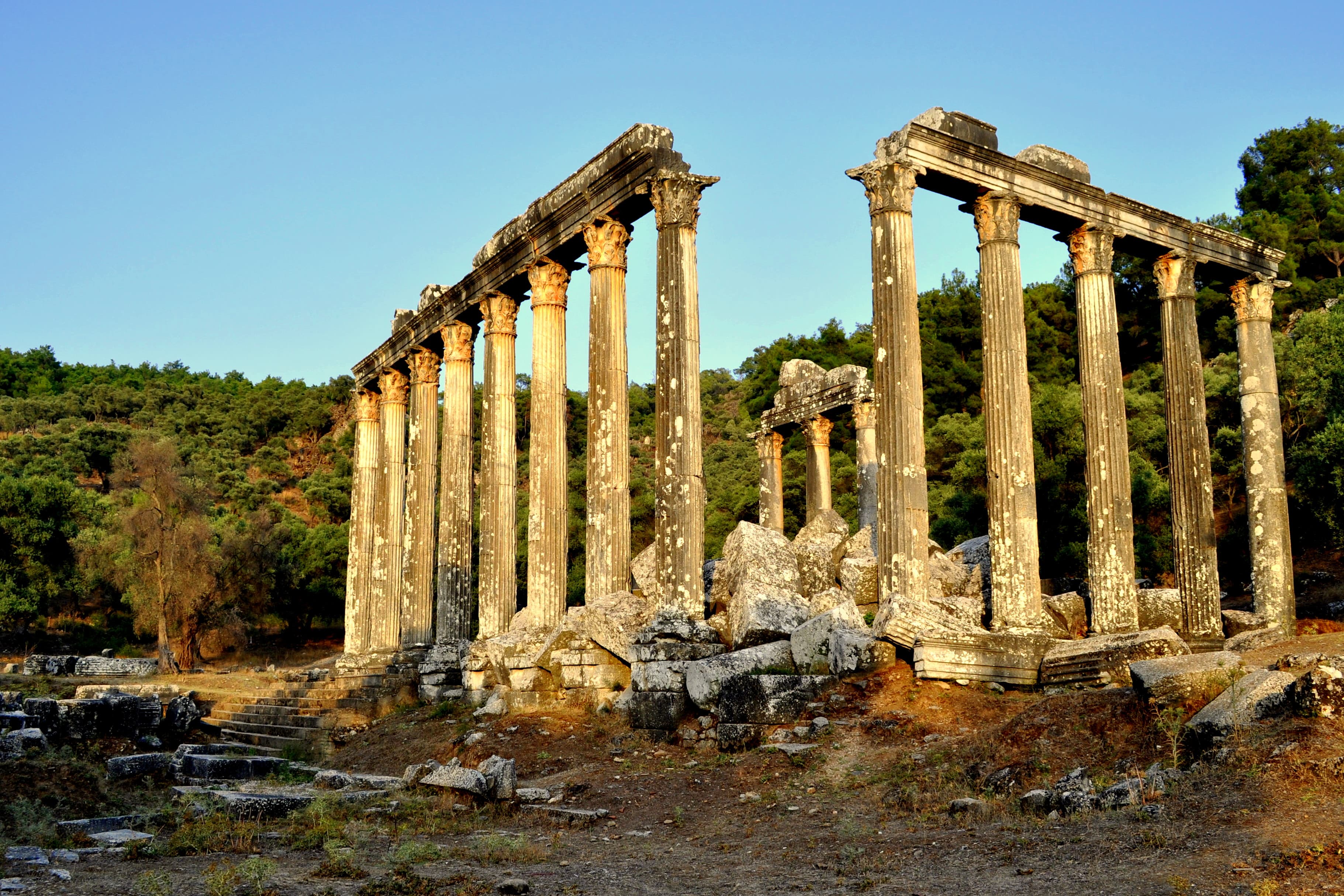
Visit essentials
A quick read before you go
- Duration
- 1–2 hours for the temple complex and wider city ruins.
- Access
- Located on or near the D525 road, approximately 12 km northwest of Milas and 4 km from Selimiye.
Overview
Between Milas and the D525 highway, a low stone wall encloses an olive grove probably tended since before the temple was built. Sixteen Corinthian columns rise from their stylobate in near-perfect array, not as reconstructed fallen drums but largely where they have stood since the Hadrianic period, weathered in their original positions.
This is the Temple of Zeus Lepsynos. Lepsynos is an undecoded Carian word used as Zeus's epithet here long after Greek became the language of administration, commerce, and official religion. It preserves something older: an indigenous Anatolian deity worshipped here before the first Greek colonist reached western Anatolia, renamed Zeus without entirely losing a Carian identity held in that untranslatable word.
Those who funded the columns carved their names into the stone, making each pillar both structure and permanent votive. Euromos is therefore no ordinary ruin, but a building that kept one foot in the ancient world through its use and now keeps one in the present.
Why this place is sacred
Zeus Lepsynos is not quite Zeus. The Olympian name was applied to a deity already worshipped at this location, and the epithet Lepsynos — probably derived from an indigenous Carian divine name — was retained with it. This was standard practice in the Hellenistic world: Greek religion was not a replacement of indigenous Anatolian cults but a relabeling, often partial and incomplete, that allowed local populations to continue their devotional practices within a new naming system.
At Euromos, the Carian name clung more tenaciously than elsewhere. No Greek-language inscription has ever explained what Lepsynos means; the word sits in the archaeological record as an untranslated remainder, a sign that something authentic persisted. The column inscriptions add another dimension. Rather than a single donor or civic fund financing the temple, individual citizens had individual columns dedicated in their names — a form of distributed piety that made each column a personal religious act.
The temple thus became a register of the community's devotion, legible in stone. That distributed, accumulative quality of the sacred — many persons' piety adding up to a shared sacred architecture — is something that reading the columns slowly can restore to a visitor's imagination.
Sanctuary of Zeus Lepsynos, a Carian deity absorbed into the Greek Zeus tradition; civic religious center for the city of Euromos and the surrounding Carian region.
Pre-Greek Carian cult site of Lepsynos → incorporated into the Mausolean reorganization of Caria (4th century BCE) → Hellenistic and then Roman-period temple construction (Hadrianic, 117–138 CE) → abandoned through late antiquity → archaeological excavation from 1969 → ongoing restoration including column re-erection.
Experience and orientation
The entrance to Euromos is modest: a path from the road, a small fee gate, and then the olive trees open to reveal the colonnade. The first visual impression is of the columns themselves — their height, the Corinthian capitals in various states of completeness, the way the row closes on itself to form the near-complete peristyle. Most visitors stop here and photograph.
The contemplative visitor should not stop here but should instead walk slowly around the entire circuit of the colonnade, reading the inscriptions carved into the column shafts at eye level. Each one is a person's name, typically with a formula of dedication: this column was erected to Zeus Lepsynos by so-and-so. They are worn, many partially legible, a few clear. Spend a few minutes with them.
They are two thousand years old, and they are ordinary acts of human generosity toward something considered divine. The olive trees around the temple are ancient in their own right — gnarled, wide-canopied, providing a quality of dappled shade that changes the light on the columns throughout the day. Morning light rakes across the carved capitals and deepens the column fluting; afternoon turns the stone amber.
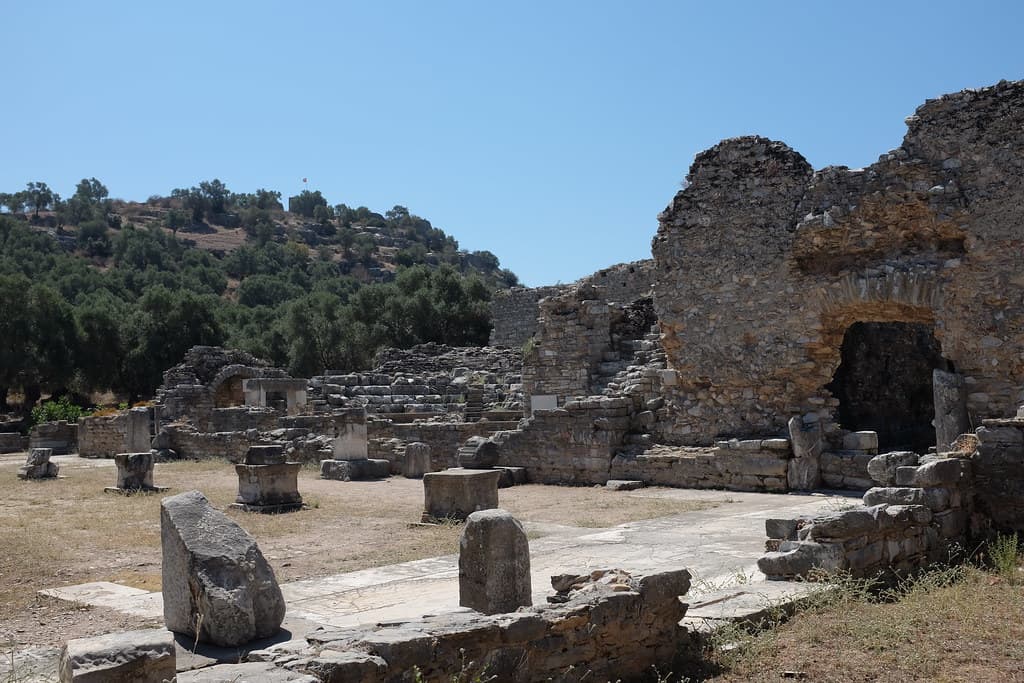
The agora, theatre, and bath complex of the wider city lie beyond the temenos wall and are worth a further half hour. But the temple itself is the magnetic center, and the contemplative visitor should return to it before leaving.
Enter through the main gate and walk the full perimeter of the colonnade before going to the broader city ruins. Read the donor inscriptions before photographing. Return to the grove at the end of your visit.
Context and lineage
The city's Carian name was Kyromos or Hyromos. When King Mausolus of Halicarnassus reorganized the cities of Caria in the 4th century BCE — a project combining political consolidation with urban design — the city received its new name Euromos, meaning approximately 'Beautiful and Strong.' This renaming was not a founding but a reframing; the settlement and its cult of Lepsynos preexisted Mausolus by an unknown span.
The 2021 discovery of two archaic kouros statues — upright male figures carved in marble in the manner of 6th century BCE Greek sculpture — in the excavation of the precinct extended the site's known sacred history by three centuries beyond the current temple's construction. One of the kouros statues bore a Carian-language inscription, the first found at this site, confirming that the pre-Mausolean city spoke its own language and conducted its own religion here well before Hellenization.
Pre-Greek Carian settlement with Lepsynos cult (at least 6th century BCE, evidenced by archaic kouros finds) → Mausolean reorganization and city renaming (4th century BCE) → Hellenistic and Roman civic development → Hadrianic temple construction (117–138 CE) → abandonment through late antiquity → excavation from 1969 → ongoing restoration.
Traditions and practice
The annual religious calendar of Euromos centered on festivals dedicated to Zeus Lepsynos, including civic assemblies and sacrifices in the sacred precinct. The Carian league — the network of Carian cities of which Euromos was a member — held periodic assemblies with religious as well as political functions.
The column-dedication practice, documented in the surviving inscriptions, shows that individual piety could take architectural form: a citizen who wished to honor Zeus Lepsynos could fund the construction of a column and have their name permanently inscribed on it, creating a physical record of devotion that outlasted the dedicant by millennia.
No active religious practice. Annual academic excavation campaigns by Muğla Sıtkı Koçman University. Restoration work ongoing. The 2021 kouros finds are displayed in the Muğla Museum.
Begin at the colonnade's eastern face, where the morning light is most direct, and walk counterclockwise around the full peristyle. At each column that carries an inscription, pause long enough to attempt to make out the lettering. You will not read ancient Greek fluently, but you can register the fact of the inscription, the scale of the letter-cutting, the height at which the mason worked.
When you have completed the circuit, step inside the temenos and stand at the approximate center of the cella space — the inner room where the cult statue would have stood. Look back through the colonnade to the olive trees beyond. This is the view the priest had, looking outward from the divine interior to the human world. Then walk into the olive grove itself, away from the temple, and look back at the colonnade from among the trees.
The columns read differently at a distance: less architectural, more like a standing forest of stone that predates the olive trees surrounding it.
Carian / Greek Religious Syncretism
HistoricalZeus Lepsynos carries a Carian epithet whose meaning was never decoded — the name of a pre-Greek deity absorbed into the Greek pantheon but not fully renamed. The column donor inscriptions represent a distinctive form of distributed civic piety.
Temple worship and sacrifice; annual civic festivals; individual column dedications as permanent votive acts; Carian league assemblies.
Archaeological Heritage
ActiveActive excavation by Muğla Sıtkı Koçman University; the 2021 kouros finds raised the site's international profile. The 'Heritage for the Future' initiative catalogued nearly 1,000 architectural blocks.
Annual excavation campaigns; architectural restoration including column work; scholarly publication.
Perspectives and open questions
Euromos attracts scholarly attention for its pre-Greek religious layer, its well-preserved Corinthian architecture, and the 2021 kouros discovery; it attracts visitors for the near-complete colonnade that gives an unusually vivid experience of an ancient sacred precinct.
Scholarly perspective
Euromos is recognized as one of the best-preserved Corinthian temples in Asia Minor, with 16 of 17 columns still standing. Scholarly consensus dates the current structure to the Hadrianic period (117–138 CE), over foundations of earlier Hellenistic construction. The epithet 'Lepsynos' is understood as a Carian divine name absorbed into the Greek Zeus tradition — one of the clearest examples in Caria of the process of religious syncretism that Greek colonization brought to Anatolia.
The 2021 discovery of two archaic kouros statues with Carian inscriptions has significantly extended the known sacred history of the site to the 6th century BCE and opened new research questions about the pre-Mausolean city.
Living and traditional perspectives
The persistence of the Carian epithet 'Lepsynos' for Zeus at this site, even after centuries of Greek and Roman administrative dominance, reflects a community that retained continuity with its pre-Greek religious identity. The name functioned as a marker of local distinctiveness within a broader Hellenistic-Roman religious world, and the community was apparently unwilling to surrender it.
Alternative interpretations
The olive grove setting of the standing columns has long generated a popular sense of living sacred landscape — not a ruin of something dead but a precinct of something dormant. The combination of ancient trees and ancient stone creates an atmosphere that many visitors describe as the closest thing available in Turkey to an uninterrupted natural sacred space.
Open questions
The meaning of the epithet 'Lepsynos' has never been conclusively decoded from Carian. The full urban plan of Euromos — its agora, bath complex, residential quarters, and the wider city — remains largely unexcavated. The relationship between the kouros statues discovered in 2021 and the pre-Mausolean sacred history of the site is an active research question.
Plan your visit
Access and arrival
Located on or near the D525 road, approximately 12 km northwest of Milas and 4 km from Selimiye. Easily accessible by car. Some bus services on the Söke–Milas route pass the site entrance; confirm timetables locally.
Milas (12 km) has hotels and services. Bodrum (40 km) has the widest range of accommodation. A day trip from either is straightforward.
Respectful visit
No formal requirements. Comfortable footwear for uneven ground; a hat is advisable in summer as the site has partial but not full shade.
Permitted and widely practiced; the colonnade is among the most photogenic ancient sites in Turkey. Early morning and late afternoon light is most favorable.
Not applicable; this is an archaeological site with no active cult.
Do not touch or climb the columns. Respect fenced excavation zones. Do not remove any material from the site.
Do not touch or lean on the columns; the stone is weathered and some surfaces are fragile. Respect any fenced excavation areas.
Location
Map loads as you approach this section.
Pilgrim reflections
A portrait of encounter, not a score
Pilgrims describe what they felt, how present they could become, and whether the place would shape a journey. There are no stars and no ranking of traditions.
No reviewed reflections yet
The first pilgrims can help describe the character of being here.
Share a reflection
Available after an account-backed “Been there.” Every reflection is reviewed before publication.
Nearby sacred places
Explore other sacred places in the region. Proximity does not establish access or travel time; check each place’s guidance.


References
Sources consulted for this page. Source categories describe the publication, not a guarantee that every claim is verified. Traditional accounts and outside interpretations may differ.
- 01Euromos | Turkish Archaeological News — Turkish Archaeological NewsacademicUp-to-date excavation news and site data
- 02Turkey's ancient city Euromos eyes UNESCO list — Anadolu AgencyofficialOfficial statement on UNESCO candidacy
- 03Euromus - Wikipedia — Wikipedia contributorsencyclopediaSolid overview of city history
- 04Discovery of Kouros Statues Puts Euromos Temple of Zeus Lepsynos on the Map — Ancient Originsacademic2021 discovery of 2,500-year-old marble kouros statues
- 05Temple of Zeus Lepsynos regains former glory with splendid columns — Daily SabahguideRestoration details and Abuzer Kizil excavation data
- 06Turkey's Euromos Zeus Temple Set to Regain Former Glory with Restored Columns — The ArchaeologistguideRestoration project overview
- 07Euromos | All About Turkey — All About TurkeyguideLocation and visitor information
- 08Euromos Ancient City | The Art of Wayfaring — Art of WayfaringguideDetailed visitor guide and site description
Share a photo
Help visitors recognize Euromos. Every submission is reviewed before publication.